
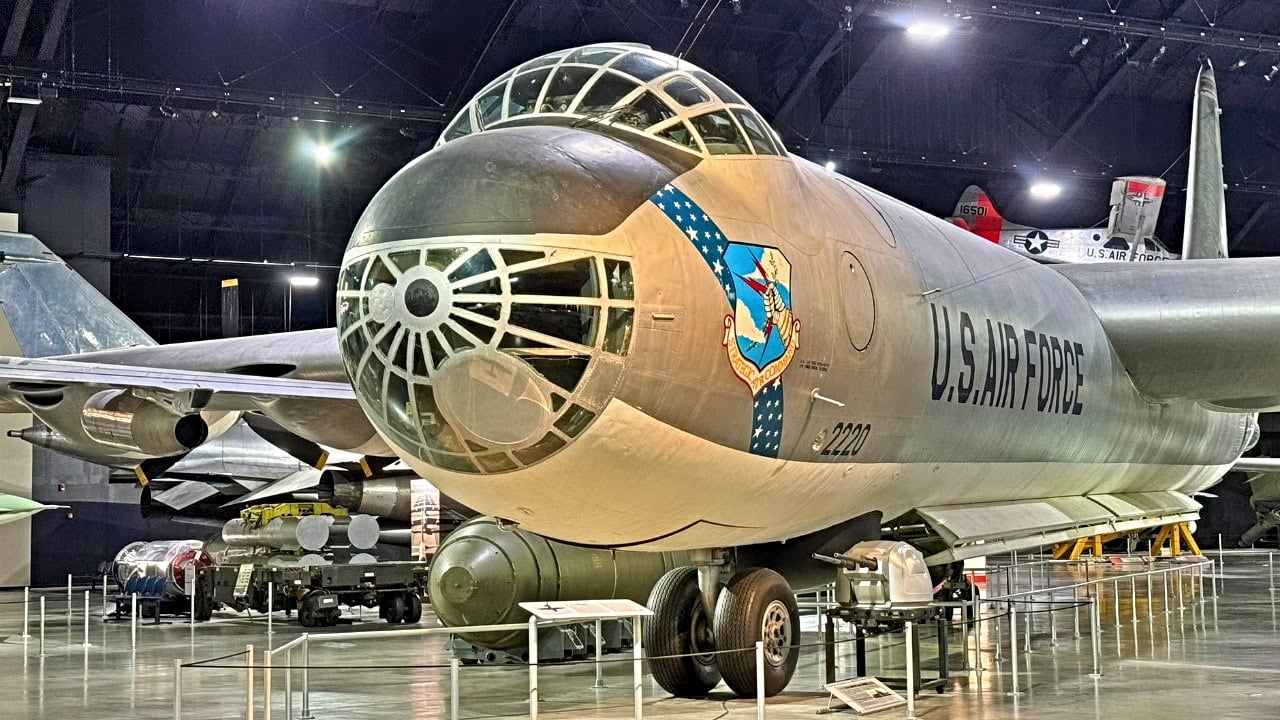
The American-made B-36 Peacemaker strategic bomber was the largest mass-produced piston-engined aircraft ever built, thereby rightfully earning its place as one of the exhibits at the National Museum of the United States Air Force (on the grounds of Wright-Patterson Air Force Base, Ohio), and also rightfully earning its place in the Photo Gallery of our esteemed Editor, Mr. Harry J. Kazianis, who got to visit the Museum recently.
As a former U.S. Air Force officer and big-time fanboy of big bombers, I’m not the least bit jealous of my boss, oh no, not a’tall (wink-wink, nudge-nudge).
And he explained that the hardest part of taking photos of this monster bomber is that it’s so large it won’t ever fit in a single photo.
Yes, she is massive. We were able to get creative to make it work, but she’s still big.
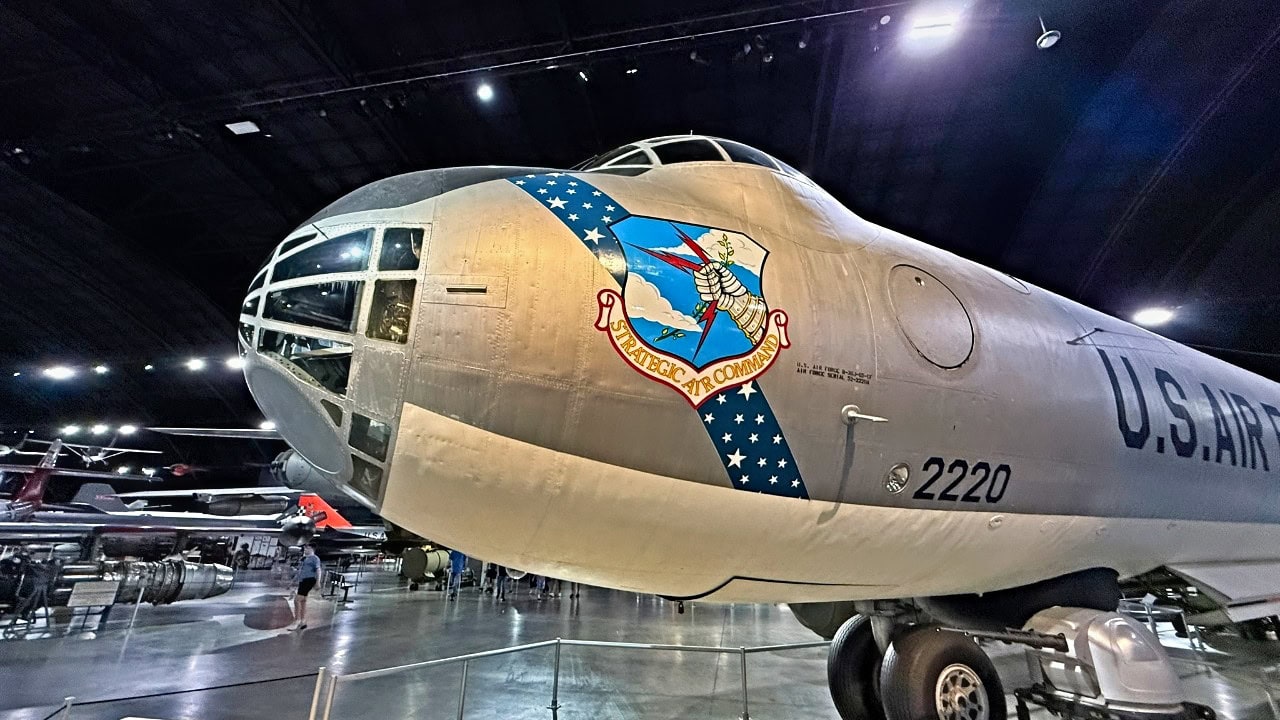
B-36. 19FortyFive.com image.
Welp, until I’m finally able to scratch my own visit to my beloved service branch’s museum and an up-close-and-personal view of the B-36 off my Bucket List, I’ll have to settle for writing about that big behemoth bomber.
B-36 Peacemaker Initial History and Tech Specs
Built by the sadly now-defunct Convair (which also built such famous warbirds as the B-58 Hustler—the U.S. Air Force’s first operational supersonic jet bomber—and the F-106 Delta Dart fighter), the B-36 actually traced its roots all the way back to early 1941, i.e., even before the United States entered World War II.
However, she didn’t make her maiden flight until August 8, 1946, one year after WWII ended, and she finally entered into official operational service with Strategic Air Command (SAC) in June 1948 (nine months after the USAF became a separate and independent branch of service).
The plane was designed to meet requirements for a strategic bomber with intercontinental range.
The result was a mammoth machine with a fuselage 162 feet long. 1 inch, a wingspan of 230 feet (the longest wingspan of any combat aircraft, exceeded only by Howard Hughes’s Spruce Goose, a civilian aircraft), an empty weight of 166,165 lbs. (again only exceeded by the Spruce Goose), a payload of 86,000 lb. of nuclear or conventional bombs, and oh yeah, a range of 10,000 miles.
That 230-foot wingspan accommodated no less than *ten* engines to make that 10,000-mile range possible (how symmetrical, eh): four General Electric J47 turbojet engines, each generating 5,670 lb. of thrust, plus 6 × Pratt & Whitney R‑4360 Wasp Major radial engines, each delivering 3,500 hp.
Crew size was 13 (though as far as this writer can tell, none of the Peacemaker’s crew ever accused her of being cursed or unlucky). In addition to that massive bomb load, the warbird’s armament included a remotely operated tail turret with two 20 mm (0.787 in) M24A1 autocannons for self-defense.
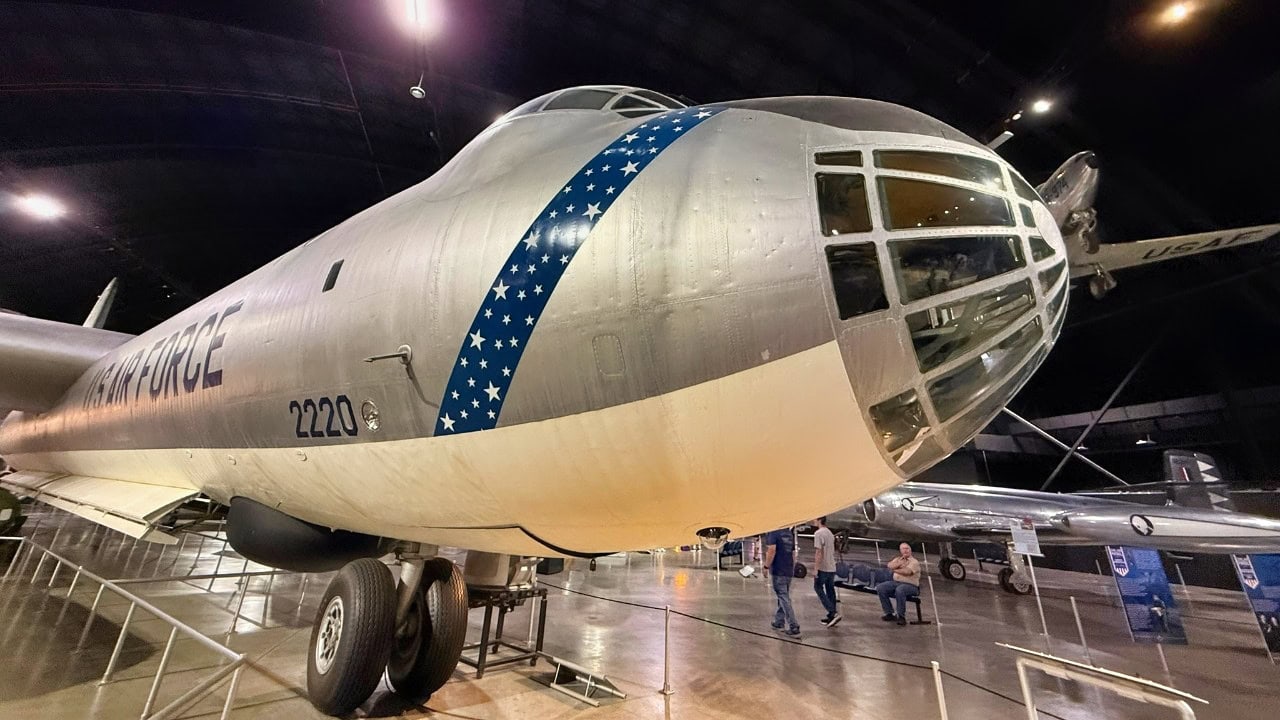
B-36 Bomber 19FortyFive Image.
Operational History (and Filmic Immortality)
Despite her impressive, intimidating size and powerful potential, the Peacemaker never got to drop her bombs in anger (the USAF stuck with the WWII-vintage B-29 Superfortress for strategic bombing missions during the Korean War).
She lasted a mere 10 years before being retired in 1959, replaced by the legendary (and all-jet-powered, though still subsonic) B-52 Stratofortress AKA the “BUFF,” which is still going strong today thanks to its reliability, versatility, and ability to deliver sheer physical and psychological devastation alike.
Charles Earley of SlashGear even goes so far as to call the B-36 “One of the Worst Bombers Ever Made.” His rationale: “[The engine] setup was flawed because it didn’t allow for cooling, causing engines to overheat and catch on fire in mid-flight. Adding insult to injury were the insane number of sparkplugs on each of these Bombers, 336 to be exact, 56 per engine … Because of the leaded high-octane fuel used, sparkplugs got fouled often, requiring frequent changes.” The plane’s slow cruise speed also would’ve made it susceptible to easy interception by enemy fighters such as the MiG-15 (NATO reporting name “Fagot”).
That said, the B-36 did manage to gain a bit of cinematic stardom during her relatively brief career, thanks to the 1955 motion picture Strategic Air Command, starring the iconic Jimmy Stewart, Harry Morgan (in his pre- “M.A.S.H”. days), and the lovely June Allyson.
In this classic movie, Mr. Stewart portrays Col. “Dutch” Holland, a reactivated Air Force Reserve officer who hasn’t been in the cockpit since his B-29 Superfortress days in WWII (he had been playing Major League Baseball in the interim) and now must adjust to the Jet Age.
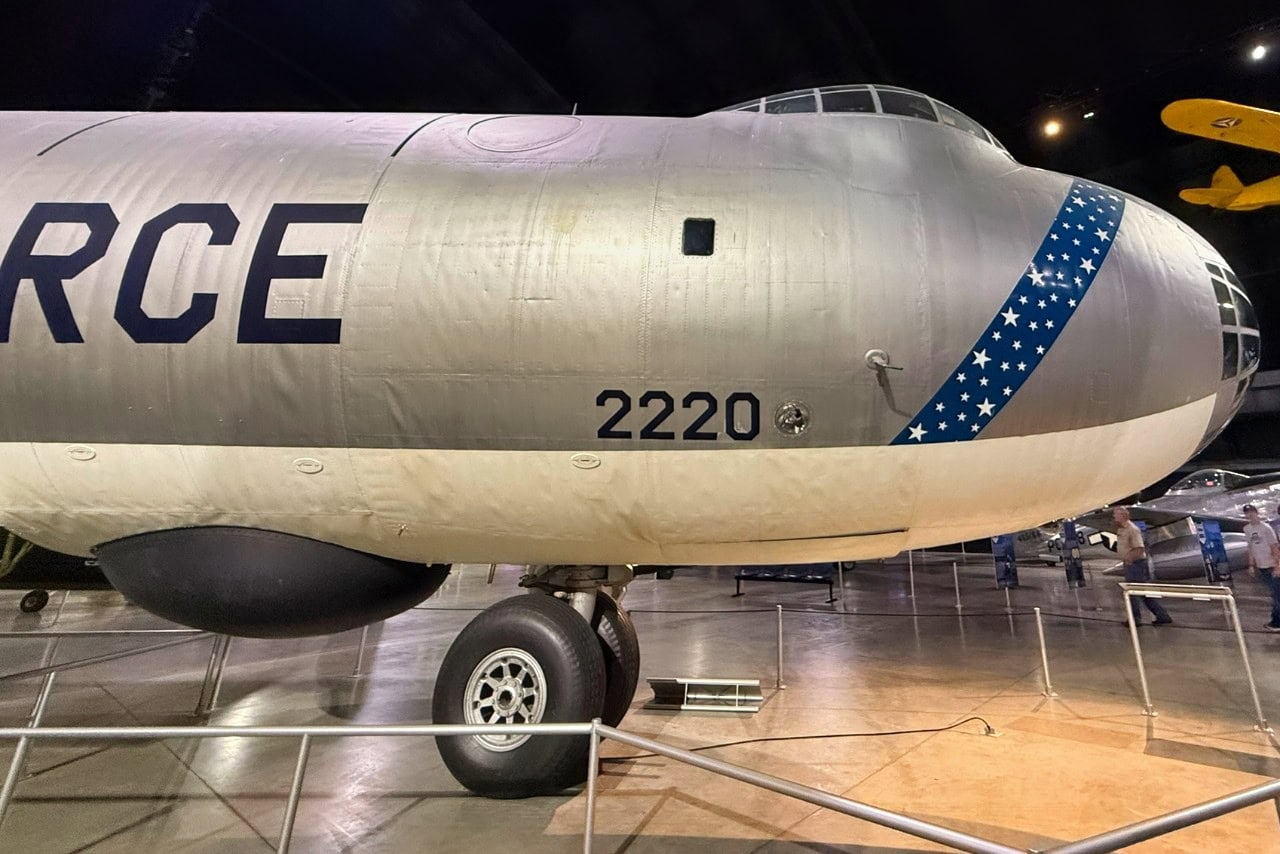
B-36 Bomber, Dayton, Ohio, USAF Museum. Image Credit: 19FortyFive.com/Harry J. Kazianis
“Dutch” flies a B-36 in the first half of the flick and a B-47 Stratojet (America’s first jet bomber) in the second half. Mr. Stewart’s performance gains an additional air of legitimacy (bad pun intended) from his real-life status as a USAF Reserve Officer and a bomber pilot to boot; he received two Distinguished Flying Crosses for his WWII service and eventually retired at the rank of Brigadier General.
(Quite a contrast to his George Bailey character in “It’s a Wonderful Life,” who is medically disqualified [4-F classification] from military service in WWII, whilst his younger brother Harry becomes a combat pilot and war hero.)
Where Are They Now?
Out of 384 total B-36 airframes built, a total of four survive today, preserved for posterity in museums:
-AF Serial No. 52-2220, the aforementioned specimen at the National Museum of the United States Air Force that graces the photos in this article; according to the Museum’s official info page, “Making the last B-36 flight ever, the aircraft on display flew to the museum from Davis-Monthan Air Force Base, Ariz., on April 30, 1959.”
-AF Ser. No. 51-13730, at Castle Air Museum at the former Castle AFB in Atwater, California
-AF Ser. No. 52-2217, at the Strategic Air Command & Aerospace Museum, near Ashland, Nebraska
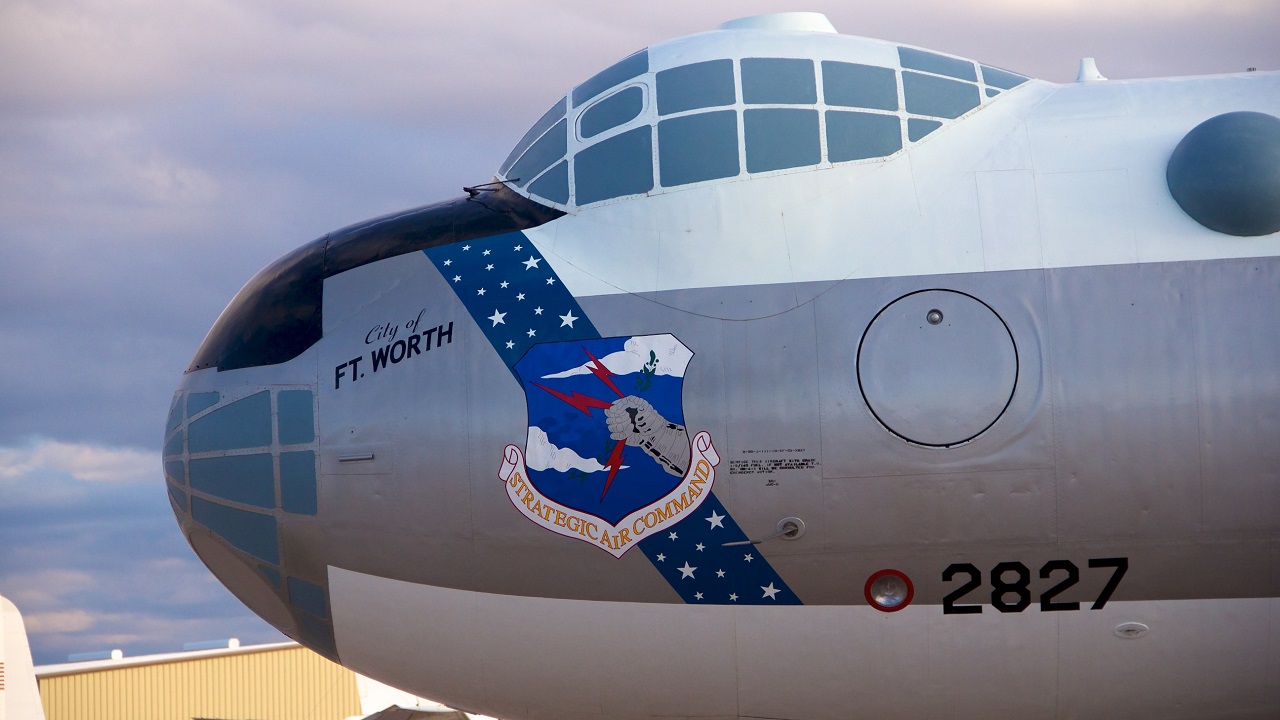
Nose art on United States bomber B-36J Peacemaker named City of Fort Worth.
-AF Ser. No. 52-2827, at the Pima Air and Space Museum, adjacent to Davis–Monthan AFB in Tucson, Arizona; this specimen carries additional sentimental value and posterity power as the final Peacemaker produced, named “The City of Fort Worth” (and indeed lent to that city during the warbird’s retirement year.
Speaking of Fort Worth, there is also a B-36 Peacemaker Museum, part of the Fort Worth Aviation Museum at Meacham Airport. However, as per the museum’s own hard-scratching disclaimer, “We do not have a B-36 Bomber on site.” (Jeez-Louise, what a cruel tease!)
Musical Outro
Methinks it apropos to conclude this article with the final verse of a song sung by a man who actually flew the B-36, that being the song “Peacemaker” by the late great James P. “Bull” Durham (Lt. Col., USAF, Ret.), a former bomber and gunship pilot during the Cold War who found a second career as a professional singer on the Erosonic record label along with retired USAF fighter pilots Lt. Col. Dick Jonas and Maj. Irv Levine (who flew the F-4 Phantom II and F-105 Thunderchief, respectively, during the Vietnam War):
“She goes on forever, and there’s nothing to fix/Just ain’t no bomber like a B-36/One day I will leave her, then what will I do?/I’ll park my young a** in a B-52!” (Indeed, Bull did so [God rest his soul], and sang about it accordingly.)
About the Author: Christian D. Orr
Christian D. Orr is a Senior Defense Editor. He is a former Air Force Security Forces officer, Federal law enforcement officer, and private military contractor (with assignments worked in Iraq, the United Arab Emirates, Kosovo, Japan, Germany, and the Pentagon). Chris holds a B.A. in International Relations from the University of Southern California (USC) and an M.A. in Intelligence Studies (with a concentration in Terrorism Studies) from American Military University (AMU). He is also the author of the book “Five Decades of a Fabulous Firearm: Celebrating the 50th Anniversary of the Beretta 92 Pistol Series,” the second edition of which was recently published.