
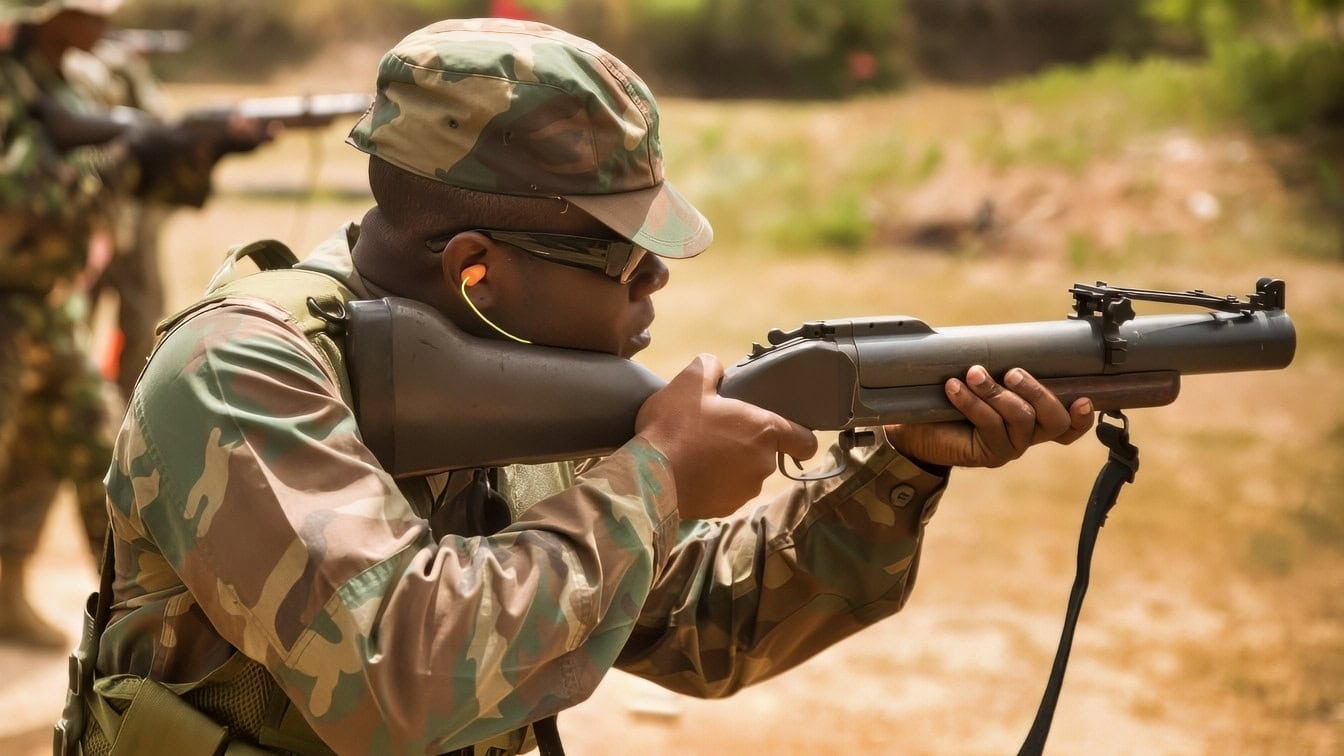
The M79 Grenade Launcher: A Vietnam-Era Workhorse That Refuses to Retire – The M79 grenade launcher was developed from a straightforward but pressing problem faced by the U.S. Army in the late 1950s: infantry squads had no effective way to engage targets in the gap between the maximum effective range of a hand-thrown grenade (roughly 40 meters) and the minimum safe range of supporting mortar fire (around 200 meters).
Existing rifle grenades from the World War II era were inaccurate, awkward to launch, and interfered with a soldier’s ability to fire his rifle normally, requiring a special round to fire them. The accuracy and effectiveness were directly influenced by the grenadiers’ expertise and training.

U.S. Commander, South Atlantic, RADM James S. Elfelt, practice fires the M79 grenade launcher. The admiral was here observing the American and the Peruvian marines during Operation Unitas XXII.
The weapons were used to great effect in Vietnam. However, many of our allies and partners in Latin America have used the M79, and it has been/is a very effective weapon for light infantry/counter-narcotics units operating in dense jungle.
Some of the units our unit trained, such as the Bolivian UMOPAR (Unidad Móvil de Patrullaje Rural), which was a paramilitary police unit starting in the early 1980s, carried M79s and M2 Carbines before transitioning to M16A2s, giving them a Vietnam-era feel.
Development Of The M79 Grenade Launcher
Springfield Armory answered the call with a purpose-built, single-shot, break-action launcher chambered for a new 40x46mm low-velocity grenade round.
Adopted in 1961, the M79 looked and handled much like an oversized single-barrel shotgun. A soldier broke the action open at the hinge, inserted a single 40mm round, closed the breech, and fired.
The weapon’s stubby profile and simple mechanism earned it a variety of nicknames among American troops in Vietnam, including “Thumper,” “Bloop Gun,” and “Elephant Gun,” references to the distinctive sound the launcher made when fired and the visible arc of the projectile in flight.
The M79 saw its combat debut in Vietnam and quickly became one of the most valued weapons in an infantry squad’s arsenal.

M79 (right) with an FN minimi, Panama, January 1989.
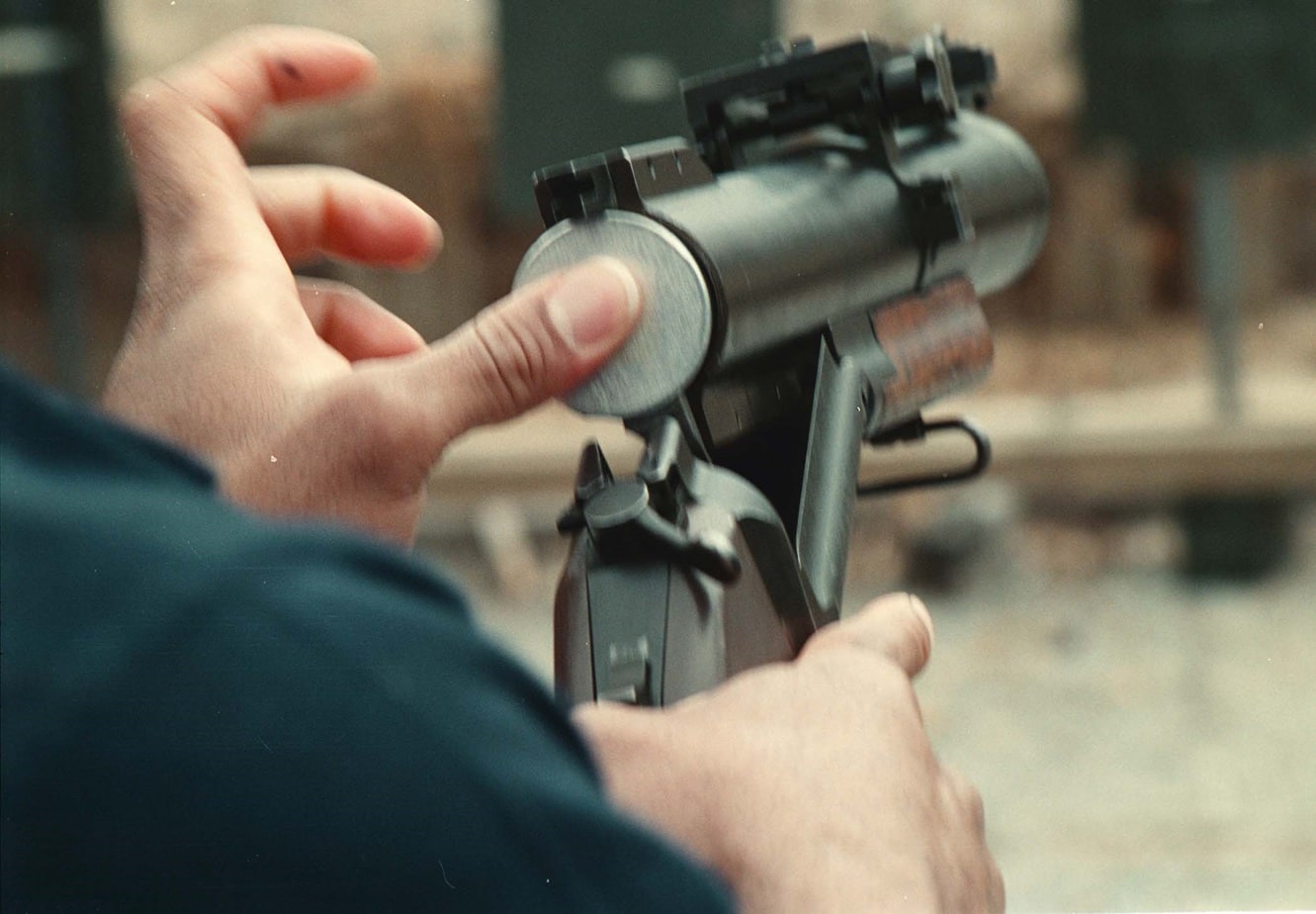
A Coast Guardsmen loads an M79 with a non-lethal round. The Coast Guard was at Camp Lejeune testing different types of non-lethal weapons.
It could lob a high-explosive round with fragmentation effects out to roughly 350 meters, giving small units organic indirect fire support without waiting on artillery or mortars.
Squads facing ambushes in dense jungle terrain, where visibility was often limited to a few meters, found the M79 particularly useful for suppressing entrenched positions and breaking up assaults.
The Operation Of The M79 Is Simple
Mechanically, the M79 is simple. It functions like a break-open single-barrel shotgun: press a lever, the barrel tips down on a hinge, and the operator loads a single 40mm grenade round into the chamber.
Closing the action cocks the internal hammer, and the weapon fires when the trigger is pulled. There is no magazine, no semi-automatic action, and no complex gas system to maintain, which made the weapon extraordinarily reliable even in the harsh, muddy, and humid conditions of Southeast Asia.
The 40x46mm ammunition family developed for the M79 proved remarkably versatile.
High-explosive fragmentation rounds became the standard load, but manufacturers also produced buckshot rounds for close-range defense, illumination rounds for signaling and battlefield lighting, smoke rounds for concealment and marking, and even non-lethal rounds such as tear gas canisters and rubber baton rounds for riot control and less-lethal engagements.
M79 Grenadier, SOCOM Commander Showed The Way
Flipping up the rear sight was time-consuming in combat, and the best, most experienced grenadiers rarely used them. Many relied on muscle memory or taped the sling to where they would slide the weapon to denote the ranges.
During the drug interdiction era, our SF A-Team was the first SF operators to train the DEA agents at the Marine Corps Base in Quantico. Prior to this, the Marines trained up the DEA “Snowcap” teams.
The SOCOM commander, General Wayne Downing, convinced the DEA to be trained by SF because they would be working side by side with them in the Andean Ridge countries.
General Downing came to visit the training, which included shooting M79s downrange. He loved spending time with the troops and was beloved by the operators he worked with.
When he saw the M79s, he beamed, recalling his time as an advisor with the Vietnamese Ranger Battalions. We asked him if he’d like to fire a few rounds. He then, without any practice, bet his Aide, and anyone else, a case of beer that he could hit an old junked vehicle 250 meters downrange three times, with all three rounds in the air before the first round hit.
Damned if he didn’t nail it. He held two spare rounds in his fingers, used the sling as he was remembered, and placed the rounds right on top of the vehicle. He winked at us and said, “I loved the “Bloop Gun.”
Pros of the M79
Reliability. The M79’s break-action design has almost nothing to go wrong. There is no gas system, no complex bolt carrier, and few moving parts, so it is nearly immune to jamming or malfunction, even when caked in mud or exposed to rain and humidity for extended periods.
Simplicity of training. Because the launcher operates like a familiar break-action shotgun, new soldiers can be trained to use it competently in a very short time, an important consideration for reserve forces, militias, or units with limited training time.
Accuracy at range. Despite its low velocity, the M79 is surprisingly accurate in trained hands, with a flip-up leaf sight allowing for reasonably precise indirect fire out to its maximum effective range.
Versatile ammunition. The wide range of 40mm rounds, from high-explosive to smoke, illumination, and less-lethal options, lets a single weapon serve multiple battlefield roles.
Low cost and durability. The M79 is inexpensive to manufacture and maintain compared to more modern under-barrel or automatic grenade launchers, and its simple steel construction gives it a long service life with minimal upkeep.
Lightweight firepower. Because the M79 is so exceedingly simple, it was very light. The weapon weighed only 5.95 pounds empty and 6.45 pounds loaded.
Cons of the M79
Single-shot limitation. The most significant drawback is the launcher’s single-shot capacity. After firing, the operator must break open the action, extract the spent casing, and manually reload before firing again, a process that takes several seconds and leaves the operator vulnerable during close engagements.
No conventional rifle capability. Because the M79 is a dedicated weapon rather than a rifle attachment, the soldier carrying it typically has no rifle for personal defense, traditionally relying instead on a sidearm such as a pistol, which is a poor substitute in a close firefight.
Minimum arming distance. Like many grenade launchers, the 40mm round requires a minimum travel distance, generally around 30 meters, before the fuze arms. This creates a “dead zone” at close range where the launcher offers no explosive capability, only buckshot rounds.
Bulk and length. While not exceptionally heavy, the M79 is long and can be cumbersome in tight quarters such as vehicle interiors, dense urban environments, or thick vegetation.
Obsolescence pressure from newer designs. The development of under-barrel grenade launchers, such as the M203 and M320, which attach directly beneath a rifle’s barrel, largely addressed the M79’s core weakness by letting a single soldier carry both a rifle and grenade-launching capability simultaneously.
This innovation is what prompted most modern militaries to shift away from standalone launchers.
Why Some Allied Nations Still Use It
Despite being succeeded in U.S. frontline service by under-barrel systems decades ago, the M79 remains in service with a number of allied and partner militaries around the world, including forces in parts of Latin America, Southeast Asia, and elsewhere. Several practical reasons explain this persistence.
First, cost matters enormously for smaller or budget-constrained militaries. The M79 and its ammunition are cheap to produce, and many nations already possess large stockpiles inherited from Cold War-era military aid programs, making replacement financially unappealing when the existing weapons still function.
Second, reliability in austere conditions is highly valued by forces operating in jungle, mountain, or tropical environments with limited maintenance infrastructure. A weapon with almost no failure points is attractive when spare parts and armorer support are scarce.
Third, some units specifically prefer a dedicated launcher over an under-barrel system because it frees a designated grenadier to focus on that role without compromising a rifle’s handling characteristics, and because training a grenadier on a separate weapon can be simpler for irregular or lightly trained forces such as militias or paramilitary police units.
Finally, in many of these countries, the M79 has been thoroughly integrated into logistics, doctrine, and institutional memory over half a century of use.
Replacing it wholesale would require new ammunition supply chains, retraining programs, and significant capital investment that many defense budgets simply cannot justify when the existing weapon continues to perform its intended function reliably.
The M79 Was Simple, Deadly, And Cost-Effective
The M79 stands as a testament to effective, simple engineering. Personally, I loved firing it and found it an outstanding, if limited weapon.
Though eclipsed in U.S. service by more versatile under-barrel systems, its rugged reliability, low cost, and battlefield-proven design have secured it a lasting role in the arsenals of numerous allied nations well into the 21st century, a reminder that in military hardware, “good enough and dependable” often outlasts “advanced and complex.”
About the Author: Steve Balestrieri
Steve Balestrieri is a National Security Columnist. He served as a US Army Special Forces NCO and Warrant Officer. In addition to writing on defense, he covers the NFL for PatsFans.com and is a member of the Pro Football Writers of America (PFWA). His work was regularly featured in many military publications.