
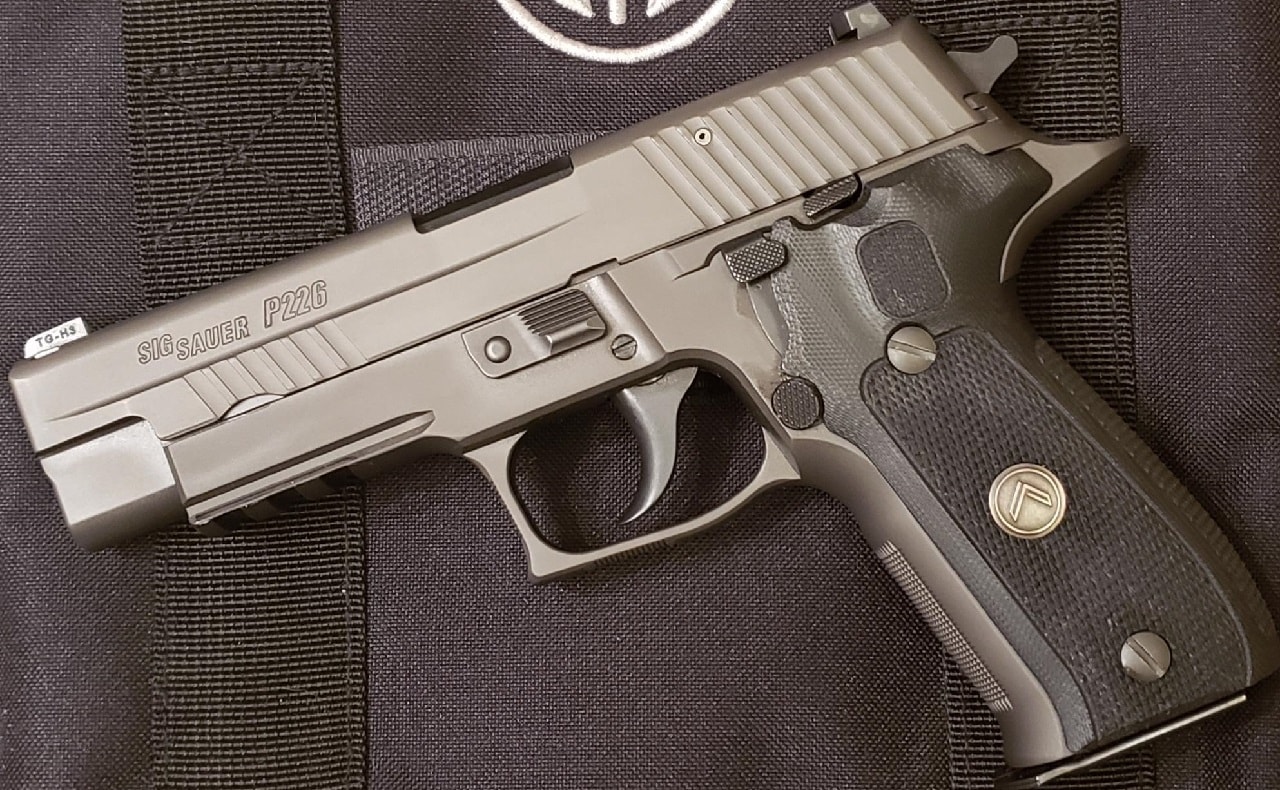
The SIG Sauer P226: A Legend Among Combat Pistols – For more than four decades, the SIG Sauer P226 has held a rare status in the world of firearms: a design so well-conceived that it remains competitive against pistols released generations later.
Adopted by elite military units, police departments, and federal agencies across the globe, the P226 earned its reputation not through marketing, but through relentless reliability under the harshest conditions imaginable.
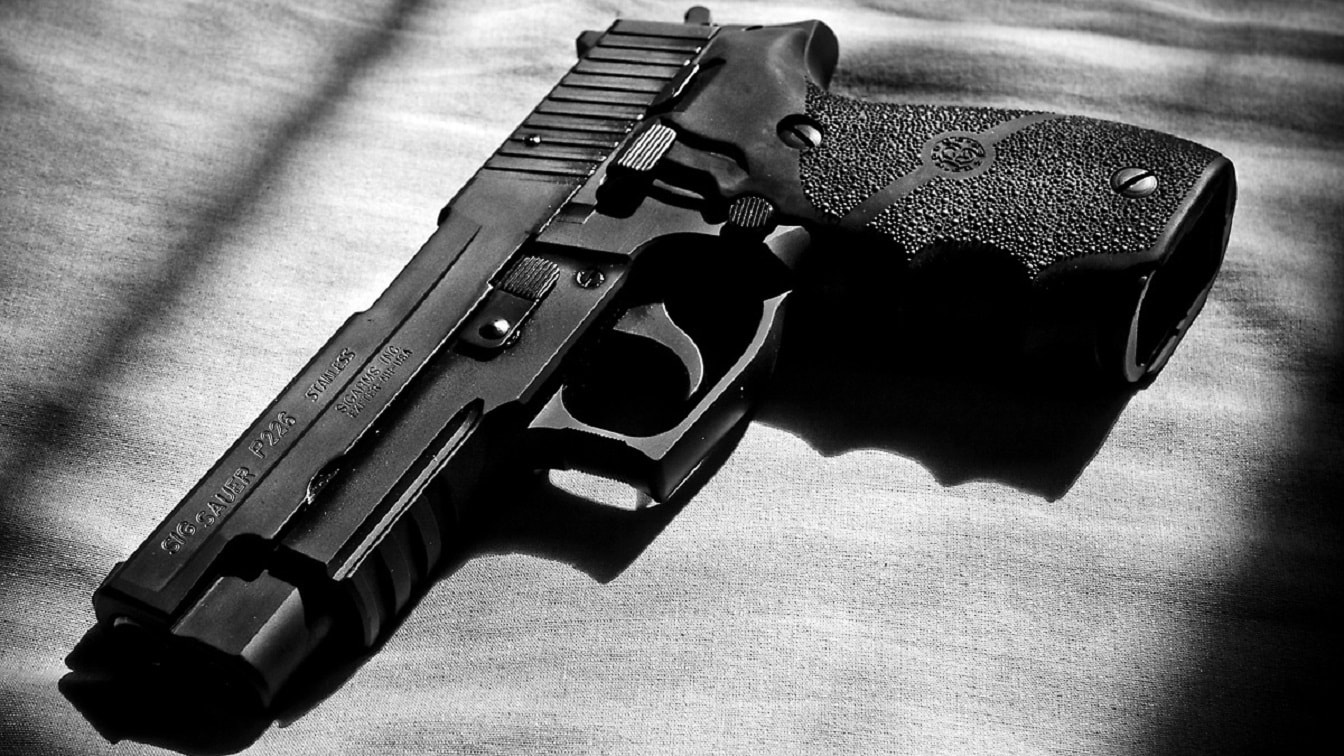
Image of Sig Sauer P226. Image Credit: Creative Commons.
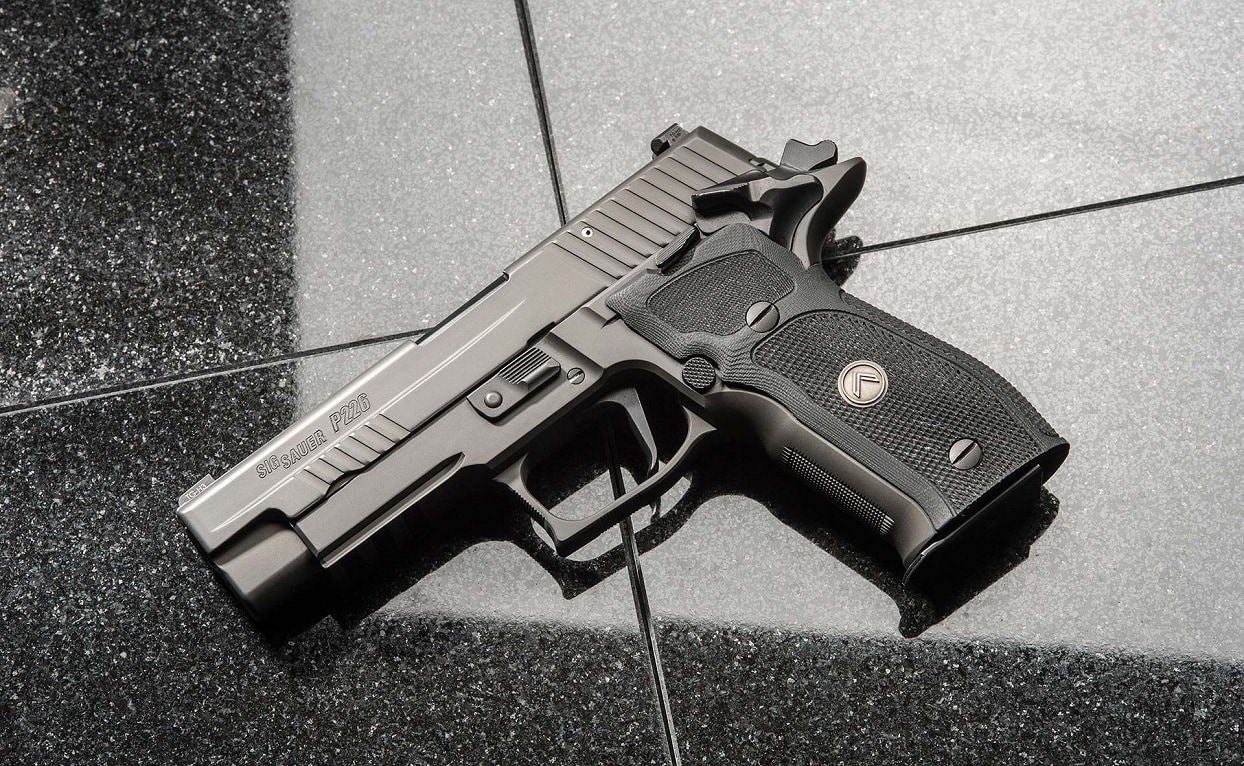
Sig Sauer Legion P226. Image Credit: Creative Commons.
To understand why it became such an outstanding combat pistol, it helps to look at where it came from, how it was built, and how it performed when it mattered most.
While the SEALs and many law enforcement agencies have finally moved on to the outstanding Glock 19, the reasons for the pistol’s popularity are apparent to anyone who relies on it to protect their lives in combat.
As I’ve mentioned several times in different pieces here, SIG Sauer makes outstanding firearms. I have always been a big fan of theirs, especially the P226. It is yet another fantastic handgun that has it all. In fact, the SIG should have been chosen as the military’s next service pistol when the beloved M-1911A1 was retired.
However, the Beretta 92F was chosen over the SIG Sauer P226 because it was cheaper. Remember the old saying, “You get what you pay for.”
Origins Born From Competition
The P226’s story begins with a request, not a rumor. In the early 1980s, the U.S. military launched the XM9 trials to replace the aging M1911A1 .45 ACP pistol with a modern 9mm sidearm.
SIG Sauer, a Swiss-German partnership between Schweizerische Industrie Gesellschaft and J.P. Sauer & Sohn, entered its P226, an evolution of the earlier P220 model that had already built a strong reputation in European service.
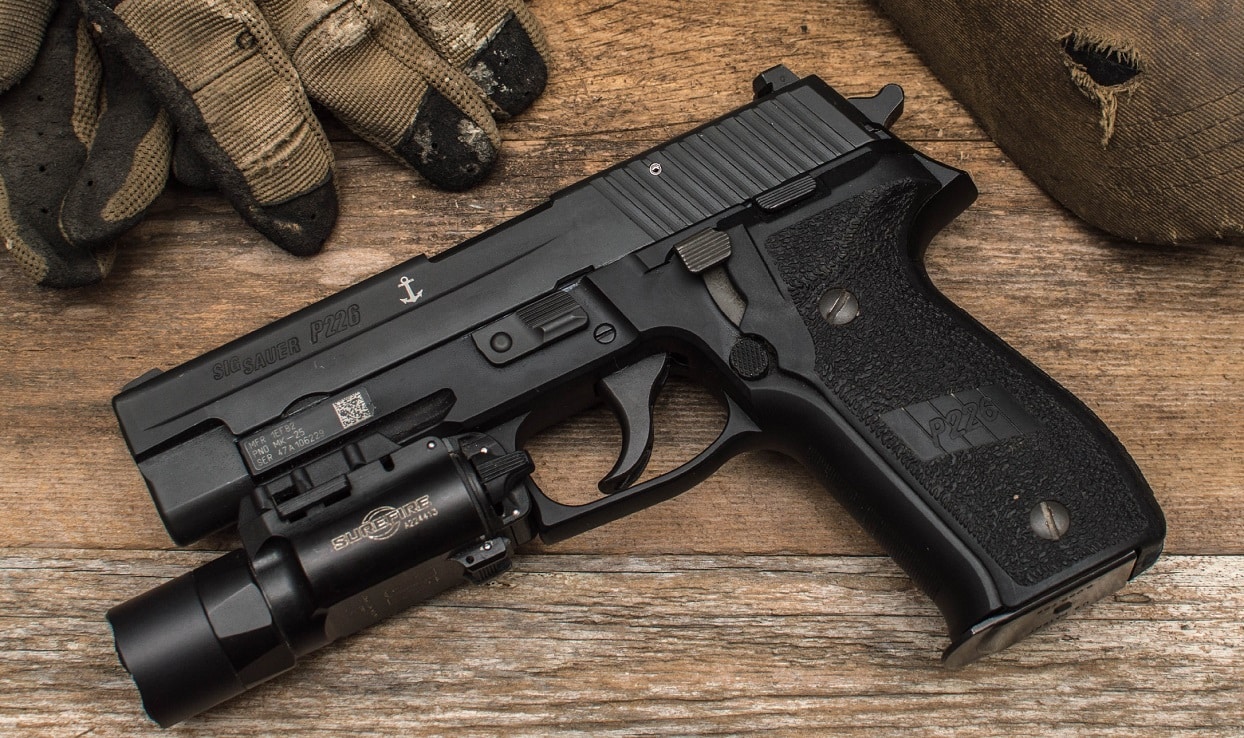
Image: Creative Commons.

Image: Creative Commons.
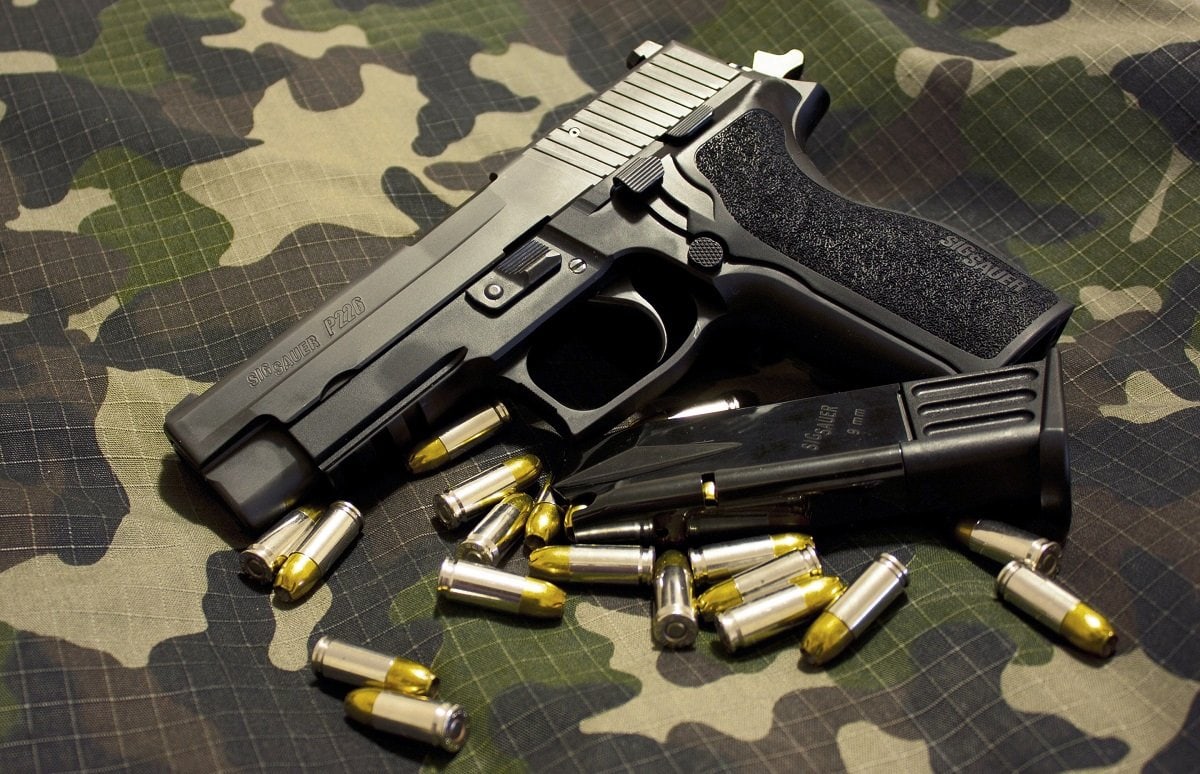
SIG Sauer P226. Image: Creative Commons.
The P226 performed exceptionally well in testing, reportedly outshooting its rivals in reliability and accuracy. In the end, the contract went to Beretta’s M9, reportedly due to cost rather than performance, since SIG’s per-unit price was higher once magazine and lifecycle costs were factored in.
It was a disappointing result for SIG, but the trials had already proven something important: the P226 was, by objective military testing standards, one of the finest combat pistols ever designed.
That reputation didn’t fade. Instead, elite units within the U.S. military took notice, and the pistol found its way into service anyway, just not through the front door.
Adoption by the World’s Most Elite Special Operations Units
The most famous chapter of the P226’s story is its adoption by the U.S. Navy SEALs, who selected it as their sidearm beginning in the mid-1980s and continued to trust it for decades.
After the adoption of the M9 Beretta, the SEALs began to put the M9 through its paces and ran into problems. Slide cracks began to develop. During a VIP visit in 1986, a SEAL was injured when a slide’s rear portion broke off, sending pieces of the slide into his face. That was enough.
The SEALs decided to buy their own pistol and went with the SIG P226 after testing five pistols and putting them through a 5,000-round endurance test. The Navy dubbed the pistol the Mk.25.
The Navy’s special operators adopted the SIG in 1989. Since then, for more than thirty years, SEALs carried the P226 into battle in Panama, Somalia, Haiti, the Balkans, Iraq, Afghanistan, and Syria.
For an organization that could choose virtually any weapon in the world and subjects its gear to brutal testing in maritime and combat environments, that endorsement carried enormous weight.
The P226 also became a favorite of other special operations units, federal agencies like the U.S. Secret Service, and a long list of international special forces and police organizations.
This kind of adoption pattern says something important: professionals who bet their lives on their equipment and have the resources to choose anything kept choosing the P226. That is a far more meaningful endorsement than any marketing campaign.
Engineering That Prioritized Reliability
What made the P226 stand out wasn’t flashy innovation. It was disciplined, conservative engineering executed to an exceptionally high standard. Several design elements combined to produce a pistol that soldiers and agents could depend on without hesitation.
The P226 uses a traditional short-recoil operating system with a locked breech, a design lineage shared with many of the most trusted service pistols in history. It’s simple, proven, and forgiving of dirt, sand, and neglect, exactly the conditions found in combat.
Unlike many of its polymer-framed successors, the original P226 used an aluminum alloy frame paired with a stamped steel slide, a combination that gave it excellent durability and a reputation for shrugging off tens of thousands of rounds without failure.
Armorers repeatedly found that P226s could endure abuse that would destroy lesser pistols.
The P226 operates on a double-action/single-action trigger system. The first shot can be fired with a longer, heavier double-action pull, useful for safe carry with a round chambered, while every subsequent shot benefits from a crisp, short single-action reset.
This gave shooters both a margin of safety for carry and speed for follow-up shots, a versatile compromise that suited the unpredictable nature of combat.
Rather than relying on a manual thumb safety that can be forgotten under stress, the P226 uses a decocking lever that safely lowers the hammer without pulling the trigger. This reduced the chance of a negligent discharge while keeping the weapon ready to fire immediately with a squeeze of the trigger.
Recoil is very light and easily controllable to reaquire the target. The trigger is smooth in double action and single action, which was light years better than the M9. The slight taper funnel of the magwell allows easy magazine change.
The P226’s barrel-to-slide fit and overall build tolerances were tight for a service pistol of its era, contributing to accuracy that exceeded what was strictly necessary for combat and proved valuable in precision shooting, hostage rescue, and long-distance engagements where surgical shot placement mattered.
The tritium sights are outstanding and allow super-easy target acquisition. And it is reliable as hell. If it wasn’t, the SEALs wouldn’t have used it for 30 years.
Proven in the Field Among Many Combat Deployments
Reliability claims mean little without a track record, and the P226 has one of the most extensive combat records of any modern service pistol.
It has been carried through jungles, deserts, Arctic conditions, and maritime operations by operators who needed a weapon that would fire every time the trigger was pulled, regardless of mud, sand, saltwater, or years of hard use.
Its reputation for functioning flawlessly in adverse environments is not folklore. It’s derived from decades of documented use by units whose survival depended on exactly that kind of dependability.
The P226’s Excellent Legacy That Still Resonates
Even as the firearms industry shifted toward polymer-framed, striker-fired pistols with higher capacities and lighter weights, the P226 never faded into irrelevance. It was an outstanding pistol for its time.
SIG Sauer has continued to produce and refine the platform, including modernized variants that retain the original’s core DNA while incorporating contemporary materials and features.
Collectors, competitive shooters, and professionals alike still regard it as a benchmark against which other pistols are measured.
The SIG Sauer P226 succeeded not because it reinvented the handgun, but because it refined every element of a proven formula to an exceptional standard, then endured the most demanding trial possible: real combat, over and over again, for more than forty years.
Personal Experience With the P226:
I have personal experience with the P226. During the early ‘90s, I was working in Bolivia on a counter-narcotics deployment with the 7th Special Forces Group. Part of that time was spent in the capital, La Paz. It was there that I met an FBI special agent, Bob C., who was a fantastic guy and a great agent.
Bob was training Bolivia’s presidential security detail, which badly needed his expertise. Other than their commander, they couldn’t hit water out of a boat at the time.
Bob asked another SF warrant officer, Mick Hogan (RIP), who was assigned to the MILGP, and me to help him out during the combat pistol training. We gladly joined.
Bob and the Bureau were arming the Bolivians with the P226. He, Mick, and I spent a familiarization day on the range with the SIG. We put about 500-600 rounds each downrange. It was love at first sight. The full-size pistol fit your hand like a glove, and after a couple of magazines of familiarization, we were knocking down steel plates on the combat range like we’d been shooting that pistol forever.
BTW, by the time their training was done, the security detail were some straight-shooting pistoleros, especially the women, who took to the training better than the guys, who, like American men, all think they know better than “the experts.” LOL
During the rest of my deployment, the M9 was put on the back burner. And I carried the P226. As anyone who knows me, knows my feelings about the Beretta.
The P226 was/is still an awesome pistol. As my deployment was coming to a close, I joked to Bob that someone had broken into my vehicle and stolen the SIG. He was too smart for that line, and I bid farewell to a great pistol. After returning to home station, I wondered why SF couldn’t ditch the Beretta for the P226.
I still ponder that one.
About the Author: Steve Balestrieri
Steve Balestrieri is a National Security Columnist. He served as a US Army Special Forces NCO and Warrant Officer. In addition to writing on defense, he covers the NFL for PatsFans.com and is a member of the Pro Football Writers of America (PFWA). His work was regularly featured in many military publications