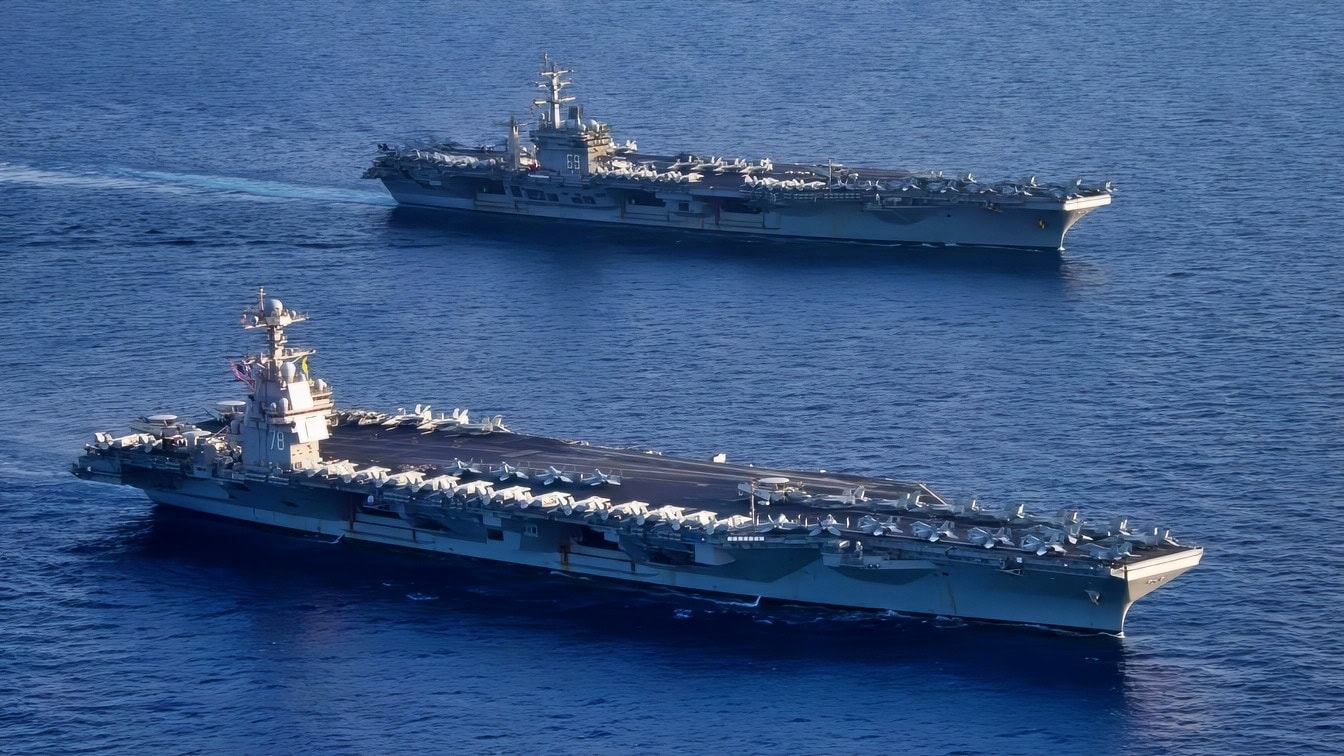
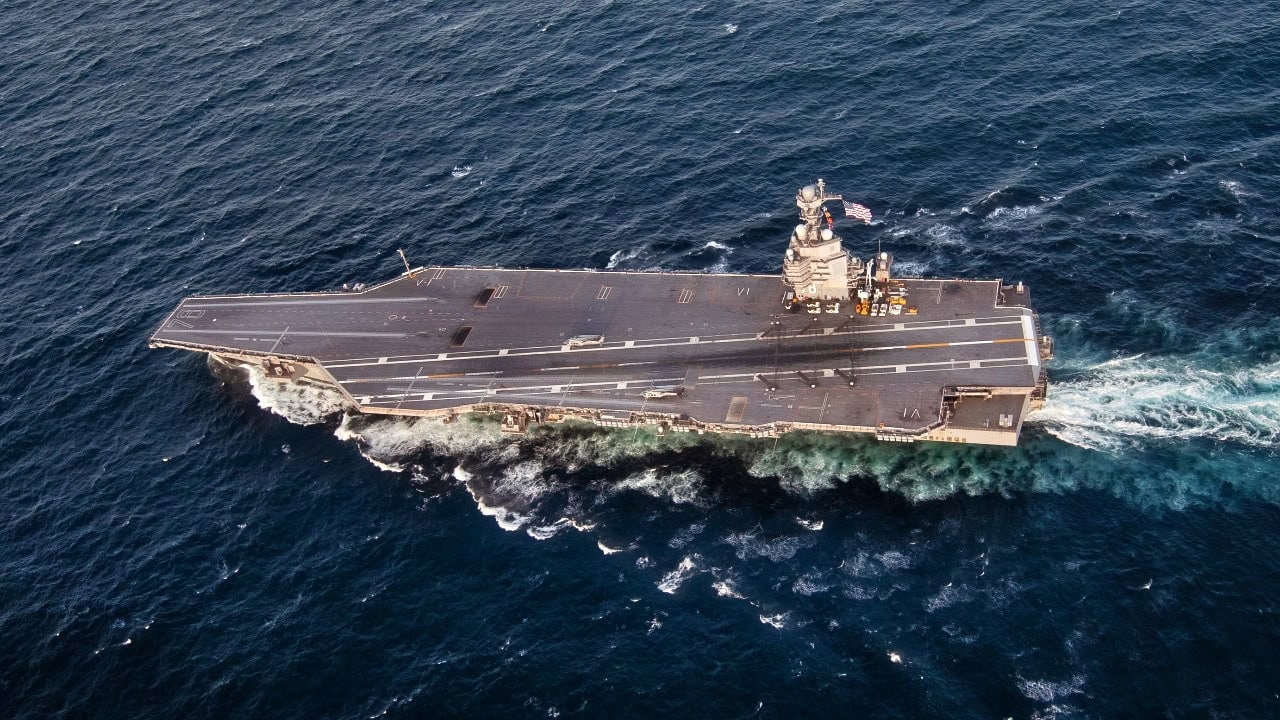
The United States Navy’s Ford-class aircraft carrier represents the apex of American naval engineering, but is also representative of technological overreach.
As the successor to the Cold War-era Nimitz-class carriers, the Ford-class promises transformational improvements in operational capacity. But it has attracted significant criticism for its high price tag, several seeming gambles on new technologies, and potential exposure in an era of advanced anti-ship and hypersonic weaponry.
The Ford-class aircraft carrier USS Gerald R. Ford (CVN 78) and the Italian aircraft carrier ITS Cavour (CVH 550) transit the Atlantic Ocean March 20, 2021, marking the first time a Ford-class and Italian carrier have operated together underway. As part of the Italian Navy’s Ready for Operations (RFO) campaign for its flagship, Cavour is conducting sea trials in coordination with the F-35 Lightning II Joint Program Office’s Patuxent River Integrated Test Force to obtain official certification to safely operate the F-35B. Gerald R. Ford is conducting integrated carrier strike group operations during independent steaming event 17 as part of her post-delivery test and trials phase of operations.
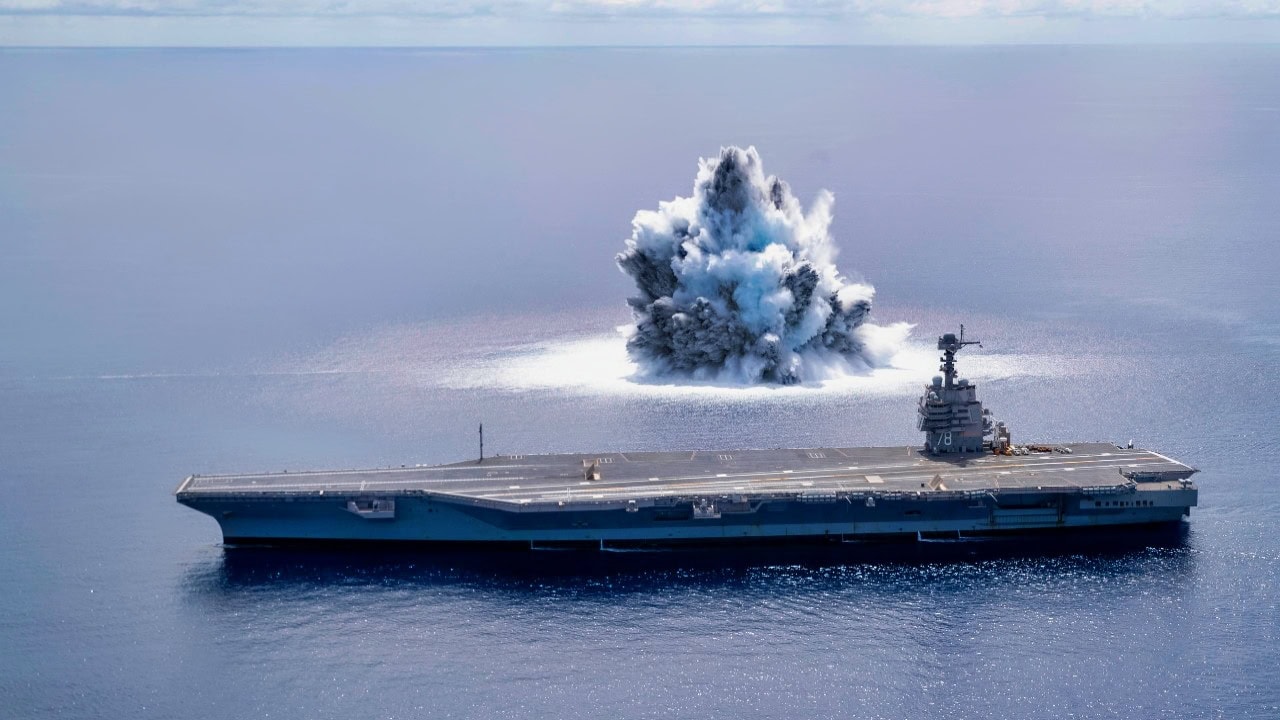
The aircraft carrier USS Gerald R. Ford (CVN 78) completes the first scheduled explosive event of Full Ship Shock Trials while underway in the Atlantic Ocean, June 18, 2021. The U.S. Navy conducts shock trials of new ship designs using live explosives to confirm that our warships can continue to meet demanding mission requirements under harsh conditions they might encounter in battle. (U.S. Navy photo by Mass Communication Specialist 3rd Class Riley B. McDowell)
The Ford-class: Operational Advantages
The Ford-class was conceived to deliver a step-change in United States Navy carrier aviation.
Arguably one of the class’s most significant innovations is the Electromagnetic Aircraft Launch System, or EMALS, which replaces the steam-powered catapults that have launched aircraft from United States Navy aircraft carriers since the 1950s.
EMALS can be tuned precisely to an aircraft’s weight, significantly reducing stresses on airframes and enabling the safe, efficient launch of both relatively lightweight unmanned systems and much larger, heavier manned fighters.
Operational tempo is one of the Ford-class’ great advantages. Compared to the Nimitz-class carriers, which can sustain around 120 sorties per day, the Ford-class is capable of 160 sorties per day, with a surge capacity that rises from 240 to 270.
Another piece of technology integrated onto the Ford-class is the Advanced Arresting Gear, which recovers a wider variety of aircraft with smoother, more predictable deceleration.
Together, EMALS and AAG boost sortie generation by about 30 percent.
Power generation is the lifeblood of the new carriers. A pair of A1B nuclear reactors produce roughly 25 percent more total power than the Nimitz’s A4W reactors, and electrical output is about three times greater.
The surplus electrical power is essential not only for EMALS and AAG but also for future systems that may be integrated onto the carriers, including more powerful radars, directed-energy weapons, and other electricity-thirsty systems.
Automation is extensive on the Ford-class, and the carrier’s new Advanced Weapons Elevators move ordnance from the magazine to the flight deck more efficiently.
Concurrently, crew requirements are reduced by 500 to 900 sailors compared to the Nimitz-class.
According to U.S. Navy estimates, this would save about $4 billion per ship in personnel and maintenance.
The Ford-class: Technological and Fiscal Criticisms
In a twist of irony, some of the precise innovations that make the Ford-class so innovative have also been not-insignificant liabilities.
EMALS and AAG have suffered repeated reliability problems, particularly during early operational testing, and have experienced significant critical failures related to software integration issues and maintenance complexity, attracting scrutiny from Congress. The U.S. Navy, however, maintains that it has rectified these issues.
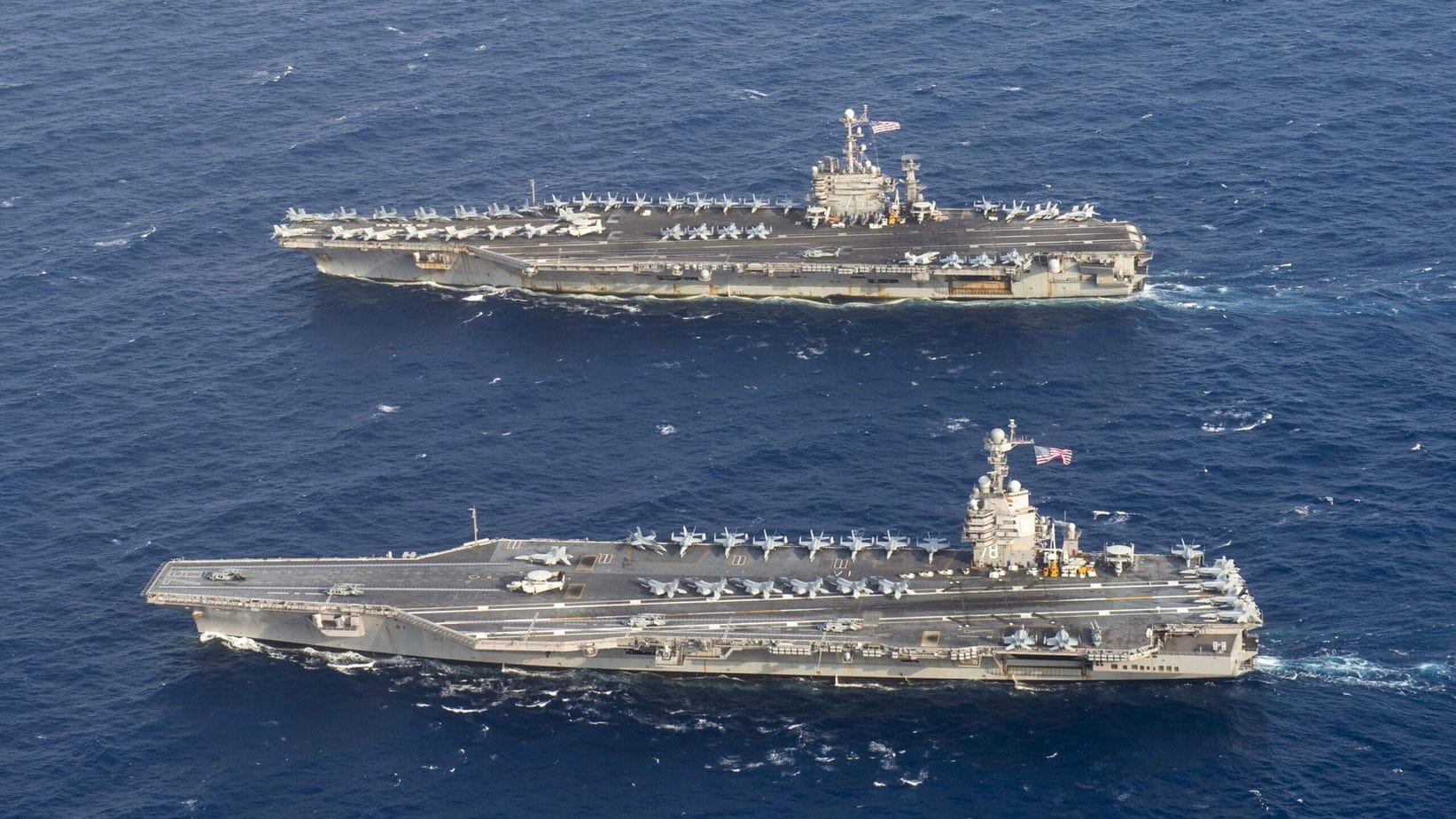
The U.S. Navy Gerald R. Ford-class aircraft carrier USS Gerald R. Ford (CVN-78) and the Nimitz-class aircraft carrier USS Harry S. Truman (CVN-75) underway in the Atlantic Ocean on 4 June 2020, marking the first time a Gerald R. Ford-class and a Nimitz-class aircraft carrier operated together underway. Gerald R. Ford is underway conducting integrated air wing operations, and the Harry S. Truman Carrier Strike Group remained at sea in the Atlantic as a certified carrier strike group force ready for tasking in order to protect the crew from the risks posed by COVID-19, following their successful deployment to the U.S. 5th and 6th Fleet areas of operation.
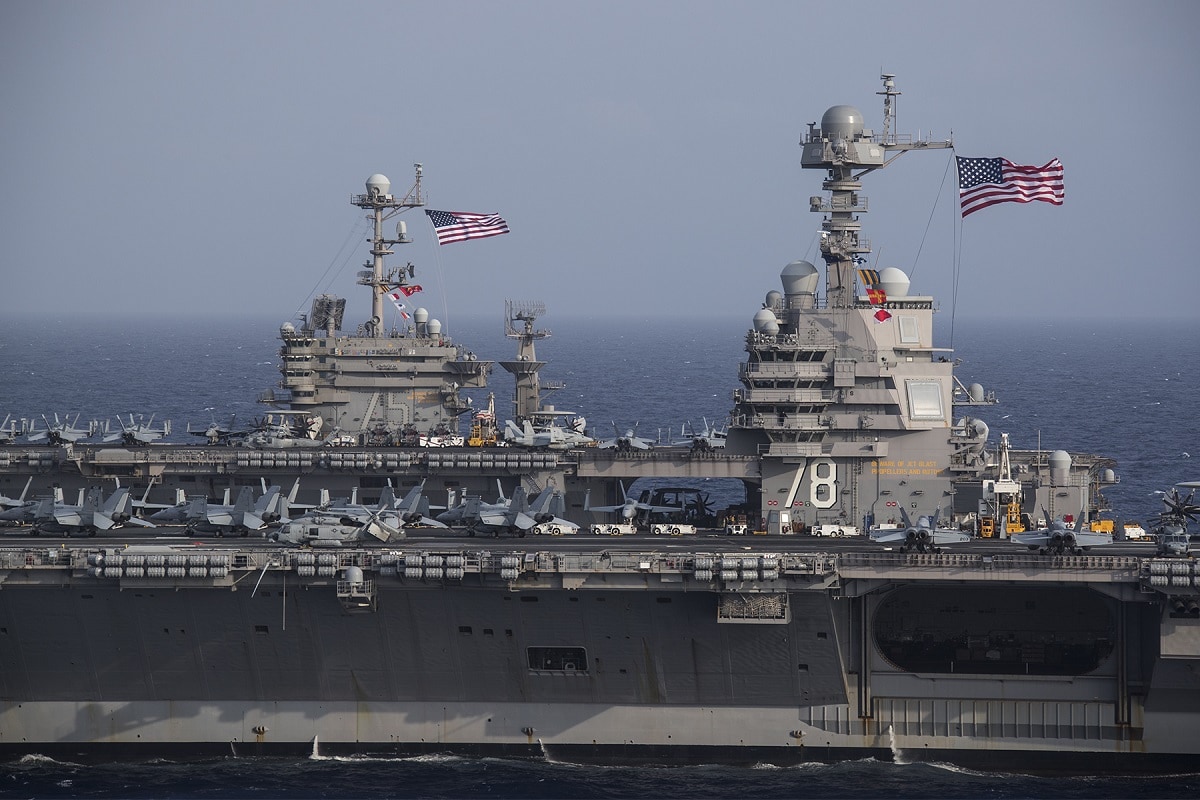
ATLANTIC OCEAN (June 4, 2020) The Ford-class aircraft carrier USS Gerald R. Ford (CVN 78) and the Nimitz-class aircraft carrier USS Harry S. Truman (CVN 75) transit the Atlantic Ocean, June 4, 2020, marking the first time a Ford-class and a Nimitz-class aircraft carrier have operated together underway. Gerald R. Ford is underway conducting integrated air wing operations and the Harry S. Truman Carrier Strike Group remains at sea in the Atlantic Ocean as a certified carrier strike group force ready for tasking in order to protect the crew from the risks posed by COVID-19, following their successful deployment to the U.S. 5th and 6th Fleet areas of operation. (U.S. Navy photo by Mass Communication Specialist 2nd Class Ruben Reed/Released
The Ford-class’s Advanced Weapons Elevators proved problematic.
Though intended to streamline ordnance handling, they experienced repeated breakdowns and delays, undermining the sortie-rate gains the EMALS was intended to deliver.
These immature systems contributed to the carrier’s delayed operational readiness and fueled accusations that the U.S. Navy had embraced unproven, overly ambitious technology before it was tested and proven.
Perhaps one of the most significant criticisms of the Ford-class has been cost.
The lead ship of the class, as well as its namesake, the USS Gerald R. Ford, experienced significant cost overruns, ultimately costing the U.S. Navy $13 billion.
Budget overruns stemmed from the concurrent development of multiple new systems alongside the carrier’s actual build, labor shortages, and the complexities of integrating them onto the carrier.
Aircraft Carriers and Strategic Vulnerability
Cost and complexity aside, the Ford-class faces a harsher strategic environment than previous classes of aircraft carrier.
As the world’s largest and most valuable warships afloat, carriers are high-value targets in any major power conflict.
The proliferation of hypersonic anti-ship missiles and long-range drones, along with resilient targeting networks, has shrunk the space in which an aircraft carrier can sail with impunity.
China’s development of the DF-21D and DF-26 — called “carrier-killer” missiles in some circles — along with Russia’s Zircon hypersonic missile system exemplify this threat.
In a contested theatre like the South China Sea of the western Pacific, a Ford-class carrier might be forced to operate farther from the fight, reducing the effectiveness of its air wings.
Critics contend that investing tens of billions of dollars in a single, vulnerable platform is anachronistic, given that the U.S. Navy’s distributed lethality strategy could offer greater resilience.
Proponents of the Ford-class counter that the carrier’s power generation and sortie capacity make it uniquely capable of sustaining high-intensity air operations, and that its defensive systems, including layered missile defenses and electronic warfare suites, provide substantial protection.
But the Ford-class is simultaneously the most powerful warship ever built, as well as a potential liability in an age of precision munitions.
Though it offers unparalleled sortie generation rates, astounding electricity generation capabilities, and a high degree of automation, it has been somewhat hamstrung by immature technologies, fiscal problems, and an overarching strategic environment that casts the survivability of aircraft carriers into question.
All military systems and platforms are a bet — but the Ford-class is one of the most expensive bets ever made by a navy.
About the Author: Caleb Larson
Caleb Larson is an American multiformat journalist based in Berlin, Germany. His work covers the intersection of conflict and society, focusing on American foreign policy and European security. He has reported from Germany, Russia, and the United States. Most recently, he covered the war in Ukraine, reporting extensively on the war’s shifting battle lines from Donbas and writing on the war’s civilian and humanitarian toll. Previously, he worked as a Defense Reporter for POLITICO Europe. You can follow his latest work on X.