
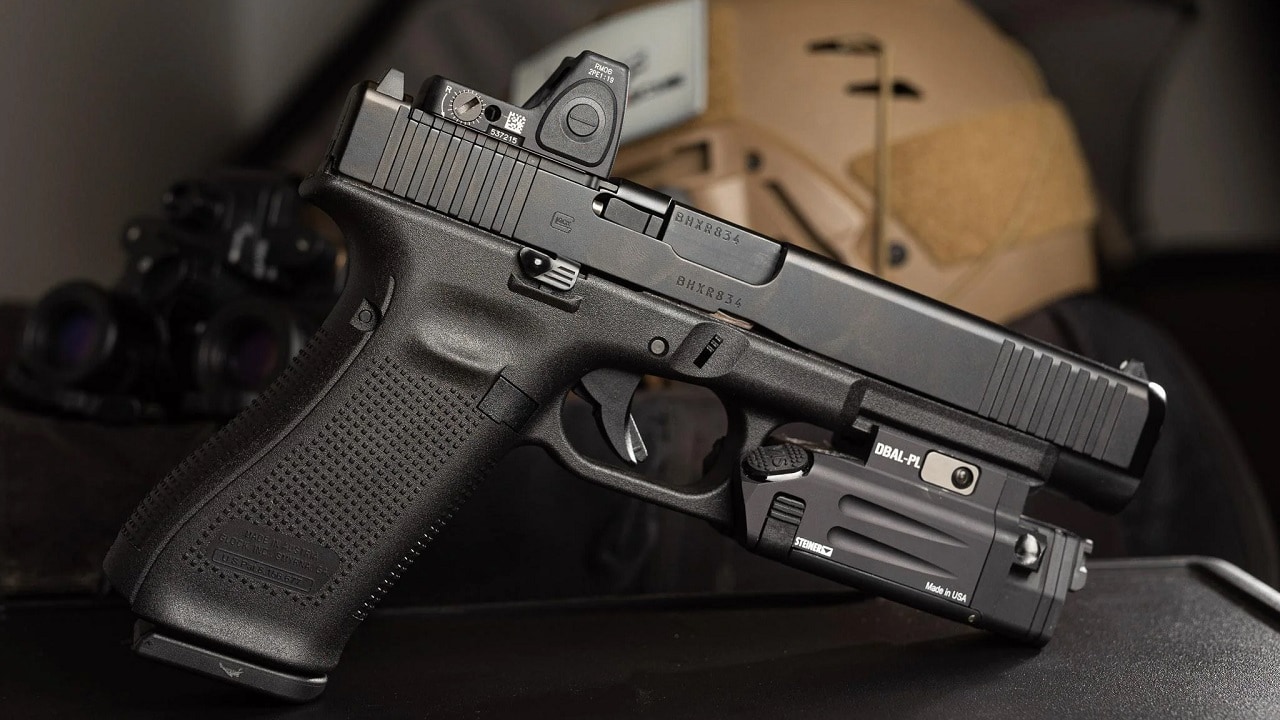
When Glock introduced the Model 34 in 1998, the goal was narrow and specific: build a pistol that could win at the top level of practical shooting sports like IPSC, IDPA, and USPSA, straight out of the box, with no gunsmith required.
Nearly three decades later, the Glock 34 has outgrown that original mission.

Glock 34 with a GTL 22 attachment.
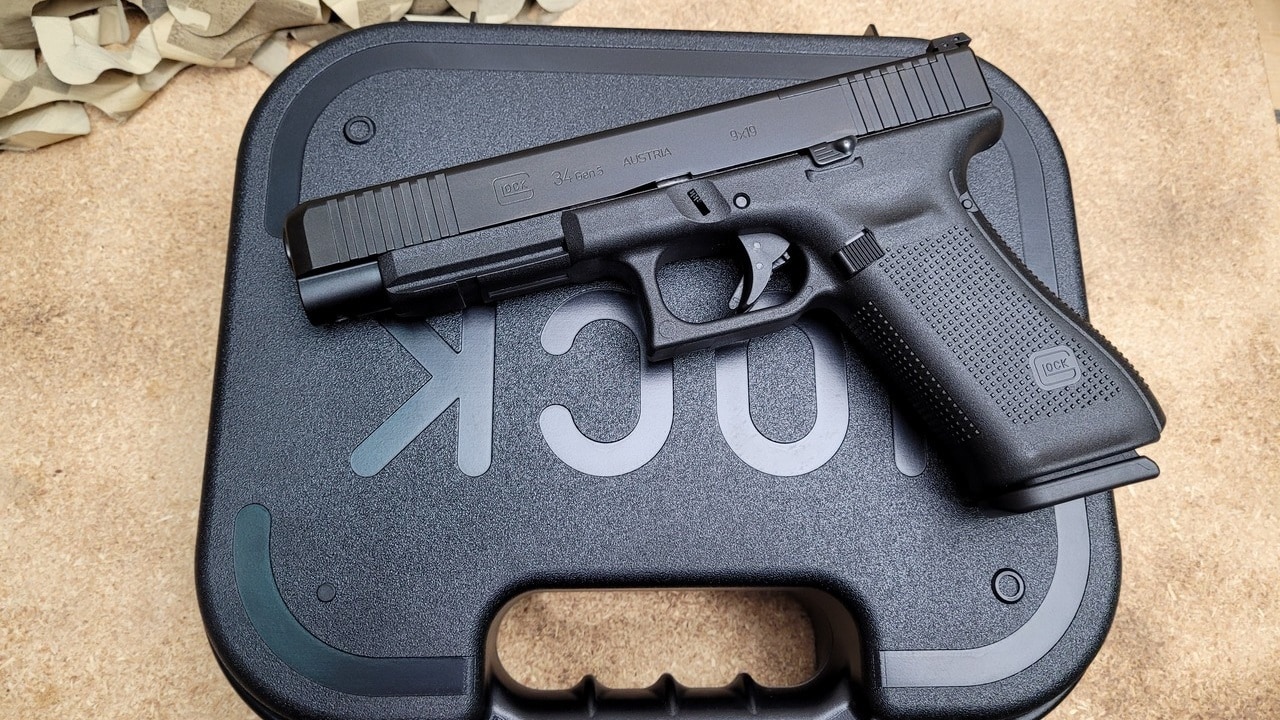
Glock G34. Image Credit: Creative Commons.
It remains a fixture on the competition circuit, but it has also quietly become a serious contender as a duty and service pistol for police departments and tactical units.
That dual identity is what makes the G34 worth examining; the same features that make it a match-winner on the range create real trade-offs when it’s carried on a belt for twelve-hour shifts.
Meet The Glock 34
The G34 is best understood as a stretched Glock 17.
It shares the same 9x19mm chambering, polymer frame, and Safe Action striker-fired trigger system as Glock’s standard-issue service pistol, but with a longer barrel and slide.
The barrel measures 5.31 inches, compared to 4.49 inches on the G17, and the slide is lengthened to match.
That extra length stretches the sight radius to roughly 7.5 inches.
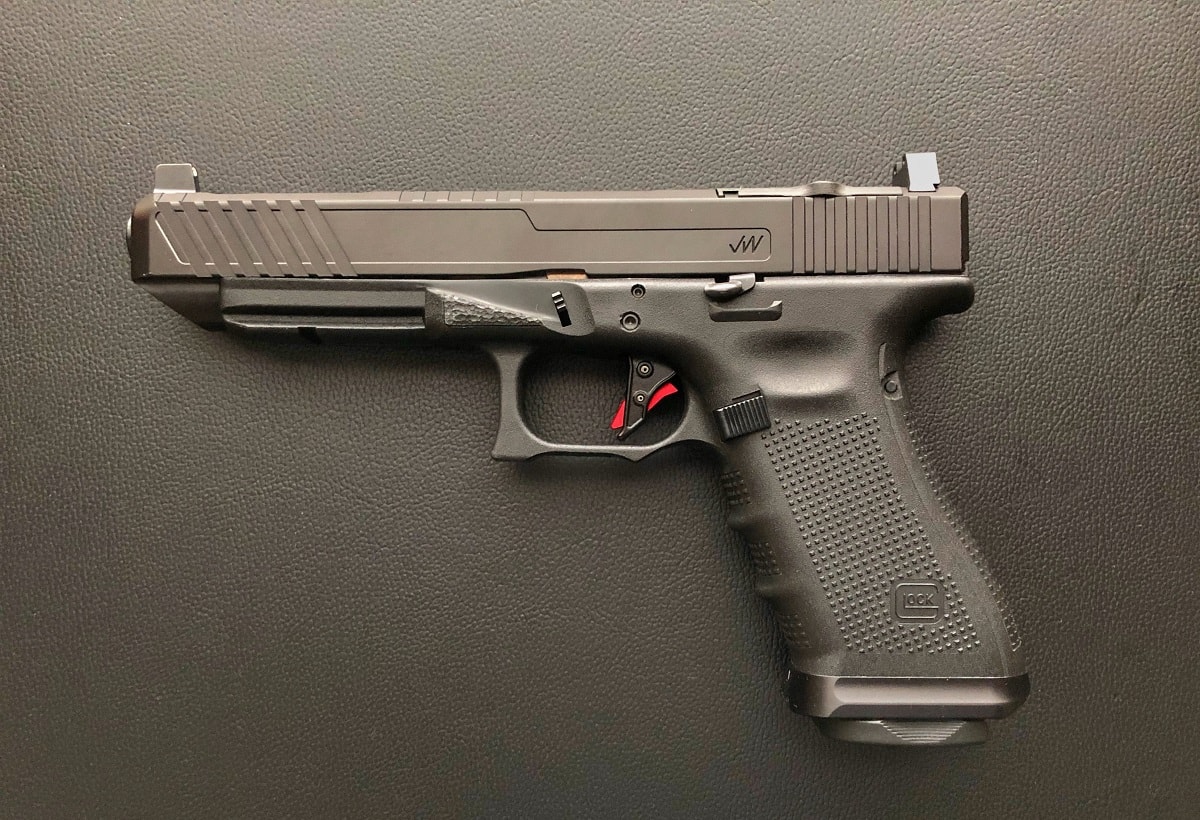
Image: Creative Commons.
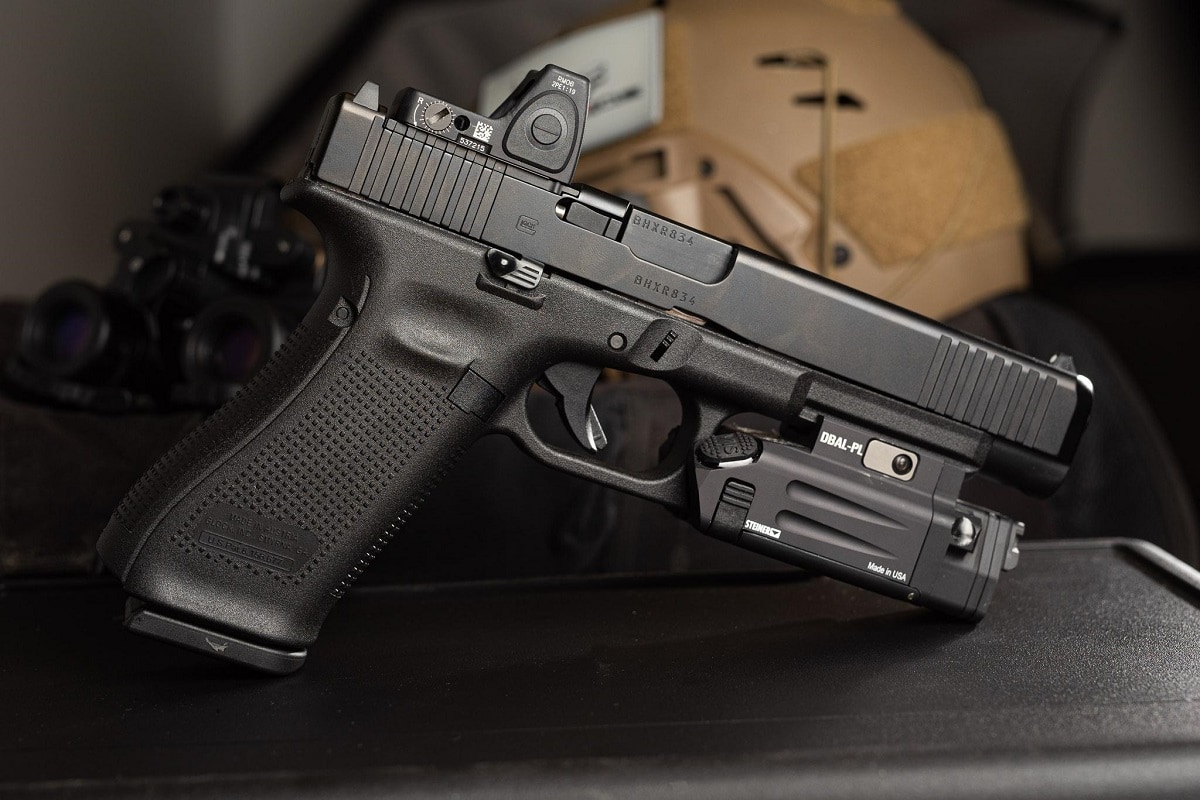
Glock 34 Generation 5
The longer sight radius means small errors in sight alignment translate into smaller errors on target, which is precisely why competitive shooters gravitated toward it.
Unloaded, the pistol weighs about 23.1 ounces; with an empty magazine inserted, that climbs to roughly 25.9 ounces.
Standard magazine capacity is 17 rounds, with factory options running as high as 33 rounds for competition use.
Later generations added features aimed squarely at the sport-shooting crowd: an ambidextrous slide stop, a reversible magazine release, a flared magazine well for faster reloads, and, in the Gen5 MOS configuration, a modular optic-mounting system that lets shooters bolt on a red-dot sight without gunsmithing.
The Glock 34 Is A Winner On The Range
The case for the G34 as a competition gun is straightforward and a no-brainer.
The extended sight radius genuinely improves practical accuracy for most shooters, particularly at the mid-to-long distances common in USPSA and IPSC stages.
The added slide mass and barrel length also work together to soften felt recoil and reduce muzzle flip, which shortens the time it takes to get back on target for a follow-up shot, a meaningful advantage when stage times are measured in hundredths of a second.
The optics-ready MOS variant closes the gap even further, since red-dot sighting has become nearly mandatory in top-tier competition divisions, though it negates some of the advantage of the longer slide.
Many competitors who carry a Glock as a duty or self-defense weapon favor the G34 as it maintains platform familiarity and muscle memory.
Reliability is the other half of the pitch.
Glock’s reputation for functioning across a wide range of ammunition and maintenance conditions is well earned, and the G34 inherits that reputation intact.
Parts compatibility with the rest of the Glock lineup also matters: holsters, sights, triggers, and aftermarket components designed for full-size Glocks largely fit the G34 with little modification, which keeps the ecosystem of support gear large and inexpensive.
Where the Compromises Show Up
The same dimensions that help on a competition stage become liabilities in daily carry.
A longer slide and barrel mean a longer, heavier package to conceal or holster comfortably, which matters for plainclothes officers or anyone carrying concealed rather than in an open-duty rig.
The extended barrel also protrudes slightly beyond the standard dust cover, which can complicate holster selection and retention-holster compatibility compared to a standard G17.
There’s also a practical marketplace issue: because the G34 is explicitly marketed and priced as a competition model, it often carries a premium over the standard Glock 17 without offering meaningfully better terminal performance or handling for close-quarters defensive use, where the sight-radius advantage matters far less than it does at 25 yards on a shooting stage.
For a duty officer whose engagements are statistically likely to occur at close range and under stress, the margin in accuracy gain may not offset the added size and cost.
Trigger feel is a matter of ongoing debate rather than a clear pro or con.
Later generations feature a somewhat lighter, crisper trigger pull than earlier Glock models, which competitive shooters generally welcome, but some agencies and instructors prefer a heavier factory trigger for the added margin of safety it provides during high-stress handling.
If there is one area of a Glock that I find wanting, it’s the factory triggers. I’ve always thought they felt a tad spongy, whereas the upgraded or aftermarket triggers were crisper.
The Glock 34 Is An Excellent If Unneeded Pistol
The Glock 34 is a very good answer to a very specific question: how do you build a pistol that performs at the top of competitive shooting sports without requiring custom work?
On that question, it delivers.
Its adoption by SWAT teams and some duty officers shows its advantages—softer recoil, longer sight radius, broad reliability—do carry over into professional use.
But for a general-issue duty pistol, its added length and cost are real trade-offs against a standard-size Glock 17, and departments and individual buyers should weigh how much of the G34’s competition-bred accuracy actually matters for the ranges and conditions they expect to encounter.
The Glock 17, when equipped with optics and an upgraded trigger system, can serve double duty as both a competition pistol and a duty weapon.
About the Author: Steve Balestrieri
Steve Balestrieri is a National Security Columnist. He served as a US Army Special Forces NCO and Warrant Officer. In addition to writing on defense, he covers the NFL for PatsFans.com and is a member of the Pro Football Writers of America (PFWA). His work was regularly featured in many military publications.