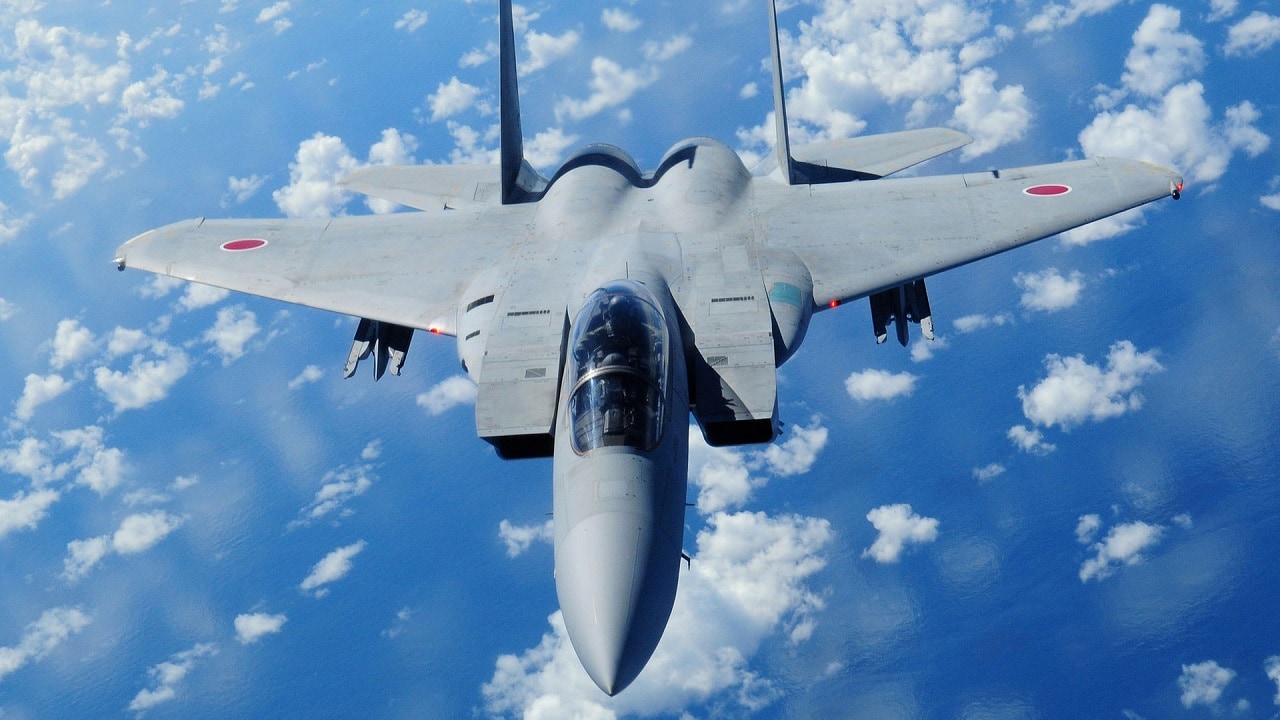
Summary and Key Points: The Japan Super Intercept Program does not pretend the F-15J can be made stealthy. It is built on the opposite assumption. An AESA radar and an infrared search-and-track system give the aircraft a passive means of finding low-observable targets; EPAWSS gives it a chance of surviving modern air defenses; and JASSM gives it reach. Networked with Japan’s F-35s, the upgraded Eagles become high-speed missile trucks, firing large salvos from afar while the stealth aircraft move forward to the sensing role.
Japan’s F-15J Explained
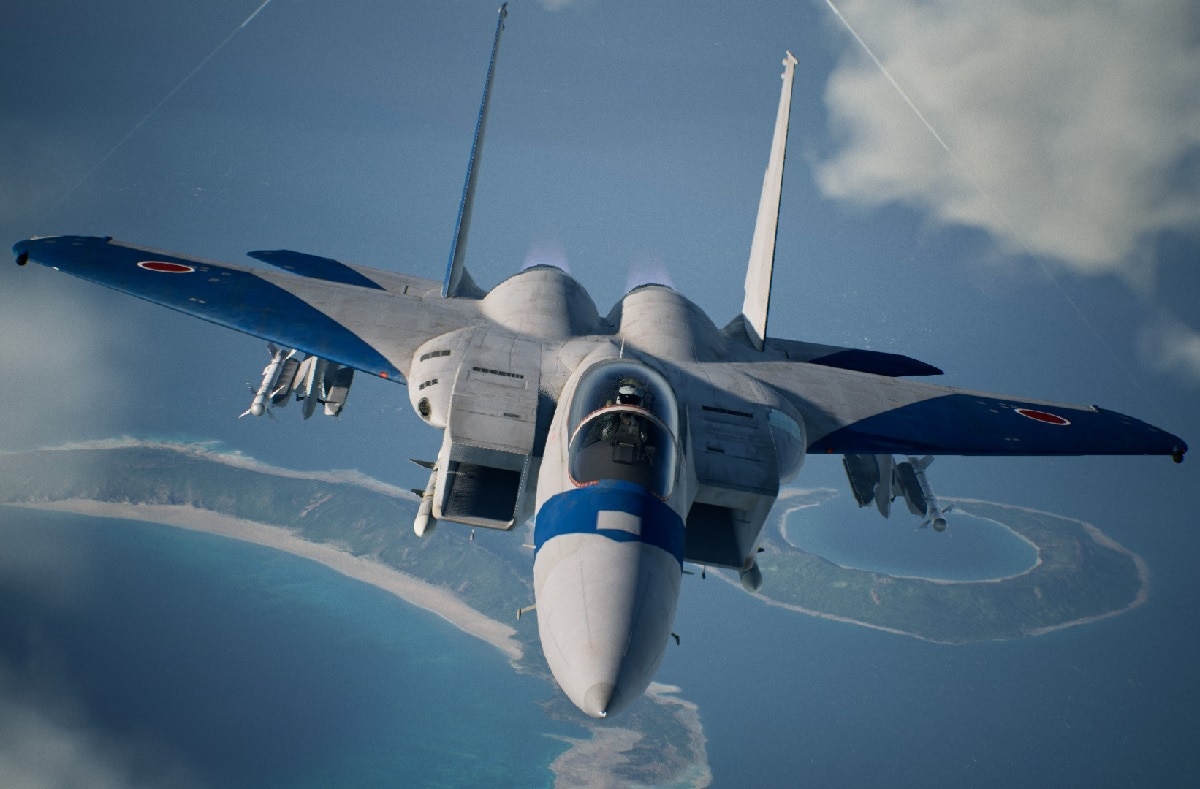
F-15J Image: Creative Commons.
The F-15J, built by Japanese defense and industrial firm Mitsubishi, is a license-built variant of the F-15C/D Eagle. The fighter, an air-superiority fighter, was also built to intercept intruding aircraft before they reach Japanese airspace.
The Japanese aircraft entered service in the early 1980s, replacing the Japan Air Self-Defense Force’s aging F-4EJ Phantom II fighters and rapidly becoming the cornerstone of Japan’s air defense.
Their Role and Origin
Tokyo sought the aircraft to fill an important role: that of a dedicated interceptor capable of long endurance, high speed, and a robust beyond-visual-range missile loadout for patrolling expansive maritime spaces.
Initially, the F-15J’s role was to deter and intercept Soviet, later Russian, and Chinese aircraft.
The F-15J excelled in that role thanks to its rapid climb rate and sustained supersonic flight. In JASDF service, the F-15J made up for the F-4EJ’s more limited range, payload, and sensor performance, which, though robust when it first entered service, had begun to lag behind newer threats.
Japan’s F-15J versus the American F-15
Though both the American F-15 and the Japanese fighter are outwardly rather similar-looking, they are not identical.
The Japanese fighter was license-built by Mitsubishi Heavy Industries and based on the McDonnell Douglas fighter; most F-15Js were assembled in Japan, with some systems either tailored to Japanese specifications or omitted entirely.
Early F-15Js lacked the full American electronic countermeasure suite and certain classified avionics, and lacked the ability to deliver nuclear weapons that were integrated onto their American relatives. Over time, the Japanese fighter also integrated domestic weapons and datalinks, creating a fleet that, though based on the Eagle, evolved.
The Japan Super Interceptor Program
By the 2020s, the F-15J aircraft were still numerous though aging, prompting Tokyo to pursue a deep modernization of the F-15J rather than retiring them.
The Japan Super Interceptor program, approved in principle in 2019 and formalized via U.S. Foreign Military Sales and Direct Commercial Sale agreements with Boeing and Mitsubishi Heavy Industries, aimed to upgrade up to 98 jets into an F-15JSI configuration.
The effort is intended to squeeze additional service life from the F-15J fleet while boosting the aircraft’s sensors, computing power, and weapons to levels broadly comparable to Boeing’s latest Advanced Eagle F-15 variants.
Some of the core Japan Super Interceptor upgrades center on the fighter’s radar, electronic warfare, and mission systems.
The mechanical AN/APG-63(V)1 radar is replaced by the AN/APG‑82(V)1 active electronically scanned array, boosting detection range, multi-target tracking, and electronic warfare resilience.
An upgraded mission computer, Boeing’s Advanced Display Core Processor II, and a new glass cockpit enhance situational awareness and weapons management.
Survivability is also boosted by integrating an AN/ALQ‑250 Eagle Passive/Active Warning Survivability System as well as improved radar-warning receivers and communications.
On the weapons side, JSI jets gain compatibility with modern Japanese missiles such as the AAM-4B and AAM-5B, and are expected to carry American standoff munitions, including the AGM-158 JASSM and JASSM-ER, thereby boosting their reach.
It is possible that infrared search-and-track capability, potentially Lockheed Martin’s Legion-ES, will be integrated onto the platform, enabling long-range target detection.
The F-15J in the Age of Stealth
The Japanese security environment has degraded rapidly in recent years, and both Russian and Chinese air activities have intensified markedly. The JSI does not, however, attempt to make the F-15Js stealth aircraft.
Rather, the program seeks to keep the F-15J useful by improving its ability to detect, survive, and shoot in a contested environment.
The aircraft’s AESA radar and IRST enhance its ability to passively detect low-observable aircraft, while EPAWSS and updated electronic warfare components improve survivability against advanced air defenses as well as enemy fighters.
Networked with Japan’s F-35s and ground-based sensors, upgraded F-15Js can act as high-speed, long-range missile trucks, launching large salvos of standoff munitions from far away while F-35s assume responsibility for forward sensing and stealth penetration of enemy or contested airspace.
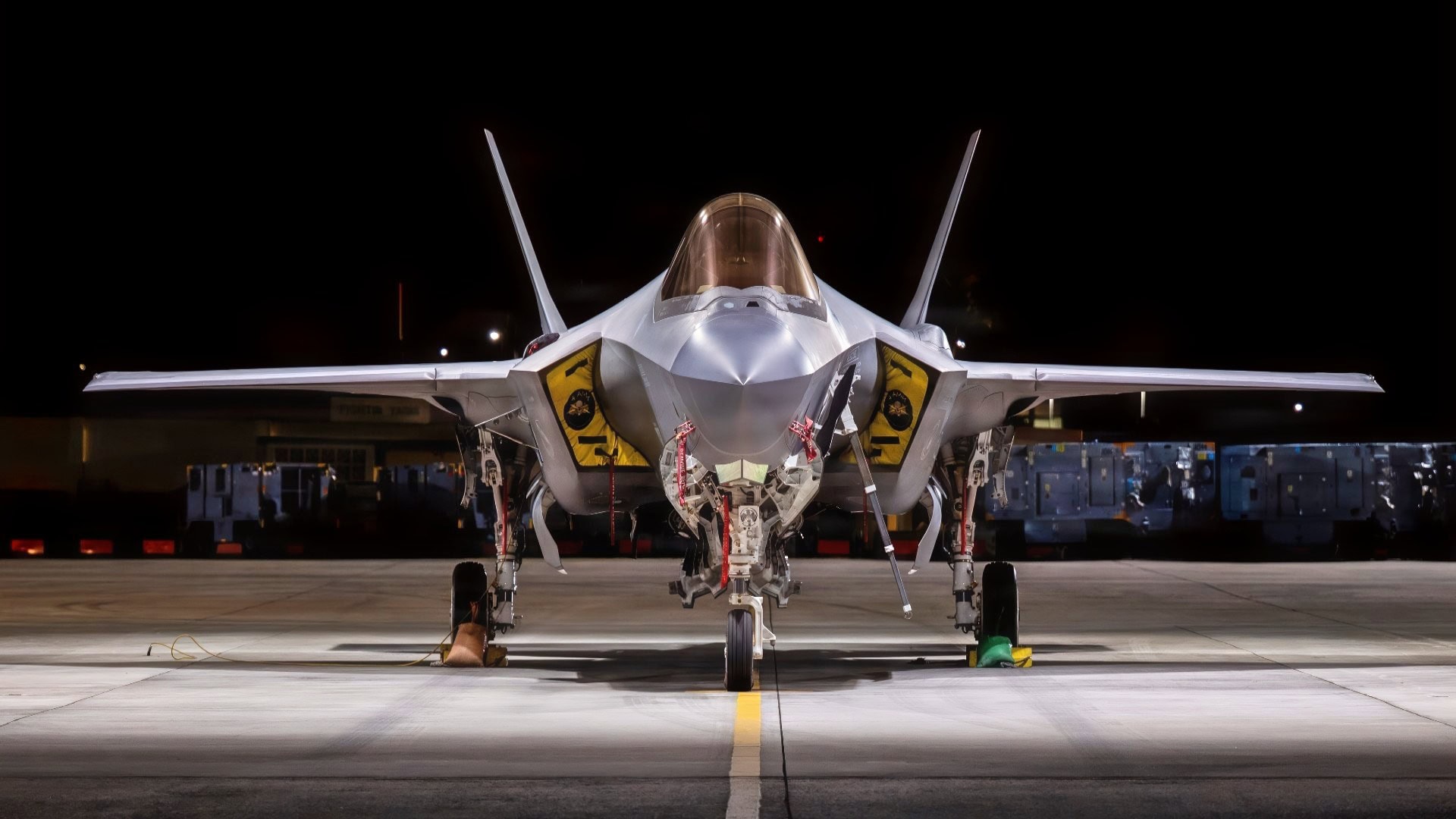
An F-35A Lightning II assigned to the 4th Expeditionary Fighter Squadron, deployed to Kadena Air Base, sit on the flight line during base-wide operational readiness exercise BH 26-1 at Kadena Air Base, Japan, Nov. 3, 2025. Kadena serves as a critical element in deterring potential adversaries through its demonstrated strength and commitment to regional security.
(U.S. Air Force photos by Senior Airman Jonathan Sifuentes)
According to current plans, about half of the remaining F-15J fleet will be upgraded to the JSI standard, and the rest will be gradually retired and replaced with additional F-35s.
The result is a mixed force in which modernized Eagles extend Japan’s interception reach and magazine depth, while complementing stealth fighters already in Japanese service.
About the Author: Caleb Larson
Caleb Larson is an American multiformat journalist based in Berlin, Germany. His work covers the intersection of conflict and society, focusing on American foreign policy and European security. He has reported from Germany, Russia, and the United States. Most recently, he covered the war in Ukraine, reporting extensively on the shifting battle lines in the Donbas and writing about its civilian and humanitarian toll. Previously, he worked as a Defense Reporter for POLITICO Europe. You can follow his latest work on X.