
Summary and Key Points: An Arleigh Burke-class destroyer carries roughly 90 to 96 missiles in its vertical launch cells. When those are gone, its air defense is gone with them, and the ship has to break off and reload. That is the arithmetic problem the US Navy has been trying to solve with lasers since the Cold War: a beam has no magazine, travels at the speed of light, and costs a few dollars of fuel per shot instead of the millions a missile costs. The Navy proved the concept a decade ago, mounting a 30-kilowatt laser aboard USS Ponce and shooting down small drones and boats. What it has not solved is power. A 100-kilowatt beam does not draw 100 kilowatts — solid-state lasers convert only a fraction of their input into light and dump the rest as heat, which means a serious weapon needs several hundred kilowatts of electricity and a cooling system to match, from a hull whose generators were sized for radar and propulsion.
The US Navy Wants Lasers: Getting Them Won’t Be Easy

(May 21, 2020) The amphibious transport dock ship USS Portland (LPD 27) successfully tests a Solid State Laser – Technology Maturation Laser Weapon System Demonstrator (LWSD) Mark 2 MOD 0.The SSL-TM program builds upon the Office of Naval Research’s previous directed-energy developments, like the Laser Weapon System (LaWS), which was successfully tested at-sea aboard the Afloat Forward Staging Base (Interim) USS Ponce (ASB(I)) 15 in 2014. (U.S. Navy photo/Released)

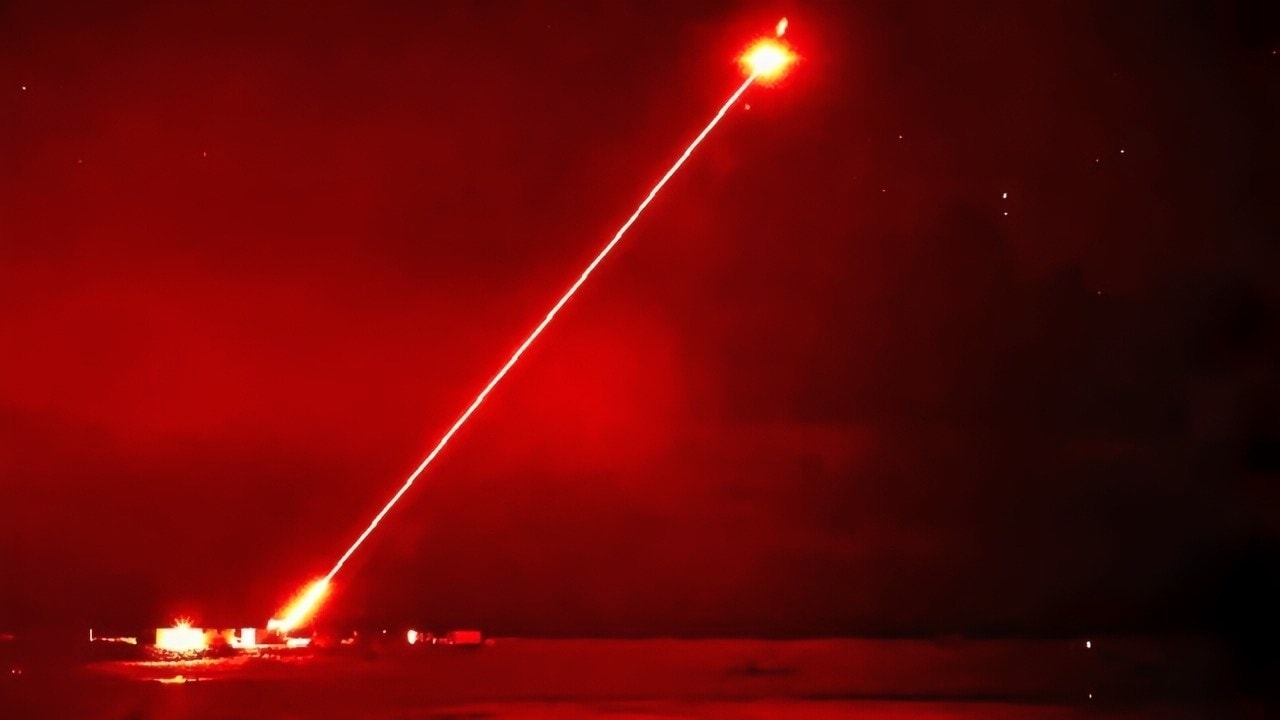
211214-M-HB658-1322 GULF OF ADEN (Dec. 14, 2021) Amphibious transport dock ship USS Portland (LPD 27) conducts a high-energy laser weapon system demonstration on a static surface training target, Dec. 14, while sailing in the Gulf of Aden. During the demonstration, the Solid State Laser – Technology Maturation Laser Weapons System Demonstrator Mark 2 MOD 0 aboard Portland successfully engaged the training target. The photograph was captured utilizing a short wave infrared lens and optical filter. (U.S. Marine Corps photo by Staff Sgt. Donald Holbert)

211214-N-VQ947-1142 GULF OF ADEN (Dec. 14, 2021) — Amphibious transport dock ship USS Portland (LPD 27) conducts a high-energy laser weapon system demonstration on a static surface training target, Dec. 14, while sailing in the Gulf of Aden. During the demonstration, the Solid State Laser – Technology Maturation Laser Weapons System Demonstrator Mark 2 MOD 0 aboard Portland successfully engaged the training target. The photograph was captured utilizing a short wave infrared lens and optical filter. (U.S. Navy photo illustration by Mass Communication Specialist 2nd Class Devin Kates)
The Navy’s reasons for pursuing laser weaponry are obvious.
Conventional air defense systems rely on expensive physical ammunition. For example, an Arleigh Burke-class destroyer can carry roughly 90–96 missiles in its Vertical Launch System (VLS) cells.
Once those missiles are depleted, the vessel becomes functionally useless; it must replenish before reengaging.
Meanwhile, drones and other inexpensive threats have proven effective—yet cost orders of magnitude less than the interceptors used against them.
A laser could solve the economic problem of using missiles against drones, with speed-of-light engagement, no physical missile magazine, and low cost per shot, ending the Navy’s need to invest millions in each missile it fires.
Yet despite the appeal of lasers and decades of experimentation, the Navy hasn’t been able to outfit its destroyers with them.
While the laser beam itself can be cheap, developing and maturing the technology into an effective, combat-ready system has been difficult.
Cold War Roots
The pursuit of laser weapons is not new.
The Navy has been chasing the idea since the Cold War, with directed-energy experimentation going back decades.
Early high-power concepts often relied on chemical lasers, as chemical reactions could produce extremely powerful beams.
But the chemical approach came with obvious downsides: it required chemical fuels and reactants that could be hazardous, corrosive, bulky, and difficult to store and replenish—downsides incompatible with life at sea.
The chemicals created safety and logistics headaches that became a problem in their own right, hardly worth replacing traditional ammunition.
So, the Navy shifted towards electrically powered solid-state lasers, eliminating the need for chemical munitions.
Proving the Science
The Navy’s Laser Weapon System, or LaWS, became one of the major demonstrations of practical shipboard directed energy—proving that the idea wasn’t merely a thing of science fiction.
Installed aboard the USS Ponce in the 2010s, LaWS was a 30-kilowatt-class weapon system capable of engaging targets such as small unmanned aircraft and boats.
LaWS was particularly attractive against targets that create terrible cost-exchange ratios for conventional weapons, in theory negating the Navy’s need to fire a six- or seven-figure missile at a quadcopter and instead using a weapon powered by electricity.
But LaWS wasn’t ready for fleet-wide deployment.
While the technology demonstrator worked, a wide gap remained between a successful demonstration and deployment.
The Woes of Scale
Lasers are close, but not quite there.
The HELIOS program, developed after LaWS, further illustrated the broader promise of directed energy. But simply killing UAVs isn’t the ultimate requirement of the technology.
The Navy wants directed energy that can defeat increasingly demanding threats.
Higher-power lasers—potentially hundreds of kilowatts—could provide much greater range and lethality. But increasing beam output isn’t analogous to simply installing a larger gun.
Instead, solid-state/fiber lasers combine energy from multiple laser modules into a usable beam, forcing engineers to confront a variety of problems: thermal distortion, beam-quality issues, higher power requirements, larger cooling requirements, and larger, heavier equipment.
Because a laser isn’t perfectly efficient and uses only a portion of the electrical input it receives, it generates enormous heat that the ship must remove.
So a 100-kW-class beam requires more than 100 kW from the ship’s electrical system.
Power and cooling requirements are especially brutal.
Obviously, the existing Arleigh Burke destroyers were not designed around cutting-edge lasers; rather, their generators were built to support propulsion auxiliaries, SPY-family radar, electronic warfare, communications, and combat systems—not lasers.
Systems like the AN/SPY-6 also demand significant amounts of electrical power and cooling. A large laser adds another major electrical and cooling requirement.
Looking Ahead
Navy officials have previously estimated that establishing the first true laser program could require around $1 billion.
But that cost doesn’t factor in the purchase and installation of lasers across the fleet.
So ultimately, lasers, floated as a way to rebalance the cost asymmetries demanded by drone engagement, are cheap to operate but highly expensive to develop and procure.
Still, the dream survives because the underlying logic is sound: low cost per shot and endless magazine depth. Expect the Navy to keep experimenting with the laser premise.
About the Author: Harrison Kass
Harrison Kass is a writer and attorney focused on national security, technology, and political culture. His work has appeared in Tablet, City Journal, The Hill, The Spectator, and The Cipher Brief. He holds a JD from the University of Oregon and a master’s in Global & Joint Program Studies from NYU. More at harrisonkass.com.