
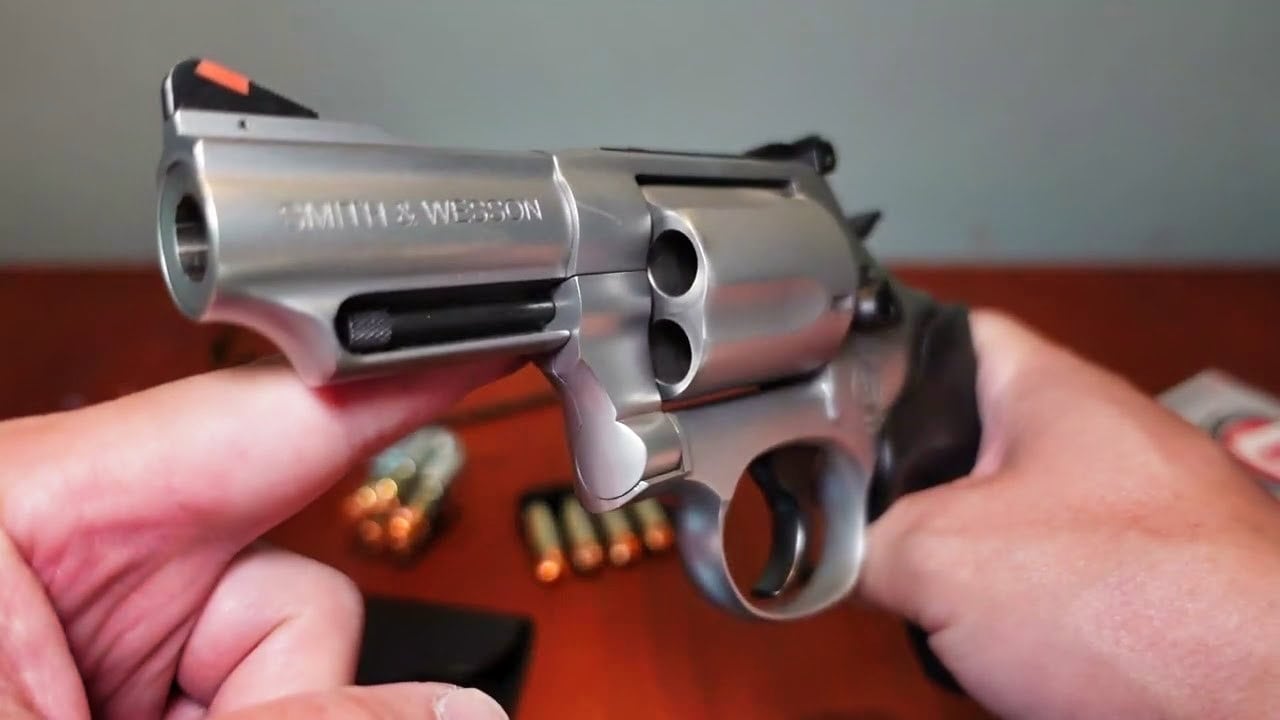
Summary and Key Points: My own .44 Magnum is a Smith & Wesson Model 29 with a 6.5-inch barrel — an N-frame, six-round gun built for a chest holster on a hunting trip rather than a waistband. That is what the cartridge has always meant. The Model 69 Combat Magnum is Smith & Wesson deliberately breaking that assumption. It sits on the L-frame, the mid-size platform between the K-frame .357s and the full-size N-frames, weighs about 34.3 ounces empty, runs 7.80 inches overall with the 2.75-inch barrel, and carries five rounds instead of six. That is the whole trade: one round of capacity and roughly seven ounces, in exchange for a .44 Magnum you can actually wear under a jacket.
Meet the Model 79 Combat Magnum by Smith & Wesson
The .44 Magnum has always been a big-gun cartridge. Six rounds, N-frame steel, built for a chest holster on a hunting trip rather than a waistband. My own Model 29 with a 6.5-inch barrel is a prime example.
Smith & Wesson’s Model 69 Combat Magnum deliberately breaks that assumption by borrowing a name the company hadn’t used in decades.
Introduced in 2014 with a 4-inch barrel and joined in 2018 by a 2.75-inch carry version, the Model 69 is built on S&W’s L-frame, the mid-size platform that sits between the K-frame .357s and the full-size N-frame .44s and .500s.
However, it carries only five rounds instead of six.
Roughly seven ounces lighter than a comparable N-frame six-shooter. That’s the trade Smith & Wesson is asking you to make, and for a lot of shooters it’s a good one.
The Name Is A Throwback
“Combat Magnum” isn’t a marketing phrase S&W invented for this gun.
It’s a name that goes back to 1955, when the company took its light K-frame .38 Special (“Combat Masterpiece”) and stretched the cylinder to handle .357 Magnum, at the urging of the late Bill Jordan, the Border Patrol legend who wanted a service revolver that was both carryable and powerful enough to end a fight.
That gun became the Model 19, and it defined a category for thirty years before magnum-era N-frames and, eventually, semi-autos pushed it off the shelf.
The Model 69 is the first gun since to actually wear the “Combat Magnum” barrel marking, and Smith & Wesson isn’t shy about the lineage. Same idea, bigger cartridge: take a caliber that used to require a full-size frame and fit it into something a person can actually carry.
Meet The Model 69 Combat Magnum
The specs back up the concept. Overall length runs 7.80 inches on the 2.75-inch-barrel version, height 5.85 inches, cylinder width a slim 1.55 inches.
The weight comes in at around 34.3 ounces empty, all stainless steel front to back, with a glass-bead satin finish on the frame and matte-black treatment on the sights, hammer, trigger, and cylinder release, so you’re not staring into a mirror when you draw.
Rifling is a 1:18.75-inch right-hand twist with five grooves, built specifically to stabilize the heavier 200-plus-grain .44 Magnum bullets rather than the lighter loads a .357 barrel is cut for.
The cylinder also drops down to .44 Special, which matters more than it should.
Full-power .44 Magnum out of a 34-ounce revolver is not a range session you want to subject your hand and wrist to.
Loading .44 Special turns the Model 69 into a mild, controllable trainer for the same gun you’ll carry loaded hot, no separate practice pistol required.
The trigger pull is where you notice this is still a working gun and not a target piece: north of 12 pounds double-action, about 5 pounds 11 ounces single-action.
The double-action is very smooth, and the single-action is crisp.
A transfer-bar safety and an integral lock, engaged through a keyhole above the cylinder release, cover the basics, and a frame-mounted ball detent gives the yoke the kind of support S&W usually reserves for its big-bore N-frame guns.
None of that is glamorous.
It’s the stuff that keeps a five-shot .44 from shaking itself loose after a few hundred full-power rounds.
The Recoil Is The Honest Trade-Off
A 2.75-inch barrel and .44 Magnum don’t naturally belong in the same sentence, and Smith & Wesson knows it.
That short a barrel bleeds off velocity fast, running somewhere around 65 to 69 percent of the energy S&W lists for full-length barrels.
However, a 180-grain .44 Magnum load from the Model 69 still puts roughly 200 more foot-pounds on target than a compact 10mm or a snub .357, guns many professionals already consider serious carry pieces.
Say what you will about whether anyone actually needs that much power and energy out of a five-shot revolver you can conceal under a jacket. That’s beside the point. Like all S&W revolvers, it shoots really well, if a little on the snappy side.
The handgun exists because Smith & Wesson decided the market wanted the option, and at an $849 suggested retail (real-world pricing closer to $750), it’s one of the more affordable ways into a .44 Magnum revolver, period.
A Trail Gun That Also Fits As A CCW
What you end up with is a revolver that splits the difference between a woods gun and a carry gun without fully committing to either.
Five rounds of .44 Magnum is serious business against anything with claws or teeth, and the shorter-barrel version is compact enough to ride on a hip without announcing itself.
The only drawback is that it gives the shooter five rounds, which in a self-defense situation, despite the firepower, is cutting things very close.
It won’t out-shoot a 4-inch N-frame on paper, and it won’t out-conceal a J-frame .38. But that was never the purpose of the design.
The Model 69 isn’t trying to replace the original Combat Magnum. It’s trying to prove the idea still works seventy years later, just with a bigger cartridge and a lighter frame. On that count, it delivers.
About the Author: Steve Balestrieri
Steve Balestrieri is a National Security Columnist. He served as a US Army Special Forces NCO and Warrant Officer. In addition to writing on defense, he covers the NFL for PatsFans.com and is a member of the Pro Football Writers of America (PFWA). His work was regularly featured in many military publications.