
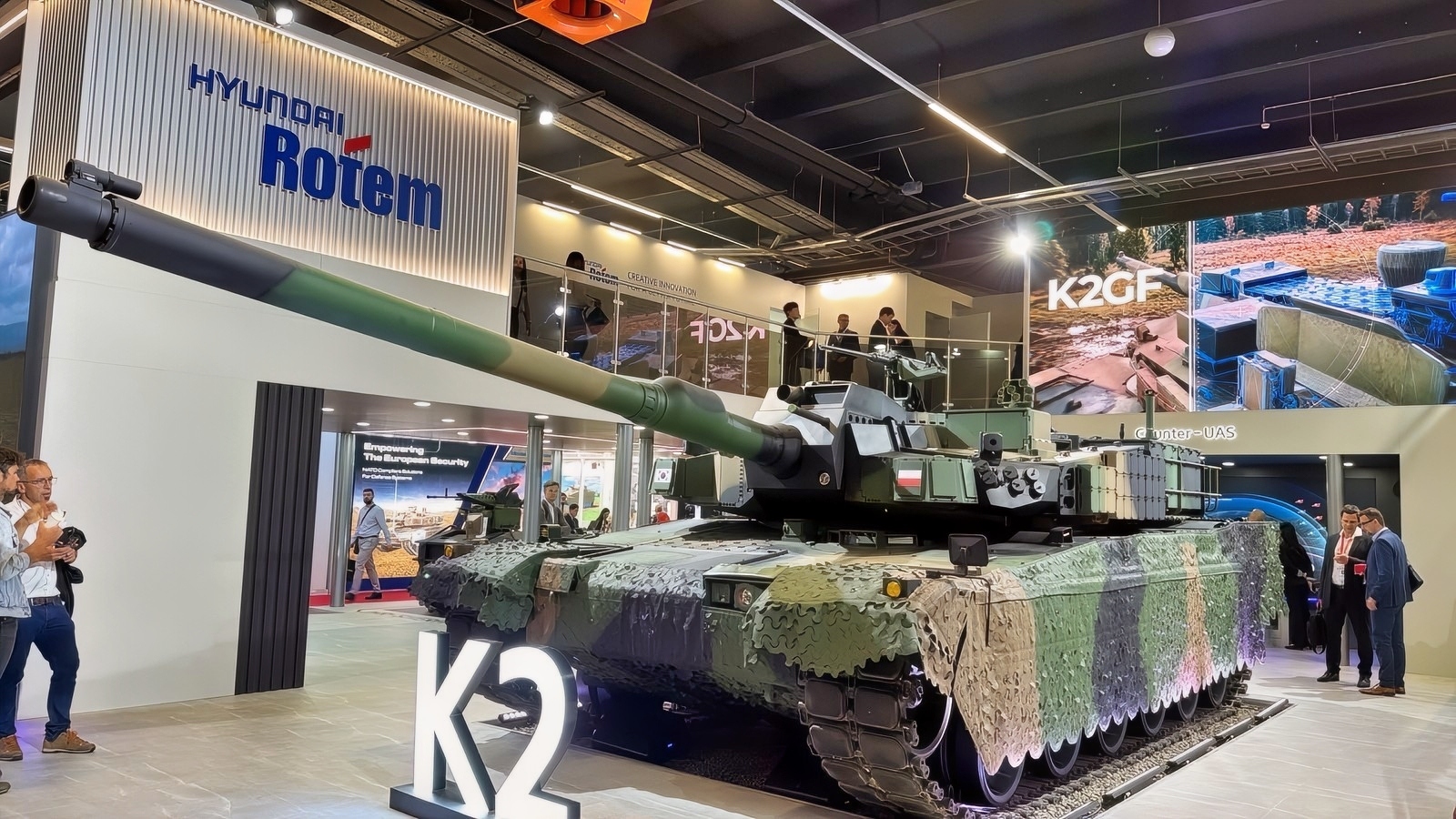
The K2 Black Panther is South Korea’s main battle tank, originally designed for a very specific battlefield: the mountainous Korean Peninsula.
It was intended to help fight a potential war with North Korea, and more than a decade after it entered service, the K2 now has a much wider purpose.
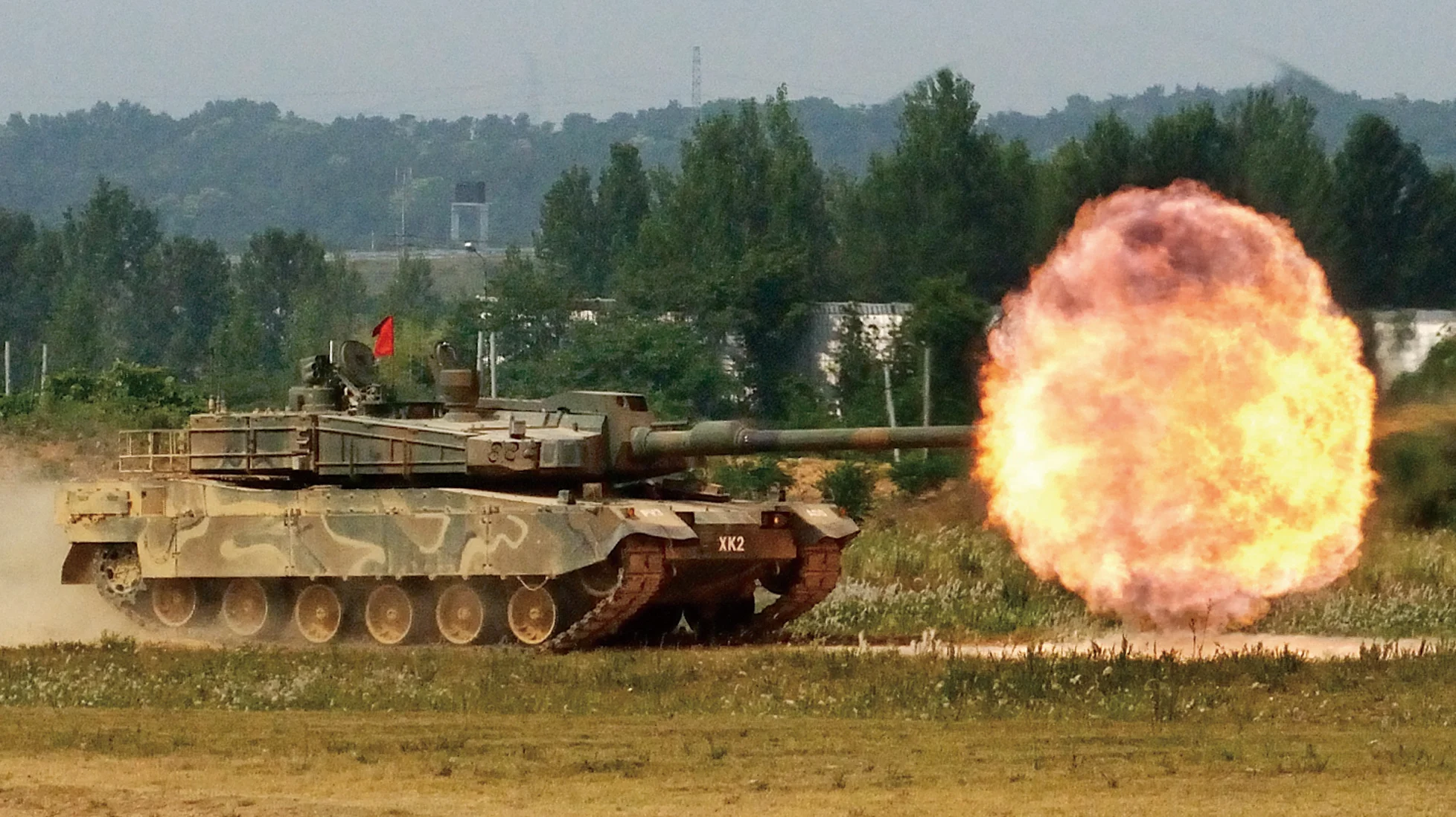
K2 Black Panther, the most expensive tank on Earth.
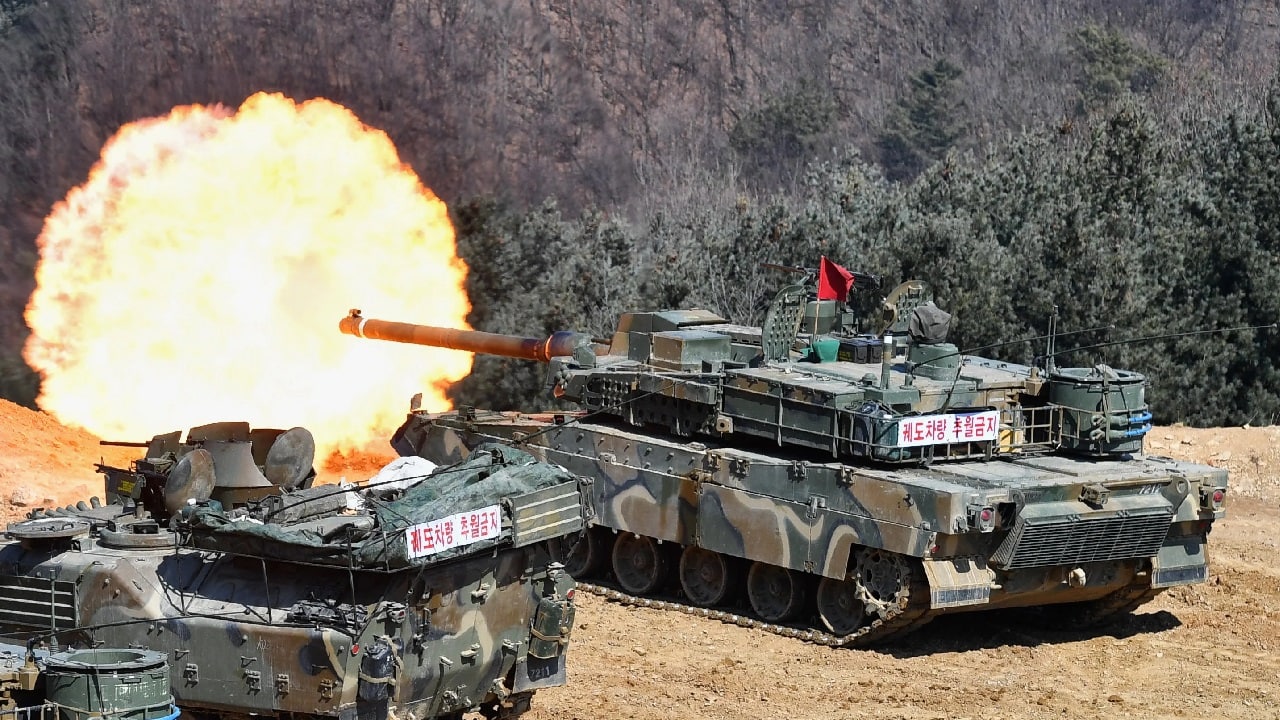
K2 Black Panther. Image Credit: Creative Commons.
Earlier this month, South Korean manufacturer Hyundai Rotem publicly displayed the Polish K2PL configuration of its tank at the MSPO 2026 defense exhibition in Kielce.
The modified version of the tank showed a design specifically adapted for a NATO customer, combining South Korean design with Polish equipment and additional systems that make it better suited to the threats that have emerged in the wake of the war between Russia and Ukraine.
The K2PL display at the exhibition described how the tank had been designed to include a new active protection system that counters incoming anti-tank weapons and drones.
It also described how the tank is fitted with a drone jammer and a remote weapon station, helping it keep up in a modern battlefield environment.
Hyundai Rotem also showed the tank with a Polish-made multispectral camouflage system that makes the vehicle harder to detect with thermal imaging and other sensors.
The exhibition unveiling also came a handful of weeks after Poland received an additional 28 K2s from South Korea – the first tanks to be delivered under Warsaw’s second major contract with Hyundai Rotem.
The latest delivery of tanks will join Polish units near NATO’s eastern frontier, while preparations continue to eventually assemble K2PLs inside Poland.
It’s the latest development in a decade-long history of a remarkable tank that, until only a few years ago, was used only by South Korea.
The Tank South Korea Built
The Black Panther is the product of South Korea’s unique geography and military requirements.
The country required a more advanced replacement for the older M48 Pattons and other members of the K1 family — a domestically produced range of tanks.
South Korea began developing its new tank after years of research, aiming to build something with greater mobility, firepower, and technological capability.
The K2 was not designed just to match other modern main battle tanks, but to operate well over South Korea’s difficult terrain.
The first K2S began entering service in 2014, but the program, like many modern programs, suffered setbacks.
Specifically, the program experienced delays related to efforts to build a domestically produced powerpack.
Locally made transmissions continued to cause reliability and durability problems even in later batches of the tank, forcing South Korea to rely partly on foreign components while its domestic industry worked through the technical issues.
But those problems didn’t stop the program from moving forward, and South Korea continued to purchase the K2. In 2024, its Defense Acquisition Program Administration approved a fourth round of production worth 1.94 trillion won, running through 2028.
Those tanks are now gradually replacing older armored vehicles and supporting the Republic of Korea Army as it prepares for potential future conflict.
What Sets It Apart
The K2 is more modern and far lighter.
It weighs approximately 56 tons in its standard configuration, making it noticeably lighter than some of the latest Western main battle tanks in use.
It features a 1,500-horsepower diesel engine, giving it a power-to-weight ratio of around 27 horsepower per ton.
Hyundai Rotem lists the tank’s maximum road speed as 70 kilometers per hour (around 44 mph) and its off-road speed at 50 kilometers per hour (around 31 mph). It has a range of roughly 450 kilometers.
But one of its most distinctive features, designed to suit Korean terrain, is its hydropneumatic suspension.
That system allows operators to raise, lower, or tilt the hull depending on the terrain.
This capability is central to the vehicle’s purpose, allowing the crew to navigate difficult ground while adjusting firing positions and moving fairly quickly.
The K2 can also cross water as deep as 4.1 meters when its snorkel equipment is installed.
Those features made it suited not only for South Korea, but also for Europe.
Poland was the obvious partner for the program because its military requires armored vehicles capable of moving across a combination of roads, fields, forests, rivers, and softer terrain, while also being mobile enough to navigate regular civilian infrastructure, which is a challenge for heavier tanks.
The K2 also only requires three crew members, rather than the four commonly found in modern main battle tanks, including the Leopard 2 and M1 Abrams – a feat achieved thanks to the inclusion of an automatic loader.
A 120mm Gun and a Three-Man Crew
The K2 uses a 120mm L/55 smoothbore cannon as its primary weapon. The gun is fed by an automatic loading system, not a crew member.
The tank also carries 40 rounds in total and can use modern 120mm ammunition.
It features secondary weapons, including a 7.62mm machine gun and a 12.7mm heavy machine gun.
The K2’s firepower is enhanced by an advanced fire-control system that includes stabilized day and night sights, laser rangefinding, and thermal imaging.
It can automatically search for and track targets, and its hunter-killer capability lets the commander locate another target while the gunner engages the current one.
Being a modern tank, it can also integrate into a battle management system and use GPS and inertial navigation.
The Polish variant has seen its communications and battlefield management architecture adapted to operate alongside other systems used by the Polish military, including the growing fleet of American M1 Abrams tanks.
How Ukraine Influenced Poland’s K2 Demands
The war in Ukraine has changed how tanks are used — and what modern armies expect of new tanks.
The war has shown that tanks are vulnerable in new ways, but it has also created new opportunities to use them differently.
Anti-tank guided missiles are still a threat, of course, but it’s the proliferation of inexpensive first-person-view attack drones and loitering munitions that pose the greatest problem today.
A tank may well be protected across its frontal arc, but it may remain vulnerable from above. The K2PL is adapting to these new threats by making the whole tank better suited for modern warfare.
The Polish configuration of the tank shown at MSPO included active protection, meaning the system responds before a projectile hits the exterior armor.
It also featured electronic counter-drone equipment and a remote weapon station.
The Polish camouflage package is designed to make the tank less visually conspicuous while reducing its thermal signature.
The K2 used by the South Koreans already features composite and reactive armor and can be equipped with both soft-kill and hard-kill active protection, depending on a customer’s requirements.
The exact level of protection on the K2 can vary between variants, and that adaptability is one of the tank’s most important selling points of the tank.
Poland Made the K2 an International Success Story
What began as a project intended to give South Korea the exact tool it needed has turned into an international success story, with Poland taking an interest in the tank soon after Russia’s full-scale invasion of Ukraine.
In 2022, Poland agreed to purchase as many as 1,000 K2 tanks from South Korea.
The first contract covered 180 vehicles, which began arriving quickly, with many arriving in December that same year.
Poland then completed deliveries of the initial batch in November 2025.
Having received them quickly, Poland doubled down, signing a second executive contract with Hyundai Rotem on August 1, 2025.
The deal covered another 180 tanks, including 116 K2GF vehicles and 64 K2PLs.
The deal also included armored recovery, engineering, and bridge-laying vehicles, and the deal included training for crews.
The first 28 tanks from the second order arrived in Poland in late August this year, and the vehicles were moved to units in eastern Poland.
This means the tanks are now being deliberately positioned in a very sensitive area: territory close to Belarus and the Russian exclave of Kaliningrad.
Manufacturing Plans
This story also has an industrial element. Under the current plan between Poland and Hyundai Rotem, the first three K2PL tanks will be manufactured in South Korea so that the modified configuration can be fully tested and confirmed to be operational, while the final assembly of another 61 will take place at the Bumar-Łabędy plant in Gliwice.
Hyundai Rotem and Bumar-Łabędy signed a deal in late April to produce both the K2PL and armored recovery vehicles locally.
But there are still questions.
Reports from Polish media this month indicate that the planned start of K2PL production in 2028 is not yet guaranteed, with both parties still working through the details of the industrial agreement.
But even with that uncertainty, the direction shows that the K2 is no longer just a South Korean tank — it is an international success and could prove to be an attractive option to other European countries as tensions with Russia grow.
Put Through Its Paces In Peru
The K2’s next customer could be confirmed soon, too.
This month, Peru publicly demonstrated a K2 at the Army’s FAME facility in Lurigancho, with the tank performing mobility tests over rocky and sandy terrain.
Peru and Hyundai Rotem are currently locked in negotiations over a planned acquisition of up to 54 K2s — and, if finalized, the agreement would give the Black Panther its first customer in Latin America.
About the Author: Jack Buckby
Jack Buckby is a British researcher and analyst specializing in defense and national security, based in New York. His work focuses on military capability, procurement, and strategic competition, producing and editing analysis for policy and defense audiences. He brings extensive editorial experience, with a career output spanning over 1,000 articles at 19FortyFive and National Security Journal, and has previously authored books and papers on extremism and deradicalization.