
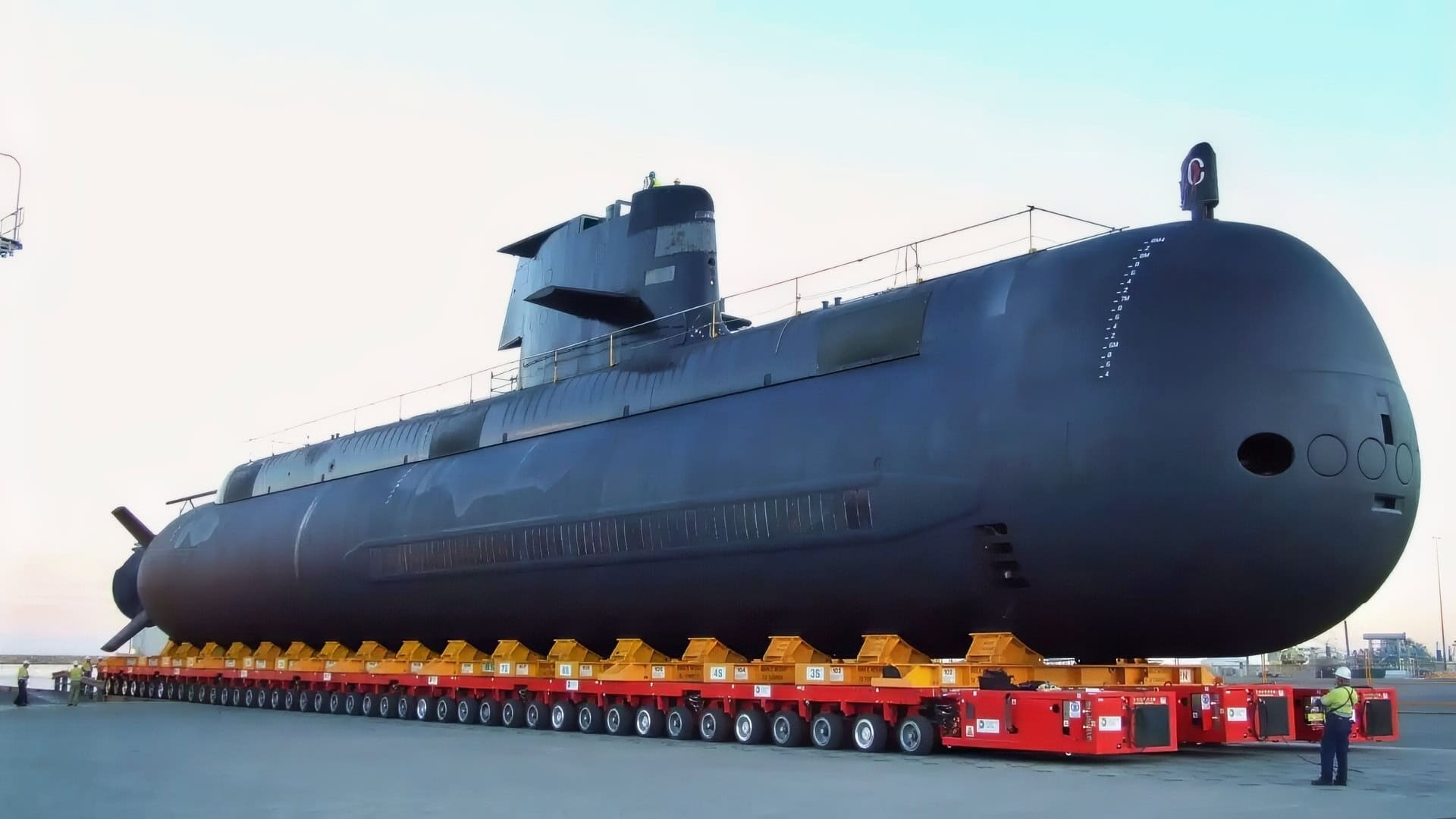
The Collins-class submarines are the only attack submarines currently in service with the Royal Australian Navy (RAN). Named after Vice Admiral John Augustine Collins, the Collins-class ships are diesel-electric and were built in coordination with Kockums in Sweden. Although the six ships in the class are Australia’s only attack submarines, the class has developed an infamous reputation for mechanical problems and low readiness.
Their development was particularly plagued by issues, and their operational history hasn’t been much better.
As a result, the RAN is currently working with the Americans and the British on the SSN-AUKUS, which will hopefully provide a more reliable nuclear-powered attack submarine.
Collins-Class: Developing a New Submarine
Development of the Collins-class began back in 1978, as the RAN began studies to replace its aging Oberon-class diesel-electric attack submarines.
From the start, the Navy wanted the new ships, or at least most of them, built domestically to boost Australia’s shipbuilding capacity.
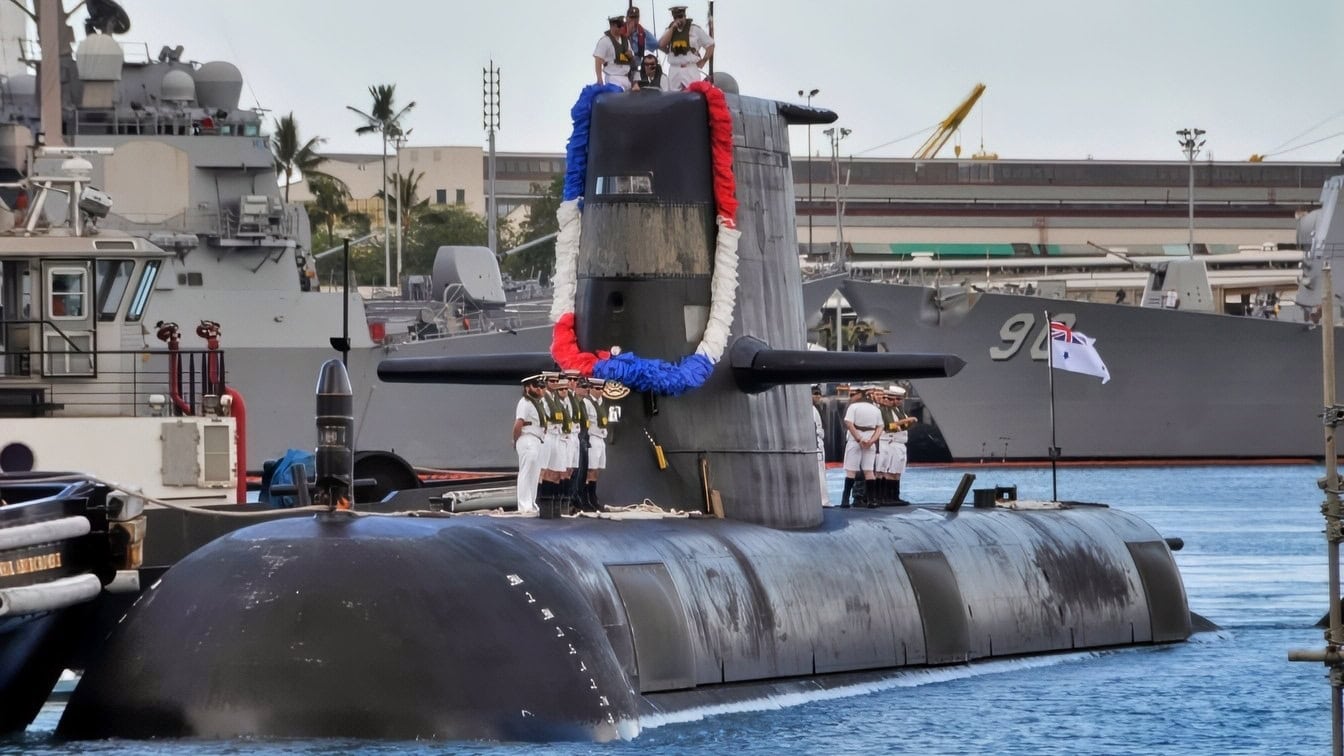
JOINT BASE PEARL HARBOR-HICKAM, Hawaii – (June 30, 2012) – Her Majesty’s Australian Ship, HMAS Farncomb (SSG 74), a Collins class submarine operated by the Royal Australian Navy, arrived at Joint Base Pearl Harbor-Hickam to participate in the Rim of the Pacific (RIMPAC) exercise, June 30. Twenty-two nations, more than 40 ships and submarines, more than 200 aircraft and 25,000 personnel will participate in the biennial RIMPAC exercise scheduled June 29 to Aug. 3, in and around the Hawaiian Islands. The world’s largest international maritime exercise, RIMPAC provides a unique training opportunity that helps participants foster and sustain the cooperative relationships that are critical to ensuring the safety of sea lanes and security on the world’s oceans. RIMPAC 2012 is the 23rd exercise in the series that began in 1971. (U.S. Navy photo by Mass Communication Specialist 1st Class Ronald Gutridge / Released)
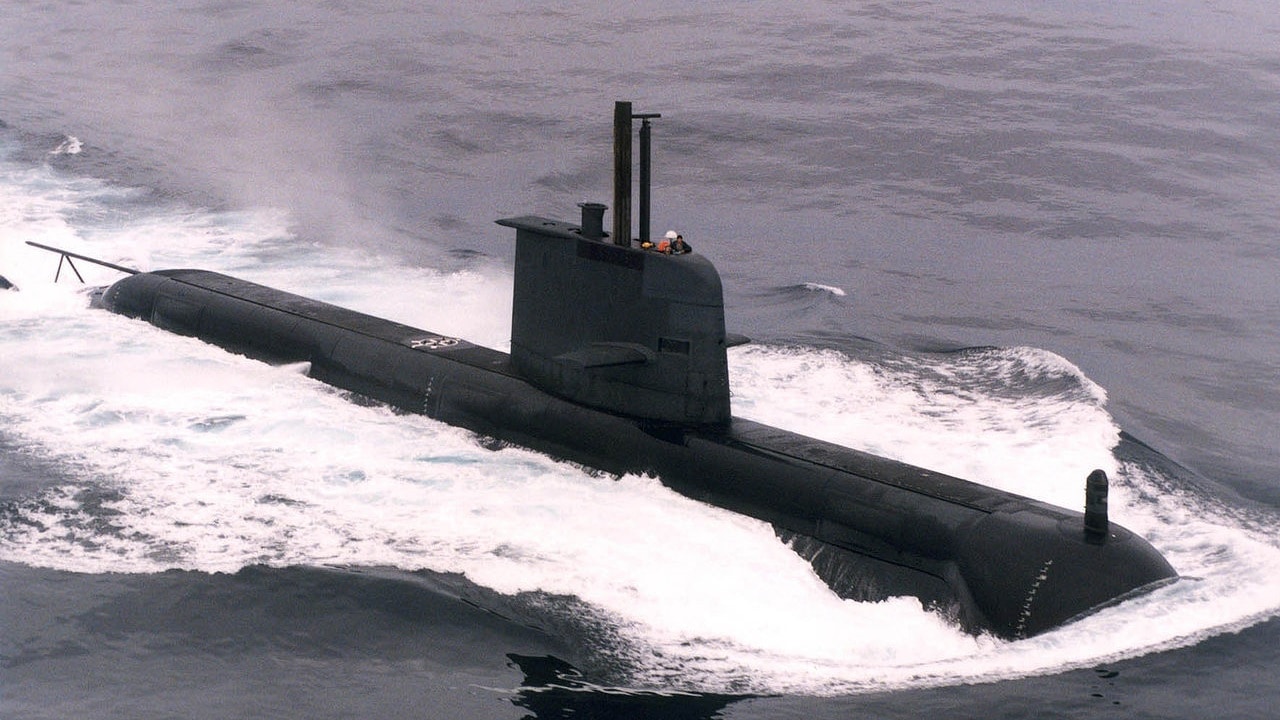
Collins-Class Submarine from Australia.
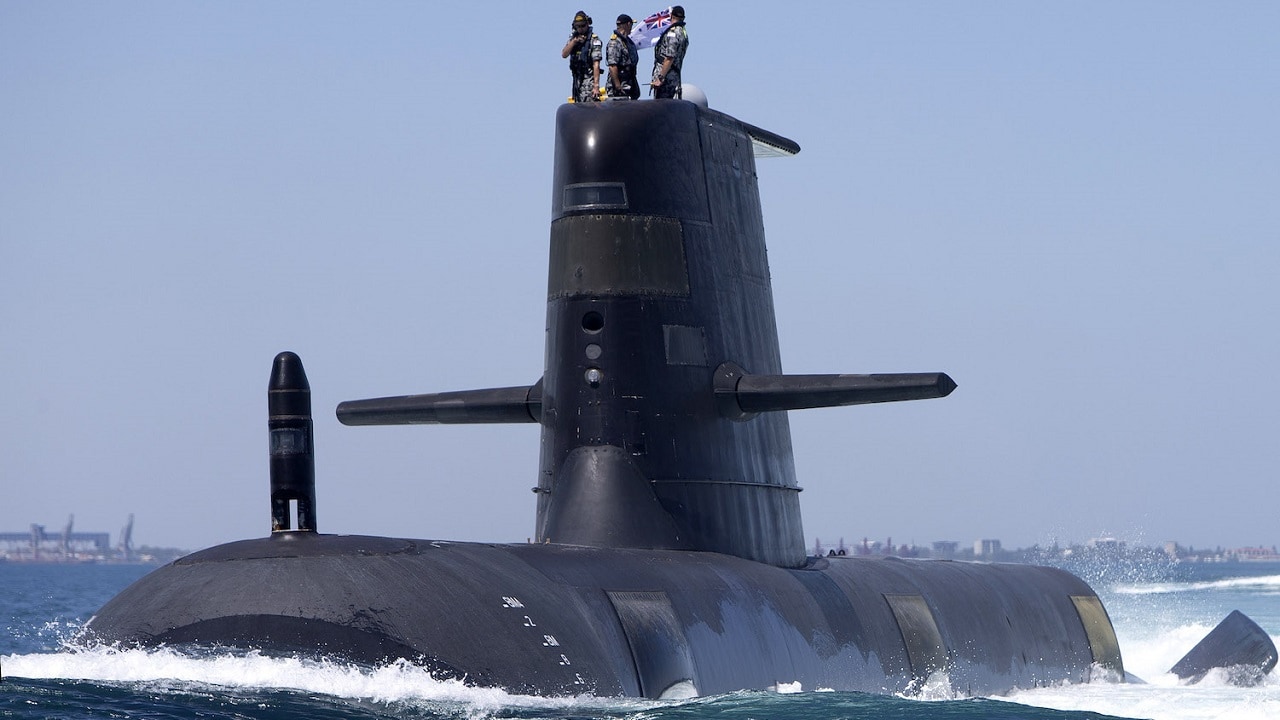
Collins-Class Submarine from Australia’s Navy.
The program had four main requirements: they had to be tailored for operations in the Australasian region, equipped with advanced combat systems, supported by Australian industry, and suitable for peacetime and wartime operations. The RAN originally wanted a fleet of ten submarines, but cost considerations reduced this to six.
With the requirements in place, the RAN sent multiple requests to shipbuilders worldwide to submit proposals for the new ship’s design.
Of all the proposals, the two most promising were the Type 2000 by German companies Ingenieur Kontor Lübeck (IKL) and Howaldtswerke-Deutsche Werft (HDW), and the Dutch Walrus-class.
Subsequent studies, however, found that the Kockums Type 417 proposal better suited Australia’s needs and was cheaper to manufacture.
After several re-reviews, the Type 417 was selected for further development.
In 1986, the government formalized a contract for the Submarines totaling around $3.9 billion (that’s about $11 billion in today’s currency).
Australia’s Problomatic Submarines
During the assembly of the lead ship, HMAS Collins, several defective welds were spotted on components assembled outside of Australia.
It turns out that Kockums, to speed up the process, employed welders who were unqualified to work with the high-strength steel used on the Collins-class.
Typically, ships used by the Swedish Navy used a different kind of steel and requested partial-penetration welds for their submarines, while the RAN wanted full-penetration welds but did not make this clear to Kockums.
In 2001, more defective welds were discovered in Collins’ bow and escape tower, the sections assembled by Kockums in Sweden.
Fixing these welds quadrupled the time she spent in dock.
Defective welds were only the beginning of the Collins-class’ many issues.
During noise tests in 1996, the RAN discovered that the ships were much louder than initial studies had predicted.
Although scale-model tests had been conducted, the hull shape was later changed after the contract was signed.
The hull and bow were lengthened by 6 feet, and the propellers were redesigned as well, which caused cavitation.
The new hull design was not subjected to the same scale-model testing as the original, so the problems went unnoticed until it was too late.
After an unorthodox meeting with Francis Smith, the commander of HMAS Sterling Naval Base, the deficiencies in the new hull design were identified.
Many of the problems were resolved by adding fiberglass or carbon fiber covers to the bow and dorsal fins.
Trying to Fix the Collins-class
Although the Collins-class suffered from several technical issues, the biggest bottleneck was the development of its combat system.
Originally contracted to the American company Rockwell, the new combat system’s requirements were vague and overly ambitious for the technology of the time.
The RAN wanted the Rockwell combat system to be advanced and ahead of its time to extend the submarines’ service life.
However, in the 80s and 90s, computing technology was simply not powerful enough to meet the Navy’s demands.
Furthermore, Rockwell’s partners, Singer Librascope and Thomson-CSF, refused to sell their intellectual property.
As a result, the combat system was significantly delayed, pushing back the entire program timeline.
The RAN ultimately purchased the AN/BYG-1 combat system developed for the Virginia-class submarine to replace the Rockwell combat system.
By 2011, readiness rates on the Collins-class were well below standard.
The federal government launched a review of the submarine fleet, headed by Dr. John Coles.
The 2012 Coles Report detailed a plethora of systemic issues in their maintenance and management and recommended several wide-ranging reforms.
Initially, these reforms led to a noticeable improvement in readiness and maintenance practices.
In 2016, the Collins-class program was praised as a magnificent turnaround, with four out of six ships available at any given time.
This, however, did not last long, as in 2024, the ships were again listed as a product of concern by the government.
With the SSN-AUKUS not expected until the 2040s, the RAN has no choice but to invest heavily in Collins-class life-extension programs to prevent any capability gaps.
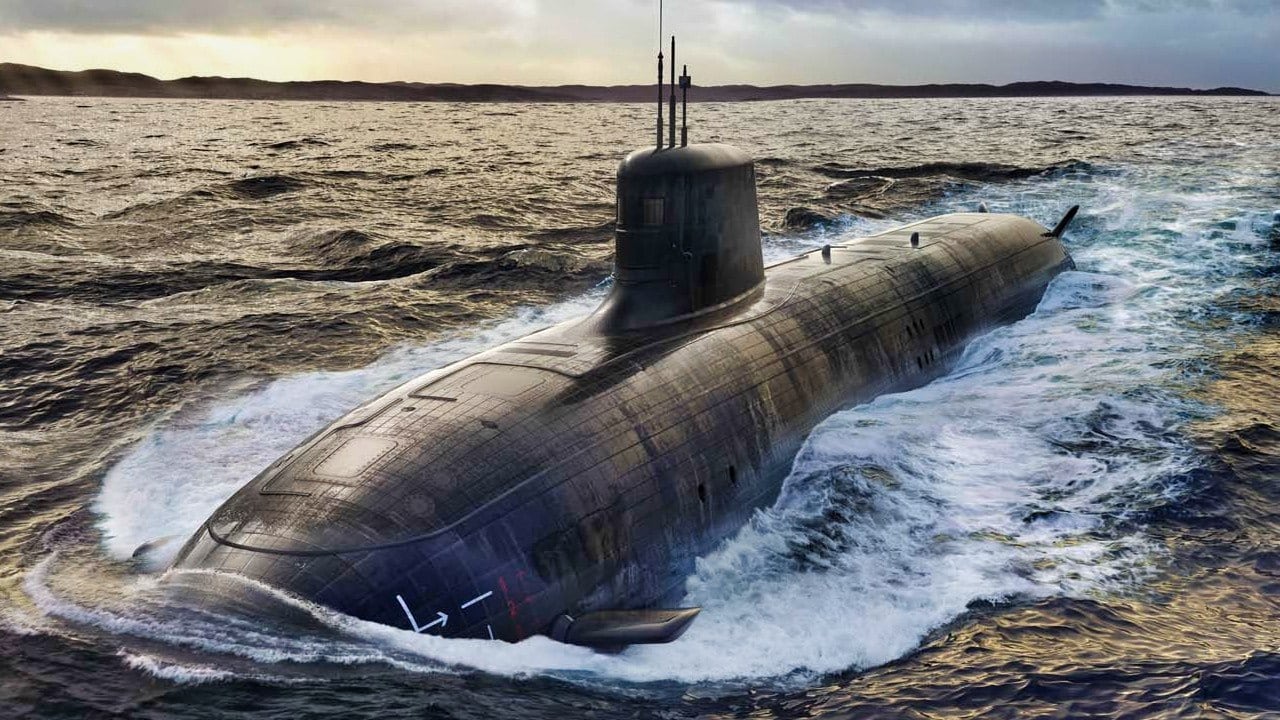
SSN-AUKUS Submarine. Image is Creative Commons Artist Rendering.
About the Author: Isaac Seitz
Isaac Seitz, a Defense Columnist, graduated from Patrick Henry College’s Strategic Intelligence and National Security program. He has also studied Russian at Middlebury Language Schools and has worked as an intelligence Analyst in the private sector.