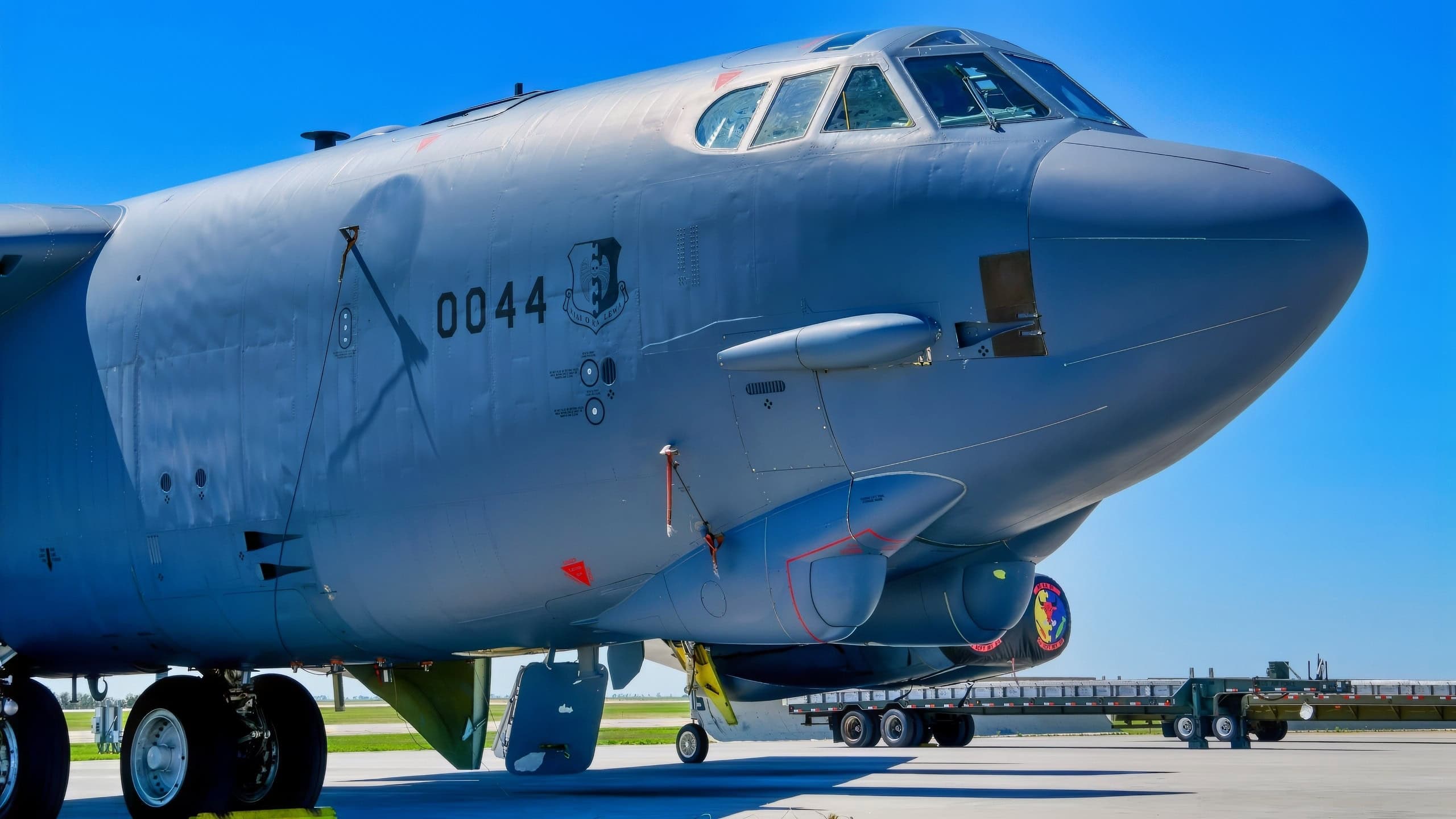
Summary and Key Points: The B-52J is the Stratofortress’s 13th upgrade program at 74. Rolls-Royce F130 turbofans replace 1960s Pratt & Whitney TF33s, giving the bomber 30% more range, a 9,000-mile combat radius, and a 70,000-pound bomb load, plus a Raytheon/Boeing AN/APQ-188 AESA radar, IRIS low-Earth-orbit satellite communications, and a crew cut from five to four. The sole B-52H test bed crashed at Edwards Air Force Base in June 2026, killing eight; GAO says $3 billion over and running behind.
The B-52J: A Mixed Bag?
If you took a WWII B-29 Superfortress and fitted it with modern, efficient turboprop engines, digital avionics, modern communications, and smart munitions, you’d have a very capable combat aircraft, even though it is nearly 90 years old.
Modern aircraft now carry high-tech sensors, targeting systems, and precision munitions into battle.
They no longer have to fight their way into a target, absorbing punishment from flak guns and enemy fighters along the way.
Now, the mission profile is to approach undetected, or, once air dominance is established, drop laser-guided bombs within feet of a target, then return to base.
Bombers are still prized for range, payload, and reliability.
This is why the B-52 Stratofortress is still flying after seventy-four years. It lifts a lot of bombs very high, goes very far, and is exceptionally reliable. The “Buff” is currently undergoing its thirteenth distinct upgrade program.
It will carry the “J” model designation.
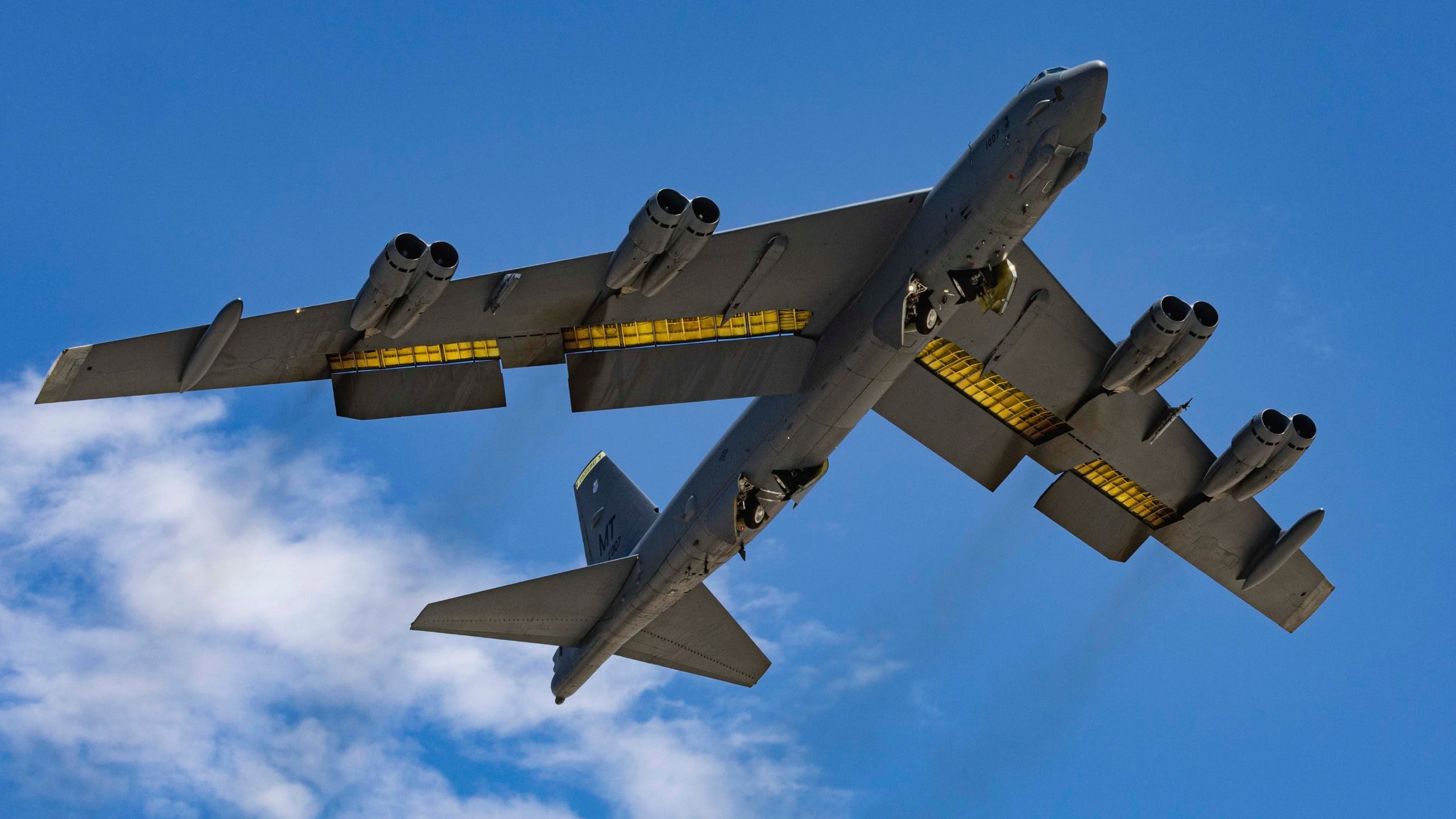
A B-52 Stratofortress assigned to the 69th Bomb Squadron, Minot Air Force Base, North Dakota, flies during Red Flag-Nellis 22-3 at Nellis Air Force Base, Nevada, July 18, 2022. RF-N 22-3 provides realistic combat training that saves lives while increasing combat effectiveness. (U.S. Air Force photo by Airman 1st Class Makenna Gott)
The new upgrades include all-new engines, radar upgrades, avionics and communications upgrades, and a reduction in crew from five to four.
New Engines Mean ‘Less Pain At The Pump’ For The B-52J
The current Pratt & Whitney TF-33 jet engines, dating back to the 1960s, will be swapped for Rolls-Royce F130 high-bypass turbofans. These engines promise to extend the B-52J’s range by 30% through improved fuel efficiency.
That is no small thing for a bomber with a combat range of almost 9,000 miles and a 70,000-pound bomb load.
A 30% reduction in fuel consumption translates to a like increase in range or loiter time over a target. It could also mean the B-52J could increase its bomb load.
New Eyes In The Sky For The B-52J
Bombers have to find their way to the target and drop bombs to succeed, so the upgrade will include an advanced Active Electronically Scanned Array (AESA) radar, expected to be the Raytheon/Boeing AN/APQ-188, which replaces the current F/A-18 Block III APG-79 system.
Rather than use a spinning or rotating radar dish(which can break in flight), AESA systems use a fixed panel with hundreds or thousands of tiny radar transceivers that can be phased or pointed in a direction in microseconds.
The radar return is so detailed it could be mistaken for infrared video.
Space-Based Communications For A New Space Age In The B-52J
The first flight of the Stratofortress in1952 predates America putting a man into space in 1961 by nine years. Since then, B-52 communications have relied on line-of-sight radios for sending and receiving signals.
The B-52J will get an IRIS system that uses low-Earth-orbit satellites, enabling instant voice, text, and data transmissions.
It will integrate with the aircraft’s other systems and send real-time performance and tracking information back to base.
If the B-52H has an engine problem, maintenance crews on the ground can see it, analyze it, and tell the flight crew what to do during the mission.
Reducing The Crew Means Saving Fuel And Space
On a passenger airliner, moving a single passenger some 9,000 miles costs between 35and-550 in fuel.
If you removed the seat and about two hundred pounds of luggage, you would more than double that cost.
Upgrades to radar and communications will mean the B-52J needs one fewer crewmember.
In its current configuration, the B-52 has a five-person crew: pilot, co-pilot, weapons system operator, electronic warfare operator, and navigator.
The integrated radar and satellite tracking system will eliminate the need for a dedicated navigator.
The electronic warfare and weapons system operators will be cross-trained as navigators able to switch between screens to perform this role.
Presumably, existing navigators will be retrained as weapons or electronic warfare operators and folded back into the now-reduced crew.
These Upgrades Do Not Come Without A Human Cost.
In June 2026, a B-52H serving as the sole test bed for the upgrade program crashed at Edwards Air Force Base in California, killing the entire crew of eight on board.
This Stratofortress lacked the new Rolls-Royce engines and was testing the new radar system. Among the dead were two of Boeing’s program test engineers.
The cause of the crash has not yet been determined, but it occurred before the second test aircraft was ready to fly.
The Air Force states that the B-52J program remains on budget and on time despite the profound loss of the first test aircraft and its experienced crew.
This claim seems to contradict a GAO report partially disclosed in July that said the upgrade program was about $3 billion over budget and behind schedule.
Of greatest concern were the Rolls-Royce engines, with the GAO reporting that the “Commercial Engine Replacement Program will likely continue to face significant challenges as the Air Force plans to begin production with little to no developmental flight testing.”
The Air Force will not replace these engines all at once, but incrementally through 2030.
About the Author: Sean Spoonts
Sean Spoonts is the former Editor-In-Chief of SOFREP.com. He is a military analyst, writer, and commentator whose work has appeared in Newsweek, CNS News, Ukrinform, and various military/veteran media networks and professional publications, including the Military Intelligence Professional Bulletin. He is a U.S. Navy veteran, having served as an Aviation Anti-Submarine Warfare Operator and Search and Rescue Helicopter Aircrewman.