If one thing the Iran War has taught the People’s Republic of China (PRC) about waging war with the United States, it’s that the tyranny of distance first defeats the Americans.
As long as the United States Armed Forces have forward bases and can sustain naval operations far from their shores, the US military can be combat-effective.
But what happens when those forward-deployed bases are no longer usable, or when US Navy warships cannot get close enough to a target to engage it?
That’s where we are today in any potential conflict between the United States and China.
Beijing had already made these calculations itself.
In fact, some evidence suggests the Iranians gleaned ideas on how to stunt US military power projection by studying China’s impressive anti-access/area-denial (A2/AD) capabilities arrayed throughout the First Island Chain.
China has been building those defenses since the 2010s. Today, they are advanced and borderline impenetrable.
A Wall of Steel
The key weapons that the Iranians have deployed against the United States have been relatively cheap, mass-produced drone and missile swarms.
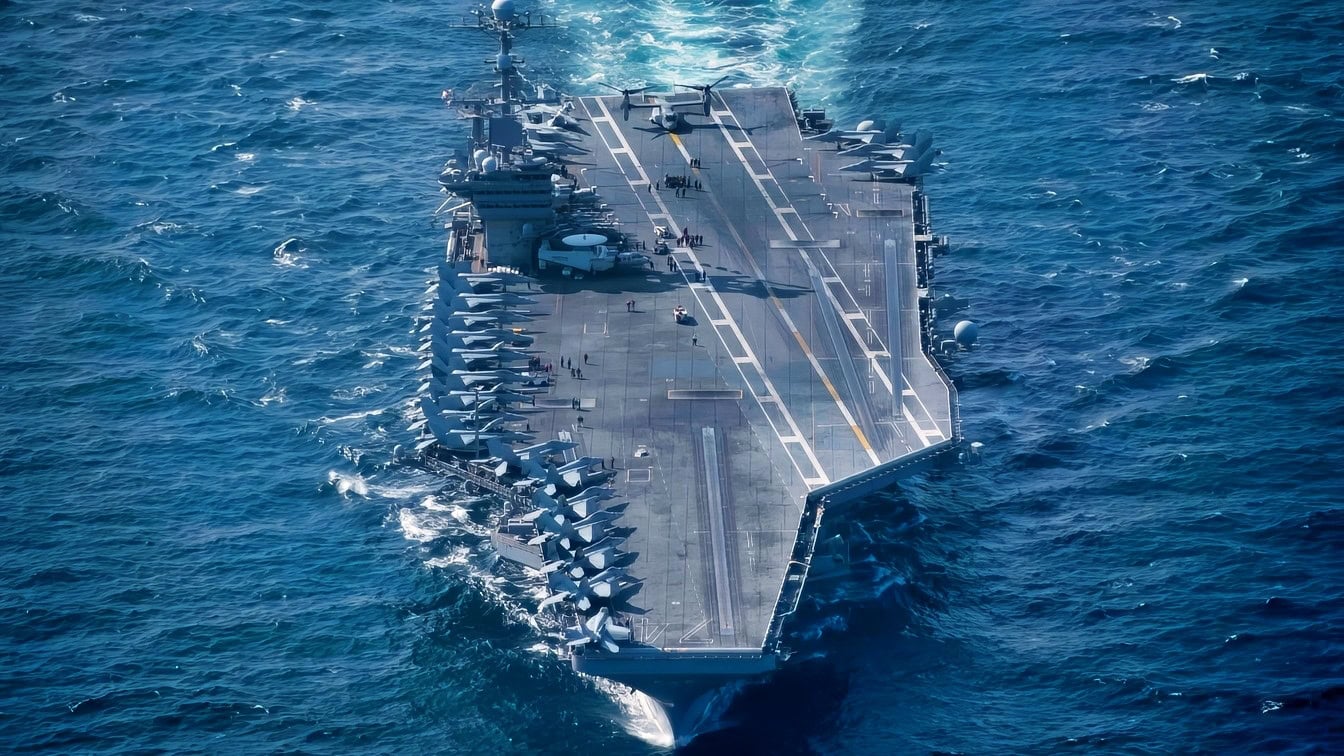
The aircraft carrier USS John C. Stennis (CVN 74) steams through the Arabian Sea, Dec. 14, 2018. The John C. Stennis Carrier Strike Group, Essex Amphibious Ready Group, and 13th Marine Expeditionary Unit are conducting integrated operations in the Arabian Sea to ensure stability and security in the Central Region, connecting the Mediterranean and the Pacific through the western Indian Ocean and three strategic choke points. (U.S. Navy photo by Mass Communication Specialist 3rd Class Connor D. Loessin)
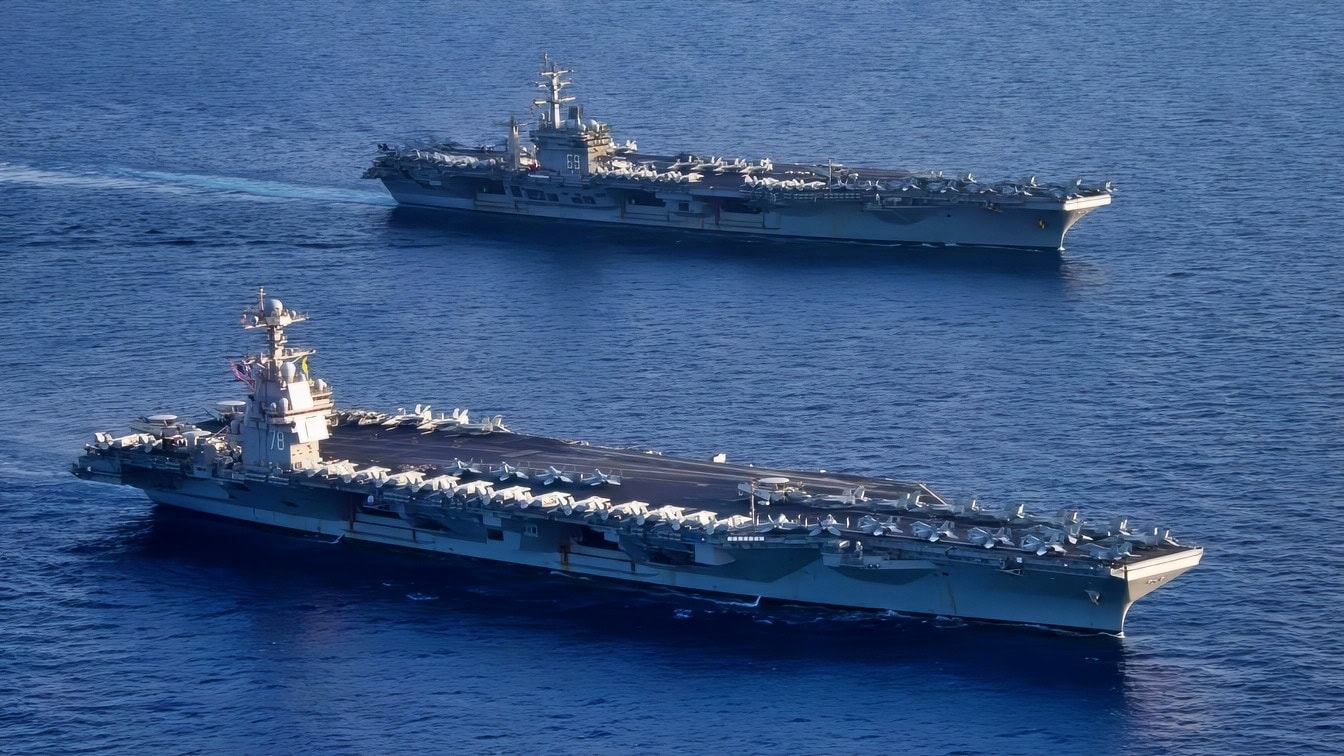
Aircraft Carriers USS Gerald R. Ford and USS Dwight D. Eisenhower (CVN-69). Creative Commons Image.
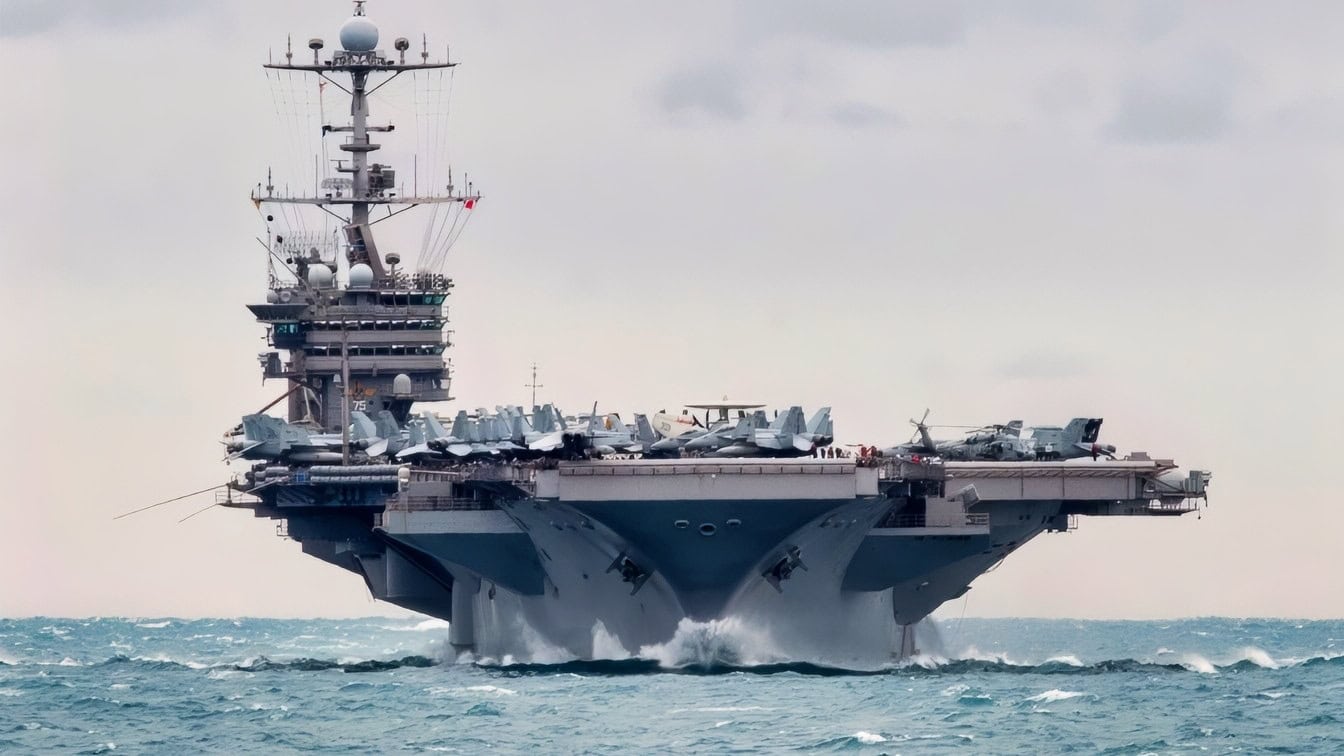
(Dec. 26, 2015) — Aircraft carrier USS Harry S. Truman (CVN 75) transits the Straight of Hormuz. Harry S. Truman Carrier Strike Group is deployed supporting maritime security operations and theater security cooperation efforts in the U.S. 5th Fleet area of responsibility. (U.S. Navy photo by Mass Communication Specialist 2nd Class M. J. Lieberknecht/Released)
These systems have caused significant damage.
They have blown through US and regional defenses, caused a staggering amount of damage to the critical energy infrastructure of the region, and used those missiles and drone swarms to blockade sensitive chokepoints.
China has studied these operations and concluded that its strategy for deterring an American assault on its forces during a Taiwan invasion (or another contingency) is sound.
While the Islamic Republic of Iran has demonstrated a surprising ability to threaten the United States military with its drone and missile swarms, the fact remains that China has an even more impressive capacity to threaten the United States’ military power in the Indo-Pacific.
A recent study by CSIS highlighted the way in which US bases throughout the region are increasingly within range of Chinese missiles and drone swarms.
These US bases, such as Andersen Air Force Base in Guam (a critical hub for the US military in the region), are dangerously vulnerable to the same kinds of attacks that the Iranians pioneered against US bases near their territory in the Middle East.
The lack of adequate protections for US personnel on those bases, as well as depleted missile defenses–and missile defenses that cost far more than do the systems attacking the bases–are found on American bases throughout the Indo-Pacific.
Learning From Iran
Beijing knows this. It has factored that reality into its plans.
That is why the Chinese have built such a comprehensive network of missiles, drones, and even hypersonic weapons with which to turn off American bases in the region at the outbreak of conflict.
Just as with the Iranians in the Strait of Hormuz (SoH), too, the Chinese have a sophisticated anti-ship ballistic missile capability.
Currently, the US Navy is hesitant to enter the Strait of Hormuz or even risk docking at its facilities in places like Bahrain out of fear of Iranian drone and ASBM swarms.
The same reality exists in the Indo-Pacific.
Keeping US warships, especially the carriers, at bay is a critical mission for the Chinese military.
If China can keep US carriers outside the First Island Chain, US warplanes must launch from farther away than US war plans call for.
Then, US warplanes launched from distant carriers would require midair refueling.
Those refuelers would become easy targets for Chinese missiles, drones, and warplanes (like the fifth-generation Chengdu J-20 “Mighty Dragon”).
Without those midair refuelers, US naval warplanes would struggle to stay combat-effective and return safely to their ships.
What’s more, China’s significant ballistic missile, drone, and hypersonic weapons capabilities are so potent that the nearby US airbases will likely be destroyed or have their runways damaged, meaning launching and recovering any US aircraft at those facilities would be problematic at best.
Iran has already shown the way for a military to repel the US military in combat effectively.
It isn’t about distant offensives. It’s not about the kind of expeditionary warfare the Americans specialize in. The Iranians are engaged in a massive defensive action.
They have turned their country into a porcupine, bristling with an extensive arsenal of missiles, drones, and hypersonic weapons.
That arsenal is buried deep underground.
They also have significant production capability to replenish their losses.
The Americans, however, are clearly struggling to maintain their arsenals and their warships.
Chinese Drones Are Not to Be Trifled With
Here again, China will push the Americans to their limits.
China already has the world’s greatest manufacturing base, and it has successfully wedded it to its military. Chinese defense firms can make missiles and drones like sausages.
They already possess a massive arsenal of these systems.
They can easily augment and expand their capabilities.
Throw in the drone threat, and the US military is going to hit a devastating wall if the US and China ever wage war upon each other.
These trends are only worsening for Americans.
The Chinese are increasing production of these systems every year.
What’s more, the Chinese are mass-producing increasingly advanced warplanes and warships, too.
Soon, the Americans are going to be outnumbered and outgunned, unable to effectively project power into the First Island Chain, all while the Chinese run roughshod there–just like the Iranians have done in their region.
The US military is well-suited to fight Desert Storm.
It is not at all prepared for 21st-century wars. Iran showed us this. China knows this.
About the Author: Brandon J. Weichert
Brandon J. Weichert is the Senior National Security Editor at 19FortyFive.com. He also manages The Weichert Brief on Substack. Weichert also hosts “National Security Talk” on Rumble. He is the author of four bestselling national security books, most recently A Disaster of Our Own Making: How the West Lost Ukraine (Encounter Books). His next book, Fortress Americas: A New Monroe Doctrine (Tucker Carlson Books), is due out November 24. Follow him via Twitter/X @WeTheBrandon.