
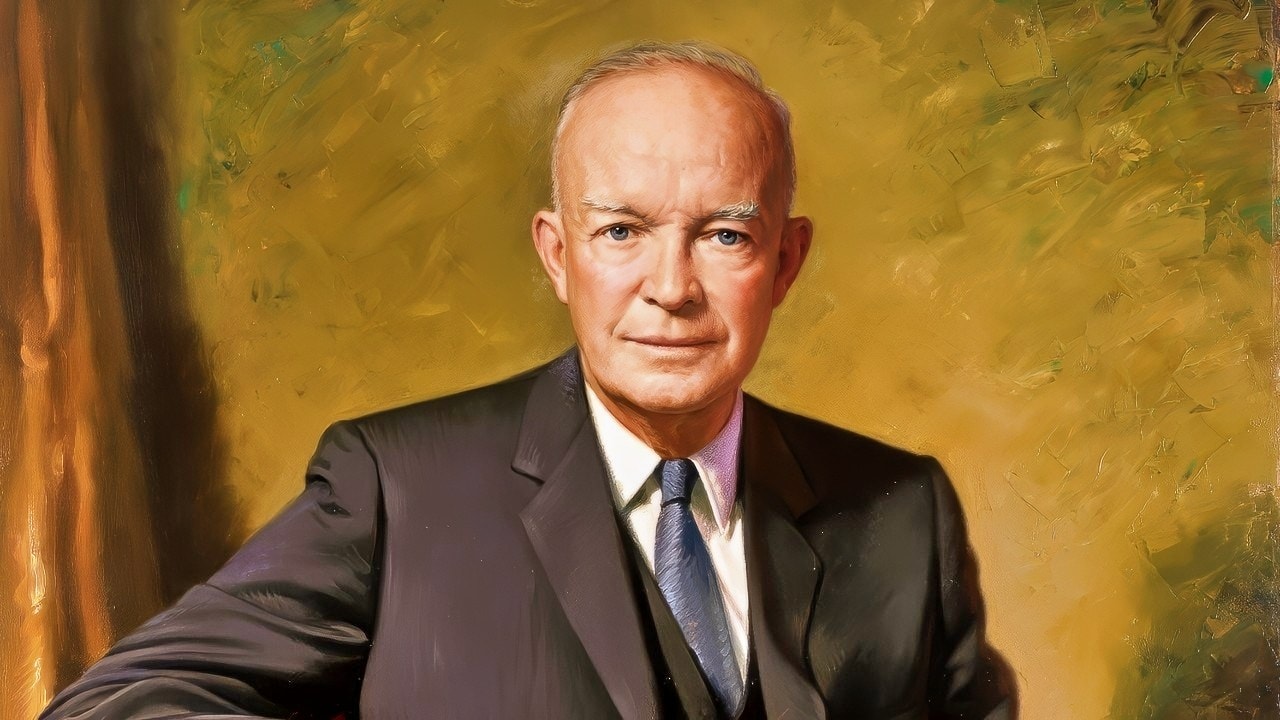
Dwight Eisenhower never fired a shot in combat. He still won the largest war in history, then spent eight years making sure we never fought the next. Ike said it best himself: “The only way to win World War III is to prevent it.” He delivered a version of it during a 1956 campaign speech in Seattle, and as a recent 19FortyFive piece points out, it came as the Soviet bloc was cracking in Poland and Hungary.
That’s a remarkable thing for the man who planned D-Day to say.
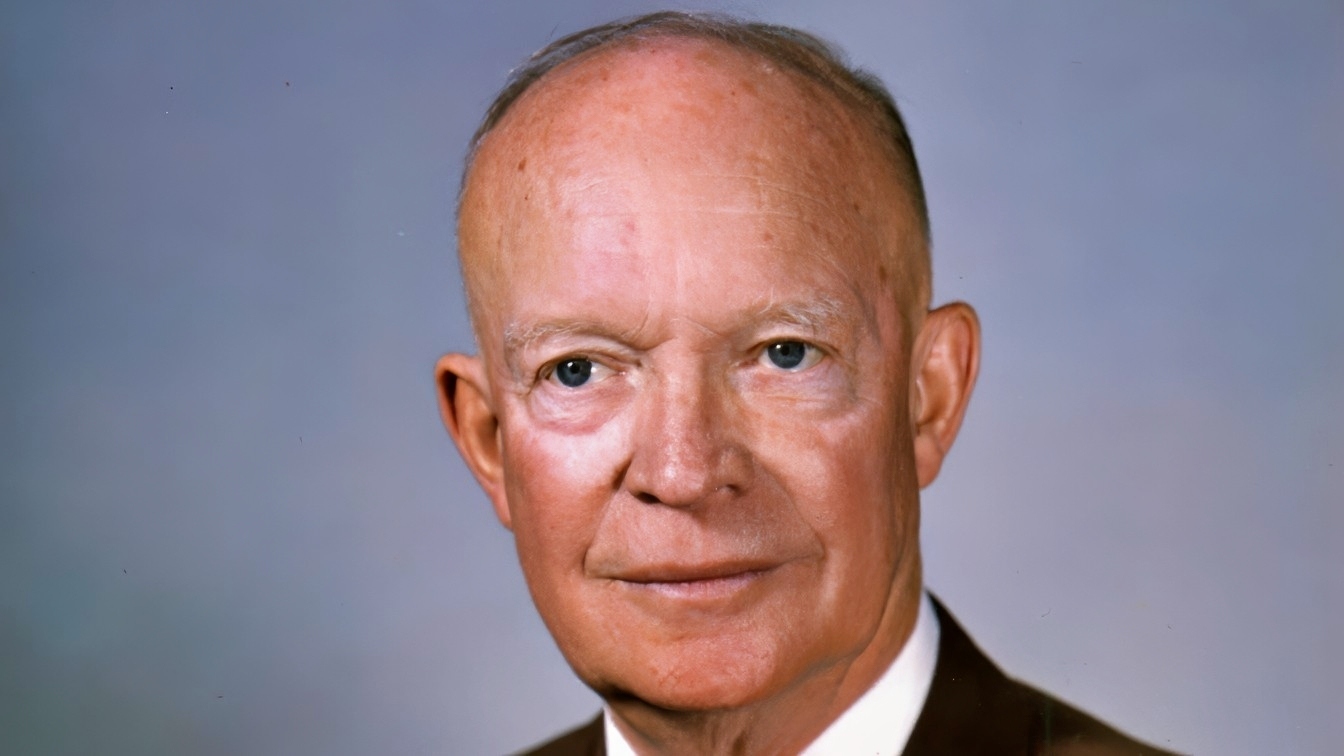
Dwight D. Eisenhower Official White House Photo
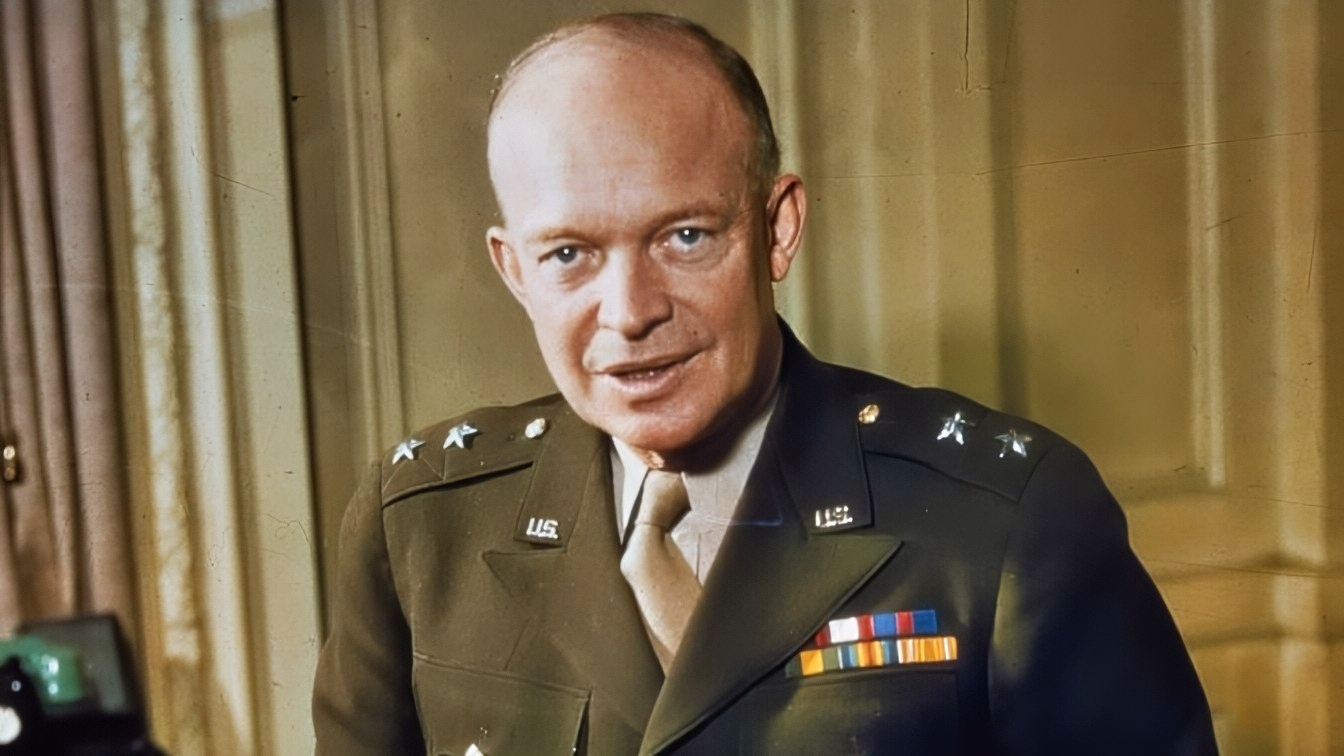
Dwight D. Eisenhower 1942 Photo Creative Commons
It’s also the key to understanding him.
A Kansas Kid Who Needed A Free Education
Eisenhower was born on October 14, 1890, in Denison, Texas, and raised in Abilene, Kansas.
Money for college was tight, so he looked at the service academies because they charged no tuition.
He passed the exams for both Annapolis and West Point, but he was too old for the Navy—the Navy’s loss.
At West Point, he was more of an athlete than a student, and he finished 125th in his class in discipline.
For those keeping score at home, that’s out of 164.
He graduated with the Class of 1915, known as “the class the stars fell on” because 59 of its members became generals.
The Officer Who Missed The War
When America entered World War I, Eisenhower wanted to go to France.
However, the Army had other ideas.
It sent him to Camp Colt in Gettysburg to build the Army’s tank training program, where he performed far above his rank.
He never reached the Western Front.
Many historians argue that was an advantage, since his thinking was never trapped in the trenches.
In 1919, he volunteered for the Army’s First Transcontinental Motor Convoy, a grinding trek from Washington to San Francisco over roads that were often barely roads at all. Remember that trip. It comes back.
Then came the mentor who changed everything. Major General Fox Conner pulled Eisenhower out of a job coaching football at Camp Meade.
He brought him to Panama, where he turned Ike into a serious student of military history and strategy.
Eisenhower later called Conner “the ablest man I ever knew.” He followed that with years as Douglas MacArthur’s aide in Washington and the Philippines, where he learned how not to handle people.
The Supreme Commander Took The Blame Before The Fight
After Pearl Harbor, George Marshall brought Eisenhower to Washington to plan the war effort.
From there, his rise was meteoric.
He commanded Operation Torch in North Africa, then became Supreme Commander of the Allied Expeditionary Force.
General Marshall was probably the best man for the job.
Still, President Roosevelt felt he was indispensable, as he built the United States military from a small peacetime force to more than twelve million troops in just a few years.
Eisenhower was chosen largely for his exceptional ability to manage a massive, multinational coalition of British, American, Canadian, and other Allied forces without alienating key Allied figures like Winston Churchill, Field Marshal Bernard Montgomery, and Charles de Gaulle.
However, the French leader always acted as the face of the Allied effort.
Eisenhower excelled at organization, logistics, and inter-service administration rather than raw field combat.
On June 5, 1944, he gave the order that launched the Normandy invasion.
Then he sat down and wrote a short note to be released if the landings failed.
In it, he praised the troops, airmen, and sailors and took sole ownership of any failure.
The National Archives preserves it, and the only sign of nerves is that he dated it July 5 instead of June 5.
That note tells you more about Ike than any campaign map.
In my opinion, every officer should read it once a year.
Commanders take credit all the time.
Very few blamed themselves in writing before the first boat hits the beach.
As the old military saying goes, “A successful plan has 100 fathers, a failed one is an orphan.” This has roots in the Roman Empire, and perhaps earlier. The Roman historian Tacitus wrote around 98 AD: “This is an unfair thing about war: victory is claimed by all, failure to one alone.”
From Soldier To President
After the war, Eisenhower served as president of Columbia University, then as NATO’s first Supreme Allied Commander. In 1952, he ran for president and won in a landslide.
So why would a career soldier spend his presidency avoiding wars? Because he’d seen what they cost. His quote reflects that: “I hate war as only a soldier who has lived it can, only as one who has seen its brutality, its futility, its stupidity.”
He ended the Korean War in 1953. In 1956, on Election Day, he was busy pressuring Britain and France into a ceasefire during the Suez Crisis, worried that the Soviets would intervene and drag the world into a major war.
Say what you want about his reliance on nuclear deterrence.
That’s beside the point.
He built that arsenal so he would never have to use it, and he never did.
Critics have argued he was a far more hard-edged Cold Warrior than his quotes suggest.
Both things can be true. Prevention requires a credible threat.
He also remembered that 1919 convoy across the US. The Federal-Aid Highway Act of 1956 created the Interstate Highway System, which Ike pushed in part because of those rutted roads and the efficiency of the German autobahn he saw in World War II.
He created what became NASA.
He sent U-2 spy planes over the Soviet Union.
The Warning Still Holds Up
On January 17, 1961, three days before leaving office, Eisenhower gave a televised farewell address that ran less than 10 minutes.
In it, he warned against the unwarranted influence of the military-industrial complex.
Coming from a five-star general, that landed hard.
Would it happen today?
Very doubtful.
I’ve always believed people misread his warning. Eisenhower wasn’t anti-military.
He was a soldier who understood that a defense establishment without oversight eventually serves itself.
Anyone who’s served has seen a smaller version of that up close.
Ike retired to his farm in Gettysburg, a short drive from the old Camp Colt grounds where he trained tankers for a war he never got to fight. He died on March 28, 1969, and is buried in Abilene, Kansas.
He won one world war. His real victory was the one that he helped to prevent.
About the Author: Steve Balestrieri
Steve Balestrieri is a National Security Columnist. He served as a US Army Special Forces NCO and Warrant Officer. In addition to writing on defense, he covers the NFL for PatsFans.com and is a member of the Pro Football Writers of America (PFWA). His work was regularly featured in many military publications.