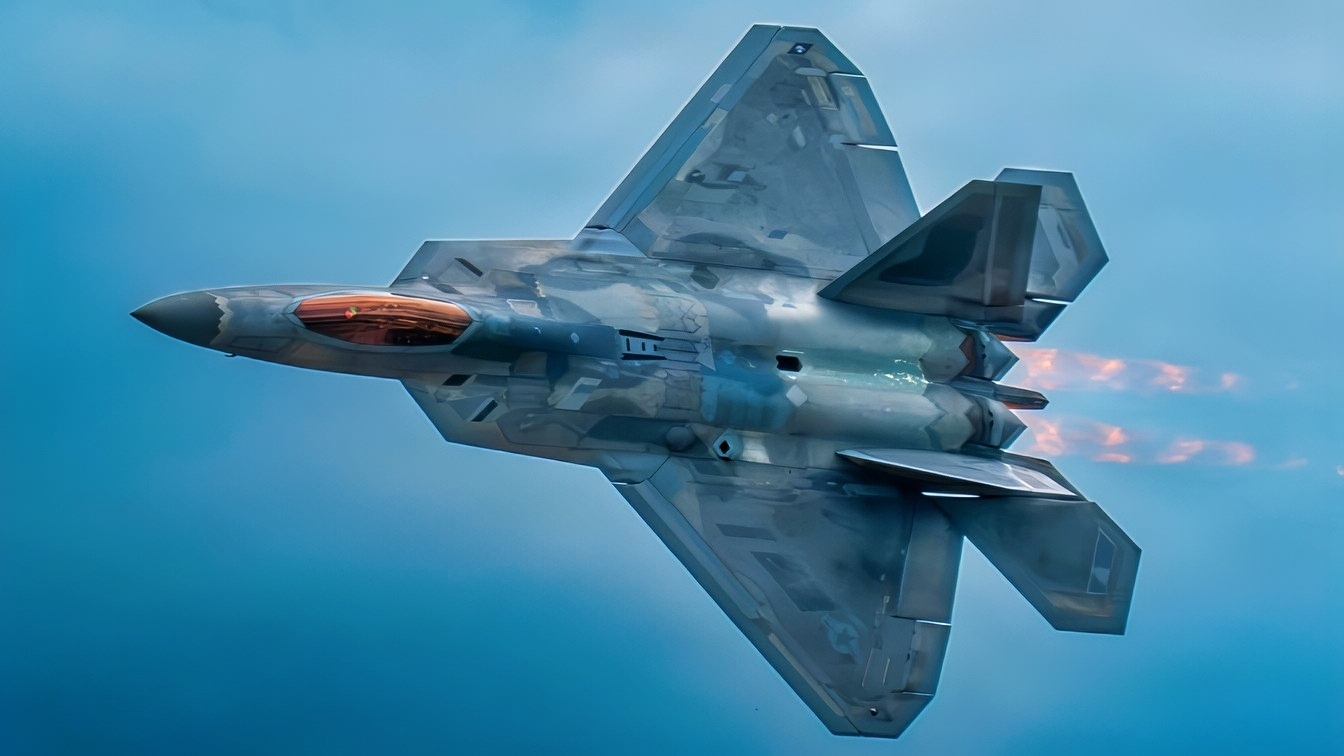
Summary and Key Points: Expert and best-selling author Brandon J. Weichert argues the F-22 Raptor, at nearly $369 million per plane, was built for cramped European skies, and its 500-to-590-nautical-mile combat radius is a liability against a Chinese arsenal that can range every US base in the First Island Chain. Lockheed Martin and the Air Force are answering with Low Drag Tank and Pylon stealth fuel tanks, about 4,000 pounds each, now in flight testing at Edwards under a $9 billion modernization program.
The F-22 Raptor Flaw in 1 Word: Range
At nearly $369 million per plane, the F-22 Raptor is among the world’s most advanced fifth-generation warplanes.
Designed as a fifth-generation air-superiority stealth warplane for a great-power confrontation with the Soviet Union, the Raptor brings impressive capabilities to any firefight.
But it hasn’t had a chance to shine the way it could have if the Cold War had continued.
Still, the Pentagon kept investing in these planes.
Today, however, some fatal design flaws are being discovered.
A Major Design Flaw
One flaw is the Raptor’s relatively poor range.
Since the outbreak of the war in Ukraine, the world has seen how important it is to fight at greater distances.
Powerful anti-aircraft systems have wreaked havoc on warplanes fighting there, forcing them to operate farther beyond visual range.
The same has held in the ongoing Iran War.
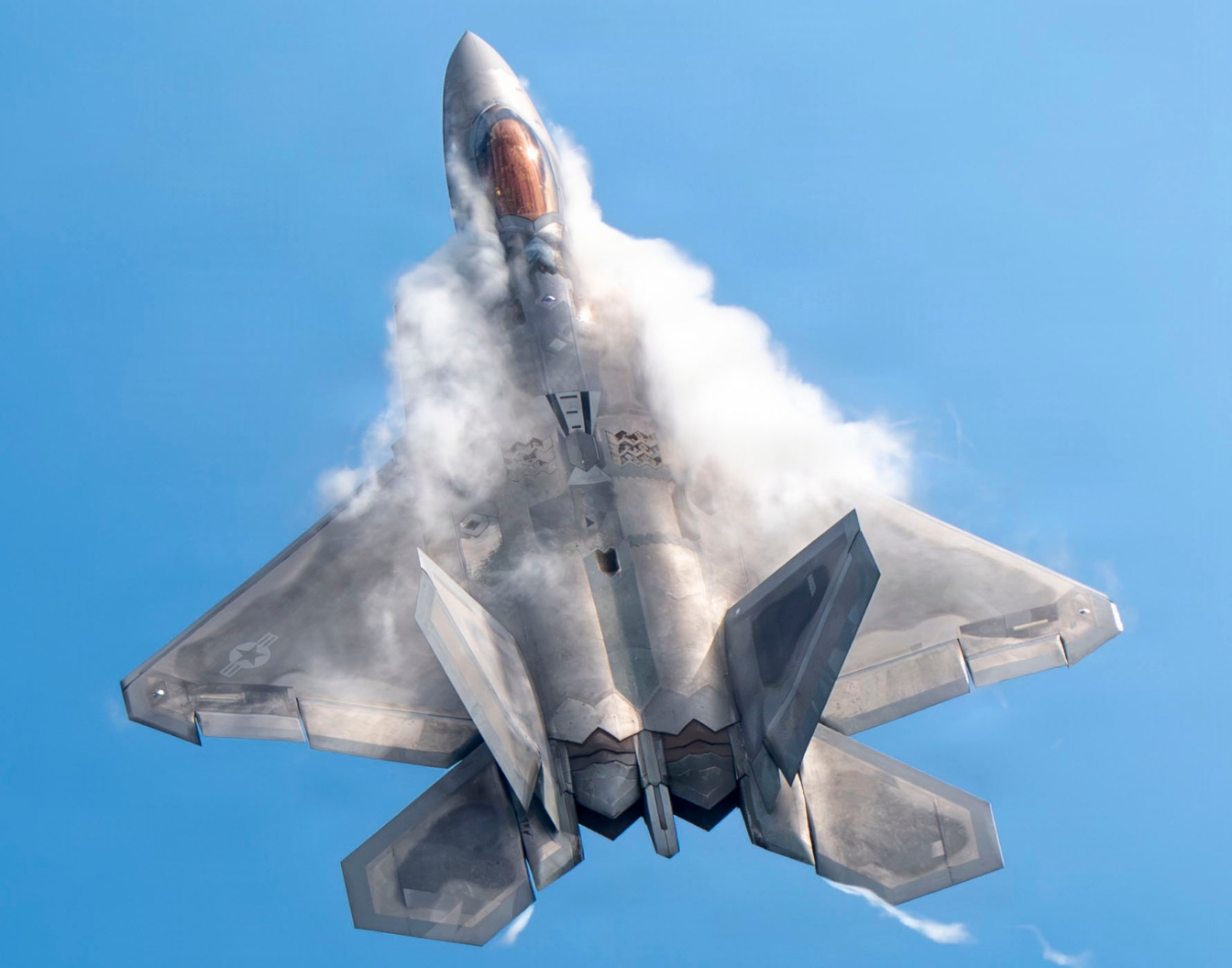
U.S. Air Force Capt. Nick “Laz” Le Tourneau, pilot and commander of the F-22 Raptor Aerial Demonstration Team, performs for the 2026 Wildwood Air Show in Wildwood, New Jersey, Sept. 12, 2026. Le Tourneau showcased the aircraft’s performance capabilities through a series of planned maneuvers designed to highlight its speed, agility and operational employment. The visible vapor forms when rapid changes in air pressure and humidity around the aircraft cause water vapor in the air to condense. (U.S. Air Force photo by Staff Sgt. Lauren Diaz)
According to its specifications, the F-22 Raptor has a combat radius of just 500 to 590 nautical miles.
The plane was designed to fight primarily over the more geographically cramped spaces of Europe against the Soviet Air Force.
But unless the European war between Ukraine and Russia becomes a true American conflict, the F-22s won’t be needed there.
They’re having some impact at the margins of the Iran War.
Readying for War With China
The Pentagon is planning to rely on the F-22’s stealth and maneuverability for any contingency involving China in the Indo-Pacific.
There’s just one problem.
If people think that Ukraine and Iran had massive anti-access/area-denial (A2/AD) capabilities to keep Russian and US warplanes, respectively, beyond visual range, China has an even greater A2/AD capability. Beijing also benefits from the region’s geography.
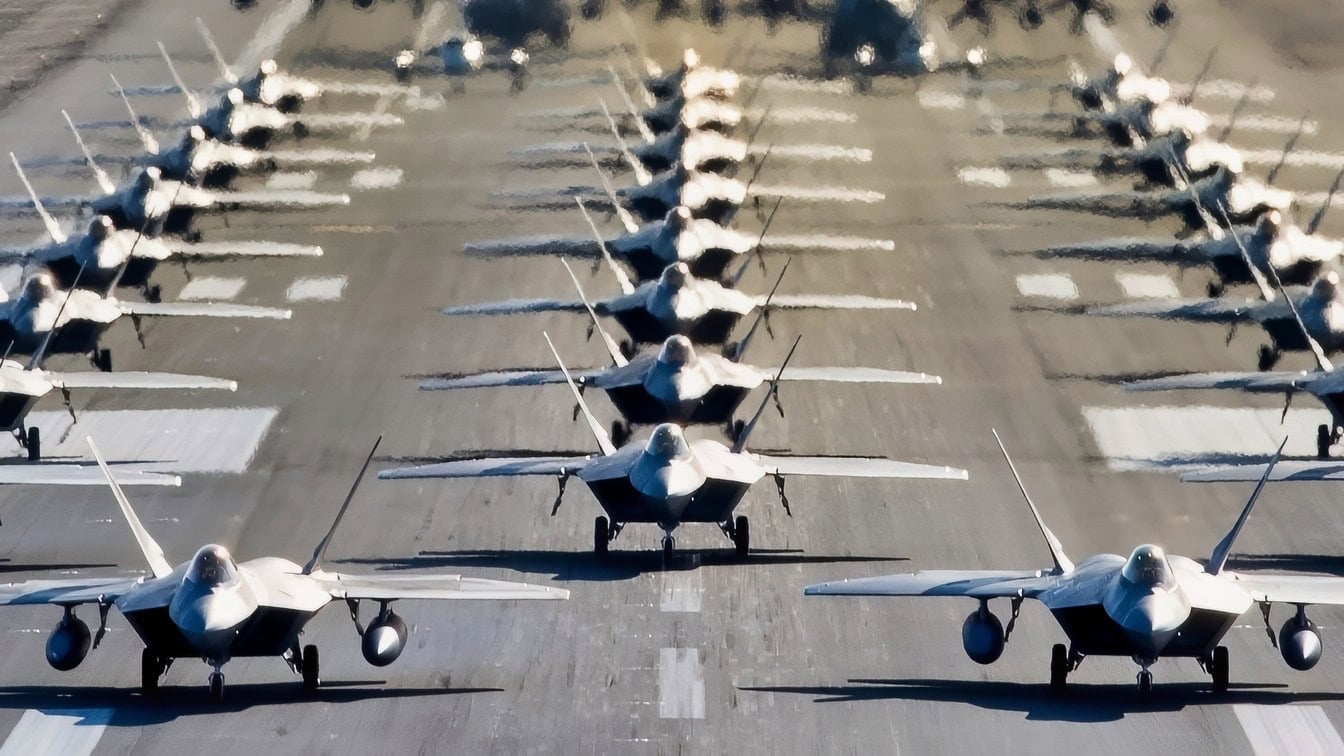
U.S. Air Force F-22 Raptors, E-3 Sentrys, C-17 Globemaster IIIs, C-130J Herculeses and C-12F Hurons participate in a close formation taxi known as an elephant walk at Joint Base Elmendorf-Richardson, Alaska, May 5, 2020. This event displayed the ability of the 3rd Wing, 176th Wing and the 477th Fighter Group to maintain constant readiness throughout COVID-19 by Total Force Integration between active-duty, Guard and Reserve units to continue defending the U.S. homeland and ensuring a free and open Indo-Pacific. (U.S. Air Force photo by Senior Airman Jonathan Valdes Montijo)
The Indo-Pacific region is where any conflict between the United States and China would be fought.
It’d be fought much closer to China’s shores, in what’s known as the First Island Chain (the territories stretching from the Kamchatka Peninsula through Japan and Taiwan down to the Philippines and the South China Sea).
In other words, Americans will have to fly their planes (and sail their ships) across vast distances.
Even planes based closer to the First Island Chain, such as the F-22s, still must fly an extraordinary distance to get within range of any potential fight because of the Indo-Pacific’s natural geography.
What’s more, China’s A2/AD arsenal can range all of America’s bases in the First Island Chain and likely some in the Second Island Chain.

U.S. Air Force Capt. Nick “Laz” Le Tourneau, pilot and commander of the F-22 Raptor Aerial Demonstration Team, performs for the 2026 Cleveland National Air Show in Cleveland, Ohio, Sept. 6, 2026. Le Tourneau showcased the aircraft’s performance capabilities through a series of planned maneuvers designed to highlight its speed, agility and operational employment. (U.S. Air Force photo by Staff Sgt. Lauren Diaz)
If the F-22 is to be the main warplane America first deploys against China in any conflict, these birds might not even be able to take off if they are forward-deployed, because China can strike the runways of any American airbase in the region, preventing aircraft from launching and recovering.
The New Tanks for Lockeed F-22 Raptor
Because the F-22s are so central to US war plans in the Indo-Pacific, the Air Force is working feverishly to extend their range by developing stealth-friendly external fuel tanks.
Lockheed Martin and the US Air Force are implementing the Low Drag and Pylon (LDTP) System as part of the larger $9 billion F-22 modernization program.
Flight testing is currently underway at Edwards Air Force Base in California, and the tanks are in production.
The problem with the current 600-gallon drop tanks is that most US Air Force planes can carry them, forcing pilots to use a “drop and fight” tactic in which F-22s jettison both the tanks and the pylons before entering enemy airspace.
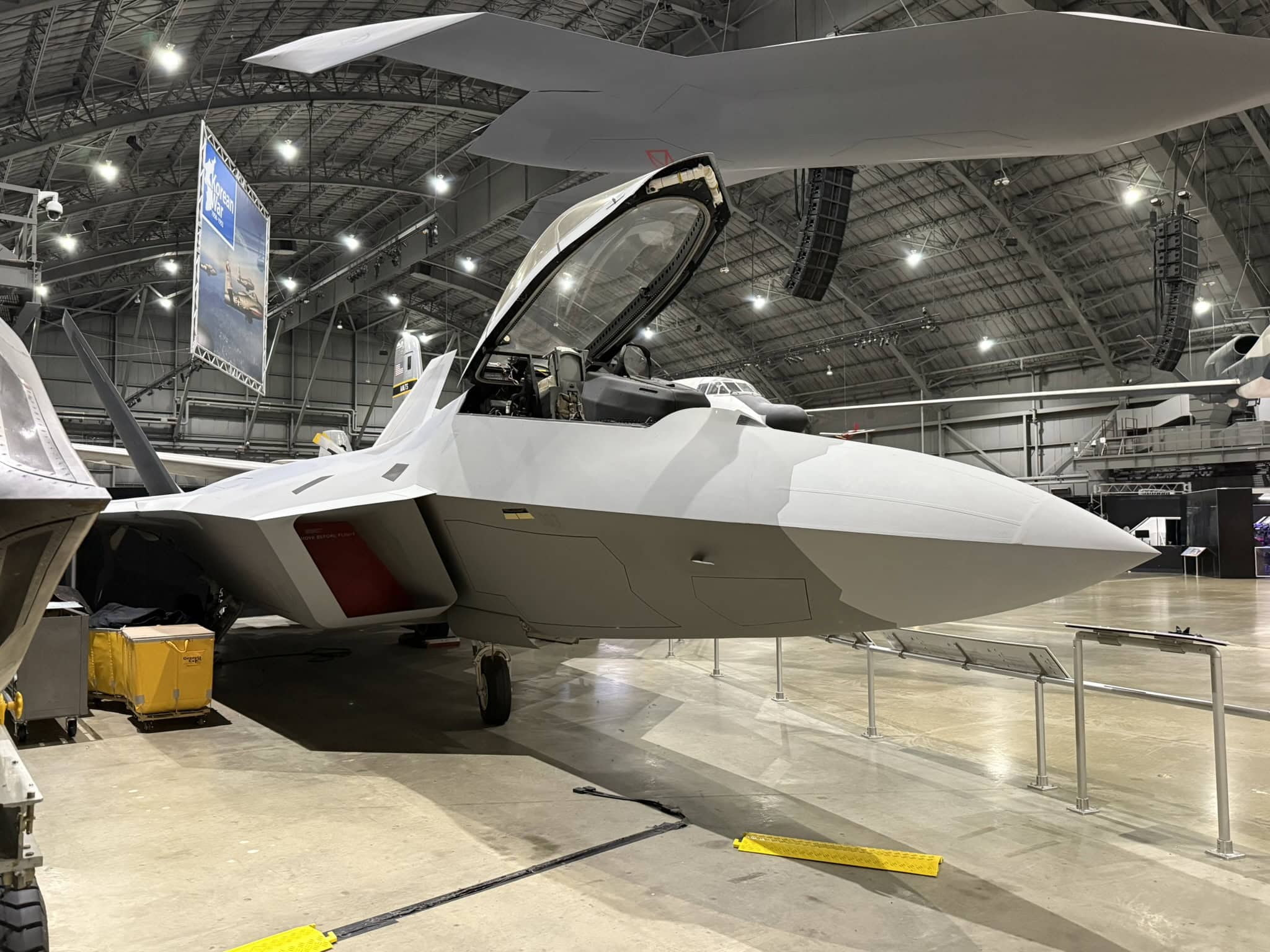
F-22 at the National Museum of the U.S. Air Force in July of 2025. Image Credit: Harry J. Kazianis.
That’s because older external fuel tanks essentially end the F-22’s vaunted stealth by turning the plane into a large radar reflector.
The F-22’s whole point is to avoid radar detection.
But the plane also has to fight.
Because of the Indo-Pacific geography and China’s comprehensive, advanced defenses, particularly throughout the First Island Chain, stealth is no longer enough.
The Ukrainians, Russians, Iranians, North Koreans, and Chinese have all come to dominate different, key aspects of twenty-first-century warfare.
Can We Adapt?
Meanwhile, the United States and most of its partners are still prepared to fight the wars of the late twentieth century, and their defense bureaucracies are too sclerotic to adapt.
Lockheed’s newer tanks are designed to maintain stealth, ensuring the F-22s can fly longer ranges, fight reliably, and have a real chance of returning home.
The new tanks are meant to withstand the extremes of air-combat maneuvering. Lockheed made them to remain attached throughout a combat mission.
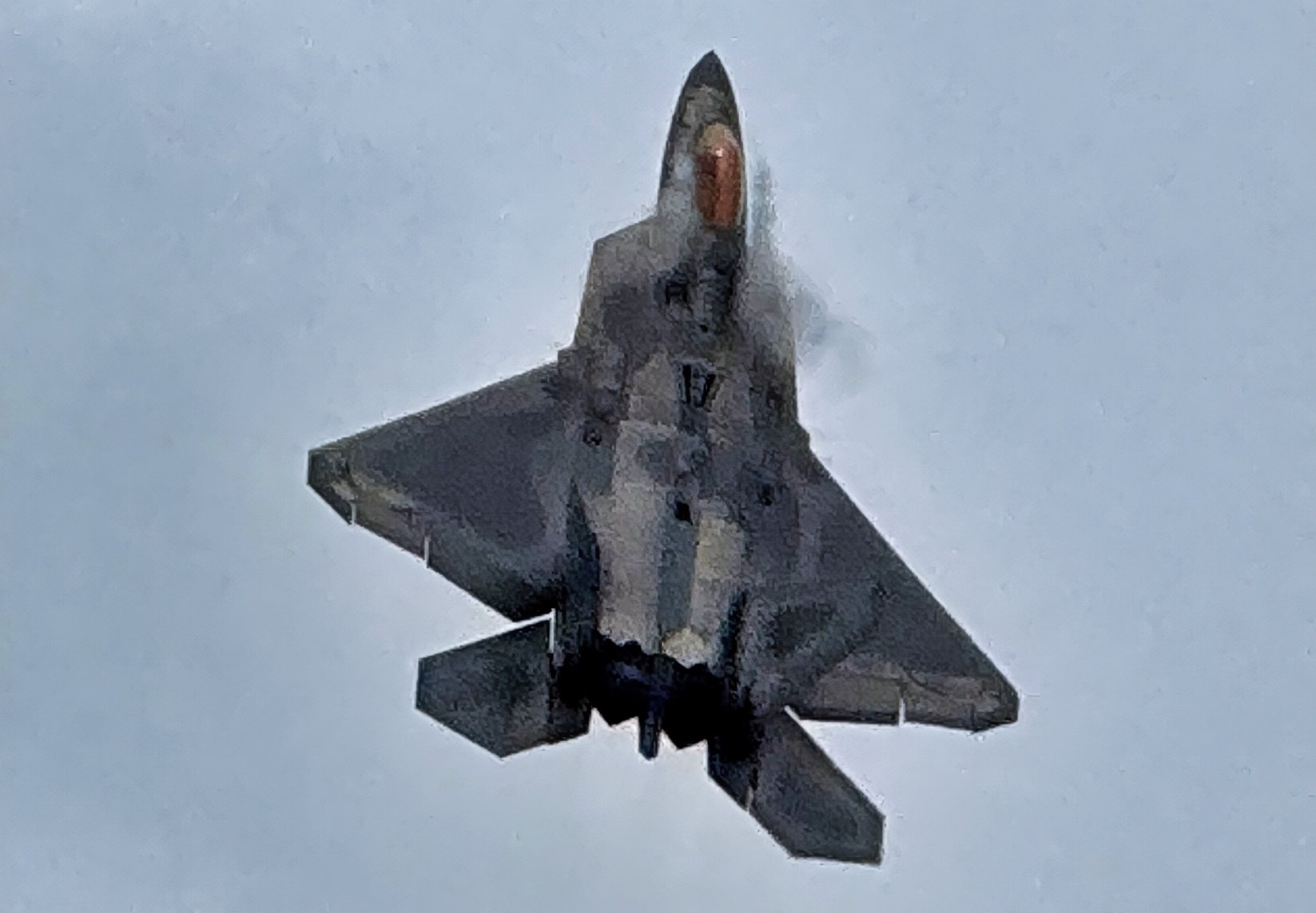
F-22 Raptor high in the sky. Image taken by Harry J. Kazianis in Lakeland, Florida on 4/19/2026.
The older tanks must be dropped at the start of combat. Plus, the newer tanks carry more fuel (about 4,000 pounds of aviation fuel each).
Their aerodynamic efficiency also significantly extends the F-22’s combat range, according to Sandboxx, a respected online trade publication.
Lockheed is also pairing these new external fuel tanks with the underwing Infrared Search and Track (IRST) pods.
The farther beyond visual range the F-22s operate, the more fuel and sensors they need.
Lockheed and the Air Force see the problem.
They’re addressing it.
The question remains whether these systems will be ready when a conflict erupts.
About the Author: Brandon J. Weichert
Brandon J. Weichert is the Senior National Security Editor at 19FortyFive.com. He also manages The Weichert Brief on Substack. Weichert is the co-host for The Mario Nawfal Show on Twitter/X. He is the author of four bestselling national security books, most recently A Disaster of Our Own Making: How the West Lost Ukraine (Encounter Books). His next book, Fortress Americas: A New Monroe Doctrine (Tucker Carlson Books), is due out December 8. Follow him via Twitter/X @WeTheBrandon.