
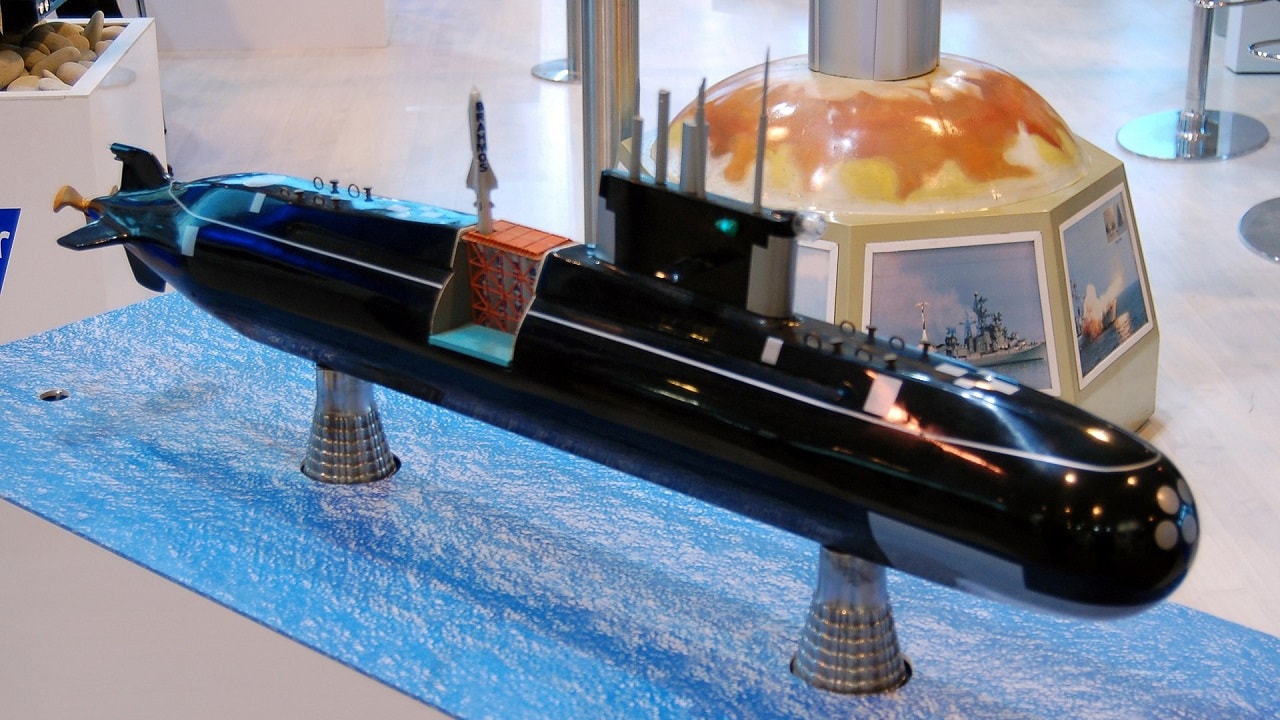
In Slavic mythology, Lada is the goddess of beauty, spring, and rebirth, the counterpart to the Scandinavian goddess Freyja and the Greek goddess Aphrodite. Still, in the present-day military context, the name “Lada” has a far deadlier ring to it, as in Russia’s Lada-class diesel-electric attack submarines.
Russian Navy Lada-Class: Initial History and Tech Specs
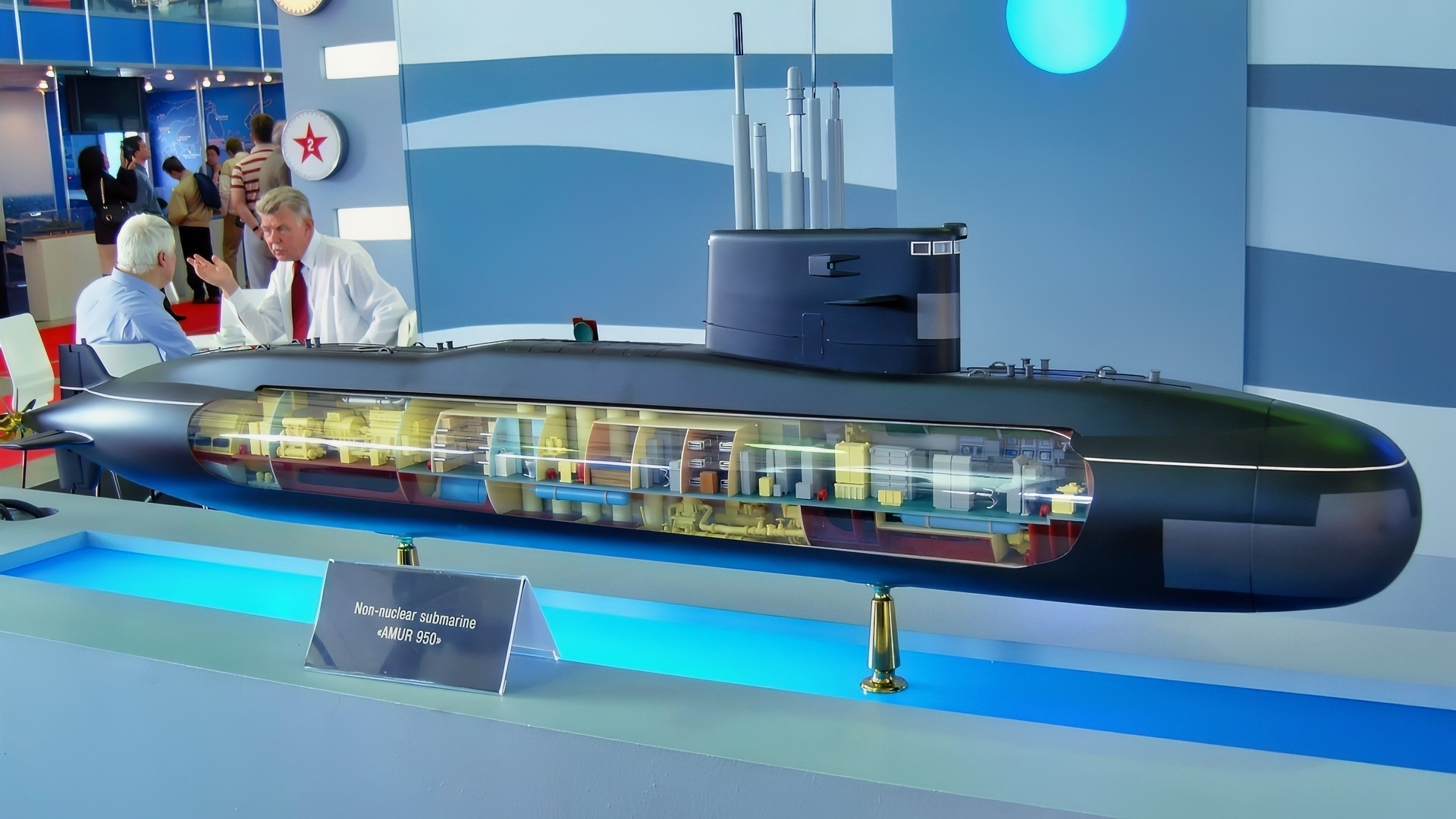
Amur-class Submarine this is the export version of the Lada-class. Creative Commons Image.
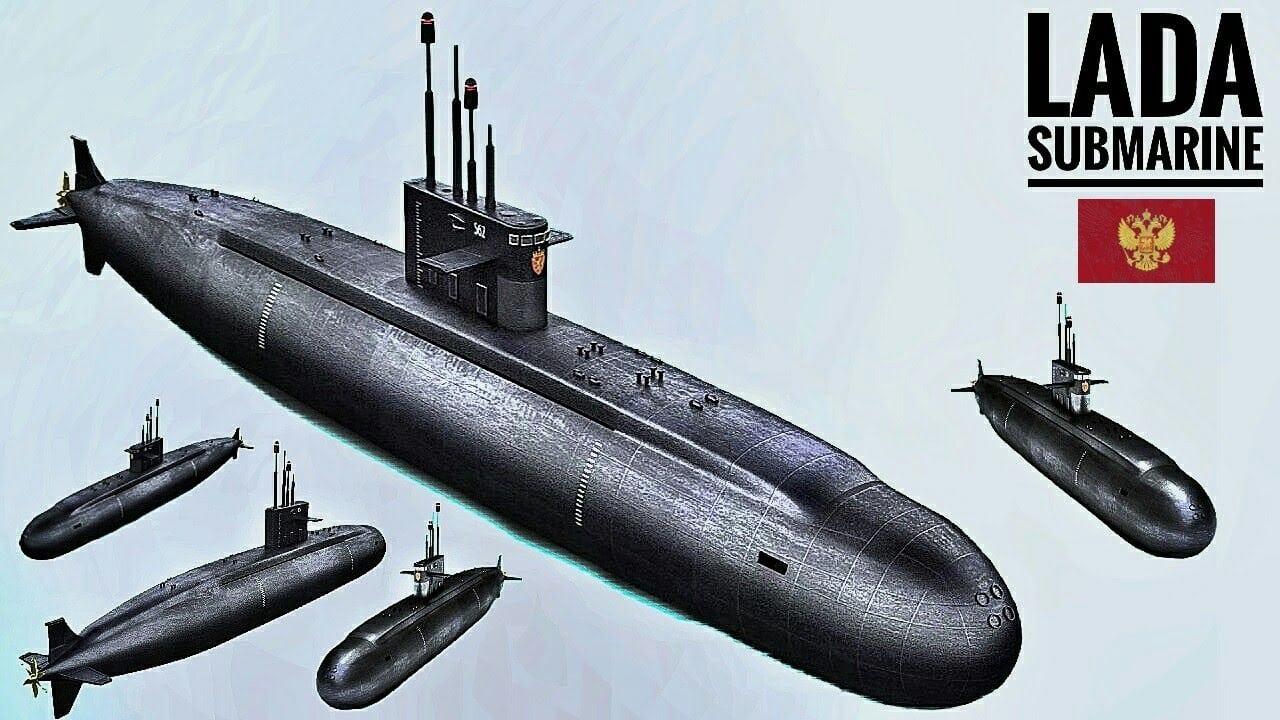
Lada-class Submarine. Image Credit: Creative Commons.
The Rubin Central Design Bureau designed these boats—headquartered in Leningrad, which reverted to its pre-Communist name of St. Petersburg after the Soviet collapse—and the Admiralty Shipyards built them; the Admiralty Shipyards is also headquartered in St. Petersburg and is one of Russia’s oldest and largest shipyards, dating back to 1704.
The saga of the Ladas began on 26 December 1997 with the keel-laying of the first ship of the class, the B-585 Sankt Peterburg, which was essentially considered a prototype. Next came B-585, launched on 28 October 2004 and entered trial service on 8 May 2010.
Since then, two other ships of the class have been completed: B-586 Kronshtadt and B-587 Velikiye Luki; the latter was named for a city that was the site of a major battle between the Red Army and Nazi Germany’s Wehrmacht during the so-called “Great Patriotic War.”
The Ladas were envisioned as the “fourth generation” successor to the ubiquitous Type 636 (NATO reporting name: Improved Kilo-class) diesel-electric boats.
They reportedly have a displacement of 1,765 tons surfaced and 2,650 tons submerged, a hull length of 219 feet 2 inches, a draught of 21 ft 4 inches, and a beam width of 23 feet 4 inches.
Test depth, aka safe operating depth, is believed to be 980 feet, with an operational range of 7,500 nautical miles at 3 knots and an endurance of 45 days. Crew complement is estimated at 35 commissioned officers and 44 enlisted sailors.
Armament-wise, there are six 21-inch forward torpedo tubes, with a capacity for 16 torpedoes or surface-to-surface missiles (SSMs), 44 mines, or ten Kalibr land-attack cruise missiles.
Army Recognition reports that there is a distinct possibility the Ladas could also carry aerial and underwater drones.
The powerplant consists of an electric propulsion motor on permanent magnets with a single 2,700 hp shaft that propels the subs at a reported max speed of 21 knots submerged and 10 knots on the surface.
Other impressive features—at least on paper—include a pressure hull made of the new AB-2 strength steel, a new Molniya hull anechoic covering for improved stealth, a new SED-1 synchronous electric motor with permanent magnetic excitation, the Lira sonar system—which marks the first time a Russian bow sonar has had a conformal antenna—the Litiy automated combat management system, the Parus-98 optronic mast, and the Distantsiya integrated communications system.
The Lada also holds a wee bit of historical significance as the first Russian submarine class to employ a single-hull design.
Operational History in Brief
To paraphrase the great bard William Shakespeare, “Much ado about very little.” As is true of a lot of up-and-coming Russian military weapons systems, production isn’t proceeding anywhere near as smoothly as originally hoped.
That heavily hyped Sankt-Peterburg was, in the words of Eric Wertheim of the US Naval Institute publication Proceedings, “suffered delays and failed to live up to expectations.” Among the chief problems plaguing the boat’s official debut was the failed attempt of integrate an Air-Independent Propulsion (AIP) system.
Embarrassingly, B-585 didn’t finally enter official operational status until September 2021, a whopping 17 years after her sea trials, and to add insult to injury, she has already been decommissioned and consigned to the scrapyard!
Compounding the embarrassment to the Russian shipbuilding industry, Velikiye Luki was originally laid down on 10 November 2006 but then had to be re-laid in 2015 because it needed a redesign!
As a stopgap measure, the Type 636 Kilos the Ladas were supposed to replace have been further upgraded to the 636.3 version, known to NATO as the Improved Kilo II class.
Accordingly, on or about 12 June 2025, the final member of the Improved Kilo II class, the Yakutsk, was officially accepted by the Russian Navy and designated for its Pacific fleet.
Ergo, the only currently operational Lada boat the Russian Navy has left is the Kronshtadt, which was finally commissioned on 31 January 2024. Meanwhile, Velikiye Luki was launched in December 2023 and finally began her sea trials in the Gulf of Finland in October 2024.
In 1 Word: Failure?
Three more Lada-class boats —the Vologda and Yaroslavl, both laid down in June 2022, and Maloyaroslavets, which had its own keel-laying ceremony on 27 August of this year—are currently under construction, with projected commissioning dates TBD. Presumably, they’ll have the respective serial numbers of B-588, B-589, and B-590, but this has not been officially verified yet.
But even that trio seems to have forlorn hope at best: the Ladas’ days appear to be numbered, as proposals already exist to replace them with the “fifth generation” Project Kalina and Amur-class diesel-electric submarines.
About the Author: Christian D. Orr
Christian D. Orr is a Senior Defense Editor. He is a former Air Force Security Forces officer, Federal law enforcement officer, and private military contractor (with assignments worked in Iraq, the United Arab Emirates, Kosovo, Japan, Germany, and the Pentagon). Chris holds a B.A. in International Relations from the University of Southern California (USC) and an M.A. in Intelligence Studies (with a concentration in Terrorism Studies) from American Military University (AMU). He is also the author of the book “Five Decades of a Fabulous Firearm: Celebrating the 50th Anniversary of the Beretta 92 Pistol Series,” the second edition of which was recently published.