
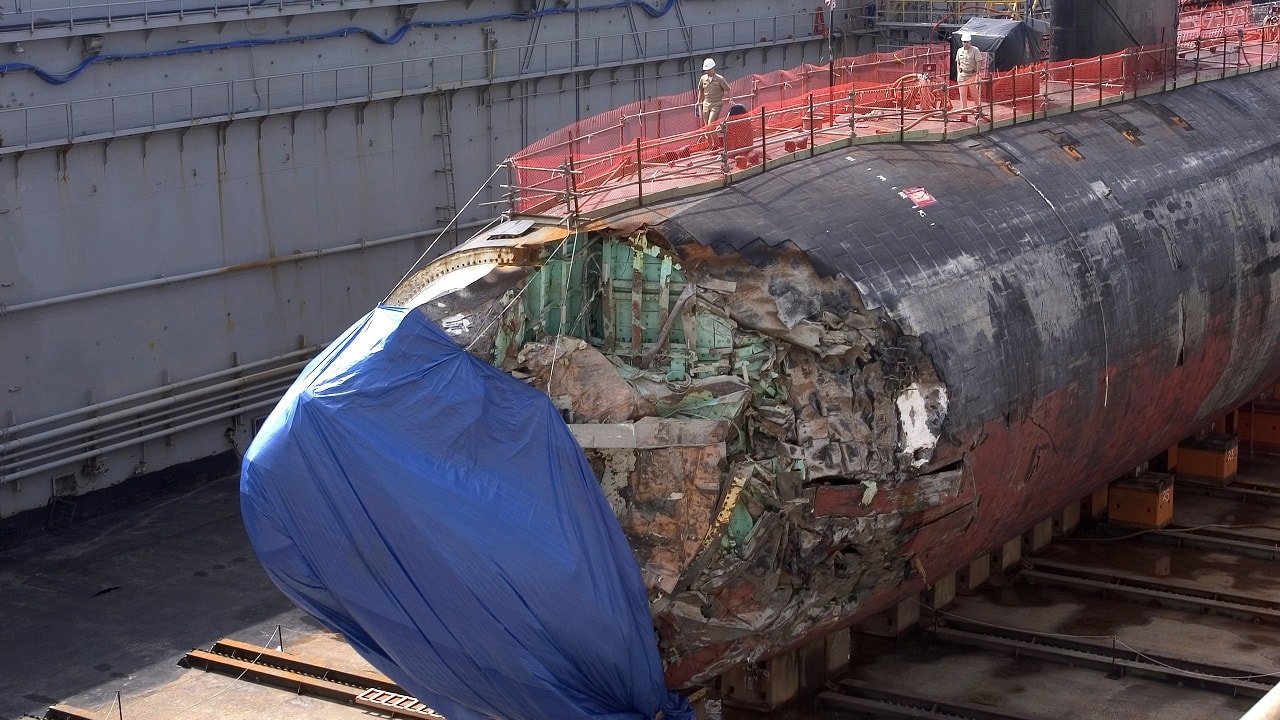
Key Takeaways – In 2005, the Los Angeles-class attack submarine USS San Francisco slammed at high speed into an unmapped seamount, turning a routine deep-water transit into a survival fight.
-The bow crumpled, sailors were badly injured, and one machinist’s mate later died—yet the pressure hull and reactor plant held.
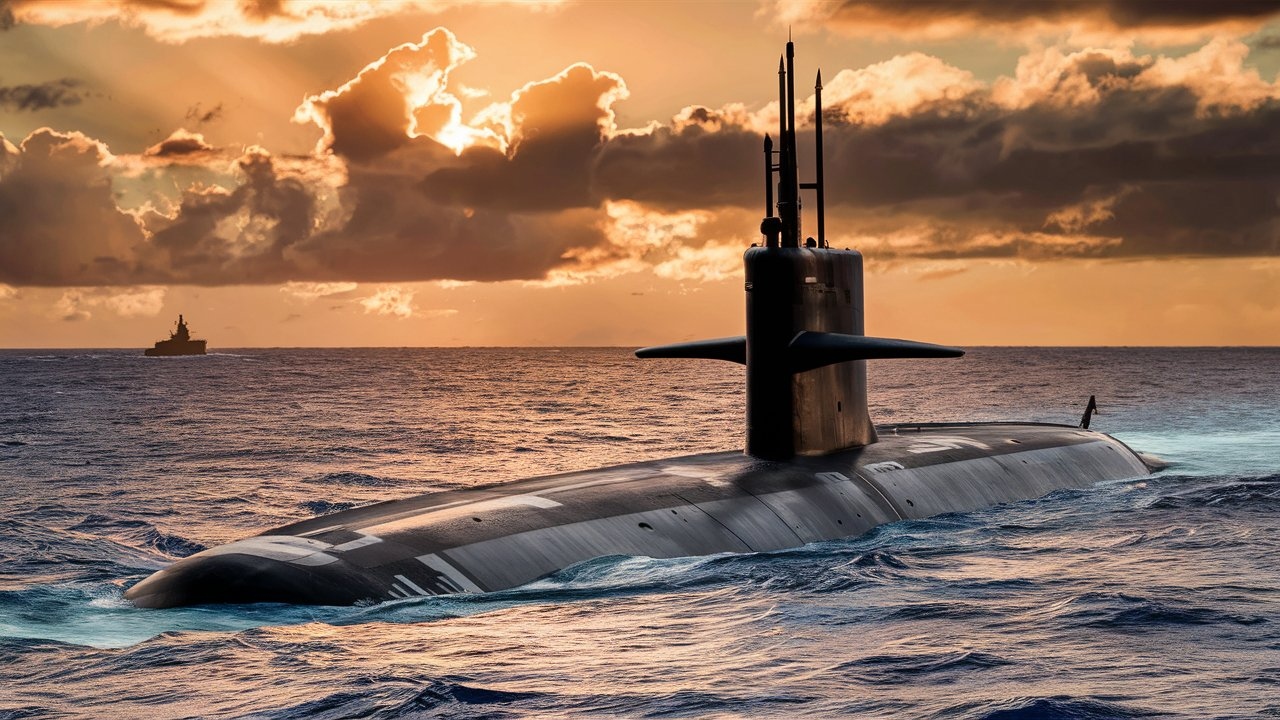
Los Angeles-Class Submarine. Image Created by Ideogram.
-Emergency blows, compartmentation, and drilled-in damage control brought the battered boat to the surface and back to Guam.
-Investigators blamed navigation failures and overconfidence, prompting tighter voyage-planning standards and renewed seabed mapping.
-Shipyard crews later cut off the destroyed bow and grafted on a new one, sending San Francisco back to sea before her final role as a training ship.
This Los Angeles-Class Submarines Proved How Tough U.S. Navy Subs Really Are
About ten years ago, I discovered that an actual Los Angeles-class submarine smacked into what many call an ‘underwater mountain‘ and didn’t sink. When I asked an Electric Boat engineer about it – someone who actually helped build the sub – he was not surprised: “[T]hose subs were built for war with Russia. They have to be able to survive what looks impossible.”
On a January day in 2005, USS San Francisco was sprinting deep and fast in the vast Pacific, en route from Guam toward Australia. The crew had every reason to believe their plotted track was safe.
Then, without warning, the boat slammed head-on into an underwater mountain and everything inside lurched forward. Sailors were thrown, equipment wrenched from mounts, alarms flooded the control room. In seconds, the mission turned into a fight for buoyancy, stability, and survival.

PACIFIC OCEAN (July 31, 2018) – Sailors assigned to Los Angeles-class fast-attack submarine USS Olympia (SSN 717) participate in a swim call at sea, July 31 (U.S. Navy photo by Fire Control Technician Senior Chief Vien Nguyen)
Amid the chaos, the crew executed the emergency blow—dumping high-pressure air into main ballast tanks to claw the submarine back to the surface. It worked, despite the bow structure being crumpled and the forward ballast tanks taking the brunt of the impact.
The crew stabilized the boat, treated the injured as best they could, and coaxed the shaken vessel toward Guam on the surface. One machinist’s mate, Joseph Ashley, succumbed to injuries; many shipmates were hurt, but the pressure hull held and the reactor plant remained secure. The submarine was bruised, not broken.
Why Submarine USS San Francisco Survived What Should Have Sunk Her
Submarines are purpose-built to endure crushing pressure from the outside; few are designed to collide with a mountain. Why did San Francisco survive?
Start with structure. A Los Angeles-class sub has a robust cylindrical pressure hull nestled behind lighter “non-pressure” framing in the bow where the large spherical sonar array and ballast tanks live. In a head-on impact, that sacrificial forward volume can deform to absorb energy while the pressure hull—the crew’s life capsule—stays intact. Compartmentation and ruggedized systems keep critical engineering plant equipment secure under shock loads.Add to that the boat’s emergency buoyancy tools and disciplined drills. When the crew triggered the emergency blow, massive banks of compressed air displaced seawater in the main ballast tanks, giving the boat the lift it needed to break the surface even with damaged forward tanks.
Design philosophy matters, but so does training. The submarine force treats damage control as a religion; sailors practice it until it’s muscle memory. That’s what you saw in those minutes after the impact: triage stations set up in cramped spaces, electrical and mechanical checks cycling furiously, and the control team nursing the sub through the surface transit back to Guam. The Los Angeles-class was engineered for resilience; the crew used every ounce of it.
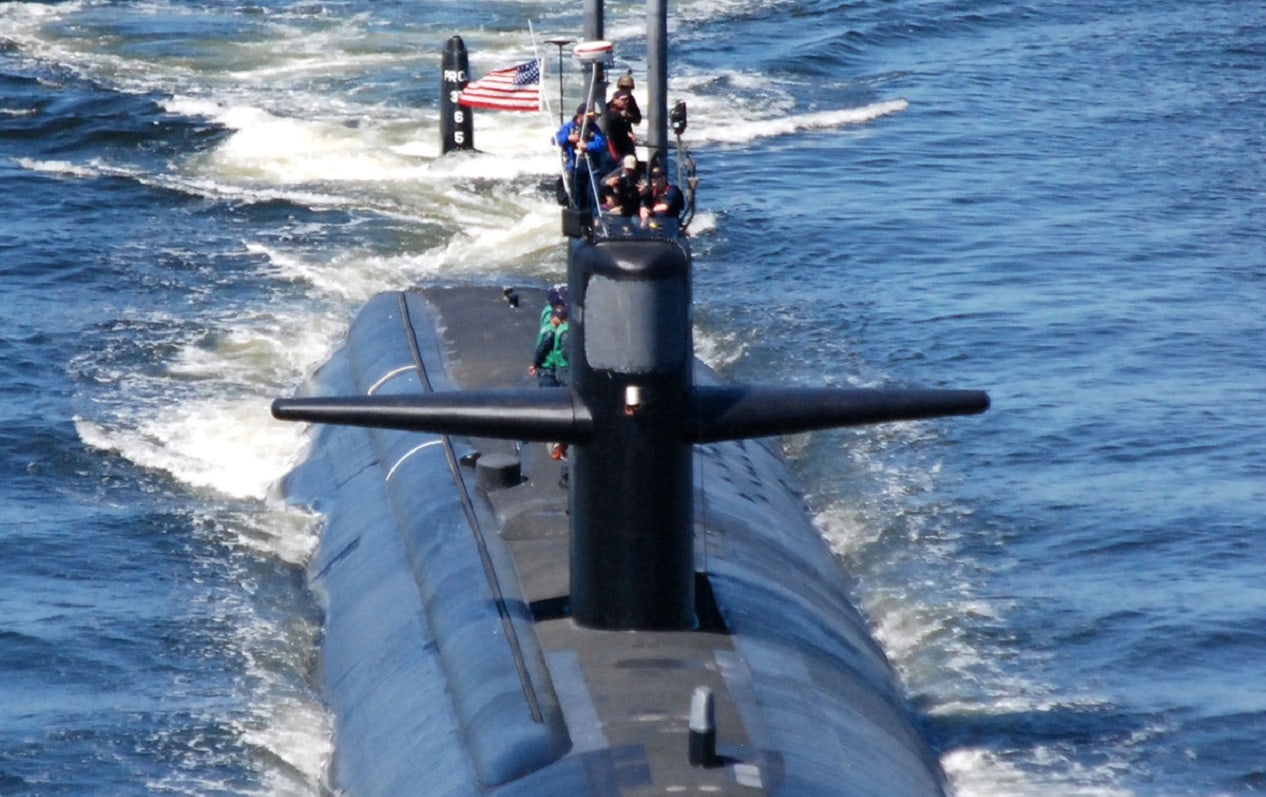
Los Angeles-Class Attack Submarine. Image Credit: Creative Commons.
What The Investigation Found—And Fixed
The Navy’s investigation pulled no punches.
The root cause wasn’t fickle fate; it was navigation. The seamount USS San Francisco struck was not shown on the primary chart in use, but investigators concluded the team had not built a “belt-and-suspenders” picture from all available sources and had accepted more risk than warranted at high speed and depth. In plainer language: incomplete data and overconfidence met the worst possible geography.
The aftermath changed behavior and, to a degree, the ocean mapping enterprise. Fleet commanders reinforced conservative voyage planning standards for deep transits and demanded redundant checks—fathometer (echo-sounder) monitoring, grab-sampling of alternate chart products, and updated “subnotes” with hazard reviews.
Just as important, the Navy, NGA, NOAA, and academic partners accelerated efforts to stitch sparse soundings, satellite-derived gravity data, and rescued legacy bathymetry into more complete global grids. No single dataset will ever be perfect, but the lesson was unmistakable: never bet a boat on a single map.
The “Nose Transplant” That Put Her Back To Sea
When shipyard workers finally laid eyes on San Francisco’s bow, it looked like a crushed soda can. The pressure hull aft of the bow was sound, however, and the boat had recently been refueled—meaning she still had years of reactor life.
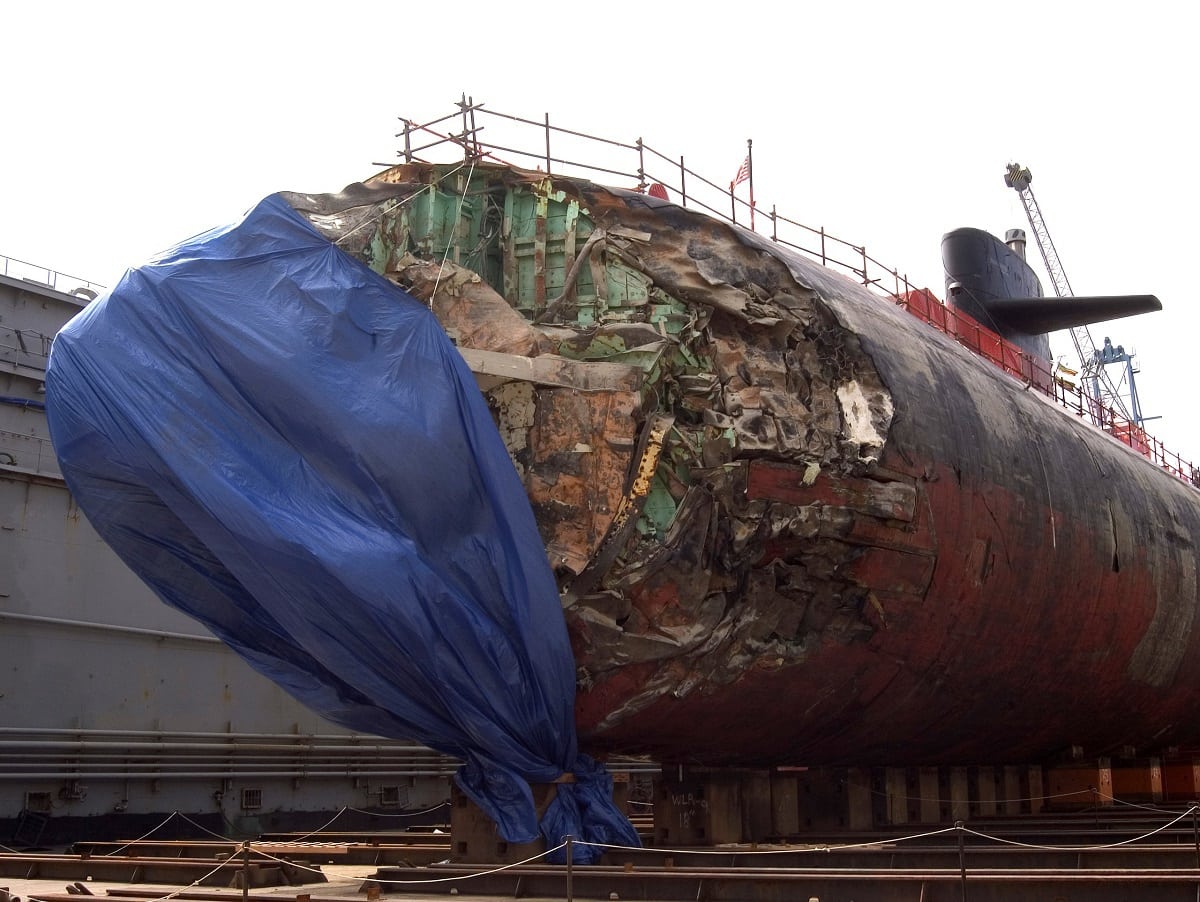
050127-N-4658L-015.Apra Harbor, Guam (Jan. 27, 2005) – The Los Angeles-class fast-attack submarine USS San Francisco (SSN 711) in dry dock to assess damage sustained after running aground approximately 350 miles south of Guam Jan. 8, 2005. . The Navy former dry dock known as “Big Blue” is capable of docking ships that weigh up to 40,000 Long Tons. The Navy certified Big Blue for the one-time docking of San Francisco. San Francisco is the second fast-attack submarine to be attached to the forward-deployed Submarine Squadron Fifteen, home ported on board Naval Base Guam. U.S. Navy photo by Photographer’s Mate 2nd Class Mark Allen Leonesio (RELEASED)..
The Navy made a pragmatic call: rather than decommission San Francisco or refuel another boat, technicians at Puget Sound Naval Shipyard cut off the mangled forward end. They grafted on the intact bow section from a sister sub that was retiring. It was a feat of heavy engineering: more than a million pounds of steel, a sonar sphere, and ballast tanks were aligned, joined, rewired, and retested.
The economics were compelling—tens of millions less than refueling another hull—and the result was a fully restored attack submarine. In 2008, she undocked with the new bow attached, and by 2009, San Francisco was back at sea, completing additional deployments before closing out active service.
In 2016, the boat shifted to a second career as a moored training ship, where new generations of sailors learn the very systems and procedures that once saved her crew.
What The Crash Teaches About The Los Angeles-Class
For all the glamorous talk about stealth and sensors, the Los Angeles-class’ quiet superpower is survivability. Several design features converged to keep San Francisco whole:
-A strong, shock-tolerant pressure hull that takes punishment without cracking and isolates the crew and reactor from the forward crumple zones.
-Spherical bow sonar and surrounding structures ahead of the pressure hull that can deform like a crumple zone in a car accident, bleeding off energy before it reaches the people capsule.
-Redundant floatation and emergency buoyancy, including high-pressure air banks dedicated to fast “blows” of main ballast tanks.
-Designed-in compartmentation and rugged mounts that keep critical gear online after shock.
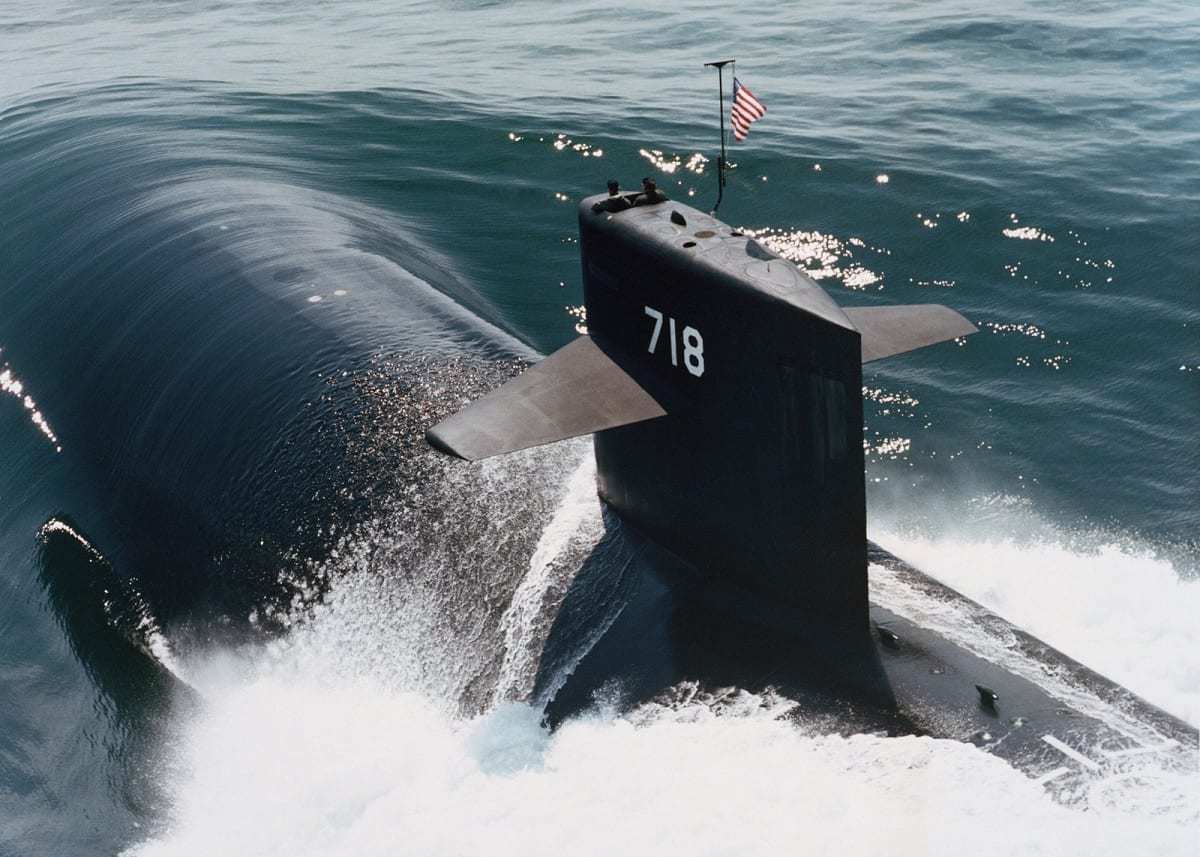
Aerial port quarter view of the sail area of the Los Angeles class nuclear-powered attack submarine USS HONOLULU (SSN 718). The submarine is underway during sea trials.
Relentless damage-control culture, because steel only gets you so far if the team can’t diagnose, prioritize, and execute under stress.
That last point is hard to quantify but easy to appreciate: the difference between a disaster and a survivable accident often comes down to training and the ability to slow time in a crisis.
The Human Ledger
It’s impossible to tell this story without acknowledging the cost. One sailor lost his life; nearly a hundred shipmates were injured. The collision was survivable, but it was not benign.
That the crew brought San Francisco home speaks to their discipline and courage; that the crash happened at all is a sober reminder that complacency and gaps in data can compound into catastrophe at sea. The community honored the fallen, cared for the wounded, and then did the hardest, most necessary thing: learned.
From Seamount To Shipyard To Sea—And Beyond
San Francisco’s arc after the accident is almost cinematic: crushed bow, daring shipyard “transplant,” renewed deployments, and finally a dignified retirement to serve as a schoolhouse. It’s also instructive—the choice to repair and return her to sea balanced cost, fleet needs, and safety.
The decision to end her seagoing career and transition to a training platform ensured that the lessons—both mechanical and human—would resonate with the next generation.
There’s a broader resonance, too. The Navy’s submarine force was built on the back of painful experience—from Thresher to San Francisco—and it tends to institutionalize what it learns.
After 2005, voyage planning standards tightened, navigation teams embraced a more skeptical, multi-source mindset, and the mapping community got fresh momentum to improve the seabed picture.
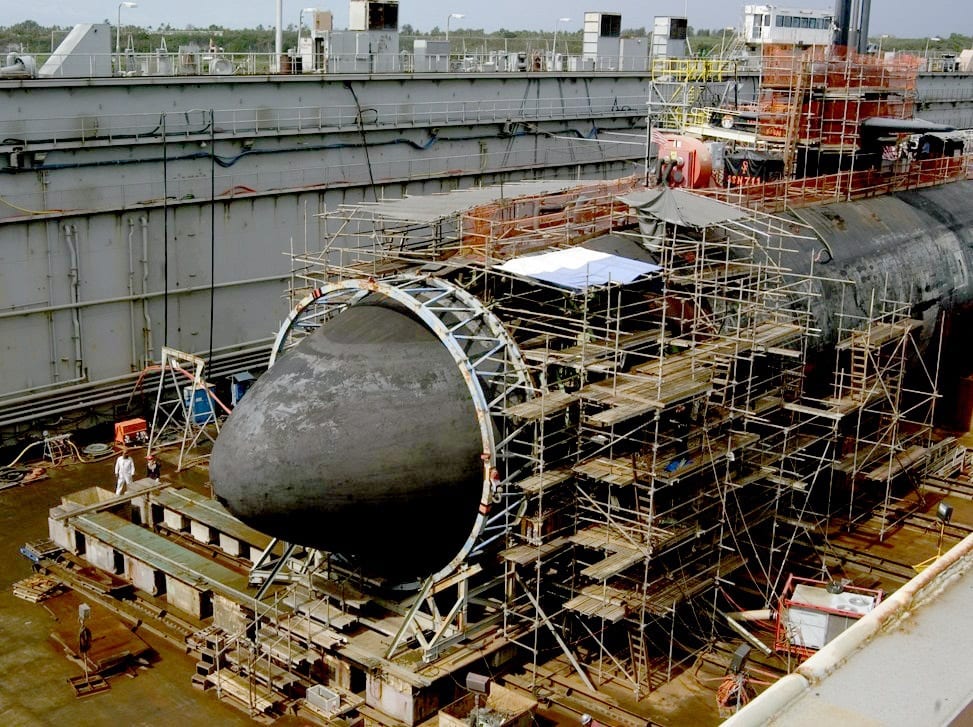
Apra Harbor, Guam (May 8, 2005) Ð The Los Angeles class submarine USS San Francisco (SSN 711) shown in dry dock is having repairs made on its damaged bow. A new large steel dome about 20 feet high and 20 feet in diameter was put in the place of the damaged bow. San Francisco ran aground 350 miles south of Guam Jan. 8, killing one crew member and injuring 23. U.S. Navy photo (RELEASED)
None of that erases the risk of the deep ocean; it does make the next accident less likely and more survivable.
Why This Submarine Story Still Matters
The Pacific hasn’t grown any smaller, and the seafloor hasn’t gotten any flatter. Submarines routinely operate in poorly surveyed regions where GPS can’t help them, at speeds and depths that give crews little time to react.
The 2005 collision remains a cautionary tale about navigation humility and a powerful validation of American submarine engineering. When everything went wrong, the hull held, the emergency systems worked, and a well-trained team bought itself a second chance.
In an era obsessed with new sensors and exotic propulsion, San Francisco’s lesson is timeless: design for the worst day, drill for the worst day, and—if it comes—fight your boat home.
About the Author: Harry J. Kazianis
Harry J. Kazianis (@Grecianformula) was the former Senior Director of National Security Affairs at the Center for the National Interest (CFTNI), a foreign policy think tank founded by Richard Nixon based in Washington, DC. Harry has over a decade of experience in think tanks and national security publishing. His ideas have been published in the NY Times, The Washington Post, The Wall Street Journal, CNN, and many other outlets worldwide. He has held positions at CSIS, the Heritage Foundation, the University of Nottingham, and several other institutions related to national security research and studies. He is the former Executive Editor of the National Interest and the Diplomat. He holds a Master’s degree focusing on international affairs from Harvard University.

