
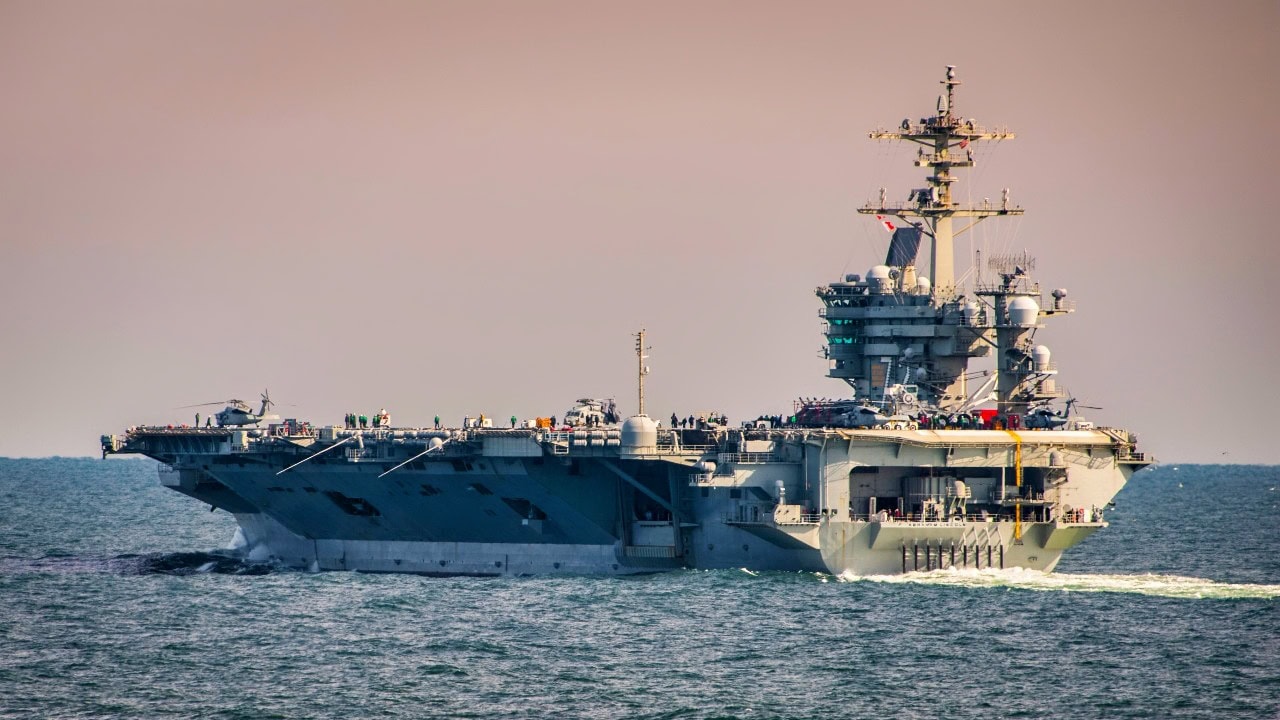
Article Summary – Born from Cold War fears of Soviet bombers, submarines, and missiles, USS Nimitz (CVN-68) became the template for the modern nuclear supercarrier.
-Her twin reactors, four catapults, and vast deck space enabled unmatched endurance and sortie generation from Vietnam’s aftermath through Desert Storm, the post-9/11 wars, and today’s Indo-Pacific tension with China.
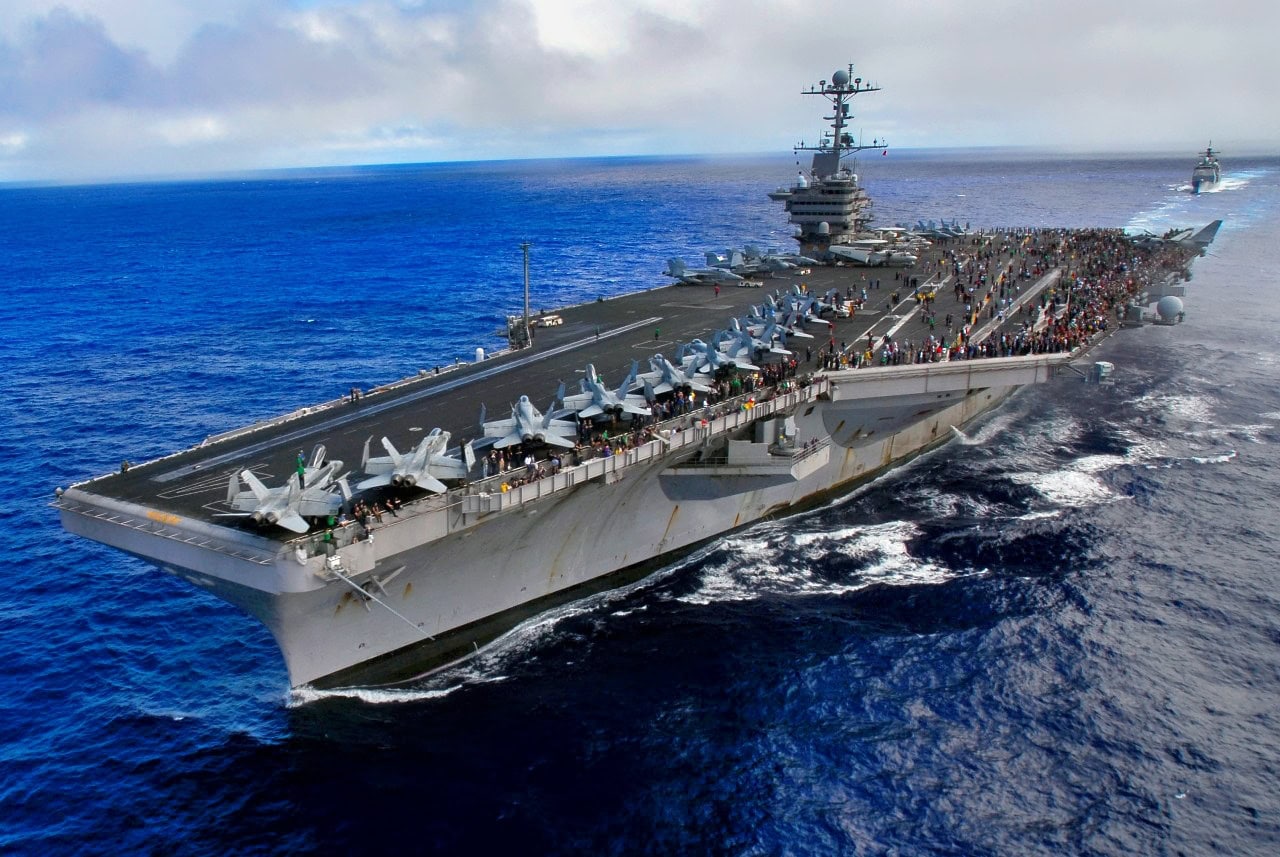
Nimitz class aircraft carrier USS John C. Stennis (CVN 74) leads guided-missile cruiser USS Antietam (CG 54) prior to conducting an air power demonstration. The air power demonstration showed the capability of Stennis and Carrier Air Wing 9 to service members’ family and friends who were invited to get underway with the ship. Stennis is returning to the United States after a 7 month long deployment promoting peace, regional cooperation and stability, and supporting the global war on terrorism.
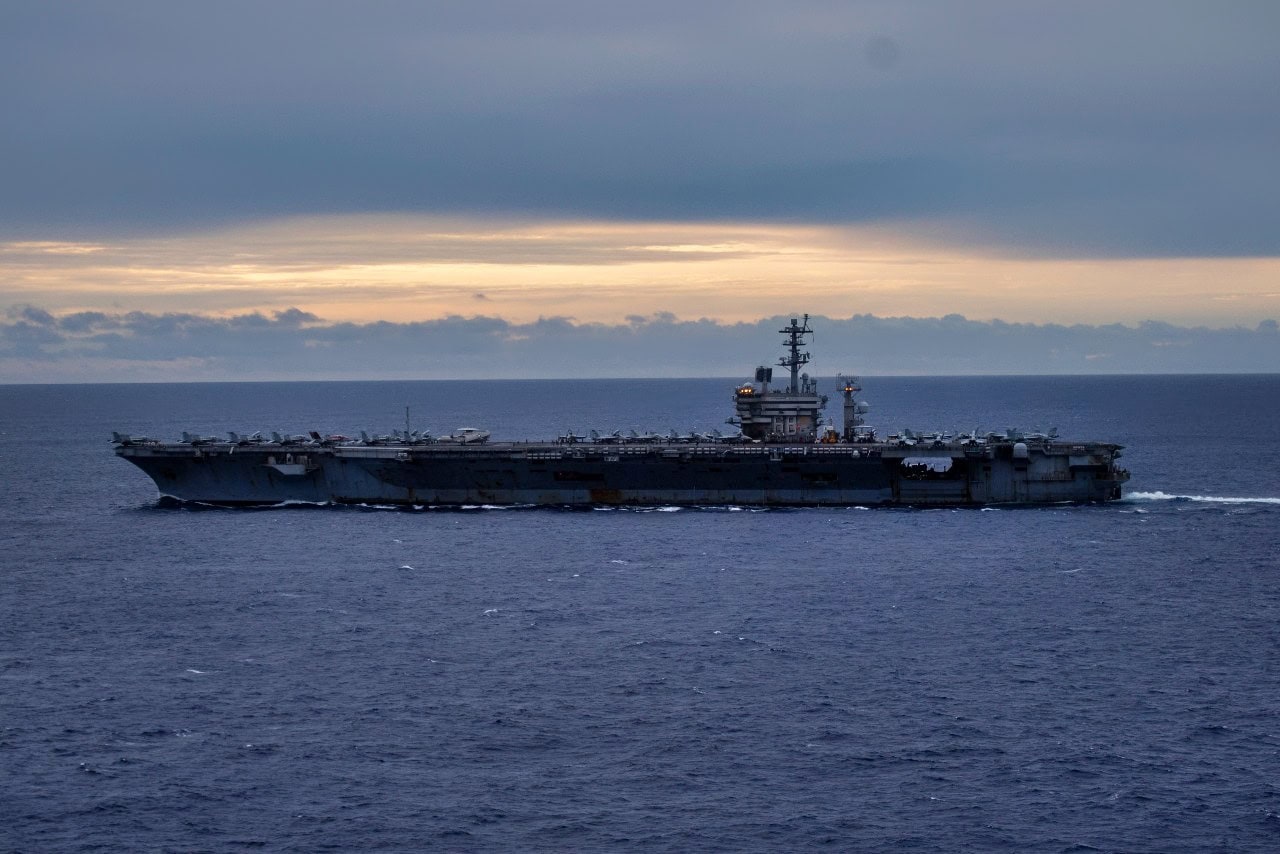
PACIFIC OCEAN (May 30, 2023) The aircraft carrier USS Nimitz (CVN 68) steams through the Pacific Ocean. Nimitz is in U.S. 7th Fleet conducting routine operations. 7th Fleet is the U.S. Navy’s largest forward-deployed numbered fleet, and routinely interacts and operates with allies and partners in preserving a free and open Indo-Pacific region. (U.S. Navy photo by Mass Communication Specialist 3rd Class Kenneth Lagadi)
-Decades of upgrades kept her lethal, from CIWS and ESSM to advanced networks and ever-evolving air wings. Now approaching the limits of her economic service life, Nimitz’s retirement is less a retreat than a handoff—clearing room for Ford-class carriers and a more distributed, unmanned-heavy future fleet.
USS Nimitz vs. the Future Fleet: Should America Keep Its Old Supercarrier?
By the late 1960s, U.S. naval planners faced a stark challenge. The Soviet Union was deploying long-range bombers, nuclear submarines, and antiship missiles—all aimed at pushing American carriers farther from the fight. The answer could not be a marginal improvement; it needed to be a step change in endurance, sortie generation, and survivability.
Enter the concept behind USS Nimitz (CVN-68): a nuclear-powered, high-capacity carrier with the fuel endurance to loiter for months, the deck real estate to cycle large air wings in all weather, and the electrical/power margins to absorb generations of sensors and defenses. The aircraft carrier had already proven decisive in Korea and Vietnam; the strategic wager was that a nuclear supercarrier, properly protected, would remain the centerpiece of U.S. power projection across oceans and time.
And as I have said before, the Nimitz-class of carriers, started here with these carriers, might be the very best ever at sea. Here’s why:
Design DNA: What Came Before—and What Nimitz Changed
Nimitz did not appear from a blank sheet. She was the synthesis of three design lineages:
The Forrestal/Kitty Hawk Line. These post-war conventionally powered carriers standardized the angled flight deck, steam catapults, and deck-edge elevators that made fast-jet operations safe and efficient. Their deck cycle logic—launch, recover, respot, repeat—became the rhythm of modern carrier aviation.
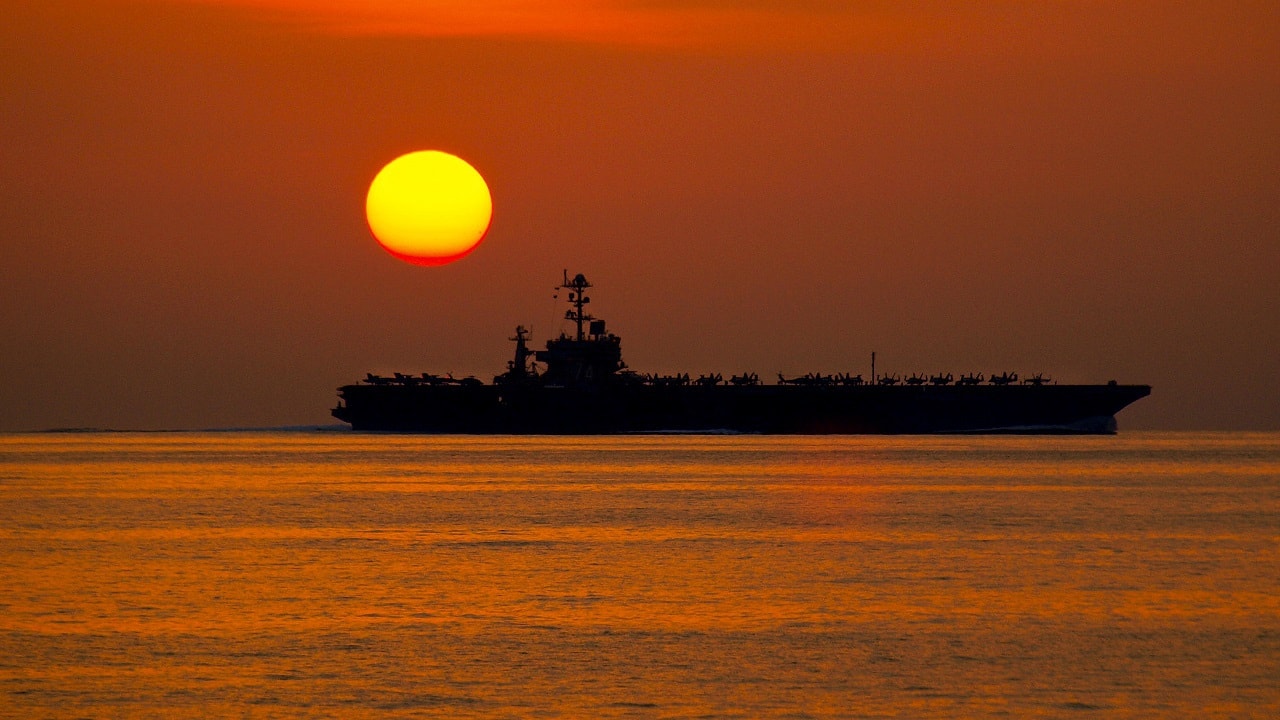
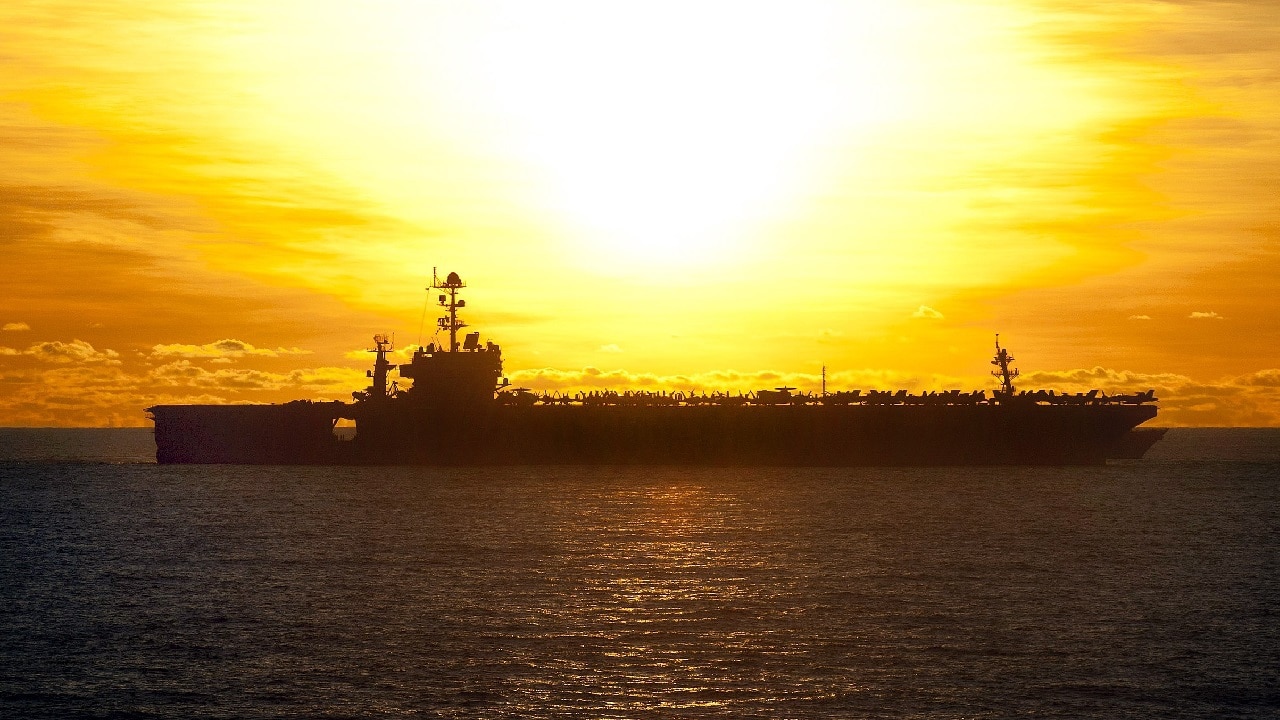
U.S. 5TH FLEET AREA OF RESPONSIBILITY (Jan. 5, 2012) The Nimitz-class aircraft carrier USS John C. Stennis (CVN 74) operates in the Arabian Sea during sunset. John C. Stennis is deployed to the U.S. 5th Fleet area of responsibility conducting maritime security operations, theater security cooperation efforts and support missions for Operation Enduring Freedom. (U.S. Navy photo by Yeoman 3rd Class James Stahl/Released)
(July 8, 2012) The Nimitz-Class aircraft carrier USS George Washington (CVN 73) conducts an early morning replenishment at sea with the George Washington Strike Group. George Washington is forward deployed to Yokosuka, Japan, and is underway in the U.S. 7th Fleet area of responsibility. (U.S. Navy photo by Mass Communication Specialist 3rd Class Paul Kelly/Released) .
USS Enterprise (CVN-65). The first nuclear carrier proved the endurance case but carried eight reactors and unique systems that complicated life-cycle costs. Nimitz adopted a two-reactor approach with more efficient plant design, keeping nuclear endurance while simplifying the machinery arrangement.
Vietnam’s Lessons. Sustained, high-tempo operations in harsh climates pushed designers toward robust aviation fuel systems, larger magazines, and damage control layouts that minimized single-point failures.
The result was a hull nearly 1,100 feet long with four catapults, four arresting wires, expansive hangar volume, and a flight deck plan optimized for cyclic operations. Deck-edge elevators (including the massive portside forward elevator), a compact but functional island, and air ops choreography matured into a repeatable template that later hulls would refine rather than reinvent.
Engineering That Endured: Power, Protection, And The Deck Cycle
Three engineering choices gave Nimitz extraordinary staying power.
Nuclear Endurance. Two pressurized-water reactors delivered years of steaming between refuelings, effectively decoupling operational reach from oilers and allowing the ship to remain on station through protracted crises. Nuclear power also supplied the electrical headroom for evolving radars, combat systems, and self-defense weapons.
Sortie Machinery. Four steam catapults, high-capacity jet blast deflectors, and carefully zoned fueling/arming pits enabled large cycles of fighters, strike jets, and E-2 Hawkeyes. The ship’s air department procedures—where to stage tankers, when to “fence in” the next launch, how to respot the deck—became Nimitz-class doctrine.
Survivability In Depth. Compartmentation, armored magazines, redundant firefighting and electrical runs, and improved damage-control stations were baked in. Later refits layered in electronic warfare, decoys, and point defenses, making Nimitz increasingly resilient against evolving missile threats.
Influences In Steel: How Past Carriers Shaped Nimitz
From Forrestal and Kitty Hawk, USS Nimitz inherited operability—the human-machine choreography of moving metal and men safely under tempo. From Enterprise, she took the nuclear logic: an air wing is only as good as its time on station, and you get that from endurance plus logistics margin. From the Essex and Midway families she took institutional memory—hangar management, weapons elevators that feed the flight deck efficiently, and the relentless focus on safety after tragic fires in earlier eras. Nimitz organized all of those lessons around the post-Vietnam jet age and never looked back.
Operational History: From The Cold War To The Long Wars
Few hulls have touched as many eras as USS Nimitz. Highlights illustrate why she became the archetype:
Early Cold War Deployments. Mediterranean and Indian Ocean cruises put Nimitz at the center of U.S. signaling—deterring adversaries, reassuring partners, and practicing blue-water air defense against long-range bombers and submarines.
Gulf of Sidra (1981). Fighters from Nimitz shot down two Libyan Su-22s after hostile actions over contested waters—an early proof that a Nimitz-class air wing could control the air picture far from U.S. shores and under political scrutiny.
Indian Ocean And Persian Gulf (1980s–1990s). As crises flared—from the Iran hostage aftermath to maritime escort missions—USS Nimitz demonstrated the essential carrier virtues: arrive on time, stay on station, launch on demand.
Post-9/11, Afghanistan, And Iraq. Like her sister ships, Nimitz surged to CENTCOM waters, launching sustained close air support, interdiction, and ISR sorties. The nuclear endurance-plus-sortie machine combination paid dividends when land bases were crowded or politically constrained.
Pacific Presence (2010s–2020s). With tensions rising in the Indo-Pacific, Nimitz rotated through 5th and 7th Fleets, integrating new aircraft and tactics while reinforcing alliance commitments across Japan, Korea, and the Indian Ocean.
COVID-Era Deployments. In the early 2020s, USS Nimitz completed one of the longest carrier deployments of the modern era, a testament to crew resilience and the class’s operational stamina under unprecedented global constraints.
The common thread: credible presence and reliable power projection in every decade of service.
USS Nimitz Wartime Experience: What The Air Wing Proved From Her Deck
Wartime history from Nimitz’s deck reads like a syllabus for modern naval aviation:
Air Superiority And Fleet Defense. The carrier’s fighters controlled airspace around strike packages and protected high-value units, practicing long-chain engagements against cruise-missile-armed bombers and increasingly capable adversary fighters.
Strike And Close Air Support. From precision strikes on hardened targets to dynamic targeting in support of troops ashore, Nimitz’s air wings cycled day and night, integrating forward air controllers, tanker plans, and complex routing across heavily defended terrain.
ISR And Command-And-Control. E-2 Hawkeyes, organic tankers, and later sophisticated network nodes turned the carrier into a floating air operations center, sharing a fused picture with joint and coalition forces.
When crises demanded, Nimitz delivered round-the-clock effects—the fundamental measure of carrier relevance.
Accidents And Lessons: Safety Paid For In Blood Onboard USS Nimitz
Long careers are honest. USS Nimitz endured the tragedy of a catastrophic flight deck crash and fire in the early 1980s that killed and injured sailors, drove reforms in ordnance handling, and shaped Navy culture around sobriety, supervision, and standardization. Those lessons—written in red ink—echo across today’s deck procedures, from weapons stowage to crash-and-salvage drills. The ship’s survival and fast recovery underscored the class’s built-in resilience and the crew’s professionalism.
Upgrades That Kept Nimitz Lethal: From CIWS To CEC
If Nimitz’s design was the skeleton, upgrades were the muscle that kept her fighting fit:
Refueling And Complex Overhaul (RCOH). Mid-life refueling plus deep system replacement reset the reactor clock and modernized propulsion, electrical distribution, and damage-control ecosystems. RCOH also opened space and power margins for later combat-systems growth.
Air Defense Evolution. From NATO Sea Sparrow to Evolved Sea Sparrow Missile (ESSM), from Phalanx CIWS to rolling in RAM launchers, Nimitz gained layered point defense against sea-skimmers and fast inbounds.
Sensors And Combat Systems. Successive radars, electronic warfare suites, decoys, and Ship Self-Defense System (SSDS) integrations tightened the ship’s reaction time and automated threat classification—critical when seconds matter.
Networking. Cooperative Engagement Capability (CEC), Link-16, and other data-links turned the battle group into a sensor-shooter web, allowing Nimitz to fire with someone else’s eyes and share her own picture widely.
Aviation Ecosystem. The flight deck and aviation support systems adapted for heavier, hotter jets; jet blast deflectors, fueling systems, and maintenance spaces were upgraded to support successive air wings—from A-7s and F-14s to F/A-18E/Fs, EA-18Gs, and E-2D Hawkeyes.
This growth path is why a ship commissioned in the 1970s remained decisive half a century later.
The Air Wings She Launched: Generations Of Naval Aviation
Walk the arc of Nimitz and you walk the arc of U.S. carrier aviation:
Early Years. A-7 Corsair II, F-14 Tomcat, A-6 Intruder, EA-6B Prowler—airframes that defined Cold War sea control and deep strike.
Transition Period. F/A-18C/D Hornets and S-3 Viking tankers evolved the carrier air wing toward multirole efficiency and organic tanking.
Modern Wing. F/A-18E/F Super Hornet, EA-18G Growler, E-2D Advanced Hawkeye, MH-60R/S helicopters—networked, precise, and built for complex electronic warfare and maritime strike alongside joint partners.
The ship’s hangars, shops, and deck crews adapted each time, proof that design headroom is strategy in steel.
Retirement On The Horizon: What It Means And Why Now
Nuclear carriers do not “wear out” overnight; they complete a nuclear life plan. After one RCOH, Nimitz is approaching the outer edge of economic service life. Retirement involves defueling, inactivation, and a protracted recycling process that respects nuclear stewardship and the scale of the hull.
Why not another extension? Because every additional year demands disproportionate maintenance, parts hunts for legacy systems, and crew hours to keep vintage plant and auxiliaries within safe margins. At some point, dollars and sailors invested into a first-of-class ship buy less combat power than those same dollars and sailors invested into ships with decades of runway left.
Legacy: The Template Everyone Else Followed
Nimitz’s legacy is threefold.
She Proved The Model. Nuclear power for endurance; a deck cycle built around four cats and edge elevators; a hull and plant with upgrade headroom. Nine sister ships followed, enabling nearly half a century of uninterrupted carrier presence around the world.
She Institutionalized The Culture. Safe, repeatable high-tempo operations; cross-deckable procedures; a maintenance ecosystem that could regenerate combat power thousands of miles from home.
She Shaped Deterrence. Adversaries planned around where Nimitz-class hulls were and could be tomorrow. That constant—visible, credible, renewable power—prevented wars we rarely count.
The Case For Keeping Nimitz A Little Longer
It’s not hard to make the argument. The Pacific is becoming increasingly treacherous. The Ford-class—with electromagnetic catapults, advanced arresting gear, and higher sortie potential—is arriving, but each new hull takes time to work up, integrate, and deploy. A familiar, proven Nimitz-class ship buys surge capacity while shipyards push new construction. In a world where capacity matters—missiles, tanks, and tails—the instinct to keep what works is understandable.
Advocates add that crews already know the plant and procedures; the air wing fits the deck; the logistics pipeline is global. And in crisis, a hull at sea beats a hull on blocks.
The Case Against: Cost, Crew, And Combat Credibility
Three realities argue for letting Nimitz retire on plan.
Opportunity Cost. Every maintenance dollar and sailor devoted to a life-extended first-of-class is a dollar and sailor not building and manning new ships or accelerating modernization on younger carriers. Budgets are finite; so is skilled labor.
Aging Systems. Even with upgrades, legacy steam plants and auxiliaries demand intensive care. Spare parts procurement becomes bespoke. Those are hours not spent mastering the newest sensors, networks, and weapons that define twenty-first-century carrier fights.
Fight Of The Future. The threat web—long-range missiles, drones, and space-enabled targeting—demands quiet signatures, agile networks, and deep magazines across the air wing and escort team. Younger hulls with decades of life ahead are the better chassis for the next waves of hardening and integration.
Put simply: honoring Nimitz means not asking her to do in her last chapter what younger ships can do more safely and more efficiently for many years to come.
USS Nimitz: What Her Sunset Says About The Fleet We Need
Retiring Nimitz is not retreat; it is rotation—out with a legend that proved the model, in with ships that evolve it. The Navy’s risk is not losing a single hull; it is losing time if construction and workups lag the threat. That argues for disciplined schedules, healthy public-private yards, and investments that increase availability across the carrier force rather than heroic extensions on singular icons.
The fleet we need for the Indo-Pacific mixes Ford-class carriers, hardened escorts, stealthy submarines, and proliferated unmanned systems, all tied by resilient battle networks. That is how you stay inside an adversary’s decision loop and outlast the first shocks of a missile-saturated fight. That also happens to be the truest tribute to the ship that taught the world what a modern carrier could be.
The Final Word: A Trailblazer’s Goodbye
USS Nimitz was the proof that nuclear super-carriers, properly designed and upgraded, could dominate the air-sea fight for generations. She did exactly that—through crises, wars, and the upheavals of a changing world. Her retirement should be marked not only by ceremony but by continuity: the uninterrupted ability of the United States to show up anywhere on Earth with precision airpower from the sea. The best way to honor Nimitz is to ensure that ability never blinks.
About the Author: Harry J. Kazianis
Harry J. Kazianis (@Grecianformula) was the former Senior Director of National Security Affairs at the Center for the National Interest (CFTNI), a foreign policy think tank founded by Richard Nixon based in Washington, DC. Harry has over a decade of experience in think tanks and national security publishing. His ideas have been published in the NY Times, The Washington Post, The Wall Street Journal, CNN, and many other outlets worldwide. He has held positions at CSIS, the Heritage Foundation, the University of Nottingham, and several other institutions related to national security research and studies. He is the former Executive Editor of the National Interest and the Diplomat. He holds a Master’s degree focusing on international affairs from Harvard University.

