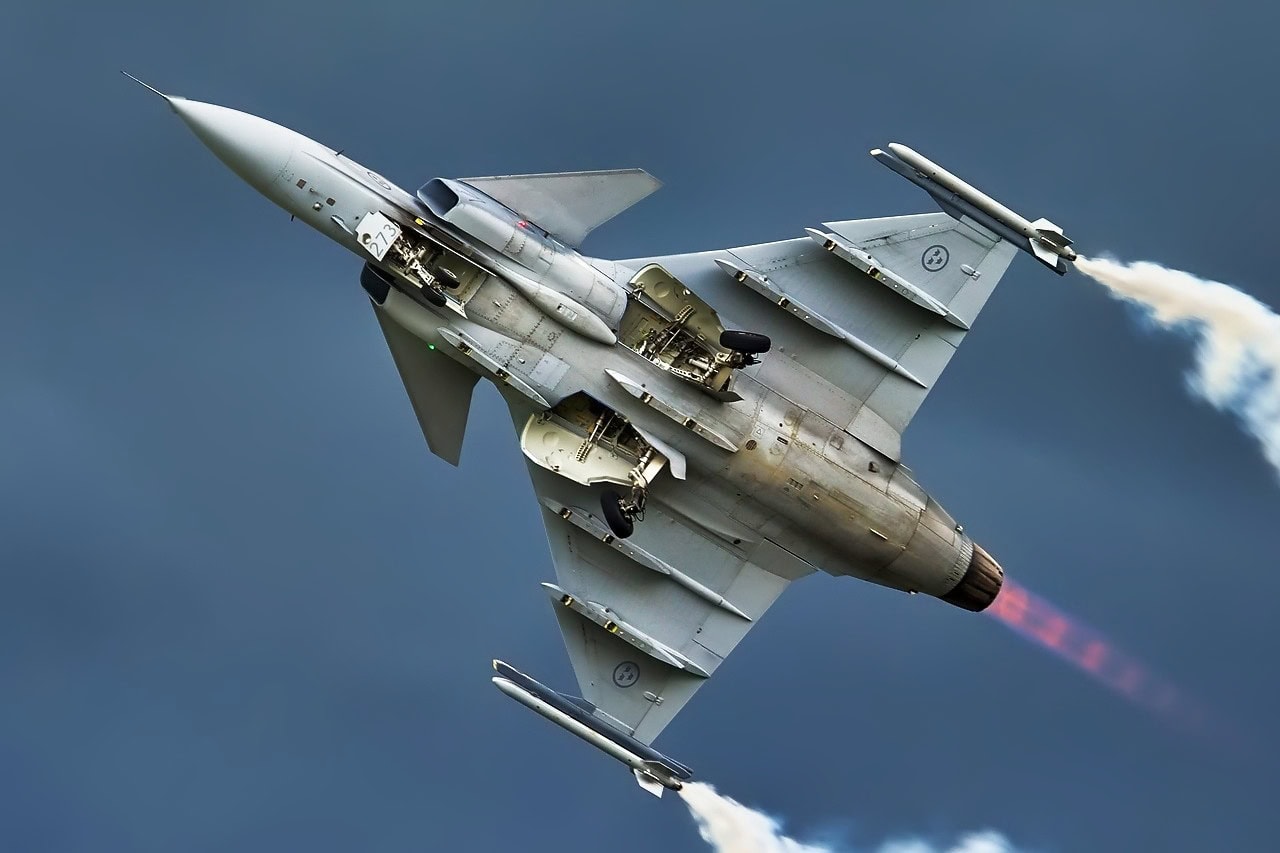
Key Points and Summary – Saab is under scrutiny after CEO Micael Johansson claimed a Canadian JAS 39 Gripen E production line and R&D hub would create up to 10,000 domestic jobs.
-The pledge echoes similar promises in Brazil, where actual employment appears far lower. Saab now says the figure reflects long-term global demand and wider sustainment work, but offers no detailed breakdown.
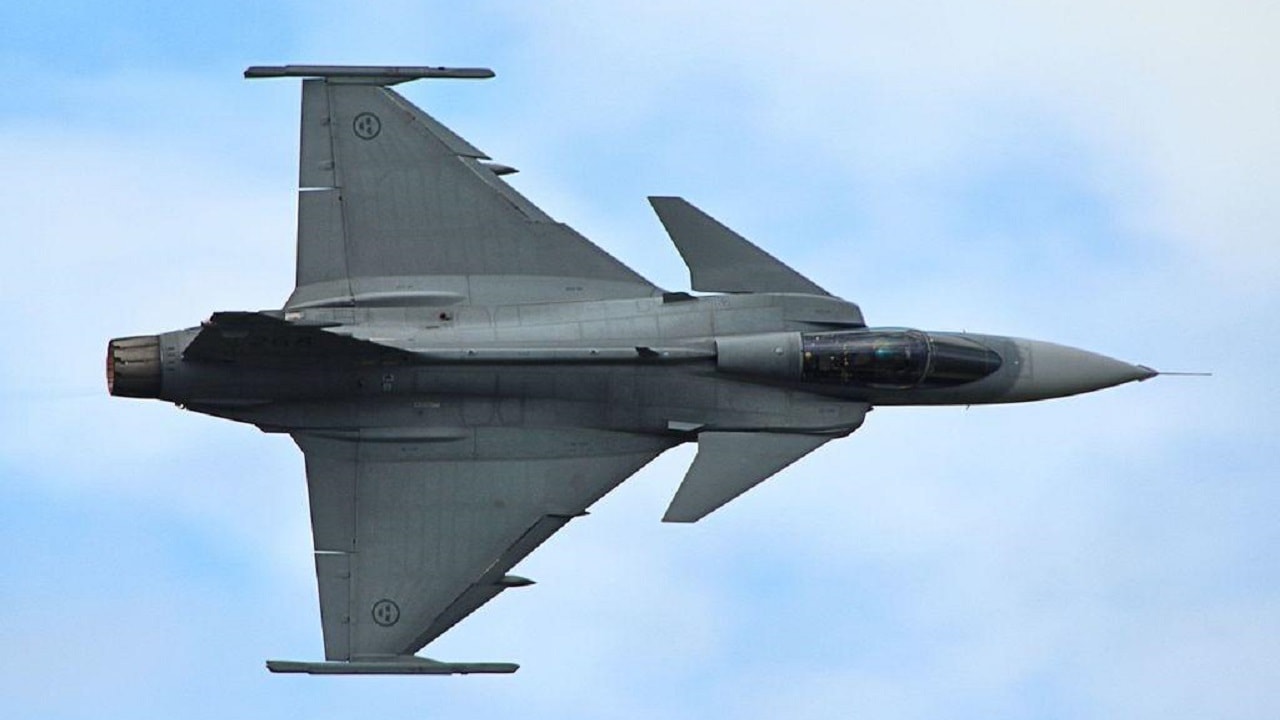
JAS 39 Gripen. Image Credit: Creative Commons.
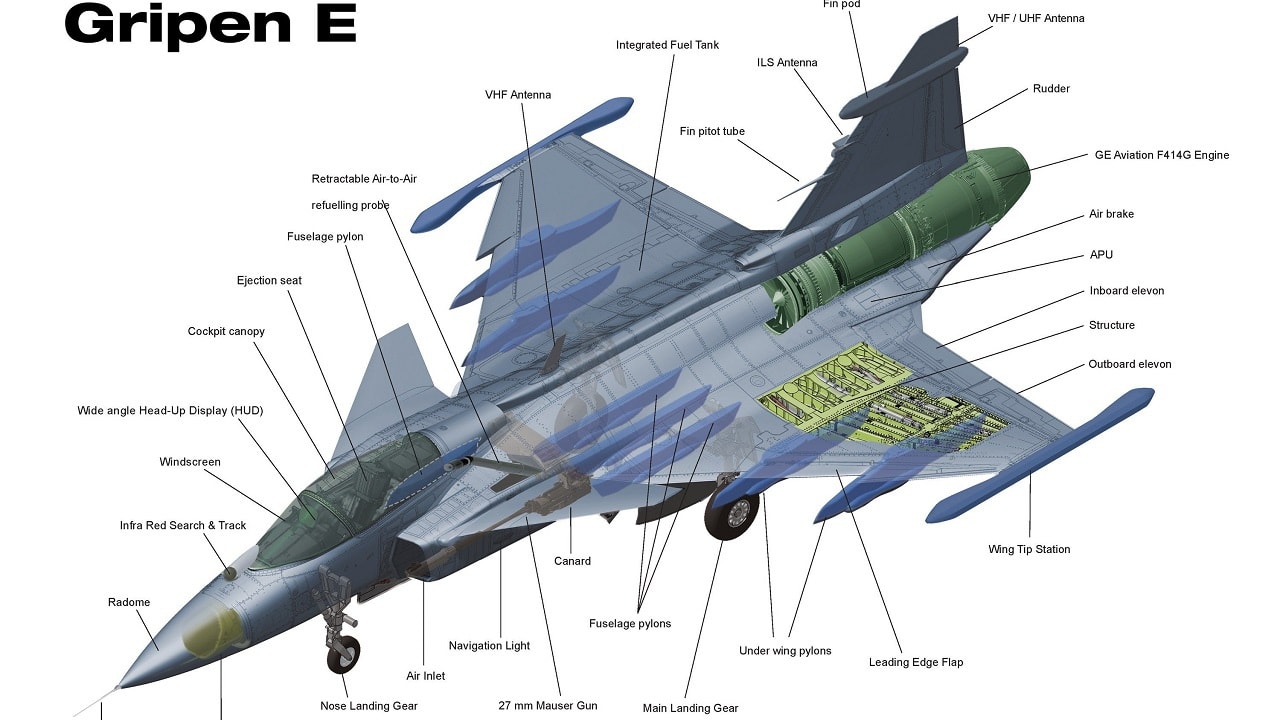
JAS 39 Gripen. Image Credit: Creative Commons.
-At the same time, a leaked 2021 evaluation shows the F-35 outscoring the Gripen E in every category, 95 percent to 33 percent, just as Ottawa reexamines its F-35 buy and weighs a mixed fleet.
-That leaves Saab’s big jobs pitch—and its anti-stealth rhetoric—under tough political and technical scrutiny.
Did Saab Really Promise 10,000 Canadian Jobs for the JAS 39 Gripen E?
Saab, the Swedish aerospace firm, has taken flak from critics over its assertion that if Ottawa selects the company’s Gripen E fighter to replace Canada’s CF-18 Hornet fleet, it will create 10,000 jobs domestically to build and sustain the fleet.
A Promise of Job Growth with JAS 39 Gripen?
The 10,000-job figure came to light in November, when Saab CEO Micael Johansson appeared on-air during a Canadian Broadcasting Corporation broadcast. During the interview, Johansson said that not only would his firm set up a production line in Canada to assemble new-built Gripen E fighters, but that Saab would also set up a research and development hub in addition to the manufacturing line.
“We can start delivering across to Canada if they select a dual slate in three years’ time,” Johansson said to CBC. And, he added, once the line is up and running, the Royal Canadian Air Force could expect to receive its first Gripen E in “roughly, between, three and five years depending on the setup,” he said, adding that the partnership would create somewhere between 9,000 and 10,000 Canadian jobs. There is already a precedent for the domestically assembled line model in Brazil.
The South American country’s decision to buy the Gripen E for the Brazilian Air Force was sweetened by Saab’s decision to build a Gripen assembly line domestically in Brazil. And, like Saab’s CEO’s recent assertion, the Swedes also talked up how many jobs would be created there.
But the actual number of Brazilians employed at the Gripen production line may in fact be in the low hundreds, rather than thousands.
It is unclear what caused the discrepancy between the two numbers, though a Saab spokesperson offered some clarity to Canadian media.
Tangible Job Growth
That 10,000-job estimate is a testament to the economic impact Saab estimates a Gripen E purchase would have on Canada. “The figure is based on projected global demand for Gripen and the corresponding production, sustainment, and R&D activities Canada would undertake,” the Saab spokesperson said via emailed remarks to Canadian media.
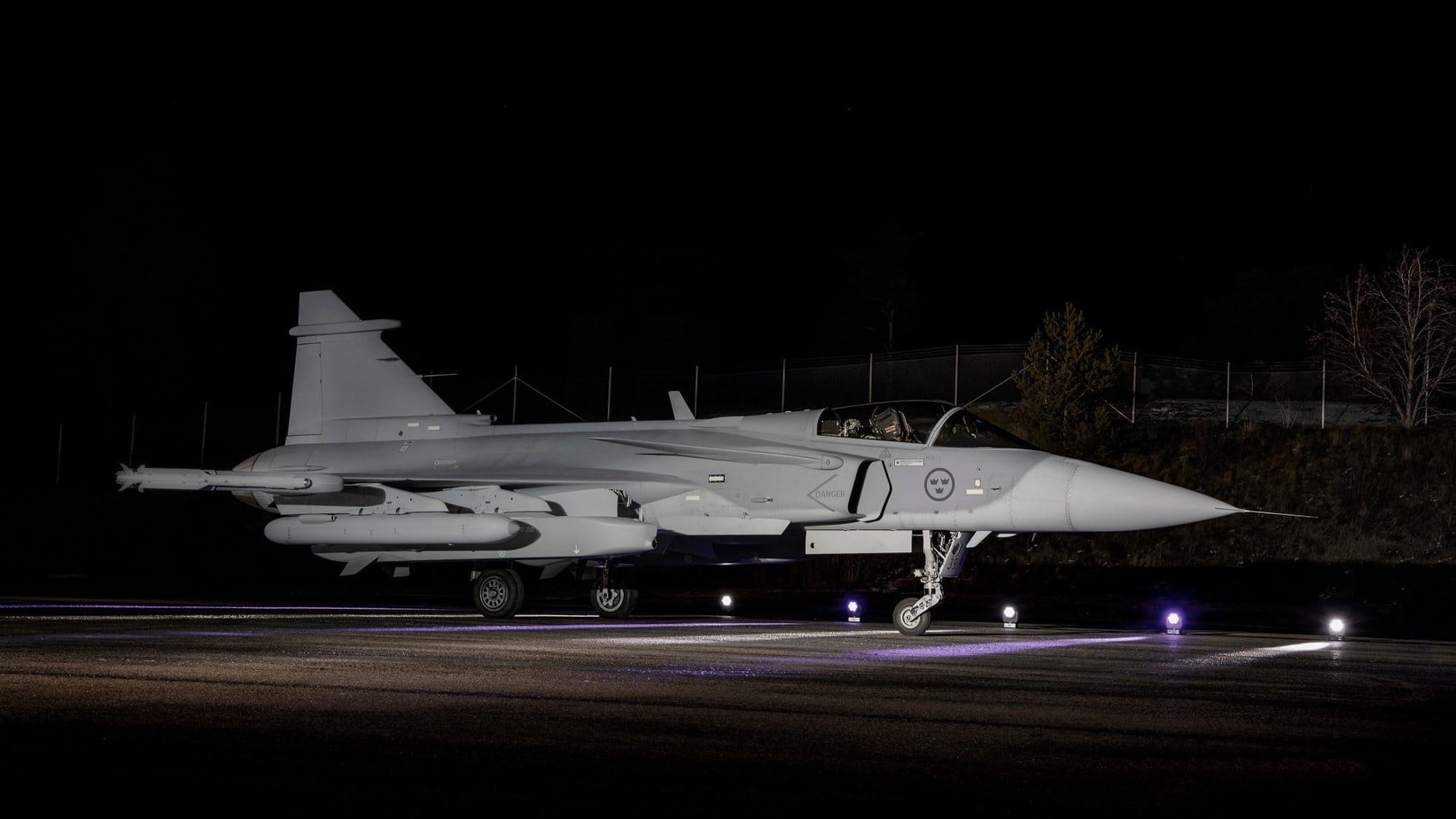
JAS 39 Gripen. Image Credit: Creative Commons.
“The details of the industrial program and the associated modelling are part of ongoing discussions with the government of Canada, so we’re not in a position to share specific breakdowns,” she caveated.
“However, the estimate aligns with established industry benchmarks and what we know Canadian firms can support.”
Canada’s Cold War-era CF-18 Hornet fleet numbers 88 aircraft. And though closely related to the United States Navy’s older Hornet carrier-capable multirole fighters, both the American and Canadian Hornets have gotten long in the tooth.
In the United States Navy, several newer aircraft have gradually complemented and replaced the Hornets, with both the similar but significantly larger and more capable Super Hornet and the cutting-edge F-35 stealth fighter operating from American flight decks. And while Canada initially elected the F-35 to replace its CF-18s on a one-to-one basis, that decision is now under review.
Prompted by the Trump administration’s mercurial and combative attitude toward Canada, as well as American President Donald Trump’s trade war with even close friends and allies, Ottawa is in the midst of reevaluating its 2022 F-35 decision and reexamining the results of that choice. And while Canada is contractually obligated to purchase some F-35 already, the country’s defense establishment is exploring the feasibility of operating a mixed fleet of aircraft, a move to diversify its fleet and afford the Royal Canadian Air Force some flexibility away from the American-led stealth fighter program.
In parallel to these developments, Canada’s CBC published a leaked 2021 evaluation of the F-35 and Gripen E, measuring the two aircraft across several categories, including Mission Performance, Upgradability, Sustainment, Technical Criteria, and Capability Delivery. The results of that evaluation were conclusive.
In every category in which the Gripen E and F-35 were evaluated, the American stealth fighter outperformed its Swedish competitor by a significant margin in most categories. Overall, the F-35 garnered 95 percent of the overall points. The Gripen E, by contrast, managed to claw together a meager 33 percent of possible points.
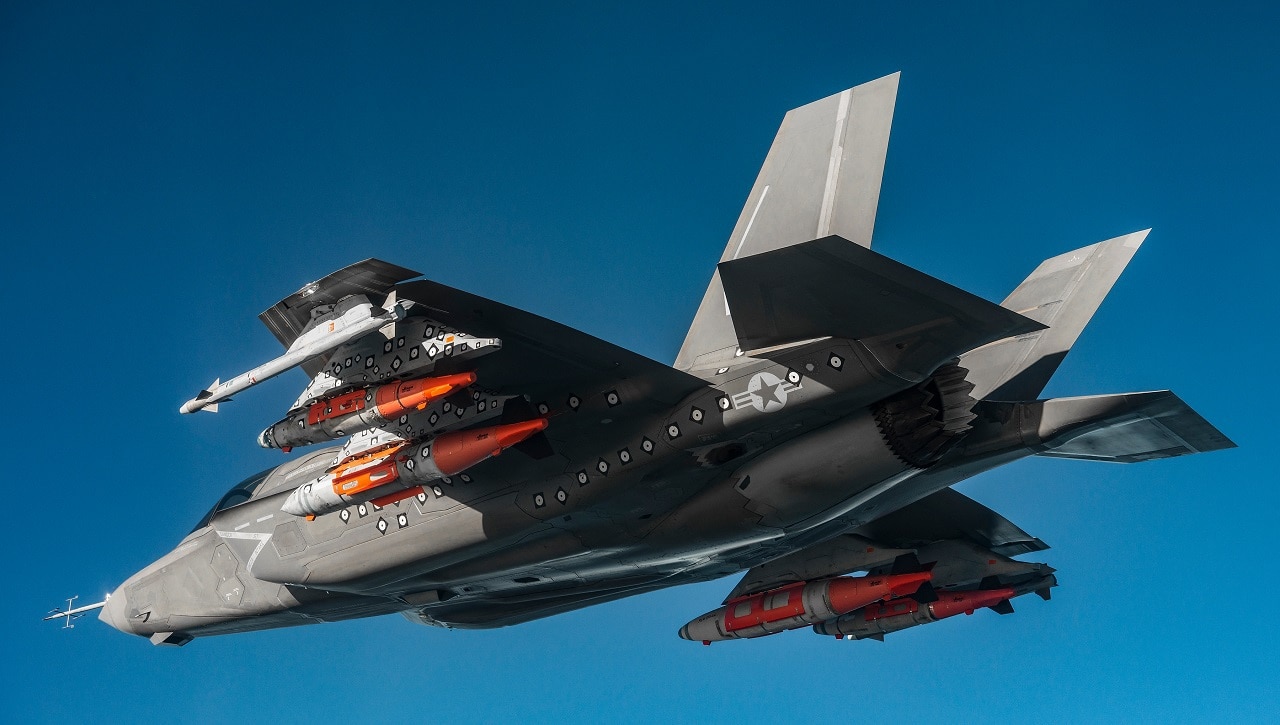
Beast Mode F-35 Fighter. Image Credit: Creative Commons.
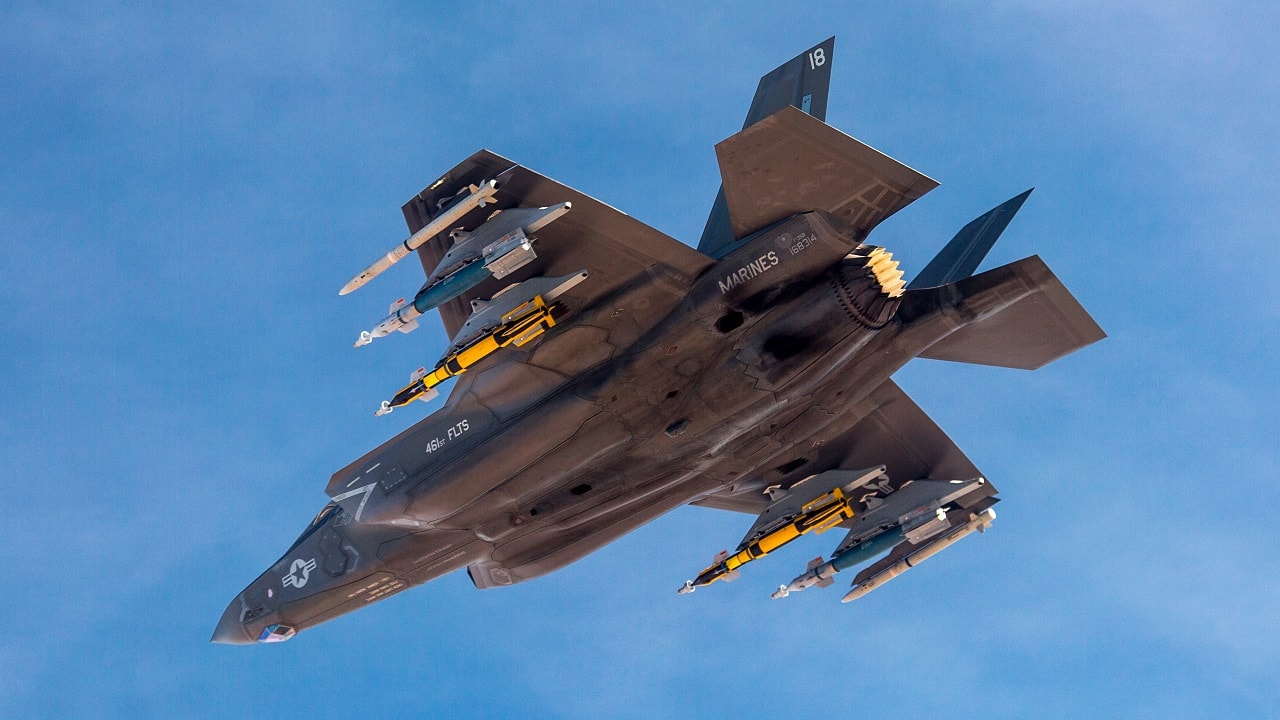
F-35 stealth fighter. Image Credit: Creative Commons.
While Saab’s Johansson’s jobs pitch came before the bombshell document leaked to Canadian media, some have questioned both the accuracy of the CEO’s position and the wisdom of operating a mixed fleet of aircraft. Commentators have noted that operating two aircraft types would effectively double the Royal Canadian Air Force’s logistical footprint.
Not only would the RCAF require two training pipelines for pilots to qualify on different aircraft, separate tracks for maintainers and support personnel would also be needed to service the very different aircraft, considering their disparate support needs. While both jets certainly need fuel and weaponry, as well as deep support to keep the fighters serviced and airworthy, the F-35’s unique capabilities require specialized support, a consequence of its stealthy fifth-generation design.
What Happens Now? F-35 vs. JAS 39 Gripen E Rages On…
Saab asserts that the Gripen’s electronic warfare capabilities cloak its fighter. “The most important reason behind this shift in focus is evolving technology, which tends to render stealth useless in the face of advances in radars. Even the most stealthy aircraft of today have parts with detectable radar signature. Another unavoidable factor is the high development, production, and maintenance cost incurred to build stealth.”
Is that an ex post facto justification of a fourth-generation fighter’s particular qualities in a world increasingly dominated by stealth aircraft? Is stealth “useless”? Another unanswered question is, would a Gripen production line create 10,000 jobs in Canada?
About the Author: Caleb Larson
Caleb Larson is an American multiformat journalist based in Berlin, Germany. His work covers the intersection of conflict and society, focusing on American foreign policy and European security. He has reported from Germany, Russia, and the United States. Most recently, he covered the war in Ukraine, reporting extensively on the war’s shifting battle lines from Donbas and writing on the war’s civilian and humanitarian toll. Previously, he worked as a Defense Reporter for POLITICO Europe. You can follow his latest work on X.