
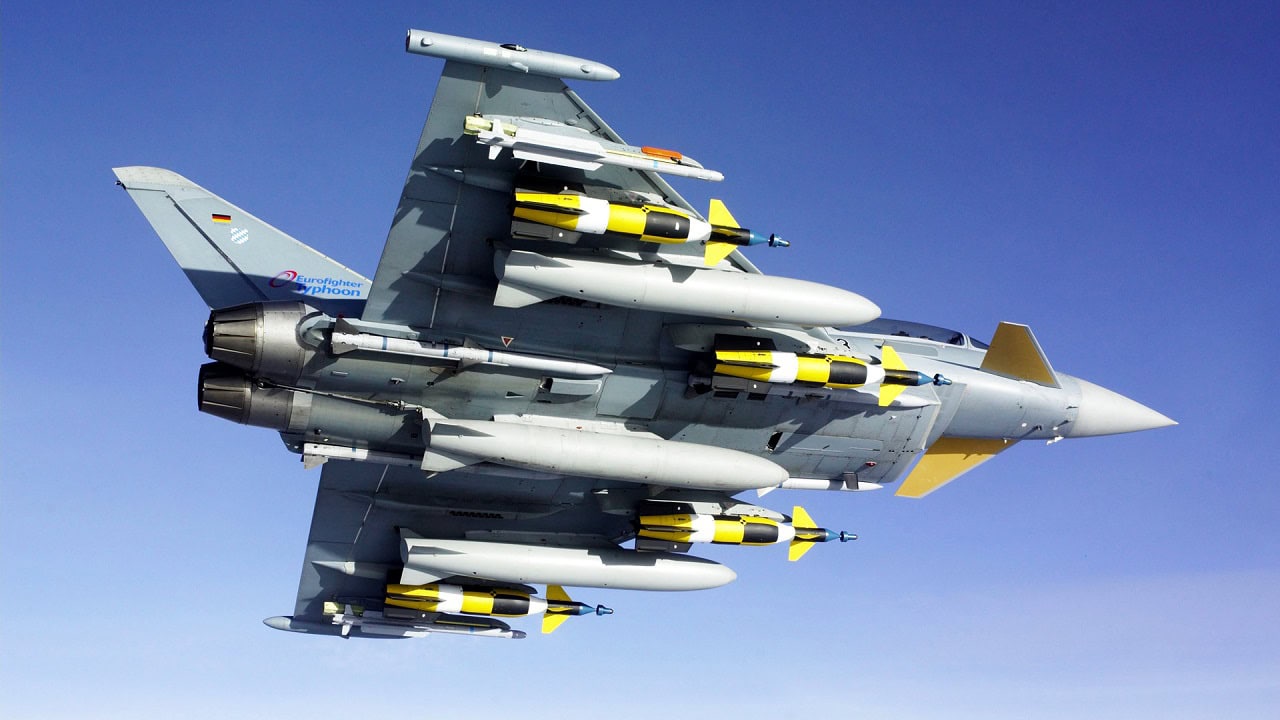
Key Points and Summary – When Canada launched its CF-18 replacement competition, the Eurofighter Typhoon was initially one of several high-profile contenders alongside the F-35, Gripen, and Super Hornet.
-But by 2019, Eurofighter walked away. Airbus and the UK Ministry of Defence concluded that NORAD “2-Eyes” security demands would make integrating a non-U.S./Canadian platform prohibitively expensive.
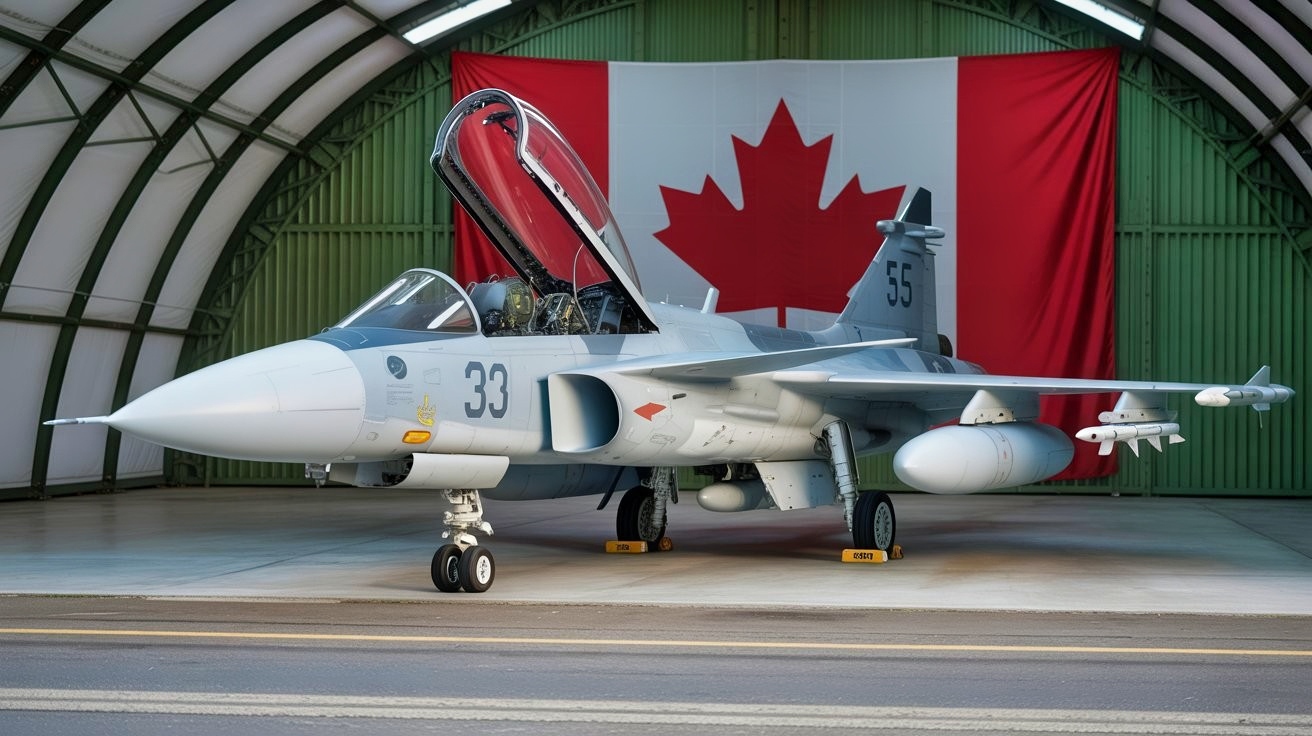
JAS 39 Gripen Fighter in Canada. Image Created with Ideogram.
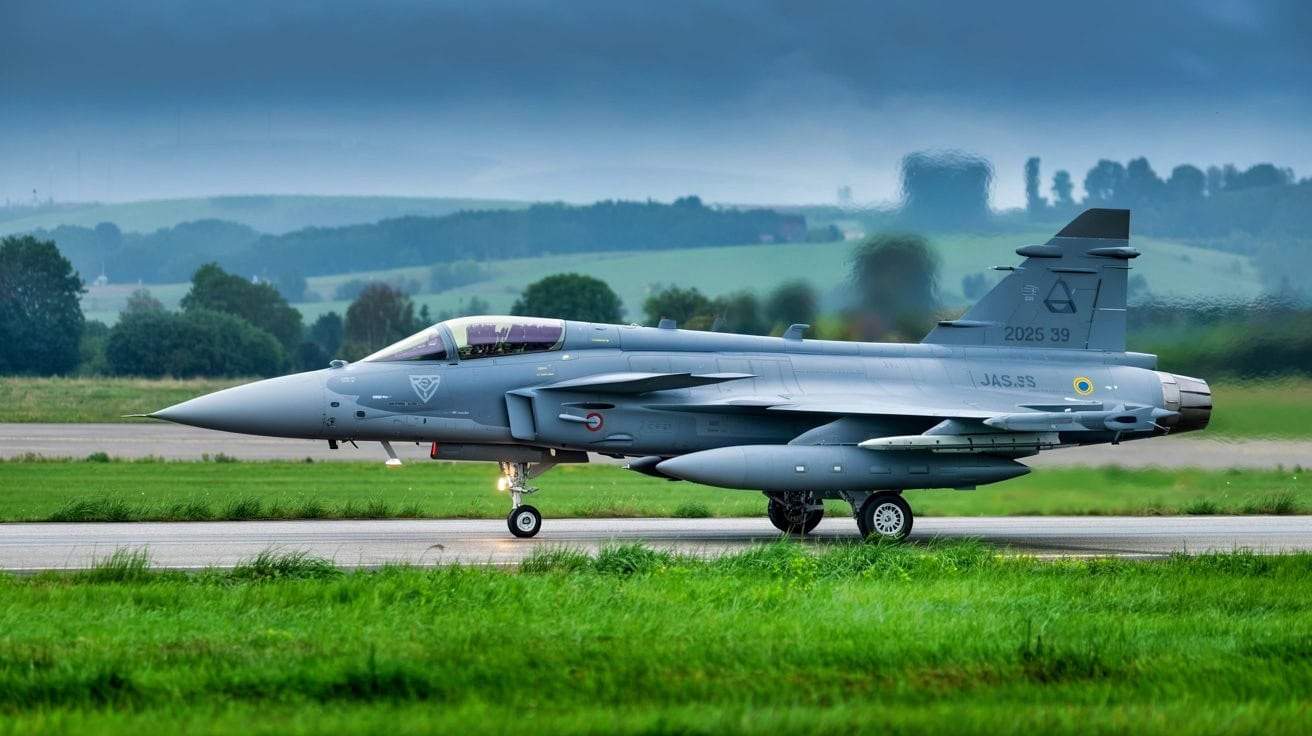
JAS 39 Gripen Fighter. Image Created VIA Ideogram.
-At the same time, revised Industrial Technological Benefits rules were seen as tailored to the F-35’s global supply chain and undervaluing Eurofighter’s industrial commitments in Canada.
-Despite the Typhoon’s impressive performance, sensor suite, and weapons loadout, Airbus judged the Canadian process skewed and no longer commercially viable.
Why the Eurofighter Typhoon Walked Away From Canada’s Fighter Deal
When the Royal Canadian Air Force began looking for a replacement for its aging CF-18s, one aircraft vying for the role was the Eurofighter Typhoon.
The other aircraft in the competition were the American-built F-35, a fifth-generation stealth fighter, the Swedish-built Saab JAS-39 Gripen fighter, and the Boeing F/A-18 Super Hornet.
However, once the competition was in full swing, on August 30, 2019, Airbus Military Aircraft and the United Kingdom’s Ministry of Defense informed the Canadian government that the decision to withdraw from the competition was taken following a “detailed review of the request for proposal (RFP)” issued on July 23.
Dassault Aviation Withdrew Earlier
Dassault Aviation withdrew from the competition in November 2018. CEO Eric Trappier cited NORAD to explain the decision, but also the impossibility for foreign manufacturers to acquire certain specifications set by a security network (“Five Eyes” in the case of Dassault).
Earlier in 2019, aviation industry sources reported that Boeing, Airbus, and Saab accused the process of being rigged in favor of Lockheed Martin.
The Eurofighter withdrew from Canada’s fighter jet competition in 2019 due to two main issues: the high cost of meeting NORAD security requirements for platforms outside the U.S.-Canada “2-Eyes” community, and the revised industrial technological benefits (ITB) rules that did not sufficiently value the commitments the Typhoon team was willing to make.
The company concluded that these conditions, combined with a perception that the competition was being altered to favor the F-35, made their proposal no longer viable.
Eurofighter Typhoon, A Very Capable 4th-Generation Fighter
The Eurofighter Typhoon is billed as the world’s most advanced swing-role combat aircraft. The Typhoon is produced by four European nations: the UK, Germany, Italy, and Spain, and their leading aerospace and defence companies: Airbus, BAE Systems, and Leonardo.
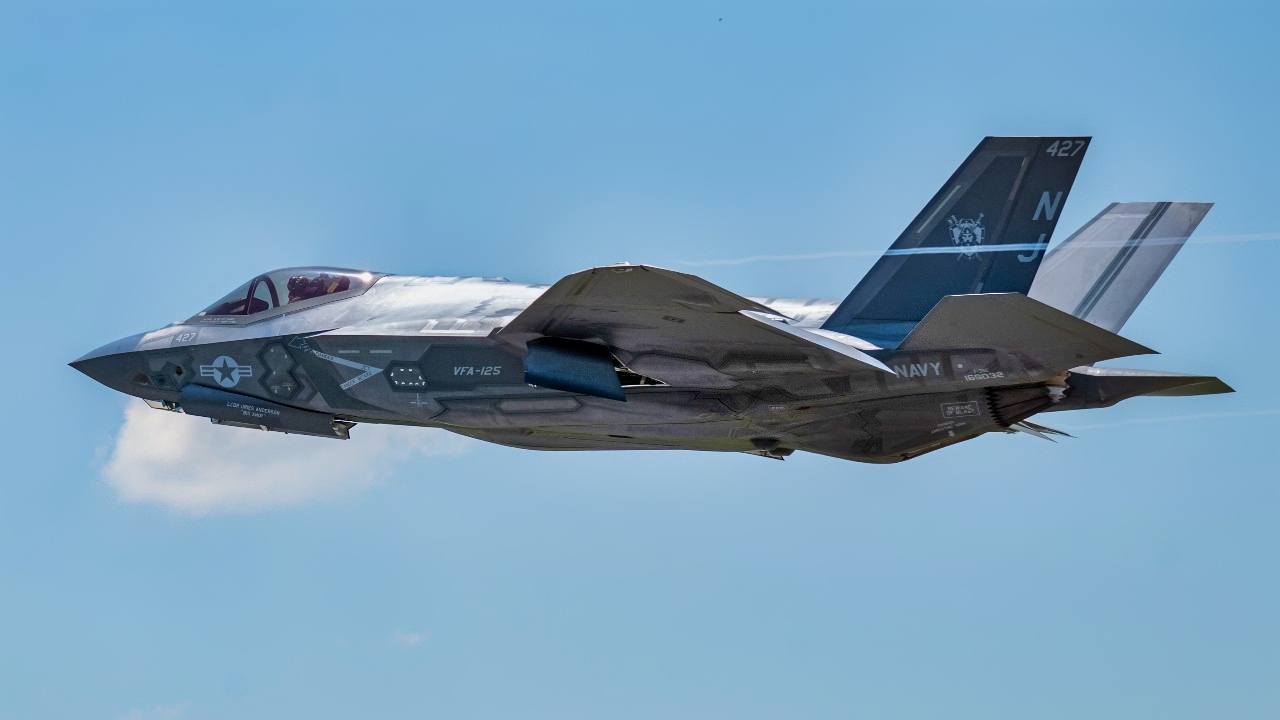
U.S. Navy Lt. Dave Hinkle, F-35C Lightning II Demonstration Pilot, performs during the 2021 Atlanta Air Show, Atlanta Regional Airport-Falcon Field, Ga., May 23, 2021. The U.S. Navy and Marine Corps’ carrier variant has larger wings and more robust landing gear than the other F-35 variants, making it suitable for catapult launches and fly-in arrestments aboard naval aircraft carriers. (U.S. Air Force photo by Staff Sergeant Thomas Barley)
This partnership allows equal access to shared manufacturing, development, and the creation of long-lasting political and industrial relations—a genuine European collaboration.
Meet The Eurofighter Typhoon
The Typhoon is a twin-engine, canard-delta wing, multirole fighter. While it is not a stealth fighter, only 15 percent of its surface area is metal; the remainder is covered in composite materials. This delivers good stealth protection from radar systems.
The engine, the EJ200, built by Rolls-Royce, is powerful, pushing the aircraft to Mach 2, and very reliable, requiring no unscheduled maintenance over 1,200 flying hours.
It is very agile and maneuverable.
The Typhoon’s E-Scan sensor array is wide, with a field of regard that is some 50 percent wider than traditional fixed plate systems.
The Multifunctional Digital Information Distribution system (MIDS) allows the aircraft to securely exchange real-time data between a wide variety of users, including air forces and, where appropriate, land and naval forces. It is high-speed, high-capacity, secure, and jam-resistant while able to share and receive information from other users in their network.
The Typhoon’s Armaments
The Eurofighter Typhoon is armed with several air-to-air missiles—the Meteor Beyond Visual Range Air-to-Air Missile (BVRAAM) system is a long-range weapon.
The IRIS-T is a supreme short-range, incredibly maneuverable, all-aspect air-to-air missile. Equipped with an innovative infrared seeker and thrust-vector control.
It is also equipped with the ASRAAM (Advanced Short Range Air-to-Air Missile) is a British missile manufactured by MBDA, primarily used by the Royal Air Force and other air forces, and the AMRAAM missile.
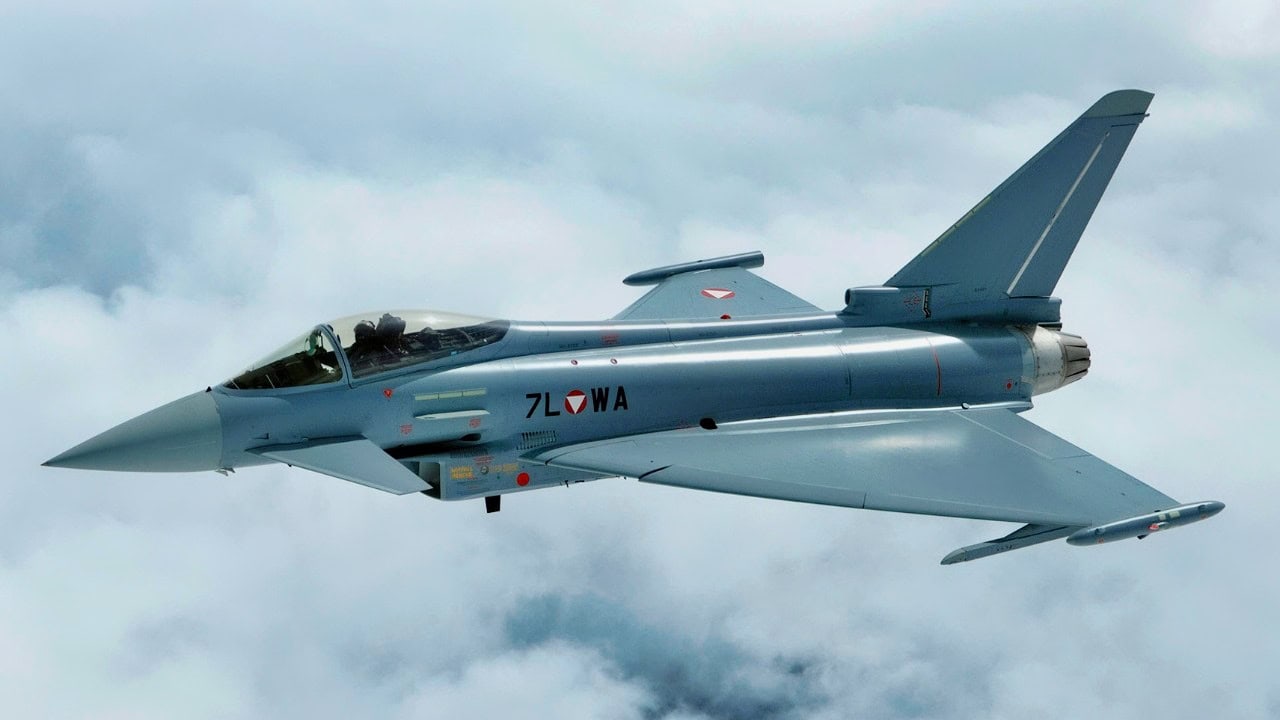
Eurofighter Typhoon. Image Credit: Creative Commons.
The Typhoon carries a variety of air-to-surface weapons. Taurus KEPD 350 missiles, Storm Shadow missiles, and the Brimstone II missiles. It also carries the Mauser BK-27 autocannon (27mm).
Air-to-surface guided bombs include Paveway II (GBU-10) 2,000 lb bomb, Paveway II (GBU-16) 1,000 lb bomb, Paveway II (GBU-48) 1,000 lb bomb, Paveway IV, and the Joint Direct Attack Munition (GBU-54).
“Two Eyes” As Opposed to “Five Eyes”
“Of the original three European competitors, Airbus with the Eurofighter flying in the U.K. [was] the closest to the level of interoperability the RCAF needs for the next fighter,” said David Perry, vice-president and senior analyst with the Canadian Global Affairs Institute.
Airbus released a statement that said, “First, a detailed review has led the parties to conclude that NORAD security requirements continue to place too significant a cost on platforms whose manufacture and repair chains sit outside the United States-Canada 2-Eyes community.”
Airbus added, “The significant recent revision of industrial technological benefits (ITB) obligations does not sufficiently value the binding commitments the Typhoon Canada package was willing to make, and which were one of its major points of focus.”
The Typhoon operates within the “Five Eyes” intelligence network of the US, UK, Canada, Australia, and New Zealand.
Airbus had hoped that, as part of the “Five Eyes” group, it could crack the “Two Eyes” community.
Industrial Technological Benefits (ITB) also played a role. Airbus determined that the revised rules for industrial benefits, which were made more favorable to Lockheed Martin, did not adequately compensate for the significant and binding commitments the Eurofighter Canada team had been prepared to make to boost Canadian industry.
The company also cited that the revised process was perceived as unfair to competitors. The change to the industrial benefits policy, influenced by the U.S. and designed to be more compatible with the F-35 program’s global supply chain model, was a key factor in the decision.
About the Author: Steve Balestrieri
Steve Balestrieri is a National Security Columnist. He served as a US Army Special Forces NCO and Warrant Officer. In addition to writing on defense, he covers the NFL for PatsFans.com and is a member of the Pro Football Writers of America (PFWA). His work was regularly featured in many military publications