
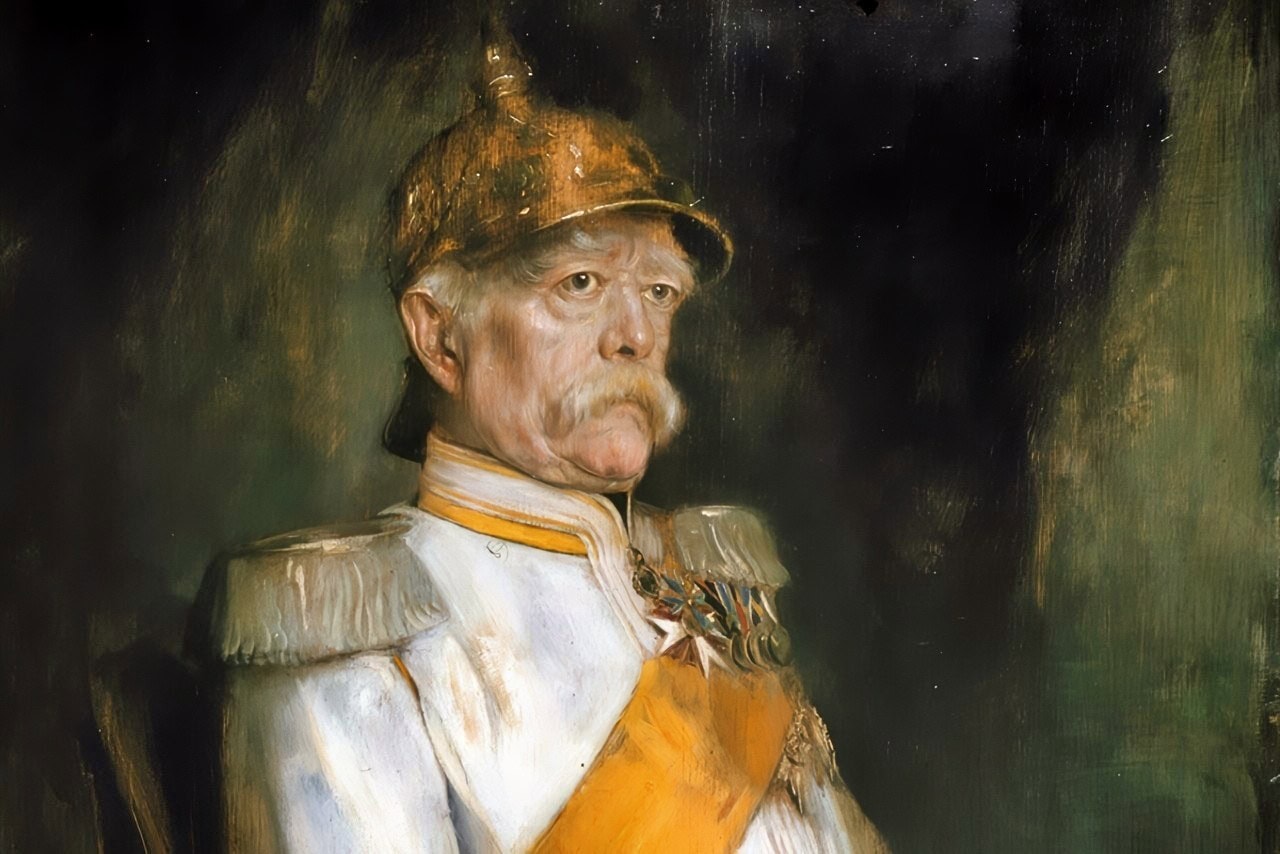
Synopsis: Otto von Bismarck is remembered as the architect of modern Germany—and as a hard-eyed realist who understood war’s human cost.
-Born into the Prussian nobility in 1815, he rose from sharp-tongued legislator to senior diplomat, then returned to Berlin to steer Prussia through a constitutional crisis.
-As minister president, Bismarck pursued unification through decisive conflict: Denmark, Austria, and France each fell in sequence, culminating in the proclamation of the German Empire in 1871.
-Yet after achieving his goal, Bismarck shifted to restraint—constructing alliances and managing crises to keep Europe stable and avoid another war.
Bismarck Has a Quote of the Day Message About War: Look Into a Soldier’s Eyes
“Anyone who has ever looked into the glazed eyes of a soldier dying on the battlefield will think hard before starting a war,” Otto von Bismarck is said to have uttered.
Bismarck is one of the most influential figures in German history and is often referred to as the father of modern Germany, playing a key role in unifying Germany and serving as the first Chancellor of the German Empire. Bismarck was no stranger to war and its consequences, as the quote above demonstrates.
At the same time, Bismarck was a pragmatist and an ardent proponent of realpolitik, who sometimes used war to advance national security.
Early Life and Career
Bismarck was born in 1815 at a noble family estate in Schönhausen in what was Prussian Saxony.
He was born to Karl Wilhelm Ferdinand von Bismarck and Wilhelmine Luise Mencken. His father was a former Prussian military officer, and his mother was a well-educated daughter of a wealthy family. Bismarck received a formal education at the University of Göttingen, where he studied law.
As an army reservist, he was stationed in Greifswald, where he studied agriculture at the University of Greifswald. At age 32, he married his wife, Johanna von Puttkamer, with whom he remained until his death.
In 1847, Bismarck began his political career by being elected to the newly created Prussian legislature. He was a staunch monarchist and made a name for himself thanks to his sharp tongue and quick wit.
In March 1848, Prussia, along with many other states in Europe, faced a revolution that advocated for a more liberalized government and a unified German state. Bismarck initially opposed German unification and remained loyal to the King of Prussia.
He was later appointed as a representative to the Diet of the German Confederation in Frankfurt, where he started shifting his opinions. He became less reactionary and more pragmatic, eventually warming up to the idea of a unified Germany as a means of counterbalancing Austria’s rising influence.
Bismarck’s Rising Influence
Bismarck’s influence continued to grow as he became more accustomed to the political landscape. In 1857, he was appointed as Prussia’s ambassador to the Russian Empire. On paper, it was a promotion, but in practice, it kept him far away from domestic affairs.
In 1862, he was appointed as the ambassador to France and sent to Paris. These diplomatic tours allowed him to size up his potential opponents and get acquainted with his enemies. Despite his time away from home, he kept up to date with domestic affairs and further increased his influence, making him one of the most important men in all of Prussia.
In 1861, the increasingly liberal legislature came into conflict with the newly crowned King Wilhelm over military reforms, with neither side able to concede. Wilhelm was forced to recall Bismarck from his diplomatic visit to France and appointed him as Minister President and Foreign Minister, placing him in charge of all foreign affairs. He assumed office at a turbulent time in European history, with the Italian War of Independence and the Crimean War unfolding concurrently. He, alongside Helmuth von Moltke and Albrecht von Roon, would transform Prussia and prime the Germanic states for their future unification.
The Unification of Germany
Bismarck set his sights on German unification, envisioning Prussia as the center of the new Germany. In his now-famous “iron and blood” speech, he declared to the Prussian Chamber of Deputies that speeches and words would not unify Germany, “but by iron and blood.”
He began by seizing the newly independent duchies of Schleswig and Holstein from Denmark when Denmark tried to claim the German-speaking duchy of Schleswig. In the wake of this victory, Bismarck launched the Austro-Prussian War against Austria.
Thanks to the strategic genius of Moltke as Chief of Staff, Prussia defeated the Austrians at the Battle of Königgrätz. In the wake of Prussia’s victory over Austria, France—under Napoleon III’s rule—declared war on Prussia and mobilized for war. However, within a couple of months, France’s armies were thoroughly defeated, and Napoleon was captured.
Immediately after his victory over France, Bismarck sought to unify all the German states. He successfully negotiated with the southern German states and secured the election of Wilhelm I of Prussia as the new German Emperor.
This new empire was a confederacy of German-speaking states, all of which retained some autonomy but were ultimately loyal to the Kaiser. The unification of Germany in 1871 was the high point in Bismarck’s career. He had successfully created a strong and unified Germany through his military victories against Austria and France and through the sheer power of his personality.
Both of these factors inspired a sense of Germanic pride among the German states and made them more than enthusiastic about joining an Austria-free unified state.
After the unification of Germany, Bismarck was appointed as the first Chancellor of Germany while retaining all of his Prussian offices. Thanks to his many hats, Bismarck effectively held complete control over the domestic and foreign affairs of the new German Empire.
He was a master of diplomacy and could convince or otherwise manipulate any foreign state to achieve his goals.
Why Bismarck Matters
He maintained a close, almost paranoid watch on other European states to avoid misunderstandings that frequently led to wars. Ironically, despite having started his career amid eight years of war, he spent the last 20 years of his chancellorship doing everything in his power to avoid war.
About the Author: Isaac Seitz
Isaac Seitz, a Defense Columnist, graduated from Patrick Henry College’s Strategic Intelligence and National Security program. He has also studied Russian at Middlebury Language Schools and has worked as an intelligence Analyst in the private sector.