Synopsis: Military Quote of the Day by President Obama:
Key Points – In a 2002 Chicago speech, then–Illinois state senator Barack Obama warned against a “dumb” and “rash” war in Iraq—arguing it would become an open-ended occupation with unclear costs and consequences.
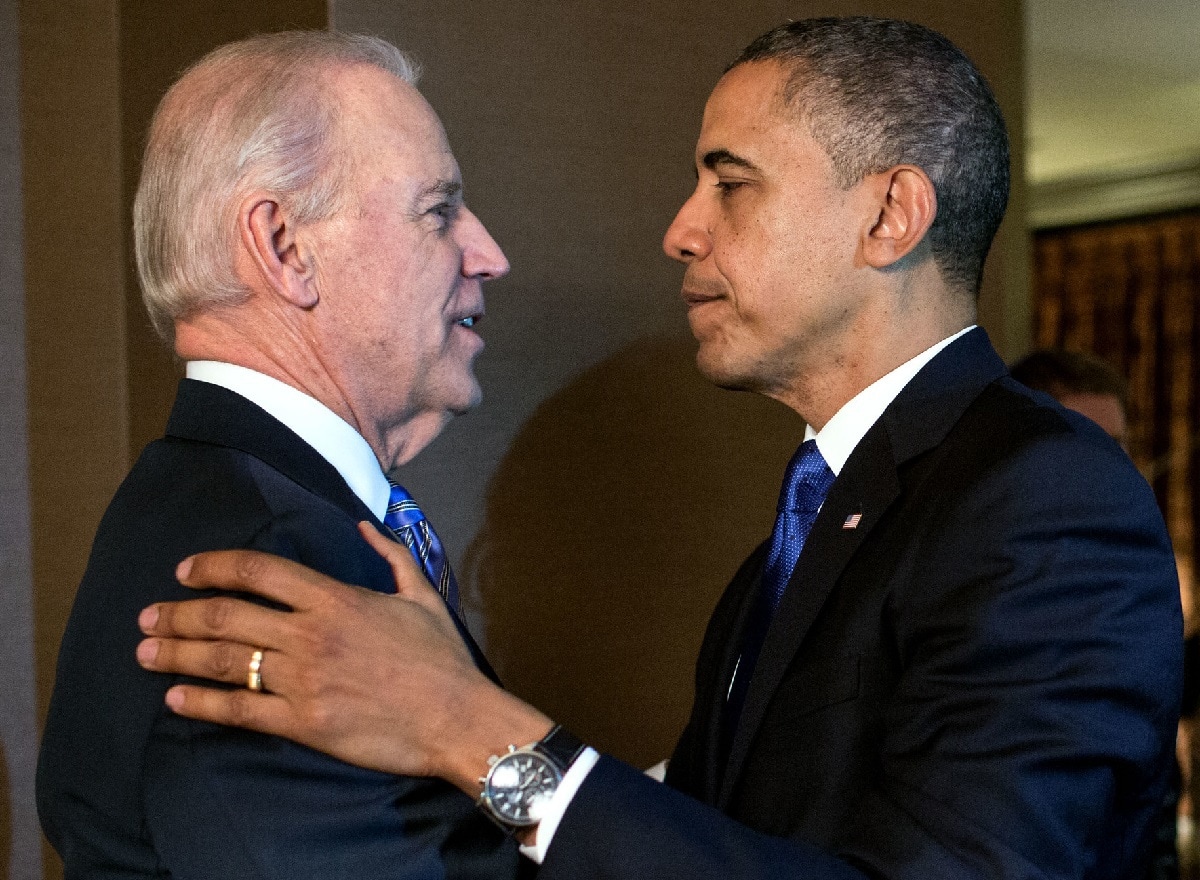
President Barack Obama and First Lady Michelle Obama embrace Vice President Joe Biden and Dr. Jill Biden moments after the television networks called the election in their favor, while watching election returns at the Fairmont Chicago Millennium Park in Chicago, Ill., Nov. 6, 2012. (Official White House Photo by Pete Souza).
-The moment helped elevate Obama as an early critic of the coming invasion and framed his worldview as a pragmatic, realist alternative to neoconservative nation-building.
-The piece traces how that posture carried into his presidency: prioritizing Afghanistan, ending the Iraq combat mission, embracing “smart power,” diplomacy, and multilateral coalitions—while also facing criticism for Libya, Syria, Crimea, and the downstream consequences of withdrawal decisions.
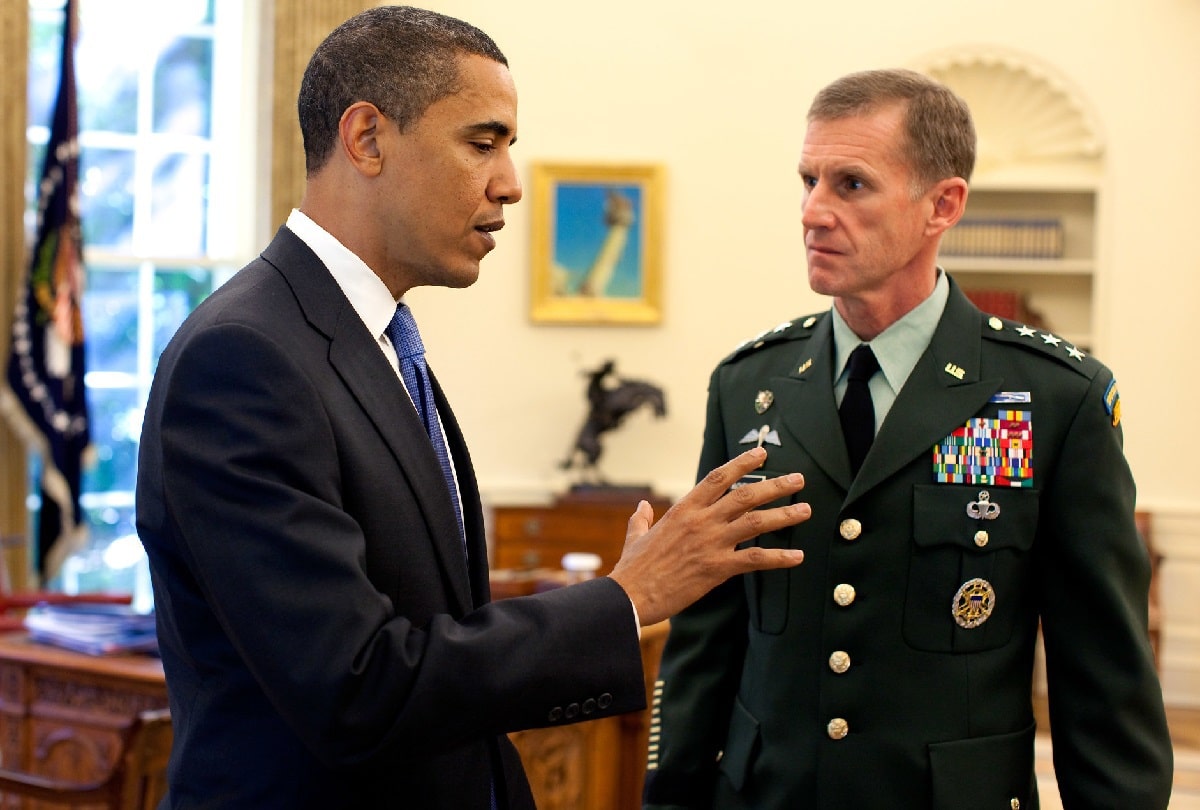
President Barack Obama meets with Lt. Gen. Stanley A. McChrystal, the new U.S. Commander for Afghanistan, in the Oval Office Tuesday, May 19, 2009. (Official White House photo by Pete Souza)
Obama’s 2002 “Dumb War” Quote Has a Message for Washington
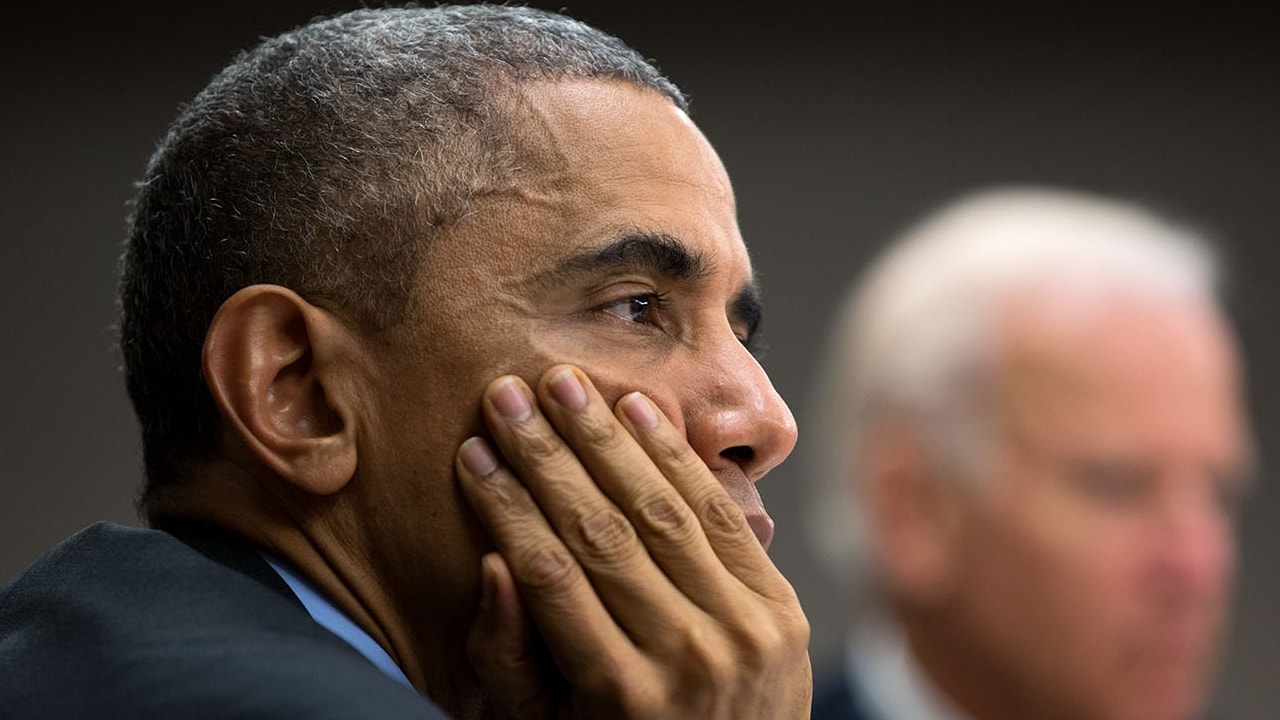
Military Quote of the Day: “I don’t oppose all wars. What I am opposed to is a dumb war. What I am opposed to is a rash war.” -Barack Obama.
This was a quote from a speech that then Illinois State Senator Barack Obama delivered in Chicago in 2002.
It was an address that gave Obama notoriety and even an element of fame for being one of the first up-and-coming political leaders to come out publicly against what would become a disastrous war in Iraq. Congress was debating whether to authorize military force against Saddam Hussein’s forces.
Obama was making a name for himself from a relatively low-power political position. Still, he had excellent communication skills and believed that a measured protest against the prevailing support for a global war on terror would help him politically.
The Realism of Obama
Obama said he was against war-making based on revenge and hatred and that America should avoid “a war based not on reason but on passion, not on principle but on politics.” This was the beginning of Obama’s support for what international relations scholars call “realism” in foreign policy and not for “neoconservatism“—the unbounded belief in war-making for the reason of democracy and nation-building in far-off lands that were not inclined to support individual liberty, freedom, and the building blocks for a new republic.
He did not believe the future war in Iraq was part of the US national interests. Obama thought that America should accept the world as it is, not how it wished it could become. He believed that his brand of technocratic and dispassionate “cool” rationality would be the best way to lead the country.
Focus on Afghanistan, Not Iraq
At the 2002 Chicago rally, Obama predicted that “a US occupation of undetermined length, at undetermined cost, with undetermined consequences” would be disastrous. Obama later believed that the war in Afghanistan was a correct and just war.
He eventually ordered a surge of US forces in Afghanistan and executed the withdrawal from Iraq. The US combat mission officially ended in August 2010, and the last US soldiers left Iraq in December 2011.
Obama had no military experience and lacked a foreign policy background, but he did have the political instincts to know that adventurous wars of choice would be dangerous for America.
More About Barack Obama
Barack Obama was born on August 4, 1961, in Honolulu, Hawaii. His parents divorced early, and his mother and grandparents raised him. Obama lived in Indonesia in 1967 and went to school there. He returned to Hawaii in 1971 to live with his grandparents and graduated from high school in 1979. He attended Occidental University and then Columbia University, where he graduated in 1983.
He worked briefly as a business analyst in New York City before deciding to move to Chicago to become a community organizer. He became director of the Developing Communities Project. He worked there for three years before attending Harvard Law School. He was the first African American to serve as president of the Harvard Law Review. He graduated with honors in 1991. He then worked on voting rights issues.
Obama successfully ran for local office and was elected to the Illinois State Senate in 1996. He also taught at the University of Chicago Law School. He ran for US Congress in 2000 but lost in the primary. He gave a speech at the Democratic National Convention in 2004 that placed him on the political map. That year, he was elected to the US Senate. He decided to run for the White House in 2007. On November 4, 2008, Obama became the first African American elected president.
Career in Foreign Relations
One aspect of Obama’s political career that influenced his foreign policy-making is his working relationship with Indiana Senator Richard Lugar, a Republican. Lugar took Obama under his wing, and they worked together on nuclear non-proliferation.
This gave Obama a taste of international relations and showed him that bipartisanship was sometimes more doable in foreign policy than in domestic policy.
Obama clearly enjoyed himself while working with Lugar. It has inspired him to enter arms limitation talks with Russia and later convinced him that he could negotiate a nuclear weapons treaty that would become New START.
Can Power Be Projected Smartly?
He would develop a foreign policy known as “smart power.” This was the idea that America should be judicious in its use of military intervention and engage in war only if necessary. This meant more reliance on diplomacy and multilateral institutions.
These beliefs came to be known as the policy of strategic restraint. Obama supported a “leading from behind” NATO intervention in Libya in 2011, in which the United States worked with a coalition from multiple nations.

President Barack Obama talks on the phone with FEMA Administrator Craig Fugate to receive an update on Hurricane Matthew, Oct. 8, 2016. The President spoke from his home in Chicago, Ill.
(Official White House Photo by Pete Souza)
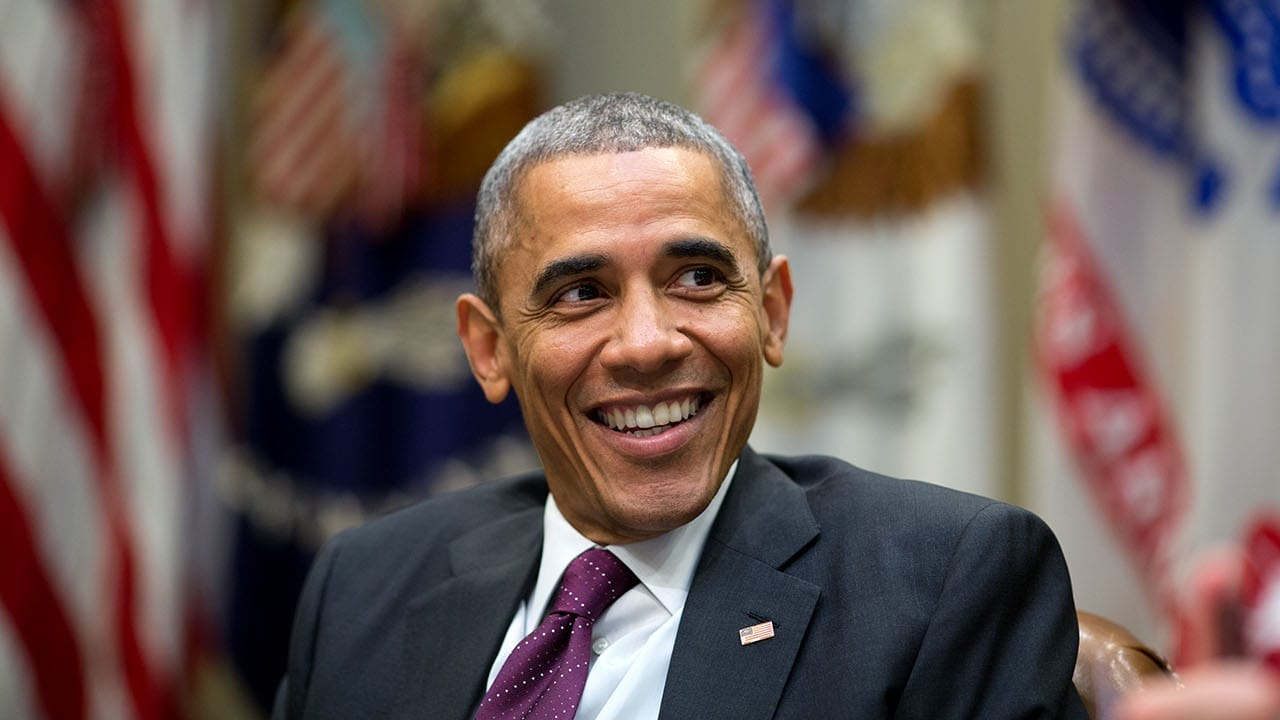
President Barack Obama laughs during a meeting in the Roosevelt Room of the White House, Nov. 17, 2014. (Official White House Photo by Pete Souza)
This official White House photograph is being made available only for publication by news organizations and/or for personal use printing by the subject(s) of the photograph. The photograph may not be manipulated in any way and may not be used in commercial or political materials, advertisements, emails, products, promotions that in any way suggests approval or endorsement of the President, the First Family, or the White House.
Mixed Record on International Security
Obama had a mixed record on foreign policy. He correctly predicted that the war in Iraq would fail and was against the mistaken views of neoconservatism. Still, he was not decisive enough in international relations and often thought that speechmaking would carry the day rather than enacting precise policies.
His early withdrawal from Iraq led the way for ISIS. He allowed the Syrian Civil War to fester and lacked the necessary leadership skills when Russia annexed Crimea in 2014, allowing Putin to have an upper hand in Eastern Europe.
However, he should be given credit for the New START Treaty, but the nuclear deal with Iran was a mistake.
Obama’s lack of foreign policy expertise before his Washington career was problematic.
He struggled with the questions of war and peace that all presidents face. He delivered many stirring speeches, but his attention waned when it came to international security, and he was more interested in domestic political issues.
Obama started his foreign policy career strongly, but did not finish it well.
About the Author: Brent M. Eastwood
Author of now over 3,000 articles on defense issues, Brent M. Eastwood, PhD is the author of Don’t Turn Your Back On the World: a Conservative Foreign Policy and Humans, Machines, and Data: Future Trends in Warfare plus two other books. Brent was the founder and CEO of a tech firm that predicted world events using artificial intelligence. He served as a legislative fellow for US Senator Tim Scott and advised the senator on defense and foreign policy issues. He has taught at American University, George Washington University, and George Mason University. Brent is a former US Army Infantry officer. He can be followed on X @BMEastwood.