
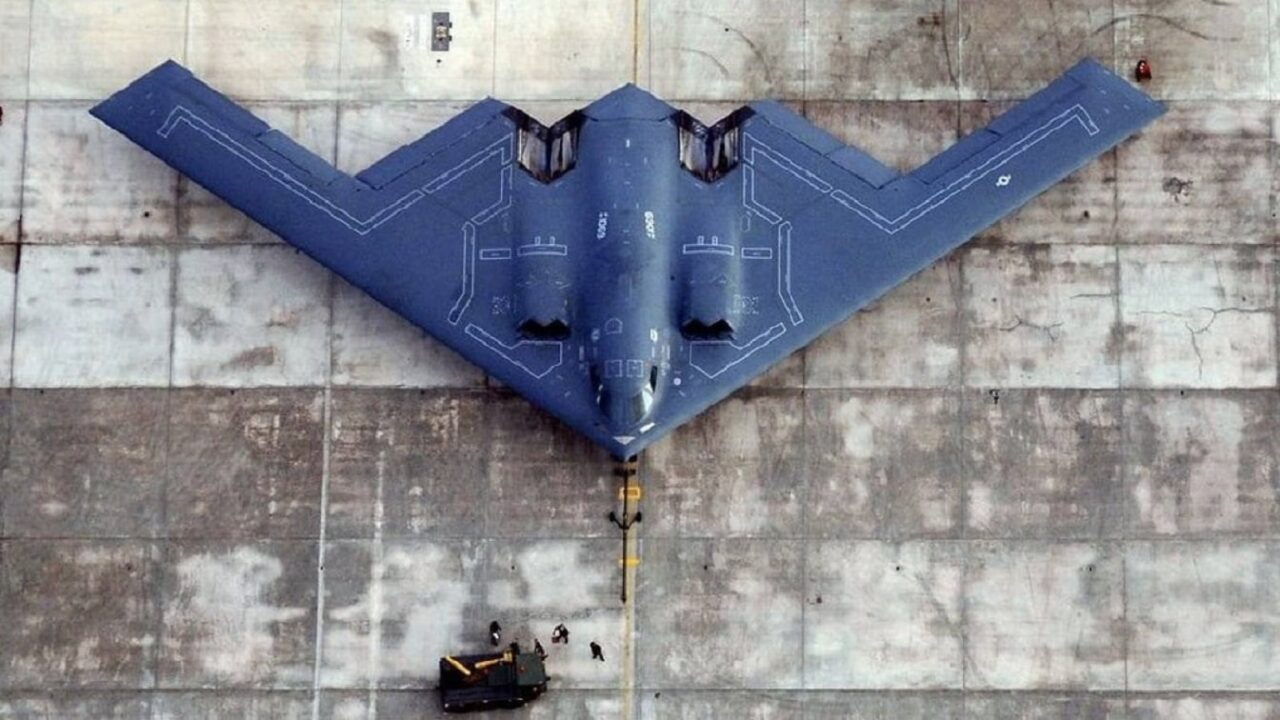
Key Points and Summary: The official plan to build “at least 100” B-21 Raiders is dangerously insufficient for a two-theater conflict against China and Russia.
-The Math: Maintenance, training, and nuclear alert duties drastically reduce the number of jets available for combat. A 100-plane fleet leaves a perilously thin conventional bench.
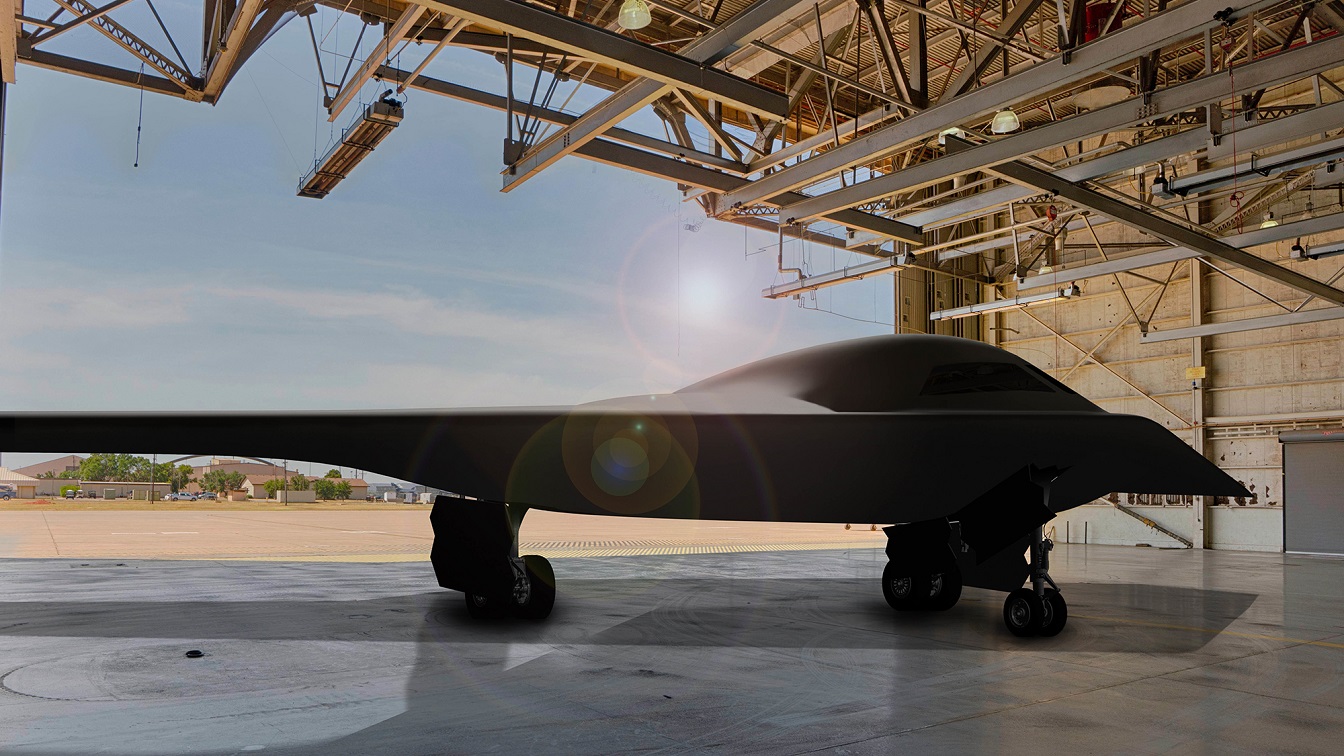
Artist rendering of a B-21 Raider concept in a hangar at Dyess, Air Force Base, Texas, one of the future bases to host the new airframe. (Courtesy photo by Northrop Grumman)
-The Risk: In a high-attrition war, a small fleet lacks the depth to absorb losses and sustain strikes beyond the first few weeks.
-The Solution: Expanding the buy to 200+ aircraft is not a luxury—it is “insurance” to ensure credible deterrence and operational resilience across two oceans.
Why 100 Air Force B-21 Stealth Bombers Aren’t Enough to Stop China and Russia at the Same Time
The B-21 Raider is not another niche airplane.
It’s the backbone of the Air Force’s future bomber enterprise, the penetrating arm that gets inside modern integrated air defenses and opens doors for everyone else.
Officially, the plan is “at least 100” aircraft as the B-21 Raider replaces the B-1B and B-2 and teams with an upgraded B-52 through a two-bomber force.
That sounds neat on paper.
In the real world of logistics, maintenance, training, nuclear obligations, and wartime attrition, 100 is a dangerously small number for a force expected to deter two nuclear-armed great powers across two oceans.
Why Stealth Bombers Are a Numbers Game
It’s tempting to believe the B-21’s stealth and sensors make quantity less important. The opposite is true. Modern low-observable aircraft demand meticulous upkeep to keep signatures low; coatings and access panels aren’t “set it and forget it.”
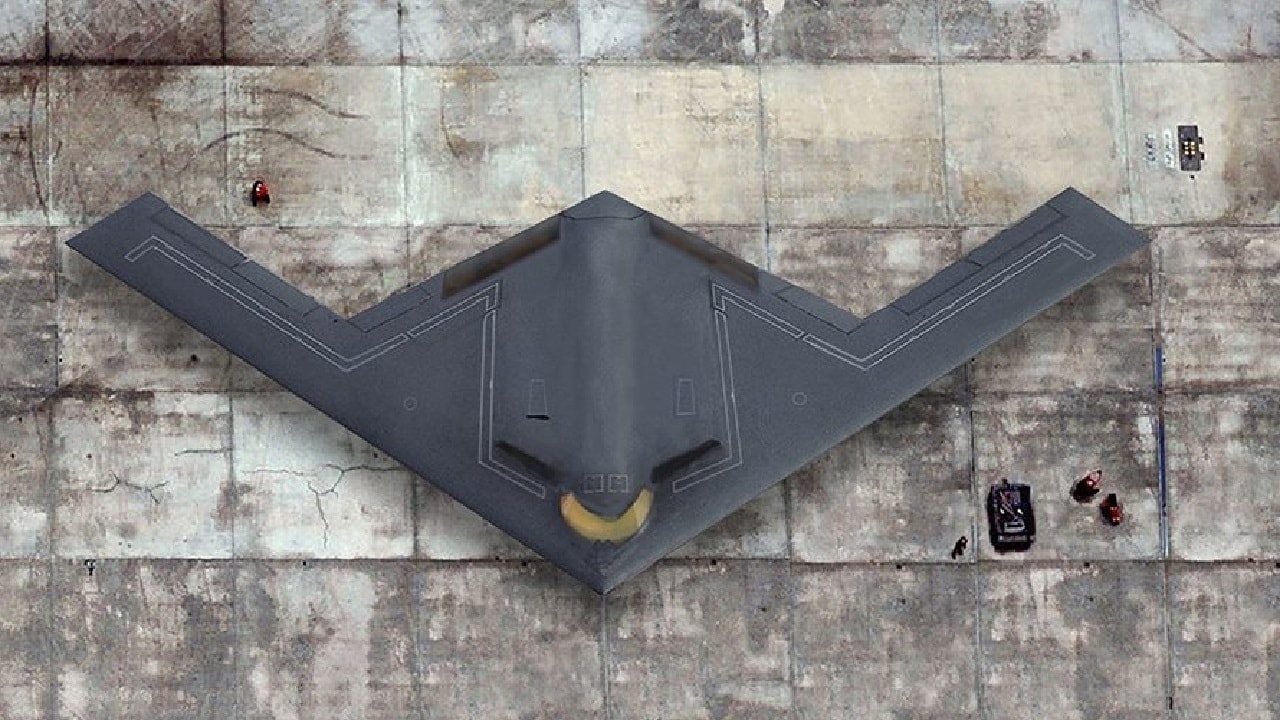
B-21 Raider artist rendering. Image Credit: Creative Commons.
Flight test, tactics development, and conversion training consume jets that cannot be in a strike line that night. Nuclear alert and certification cycles skim additional aircraft. What’s left must cover worldwide presence, surge for exercises that reassure allies, and still keep a ready package for the thing we’re trying to prevent: war.
Even in peacetime, readiness fluctuates. Compound those normal rhythms with the stress of protracted, high-tempo operations, and the mission-capable pool shrinks again.
The lesson from decades of bomber operations is simple: if you want a reliable handful of stealth bombers on the ramp every day, you need a fleet measured in hundreds, not dozens.
Two Theaters, One Fleet: The B-21 Raider Geometry Problem
The Pacific is big. From bomber bases in the American interior to tanker tracks in the mid-Pacific to release points outside the densest air defenses, every sortie is hours of transit and coordination—that geometry taxes crews, tankers, and airframes.
Now add Europe. Even if you believe great-power war will be a one-theater event, planners cannot. Crises stack. A Russian contingency can demand long-range conventional strikes and nuclear signaling flights at the exact moment Indo-Pacific tensions are peaking. With only 100 B-21s, a crisis-pairing becomes a shell game: each dramatic movement in one theater is paid for by thinning coverage in the other. That’s signaling weakness, not strength.
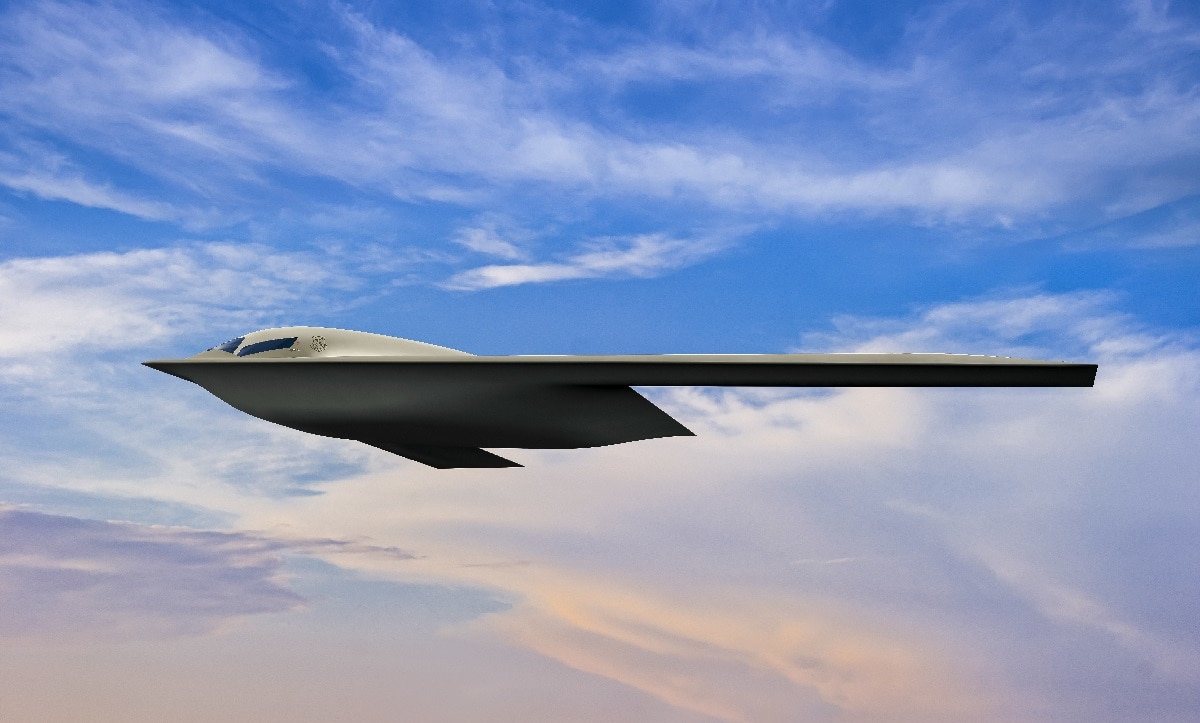
B-21 Raider. Image: U.S. Air Force
The Nuclear Tax on a Small Fleet
The B-21 Raider is dual-capable by design. That’s good strategy—one fleet, two missions—but it imposes a nuclear tax on a small inventory. Nuclear roles aren’t a sticker you slap on a jet; they’re an enterprise of inspections, certifications, unique weapons interfaces, and practiced crews.
When a portion of your stealth bombers must be ready to execute nuclear tasks on short notice, those tail numbers are not freely tradable into the conventional strike pool. In a 100-jet world, the nuclear slice looms large and the conventional bench gets shallow fast.
Basing, Dispersal, and the “One Bad Night” Risk
The current beddown plan begins at Ellsworth and expands to Whiteman and Dyess. Three main operating bases spread across the map is a start, but concentration risk is real. A peer adversary with long-range precision weapons will study your infrastructure harder than your airframes.
With a small fleet concentrated at a handful of predictable points, base attacks—kinetic or cyber—can bottle up sorties without ever shooting at the airplanes themselves. Dispersal, rapid runway repair, hardened fuel and weapons storage, and austere operating concepts all help. But the first and best insurance against “one bad night” is a bigger fleet distributed across more places.
Magazine Depth: The Munitions Problem You Can’t Wish Away
Even the best bomber is an empty truck without weapons. The B-21’s value is multiplied by long-range, survivable munitions—conventional standoff cruise missiles and, for the nuclear mission, the next-generation air-launched cruise missile.
In a serious fight, you burn through these faster than peacetime models predict. Production lines are improving, but they are not magic. A thin bomber fleet encourages rationing of precious weapons; a larger bomber fleet forces the industrial base to plan for volume from day one. Either way, a small B-21 inventory coupled with tight missile stocks creates a brittle edge: a few bad nights, a supply hiccup, and your strike tempo collapses.
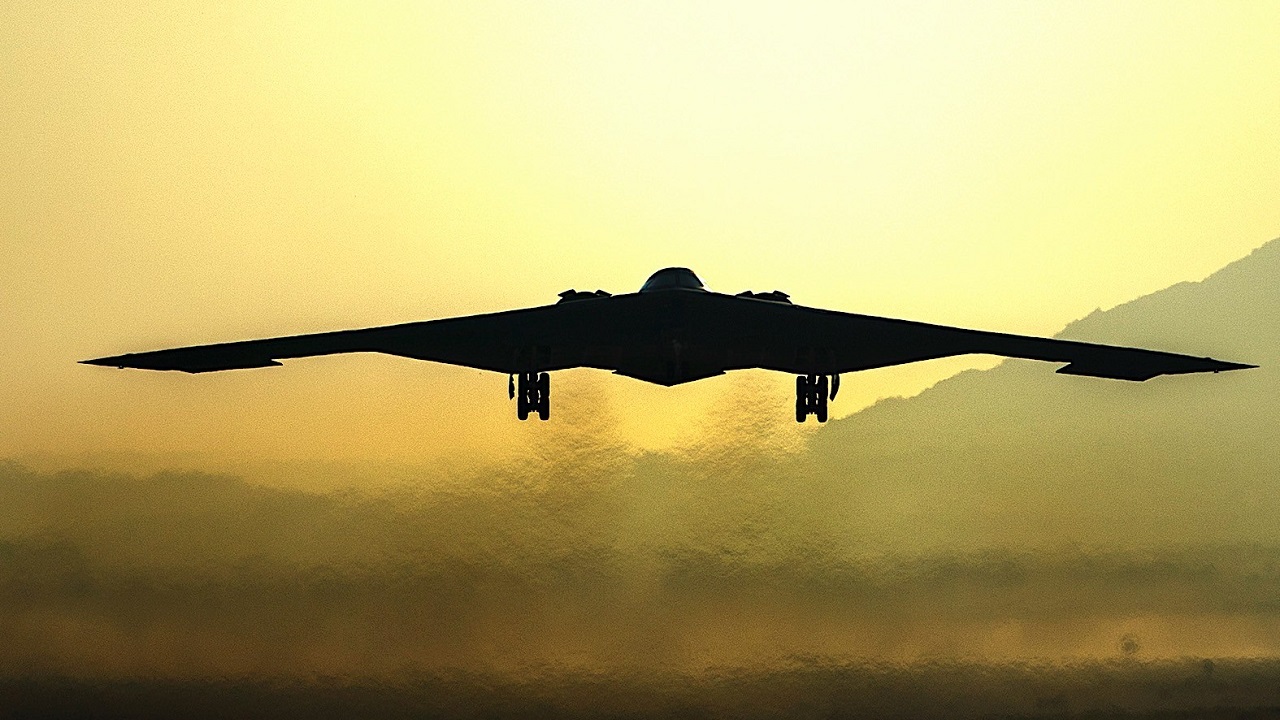
B-2 Bomber. Image Credit. U.S. Air Force.
Attrition Happens—Even to Stealth
History is unkind to the notion that leading-edge aircraft are attrition-proof.
Wartime frictions—runway mishaps, battle damage, maintenance accidents—will take B-21 Raider bombers off the board. In any Indo-Pacific scenario, sorties stretch across vast distances and multiple refuelings, multiplying opportunities for error and wear. Stealth and tactics mitigate defenses; they do not erase the risks of weather, human factors, and operational tempo.
A fleet of 100 cannot absorb misfortune the way a fleet of 200+ can. If you want the option to keep striking on Day 180, not just Day 8, quantity is a form of survivability.
A Quick Wargame: Week One vs. Week Six
Week One. Tensions spike. A multi-ship B-21 force launches night one, peels back radar nodes, crushes key command centers, and opens corridors for follow-on joint fires. The signal is powerful, the effect real. Deterrence might bite and the crisis cools. If not…
Week Six. The war grinds. Base attacks are intermittent. Tanker availability is tight. Depot pipelines clog. You’re now husbanding standoff weapons and rotating tired crews. Every stealth bomber down for phase maintenance or battle damage is a hole in a fragile rotation. If the fleet started at ~100, the operational bench is perilously thin. If it started at 200+, you can keep cycling combat-credible packages without blinking every time a jet coughs.
The Training Tail You Don’t See on the Flightline
Bombers are crewed by human beings who need to learn, and relearn, hard things: low-observable discipline, complex strike coordination, electronic warfare procedures, and joint targeting.
Those training sorties don’t vanish when a crisis begins; in fact, they intensify as new units spin up and replacement crews arrive. A small fleet cannot keep a robust training and test rhythm while sustaining combat ops and nuclear alert. The first thing a thin force sacrifices is training realism; the second is safety margin.
Signaling and Alliance Management
Deterrence is theater. Allies and adversaries both read the programmatics. A decision to cap B-21 buys near 100 tells friends and rivals alike that the United States intends to run the next quarter-century of great-power deterrence with a minimalist penetrating force.
That creates doubts downrange: Can Washington sustain simultaneous Bomber Task Force deployments, keep nuclear signaling credible, and still surge a large conventional package without leaving a seam exposed somewhere else? With 200+ Raiders, those questions get quieter. Numbers are a message.
“But We Still Have the B-52”
We will—and should—keep the B-52, a modernized magazine with global legs. But pairing the B-52 with a small B-21 fleet is not the same as pairing it with a large one. The B-52 thrives when the B-21 suppresses or blinds the nastiest defenses, lets standoff weapons do their work, and forces the adversary to divide attention. A thin B-21 cadre risks over-tasking the B-52 into environments where its survivability depends entirely on perfect timing and flawless coordination. The two-bomber construct works best when the penetrating half is big enough to keep pressure on the enemy’s systems every night.
Cost, Capacity, and the False Economy
Some will argue that 100 B-21s are enough because each jet is more capable than what it replaces. Capability matters; so does capacity. Buying too few exquisite platforms invites a false economy: you “save” in procurement and then pay in limited deterrence, brittle wartime endurance, and expensive retrofit schemes to stretch a small fleet into doing big-fleet jobs.
Worse, small fleets are unit-cost magnets—every fixed cost is amortized over fewer tails, every production perturbation hits harder, and every unplanned loss hurts more.
What If We Ignore This and Stop Around 100?
Here are the risks we would choose:
Deterrence gaps. Thin daily presence and fewer simultaneous shows of force make it easier for adversaries to miscalculate.
Basing vulnerability. Concentrated small fleets are easier to bottle up with runway strikes, cyber on support systems, or even coordinated misinformation that slows generation.
Sustainment shocks. Any hiccup—supplier issues, coatings bottlenecks, depot choke points—knocks a big percentage of the fleet offline.
Slow surge. With fewer airframes, building mass takes longer. In fast-moving crises, slower is sometimes the same as “too late.”
Alliance anxiety. Partners planning around U.S. long-range strike capacity will hedge if they see a bare-minimum penetrating fleet.
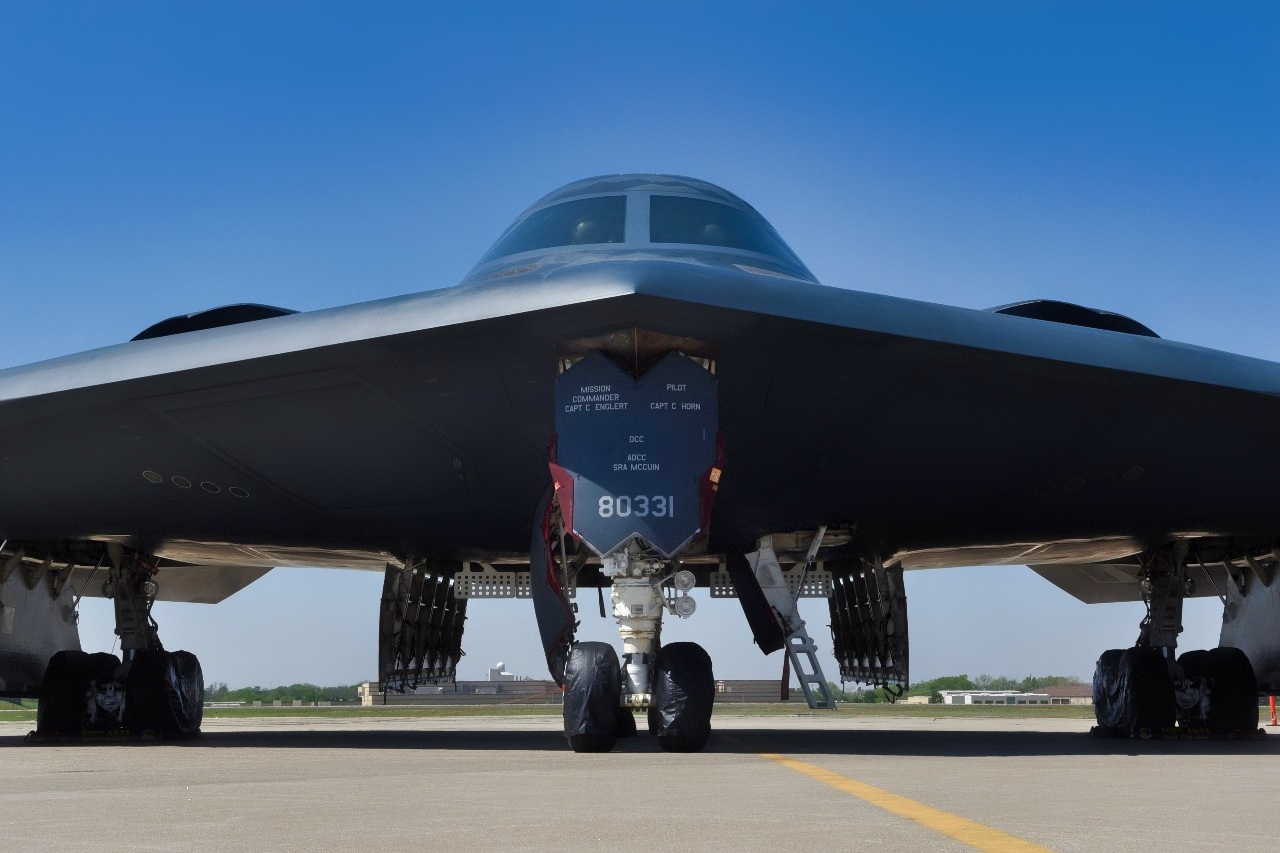
B-2A, serial #88-0331, ‘Spirit of South Carolina’ of the 509th Bomb Wing, Air Force Global Strike Command, on the parking ramp at Tinker Air Force Base, Oklahoma, during a visit April 11, 2017. The B-2A ‘stealth bomber’ visited the base to allow hundreds of personnel who work in direct support of the aircraft program through continuous software upgrades to see it in person and better understand the aircrafts’ role in the nation’s defense. (U.S. Air Force photo/Greg L. Davis)
How to De-Risk if Congress Won’t Fund 200+
If fiscal reality caps the buy near 100, you must compensate aggressively elsewhere:
Harden and multiply runways. Fund rapid runway repair, shelters, and true dispersal—not just temporary exercises—across CONUS bases and Pacific/European spokes.
Explode the munitions magazine. Lock in multi-year buys for standoff weapons and logistics kits that assume sustained high-tempo use, not boutique consumption.
Tankers and C2. Protect the tanker recapitalization schedule and accelerate modern airborne C2 so B-21 packages aren’t throttled by support shortfalls.
Pilot and maintainer pipelines. Grow crews before the airframes arrive; pour resources into LO maintenance training and tooling to keep signatures honest at scale.
Uncrewed adjuncts. Pair Raiders with stand-in or stand-near uncrewed systems to extend sensing, confuse defenders, and add decoys and jammers to the package.
Industrial surge posture. Stock long-lead parts and build parallel tooling so you can add tails fast if war or politics demand it. It’s cheaper to hold latent capacity than to invent it under fire.
These are all good ideas even with a larger fleet. With a small one, they’re survival.
The Bottom Line: 200+ Isn’t Ambition. It’s Insurance.
Deterrence fails when an adversary believes you cannot sustain the fight they fear. A B-21 fleet of ~100 tempts that belief. It risks nightly sortie gaps, brittle basing, and a shallow weapons pool—precisely the weaknesses a savvy opponent will try to exploit in a long war.
A 200+ B-21 force isn’t a luxury; it’s how you make sure the stealth bomber enterprise remains credible on Day 1 and Day 180. It signals to allies that the United States will keep showing up, and it tells adversaries there is no window—early or late—where our strike reach fades.
I’ve said it before: in the age of anti-access and precision counter-strike, quantity is a feature. For the B-21 Raider, it’s the difference between a boutique capability and a warfighting sword that never dulls.
About the Author: Harry J. Kazianis
Harry J. Kazianis (@Grecianformula) was the former Senior Director of National Security Affairs at the Center for the National Interest (CFTNI), a foreign policy think tank founded by Richard Nixon based in Washington, DC. Harry has over a decade of experience in think tanks and national security publishing. His ideas have been published in the NY Times, The Washington Post, The Wall Street Journal, CNN, and many other outlets worldwide. He has held positions at CSIS, the Heritage Foundation, the University of Nottingham, and several other institutions related to national security research and studies. He is the former Executive Editor of the National Interest and the Diplomat. He holds a Master’s degree focusing on international affairs from Harvard University.

