
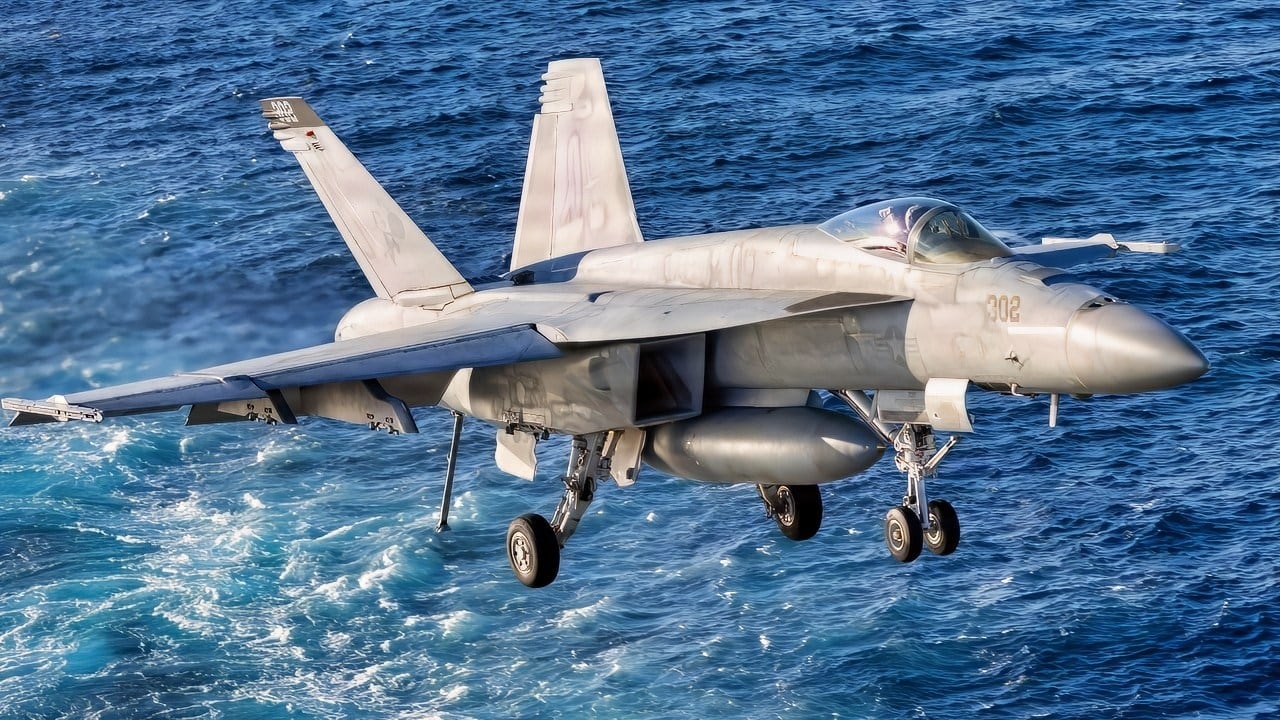
Key Points and Summary – Congress has gutted funding for the Navy’s F/A-XX program, cutting FY2026 support to just $74 million while fully backing the Air Force’s F-47 NGAD.
-That choice keeps the Navy’s sixth-generation carrier fighter in limbo just as China fields powerful A2/AD systems designed to push carriers out of the fight.

Shown is a graphical artist rendering of the Next Generation Air Dominance (NGAD) Platform. The rendering highlights the Air Force’s sixth generation fighter, the F-47. The NGAD Platform will bring lethal, next-generation technologies to ensure air superiority for the Joint Force in any conflict. (U.S. Air Force graphic)
-Without a long-range, stealthy, networked replacement for the Super Hornet, U.S. carriers risk becoming high-value “sitting ducks” that can’t reach beyond DF-21/DF-26 threat rings.
-Properly funded, F/A-XX could instead turn the carrier into a mobile hub for next-gen manned-unmanned airpower. Starved of resources, it may never get the chance.
Could F/A-XX Determine the Future Of Aircraft Carriers?
Entirely predictably, Congress recently approved a fiscal year 2026 defense authorization bill that funds the U.S. Navy’s sixth-generation carrier fighter program, known as F/A-XX, at just $74 million – an 84 percent reduction from the $453 million allocated in FY 2025.
The cut reflects the Trump administration’s newly stated priorities and budget request, and congressional acquiescence will now ensure that resources are shifted away from the Navy’s next-generation efforts to the U.S. Air Force’s land-based next-generation fighter program, NGAD.
The massive cut came even as senior Navy leaders have repeatedly warned that allowing the program to endure any more delays undermines American national security and leaves the Navy without a next-generation system, even as adversaries rapidly field new naval assets at scale.
And the problem is arguably even worse than a temporary capability gap: not funding F/A-XX now could cause such severe delays that the U.S. accelerates the aircraft carrier’s descent into obsolescence – an avoidable crisis that the Trump administration could solve with the stroke of a pen.
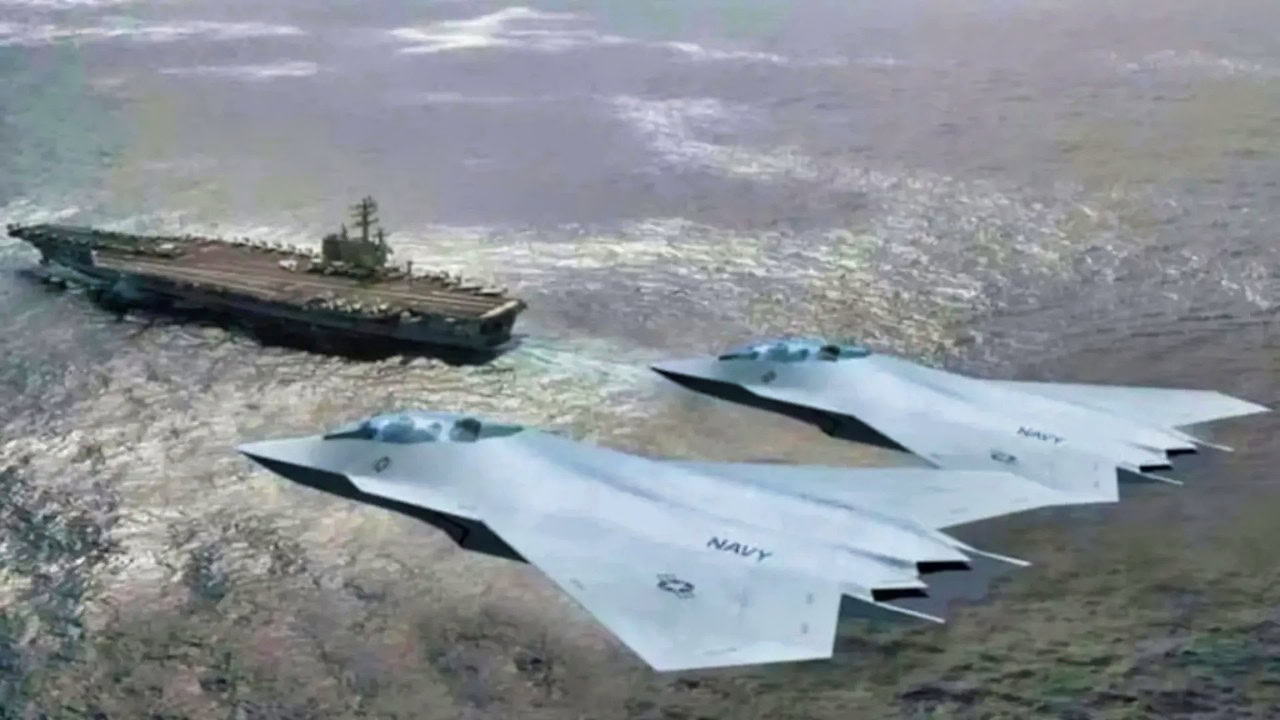
F/A-XX Fighter for US Navy. Navy graphic mockup.
The funding decision, outlined in the National Defense Authorization Act (NDAA) passed by the House of Representatives on December 10, 2025, and already cleared by the Senate in October, is a direct reflection of the Pentagon’s decision to prioritize the Air Force’s F-47 NGAD program while effectively keeping F/A-XX on life support.
What the Navy Had Planned
The Navy’s F/A-XX was conceived as a carrier-capable sixth-generation fighter designed to replace Boeing F/A-18E/F Super Hornets and EA-18G Growlers and to operate alongside its fleet of F-35Cs. It is intended to provide enhanced range, stealth, and networked combat capabilities tailored to the unique demands of naval aviation.
However, years of shifting priorities – and the arrival of the Trump administration in 2021 – have left the program in developmental limbo thanks to shifting budget allocations, with top Navy leaders still stressing the need for a decision to be made about its future soon.
Without a decision soon, the F/A-XX’s “limbo” status prevents planners from making decisions that mitigate the long-term damage that comes with effectively canceling the Navy’s next-generation fighter program.
By contrast, the Air Force’s F-47 NGAD effort has progressed with a much clearer institutional backing.
Boeing was selected in March 2025 to build the F-47 – a land-based sixth-generation fighter.
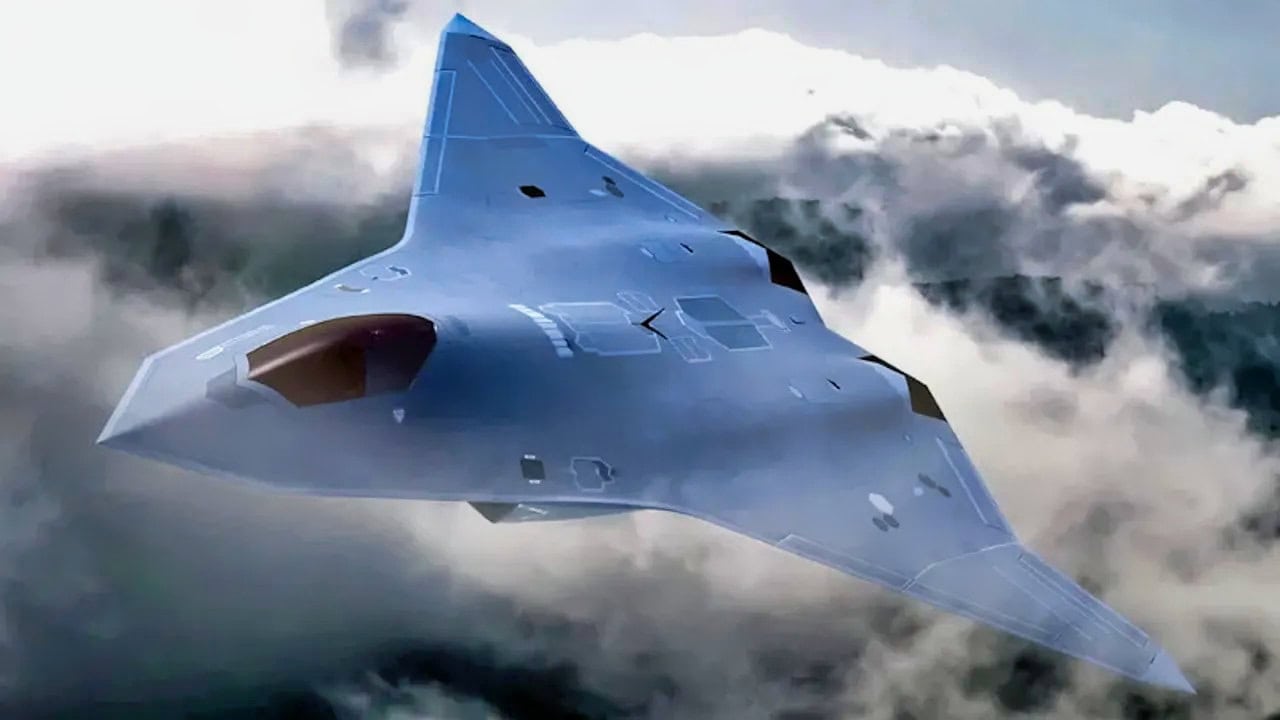
F/A-XX. Image Credit: Creative Commons.
The momentum for next-generation aviation technology seems to be squarely in the U.S. Air Force’s realm.
At the same time, the F/A-XX struggles for even some clarity about its future, not just the financial backing it needs.
The disparity in support for the two programs reflects strategic choices within the Department of Defense that hinge primarily on whether pursuing both programs simultaneously would strain America’s industrial base and delay one or both.
Air Force leaders argue that NGAD is essential to maintaining air superiority against near-peer competitors, particularly China, whose advancements in long-range missiles and integrated air defenses are central to U.S. threat assessments.
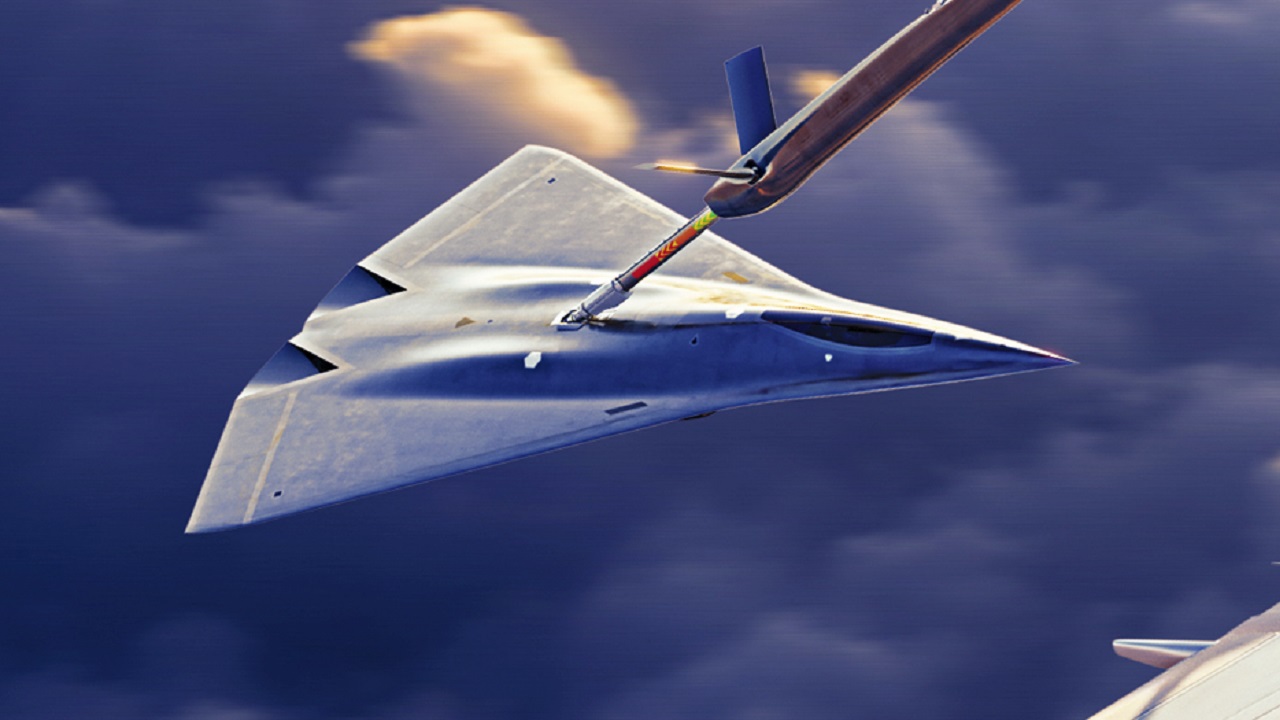
Lockheed Martin NGAD Fighter. Image Credit: Lockheed Martin.
The U.S. Navy, meanwhile, has been forced to maintain and expand its surface and submarine fleets while modernizing its air wing, stretching its budget thin, and, at the same time, unsure about which aircraft will be used in the medium term.
Is This the End Of Aircraft Carriers?
The decisions being made now will inevitably affect American aircraft carriers and, in the long term, potentially even accelerate their slow descent into obsolescence. In 2025, many argue that carriers are becoming increasingly vulnerable to modern anti-ship missiles, advanced submarines, and unmanned systems.
China’s rapid deployment of anti-access/area-denial (A2/AD) weapons, including the DF-21D and DF-26 ballistic missiles designed to target ships at sea, has intensified those concerns.
The problem is this: carriers, which must operate within a shrinking envelope of safety, risk losing their traditional role as the ultimate strike platforms when the air wing they carry cannot reach beyond those threat ranges, and when advanced weapons become cheaper and easier to field. Carriers, in effect, become “sitting ducks.”
Those vulnerabilities are compounded by age and the limitations of current carrier air wings.
While the F-35C is a competent asset, with improved stealth and sensor fusion capabilities, its range limitations and reliance on forward logistics remain significant concerns.
Without a true next-generation carrier fighter or sufficiently advanced unmanned systems integrated into the air wing, carriers may increasingly be seen as defensive assets, useful for presence and support but less capable of facilitating the penetration of contested airspace.
If F/A-XX is funded and fielded on a realistic timeline, the aircraft carrier can instead evolve into a platform for next-generation airpower, hosting long-range, survivable manned aircraft tightly integrated with loyal wingman drones, unmanned tankers, and networked strike systems that extend effective reach well beyond adversary A2/AD areas.
In that scenario, the carrier doesn’t become obsolete. Instead, it reasserts itself as a mobile, forward-deployed hub for advanced combat aviation, presuming it is equipped with constantly evolving air defense systems.
The aircraft carrier can remain central to U.S. power projection and maritime dominance in a way no land-based alternative can fully replicate – but that requires funding and confidence in a next-generation carrier-capable fighter program first.
About the Author:
Jack Buckby is a British author, counter-extremism researcher, and journalist based in New York who writes frequently for National Security Journal. Reporting on the U.K., Europe, and the U.S., he works to analyze and understand left-wing and right-wing radicalization, and reports on Western governments’ approaches to the pressing issues of today. His books and research papers explore these themes and propose pragmatic solutions to our increasingly polarized society. His latest book is The Truth Teller: RFK Jr. and the Case for a Post-Partisan Presidency.

