
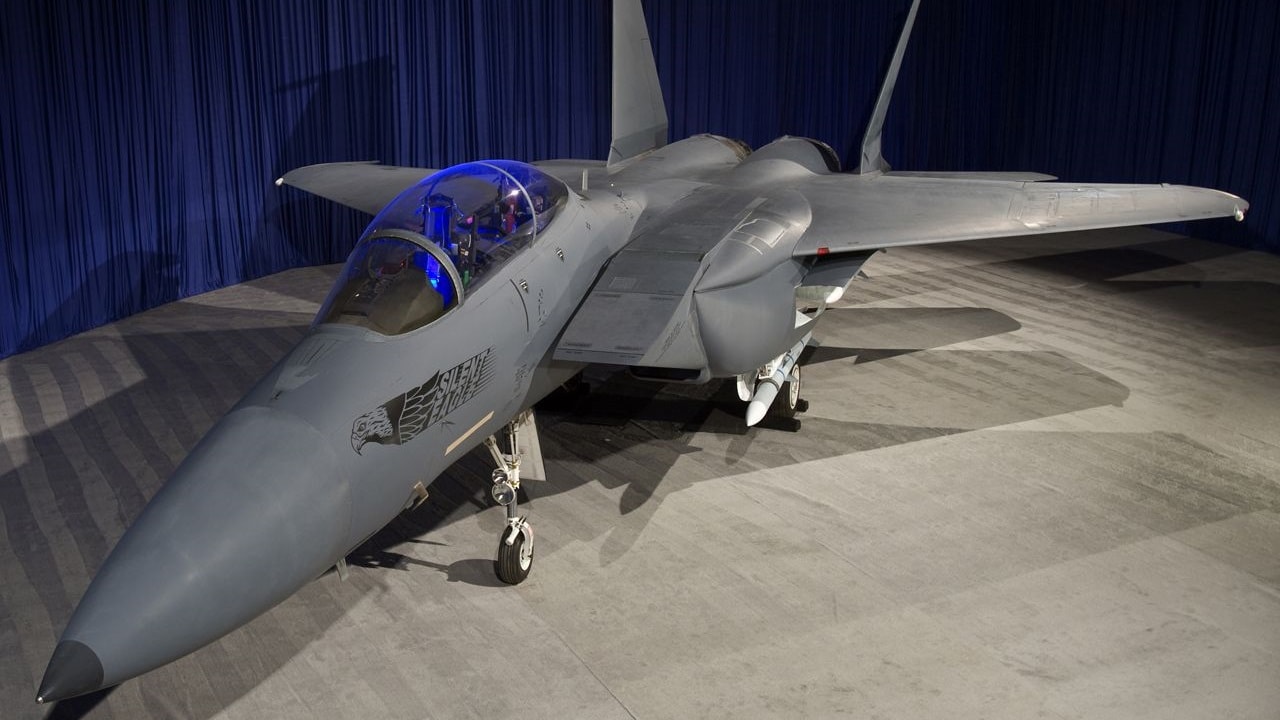
Key Points and Summary: The F-15SE Silent Eagle was Boeing’s 2009 attempt to bridge the gap between 4th and 5th-generation fighters by adding stealth features to the legendary F-15 airframe.
-The Tech: It featured conformal weapons bays (CWBs) for internal carry, radar-absorbent materials, and 15° canted vertical tails to reduce radar signature.
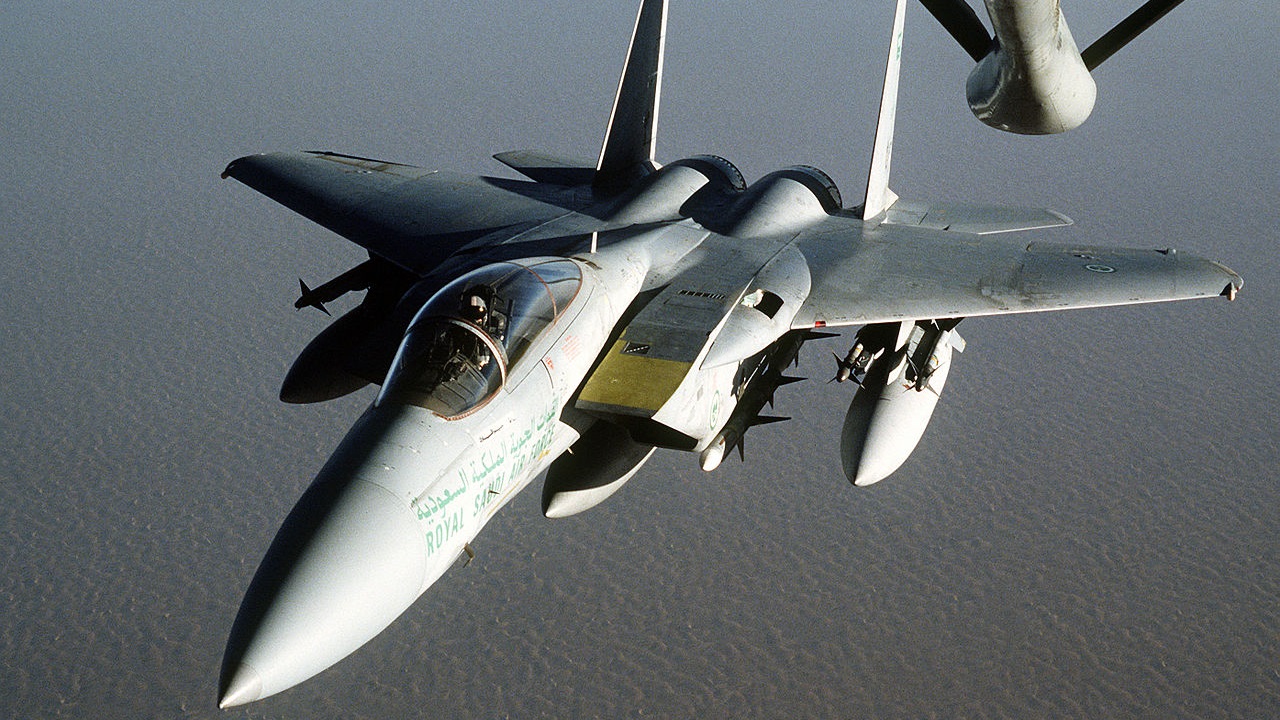
A Royal Saudi Air Force F-15 Eagle fighter aircraft approaches a KC-135 Stratotanker from the 1700th Air Refueling Squadron Provisional for refueling during Operation Desert Shield.
-The Performance: Retaining the F-15’s raw power, it boasted speeds of Mach 2.45 (1,650 mph) and carried advanced weaponry like AMRAAMs and JDAMs.
-The Failure: Despite being cheaper than the F-35, it offered only “limited stealth” (stealth-lite). Allies like South Korea and Israel ultimately opted for the full stealth capabilities of the F-35, leaving the Silent Eagle without a buyer.
The ‘Stealth’ F-15SE Silent Eagle Had 1 Big Problem That Killed It
The F-15SE Silent Eagle was a proposed stealthier version of the F-15E fighter jet that Boeing unveiled in 2009, but the airframe never went into production.
It incorporated stealth features like conformal weapons bays, radar-absorbent materials, and canted vertical stabilizers to reduce its radar signature while retaining the F-15’s combat effectiveness and weapon capacity.
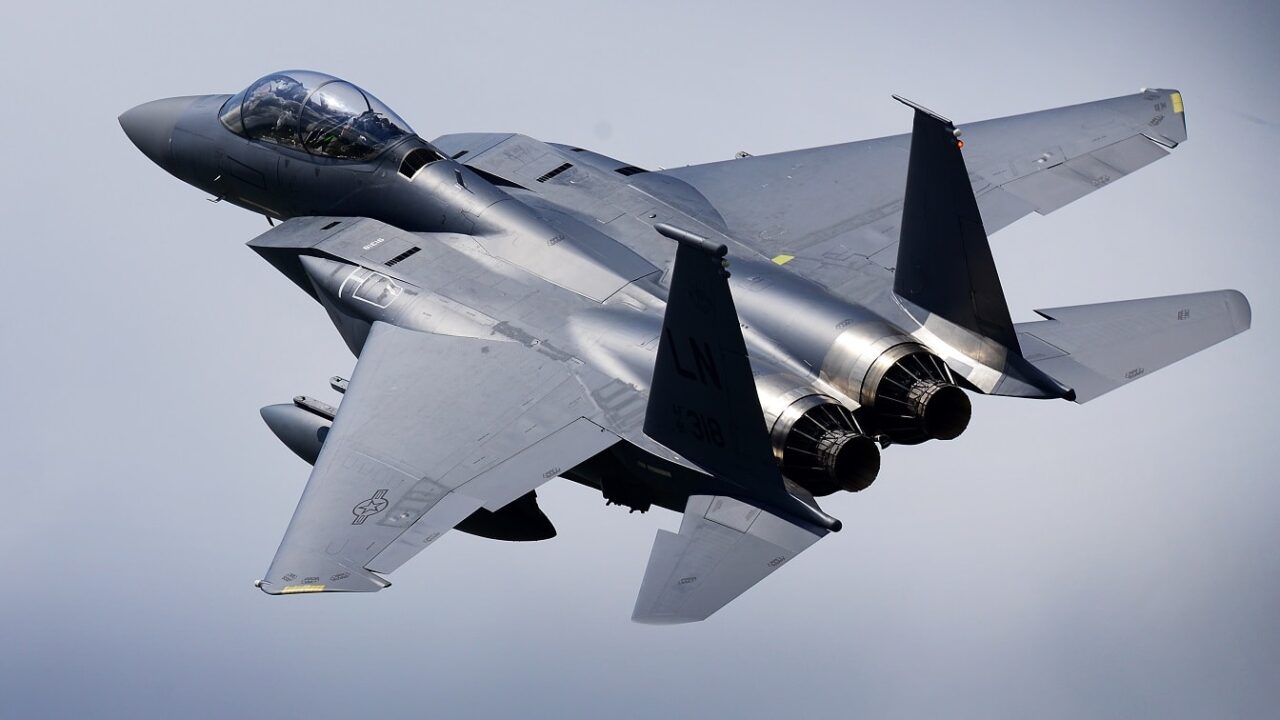
An F-15E Strike Eagle assigned to the 492nd Fighter Squadron flies over Royal Air Force Lakenheath, England, May 10. The 492nd trains regularly to ensure RAF Lakenheath brings unique air combat capabilities to the fight. (U.S. Air Force photo/ Tech. Sgt. Matthew Plew)
While it aimed to offer a more affordable, multi-role stealth capability than fifth-generation fighters like the F-22 or F-35, it was too expensive for its limited stealth. It was passed over by potential buyers, including South Korea and Saudi Arabia, who preferred either cheaper traditional jets or fully stealthy platforms.
Meet The F-15 Silent Eagle
Boeing made some changes to the highly successful and capable F-15 in an attempt to siphon off some business and bridge the gap from the Strike Eagle’s fourth-generation to the Lockheed Martin F-35’s fifth-generation stealth fighter. Boeing based the design on the original F-15 airframe, with multiple improvements to its features, systems, and components.
The aircraft features a new conformal weapons bay (CWB), replacing standard conformal fuel tanks. This design significantly increases the internal carriage capacity and minimizes the aircraft’s radar signature. Boeing learned that canting out those twin vertical tails by 15° helped reduce the F-15’s RCS even more.
Boeing added unique composite materials applied to the aircraft’s skin and frame to reduce its radar cross-section.
The aircraft was qualified to carry a variety of weapons, including “AIM-9 Sidewinder and AIM-120 AMRAAM air-to-air missiles, JDAM satellite-guided bombs, and Small Diameter Bombs, among others,” as Alex Hollings reported in Sandboxx.
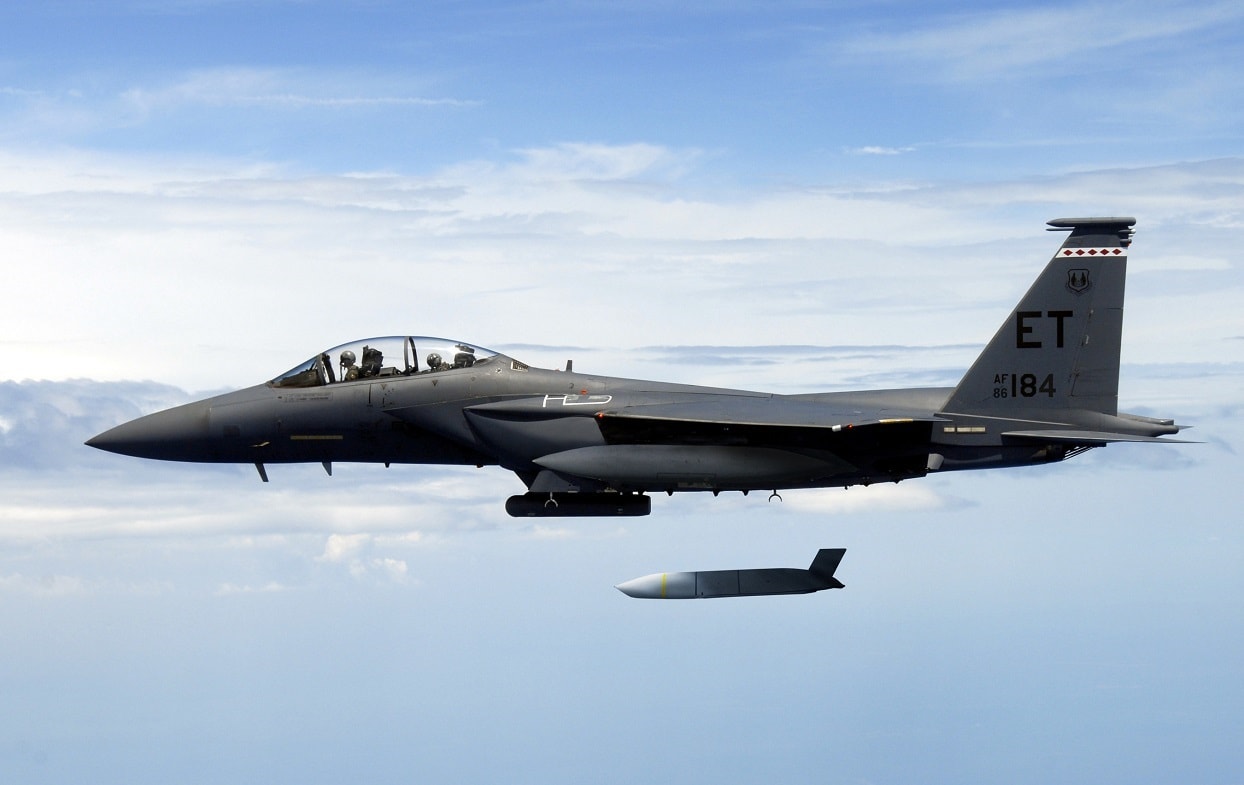
A U.S. Air Force F-15E Strike Eagle flies with a Joint Air-to-Surface Standoff Missile (JASSM). JASSM-Extended Range has more than two-and-a-half times the range of JASSM for greater standoff distance. Photo credit: U.S. Air Force. (PRNewsfoto/Lockheed Martin)
Powered by 2 × Pratt & Whitney F100-PW-220 afterburning turbofans, 58,000 pounds of thrust with afterburner, the Silent Eagle would fly at Mach 2.45 (1,650 mph) at altitude or Mach 1.2 (921 mph) at sea level.
At the time of its rollout by Boeing, it was arguably the most capable fourth-generation + fighter aircraft on earth.
Why Didn’t The F-15SE Sell With US Allies?
The improved stealth features were a selling point for the aircraft, but how much stealthier was it for real? And why didn’t the Silent Eagle have customers flocking to the door to buy the already legendary aircraft?
Hollings correctly pointed out that the world, especially the aviation world, was changing in the 2010s, where stealthy aircraft were fusing data on the fly. The Silent Eagle, like the earlier models of the Eagle, was still a bruiser, or as he put it, “like Robocop carrying a shotgun with a silencer.”
While the F-15SE was significantly more advanced than many competitor aircraft in the market, including the Eurofighter Typhoon and the Russian Su-35, the US Air Force was investing in new fifth-generation fighters like the F-22 and the F-35.
The new aircraft of the fifth generation were significantly better at stealth, and while the F-15SE, while impressive, was not in the same league as a 5th-generation fighter with stealth ‘built in’ to the aircraft’s design.
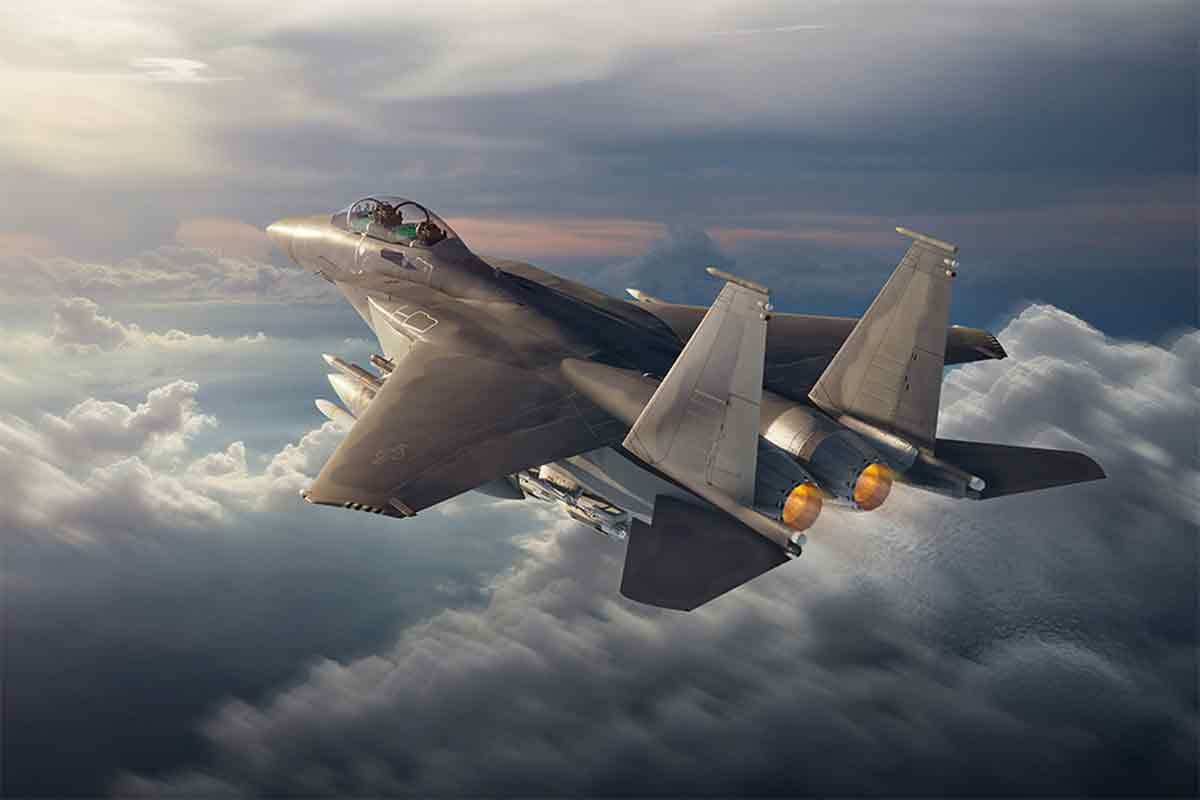
F-15EX Eagle II (Image: Boeing)
There was some initial interest from Israel, South Korea, and Japan, but those countries were added to the F-35 program. Was there political pressure applied here, or was it simply that those US allies opted for the more expensive, but more impressive aircraft? The feeling here was the latter.
The US Then Changes Course On The F-22
By 2005, a true stealth fighter had found its way into the fighter realm with the F-15’s intended replacement, Lockheed Martin’s incredible new F-22 Raptor. It was the best fighter in the world by far.
But the end of the Cold War brought short-sightedness into the Pentagon’s long-term plans. Instead of building a flotilla of untouchable F-22s, the bean counters looked to the past rather than the future.
The Pentagon decided that just 186 F-22s would ultimately be built, and lo and behold, the F-15 was thrust as America’s primary air superiority fighter once again, while the F-15E was proving invaluable across conflicts in the Middle East.
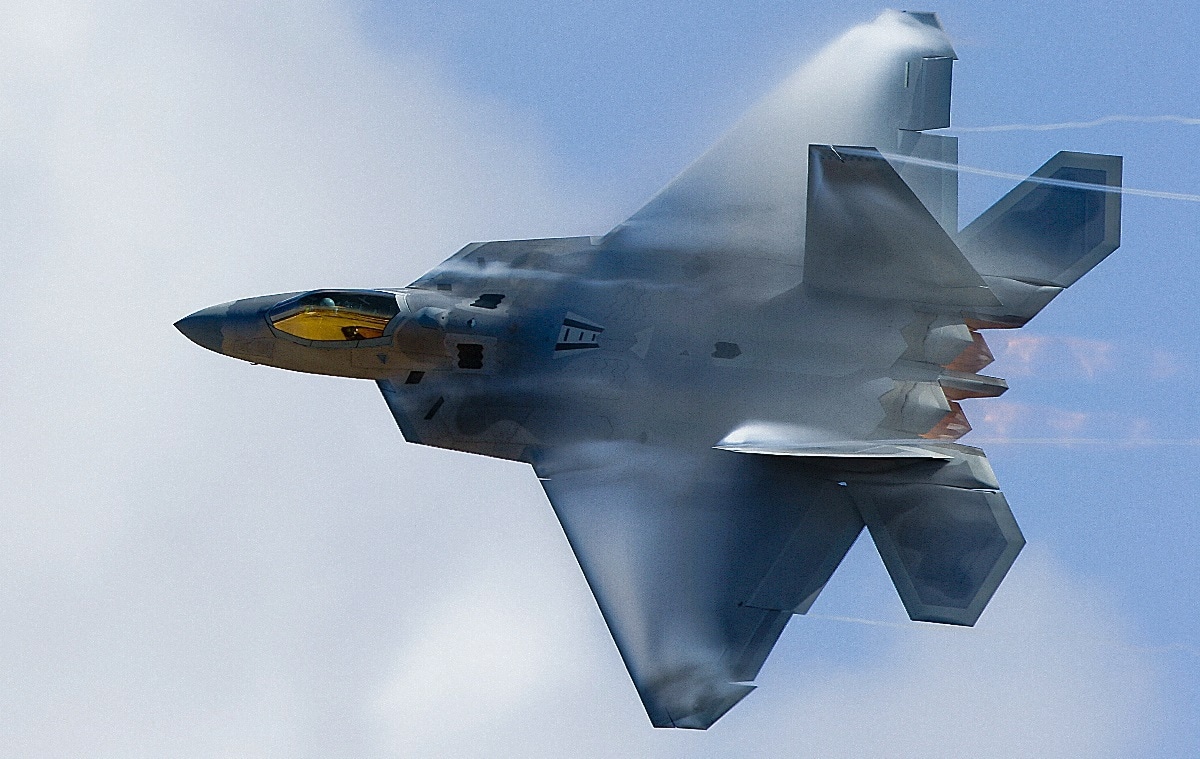
An F-22 Raptor aircraft performs a high-speed bank at the Marine Corps Community Services-sponsored annual air show Oct. 3, 2008, at Marine Corps Air Station Miramar, San Diego. (U.S. Marine Corps photo by Lance Cpl. Dan T. Le/Released)
But the temporary good news for Boeing and its Eagle was soon dashed. The F-22 may have been canceled, but the F-15E’s ground attack capabilities were now facing a new stealthy threat on the fighter sales market in the form of the latest and attack-oriented F-35 Joint Strike Fighter.
Boeing had competed and lost for the Joint Strike Fighter contract with their X-32, leaving their hopes for lucrative fighter contracts resting squarely on the F-15’s rapidly aging shoulders. And the F-35 is the most advanced fighter aircraft on earth. But it is very, very expensive.
The F-15 SE Was Once Again Thrust Into the Spotlight
The South Koreans, in particular, were initially hesitant about the F-15SE. They wanted the F-35, but stealth aircraft require a lot of detailed and expensive maintenance. The cost of the plane, plus the maintenance, was daunting. Could there be a trade-off that could benefit them?
The aircraft was outwardly quite different from the original Eagle. The 750-gallon conformal fuel tanks were removed and replaced with new conformal weapons bays (CWBs) that were very similar in external design to the fuel tanks they replaced.
Hollings wrote that this allowed the Silent Eagle to carry its firepower internally, like 5th-generation fighters like current American, Chinese, and Russian stealth fighters, eliminating the radar return created by external munitions while maintaining a similar aerodynamic profile to the Strike Eagle that was already in service.
Boeing even designed it so that in a mission profile that required less stealth and more power, the CWBs could be removed and replaced with standard Strike Eagle conformal fuel tanks, thus trading four additional weapons stations and 1,500 gallons of added fuel.
But in the end, South Korea looked forward and decided that the F-35 was the best fighter for its future. They purchased 40 F-35s, with an astronomical price tag that may have reached $176 million each.
Interestingly, Saudi Arabia, which is barred from the F-22 program due to Congressional rules, has maintained Israel’s air supremacy in the Middle East by opting for the F-35 over other C and D models.
The F-15SE was another aircraft that falls into the “what if” type of conversation.
Why did the F-15SE fail? It neither fit into a perfect niche nor was it a cutting-edge aircraft like the F-35 and the soon-to-be-operational F-47.
About the Author: Steve Balestrieri
Steve Balestrieri is a National Security Columnist. He served as a US Army Special Forces NCO and Warrant Officer. In addition to writing on defense, he covers the NFL for PatsFans.com and is a member of the Pro Football Writers of America (PFWA). His work was regularly featured in many military publications.