
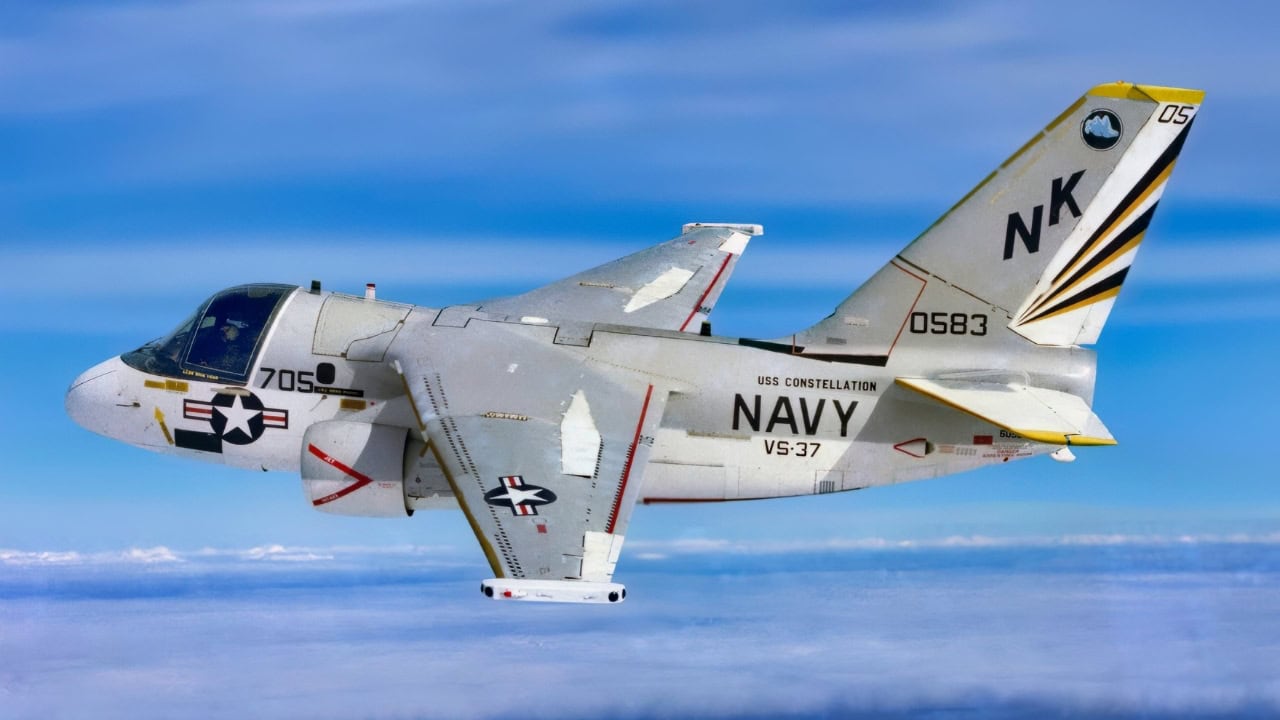
Key Points and Summary – Lockheed’s S-3 Viking arrived as the Navy’s submarine hunter, built to replace the S-2 Tracker and stalk Soviet boats from carrier decks.
-First flying in 1972 and entering service in 1974, the four-crew “War Hoover” paired sensors with torpedoes, depth charges, and later weapons.
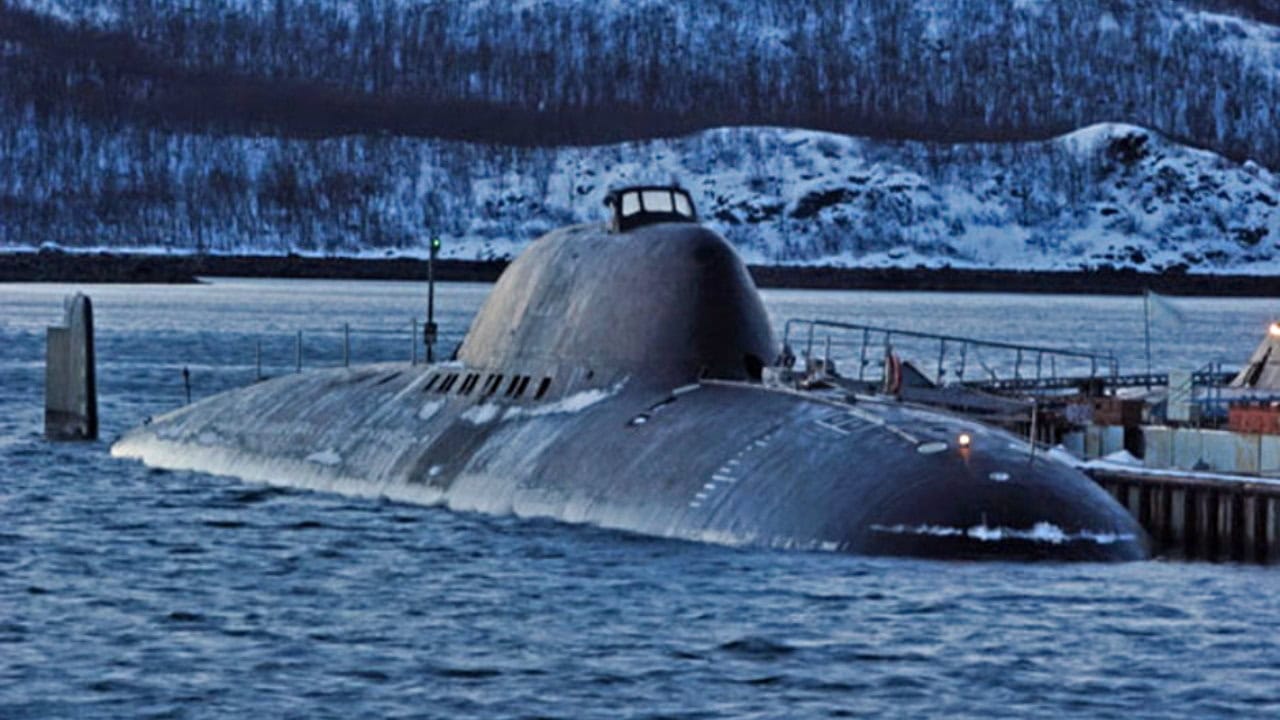
Alfa-Class Russian Navy. Image Credit: Creative Commons.
-It never scored a Cold War sub kill, but it proved versatile in Desert Storm, the Balkans, Afghanistan, and Iraq—often striking targets and refueling other aircraft.
-After its ASW mission migrated to the P-3 and P-8, the Navy retired the Viking in 2016, with a handful preserved in museums and one flying for NASA until 2021.
Meet the “War Hoover”: How the S-3 Viking Became a U.S. Navy Aircraft Carrier Legend
“Skol Vikings!” is the battle cry of the Minnesota Vikings’ long-suffering fanbase.
The Vikings for whom the football team was named were among the most feared warriors of the medieval period.
Being the seafarers that they were, it is fitting that they became the namesake of a 20th-century U.S. Navy warplane. However, rather than looting and pillaging hapless medieval British villages via wooden ships with dragonhead bows, the modern-day metallic Viking was built to ravage Soviet-designed submarines from the air during the heady days of the Cold War.
In the case of this antisubmarine warfare (ASW) platform, “SKOL” could very well be an acronym for “Sub Killer Out Lurking.”

An artist’s concept of a Soviet Yankee class nuclear-powered ballistic missile submarine after conversion into a test platform for the SS-NX-24 cruise missile.
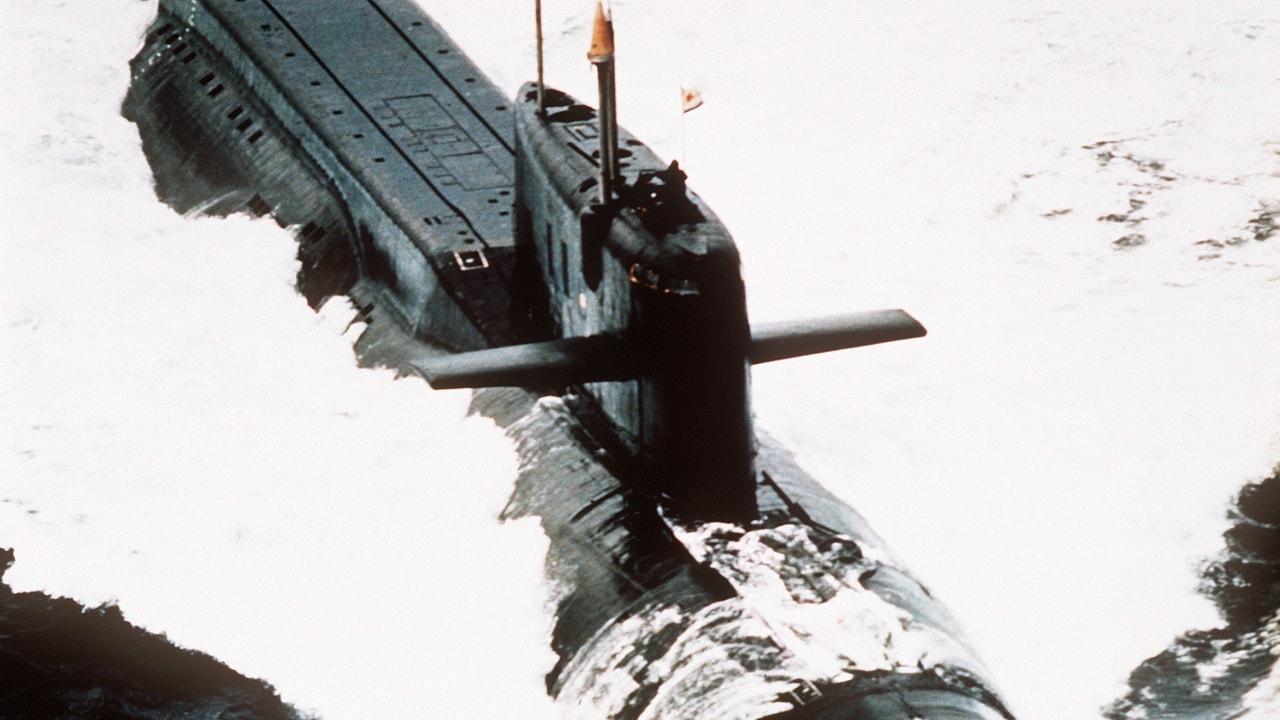
A close-up view of a Yankee Notch Class submarine underway. This is a conversion of a Yankee Class Soviet ballistic missile submarine into a strategic cruise missile platform.
Viking Takes Sail, Or Rather, Takes Flight: S-3 Early History
The S-3 was built by Lockheed, which of course was also famous for building warbirds such as the SR-71 Blackbird, U-2 “Dragon Lady,” and F-117 Nighthawk (the first stealth fighter). However, unlike that latter trio, the Viking was not specifically made by Lockheed’s legendary “Skunk Works” division.
The Viking made her maiden flight on January 21, 1972, and was officially introduced into U.S. Navy service on February 20, 1974, as the Vietnam War was drawing down.
U.S. President Richard Nixon’s Vietnamization policy notwithstanding, the debut of the S-3 couldn’t have come at a better time. A mere two years after the warbird’s operational debut, the Soviet Navy would start building its behemoth Typhoon-class ballistic-missile submarines (SSBNs). Compounding those concerns, the Navy’s ASW aerial platform at the time, the prop-driven Grumman S-2 Tracker, was on the path to obsolescence.
Accordingly, the Navy developed its VSX program in order to find a worthy successor to the Tracker.
Lockheed beat out Grumman for the winning design, which was quite a coup given the latter company’s long track record for building carrier-based warplanes.
A total of 188 S-3 airframes were built.
S-3 Viking Tech Specs and Vital Stats
-Crew: 4 (pilot, copilot/tactical coordinator [COTAC], tactical coordinator [TACCO], sensor operator [SENSO]) (more on this in a bit)
-Fuselage Length: 53 ft 4 in (16.26 m)
-Height: 22 ft 9 in (6.93 m)
-Wingspan: 68 ft 8 in (20.93 m)
–Max Takeoff Weight (MTOW): 52,539 lb. (23,831 kg)
-Powerplant: 2 × General Electric TF34-GE-2 turbofan engines, each generating 9,275 lbf (41.26 kN) of thrust
-Max Airspeed: Mach 0.79 {494 mph, 795km/h)
-Service Ceiling: 40,900 ft (12,500 m)
-Combat Range: 460.5 nmi (529.9 mi, 852.8 km)
-Rate of Climb: 5,120 ft/min (26.0 m/s)
-Armament: Up to 4,900 lb. (# kilograms) worth of ordnance, such as:
-2 × Mark 50 torpedoes
-4 × Mark 46 torpedoes
-6 × depth charges
-Mk 82 500-lb (227 kg) general purposes bombs
-Mk 83 1,000-lb (454 kg) bombs
AGM-65E/F Maverick missiles
The Viking’s four-person crew was a tad unusual—Navy warplanes were typically one- or two-man crews. The SENSO was an enlisted sailor, whereas the other three crew members were commissioned officers.

An aerial port quarter view of a Soviet Mike class nuclear-powered attack submarine underway.
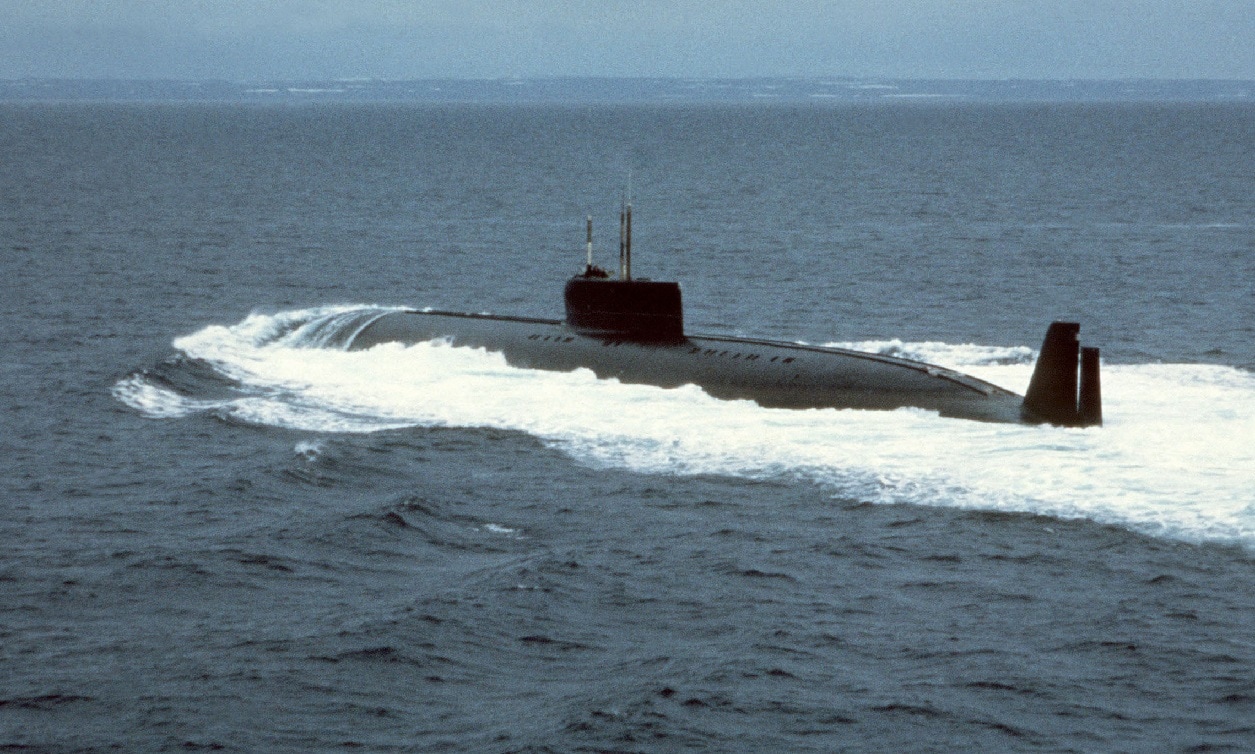
A port quarter view of a Soviet Papa class nuclear-powered cruise missile submarine (SSGN) underway.
That was not the Viking’s only oddball feature. The plane also had a unique ejection protocol: If the pilot or COTAC initiated ejection, all four crew members would be ejected, with the backseaters spewed out 0.5 seconds before the frontseaters to allow for separation. If the TACCO or SENSO, sitting in the back, initiated ejection, the pilots up front would not be auto-ejected but rather had to initiate their own ejection.
Akin to the A-6 Intruder ground-attack aircraft, the Viking carried no defensive armaments. This would probably make the original flesh & blood Vikings roll over in their graves, as they wouldn’t be caught dead without their swords.
Operational History/Combat Performance
The Cold War ended with the collapse of the Soviet Union, and the S-3 crews never got any sub kills.
The “War Hoover” (so named for the sound of its engines, which reminded crews of a vacuum cleaner) was soon replaced by the P-3 Orion—and more recently the Boeing P-8 Poseidon. After 1997 ,most Viking missions were reduced from four to two— a pilot and copilot/naval flight officer. But that didn’t mean the Viking didn’t see its fair share of combat action, thanks to the warbird’s versatile weapons’ packages.
During the 1991 Persian Gulf War, a Viking crew launched from the aircraft carrier USS Theodore Roosevelt (CVN-71) destroyed an Iraqi Silkworm anti-ship missile site with a well-placed salvo of AGM-84 Standoff Land Attack Missiles, while other Viking crews targeted Iraqi naval vessels and destroyed multiple anti-aircraft gun emplacements and coastal radars. The plane would also serve admirably in the Yugoslav Wars in the 1990s and during Operation Enduring Freedom in the skies over Afghanistan, frequently performing tanker duties in the latter conflict.
The S-3 would return to Iraq during Operation Iraqi Freedom in 2003, Among other sorties during the conflict, an S-3B crew from the USS Constellation (CV-64) destroyed an Iraqi Navy command-and-control facility in the port city of Basra.
Where Are They Now?
The Navy retired its Viking fleet from active-duty service in 2016. However, NASA acquired one of these planes back in 2004 for flight research, finally retiring that specimen in 2021.
Roughly 14 Vikings have been preserved for posterity as museum static displays. This writer can personally vouch for the ones at the National Naval Aviation Museum, NAS Pensacola, Florida, and Patuxent River Naval Air Museum, Lexington Park, Maryland.
About the Author: Christian D. Orr, Defense Expert
Christian D. Orr is a Senior Defense Editor. He is a former Air Force Security Forces officer, Federal law enforcement officer, and private military contractor (with assignments worked in Iraq, the United Arab Emirates, Kosovo, Japan, Germany, and the Pentagon). Chris holds a B.A. in International Relations from the University of Southern California (USC) and an M.A. in Intelligence Studies (concentration in Terrorism Studies) from American Military University (AMU).