
Key Points and Summary – The piece uses a widely shared Genghis Khan quote about fear to frame a short, punchy biography of Temujin’s rise.
-It contrasts his “don’t be afraid” ethos with Patton’s more human view that courage often means fighting while scared.
-From a childhood shaped by tribal politics, betrayal, and survival, Temujin builds alliances, marries Börte, and steadily consolidates Mongol power through relentless warfare—most famously against Chinese dynasties and across Central Asia.
-The article balances his ruthlessness with notes on governance: literacy, trade, religious tolerance, and strict social rules—then closes on his death, heirs, and enduring pop-culture legacy.
The Quote That Explains Genghis Khan’s Rise From Betrayal to Empire
If you’re afraid – don’t do it, – if you’re doing it – don’t be afraid!”—That quote belongs to Genghis Khan “ruler of all” or “Prince of Conquerors,” depending on the translation source, founder of the Mongol Empire and one of the most feared military leaders of all time.
The Khan’s exhortation might clash with one of the sayings of another famous (and more modern) military leader, namely U.S. Army General George S. Patton Jr., to wit: “Yes, every man is scared in his first battle. If he says he’s not, he’s a liar…The real hero is the man who fights even though he is scared.”
That nitpick and clash of military leadership philosophies aside, Genghis Khan remains an iconic figure in military history.
Early Life of Genghis Khan
He was born in Khentii Mountains (a mountain range in the Töv and Khentii Provinces in present-day northeastern Mongolia) with the name Temujin, which means “finest steel.”
There is some dispute about his birth year, with some historians placing it at 1162 CE (which fell under the Year of the Horse in the Chinese Zodiac), whilst others go with either 1155 or 1167 (both of which fell under the Year of the Pig).
In any event, his father, Yesugai, was the chieftain of their nomadic tribe. Yesugai raised little Temujin accordingly, teaching the lad how to ride horses and hunt with his brothers at an early age.
At the age of nine, Temujin was sent to live with the tribe of his future wife, Börte Üjin (whom he finally married six years later, at the age of 15, which was considered the age of majority in that society; she was two years his senior).
Alas, upon his attempt to return to his own tribe, he and his family were betrayed; Yesugai had been fatally poisoned, and another warrior took up the role as chieftain and evicted Temujin and his family from the tribe.
However, Temujin was determined not only to survive this betrayal and adversity but to gain vengeance and thrive eventually. Accordingly, he helped his family get through the brutal winter and then set his plans in motion.
Genghis Khan’s Initial Military Career…and Earning His Famous Sobriquet
As noted by his Ducksters mini-bio, “Over the next several years Temujin began to build up his own tribe. He married Borte and formed an alliance with her tribe. He was a fierce and brutal fighter and became admired by many of the Mongols for his courage. His army of warriors continued to grow until he had a large enough fighting force to take on the Tartars…When Temujin finally fought the Tartars, he showed no mercy. He decimated their army and executed their leaders. He then began to conquer his enemy Mongol tribes. He knew the Mongols needed to unite. After conquering his greatest enemies, the other Mongol tribes agreed to ally and follow Temujin. They named him Genghis Khan or ‘ruler of all.’”
Great General…and Scourge to China
It was against China that the newly-dubbed Genghis Khan would earn his greatest fame…or infamy, depending upon whom you ask.
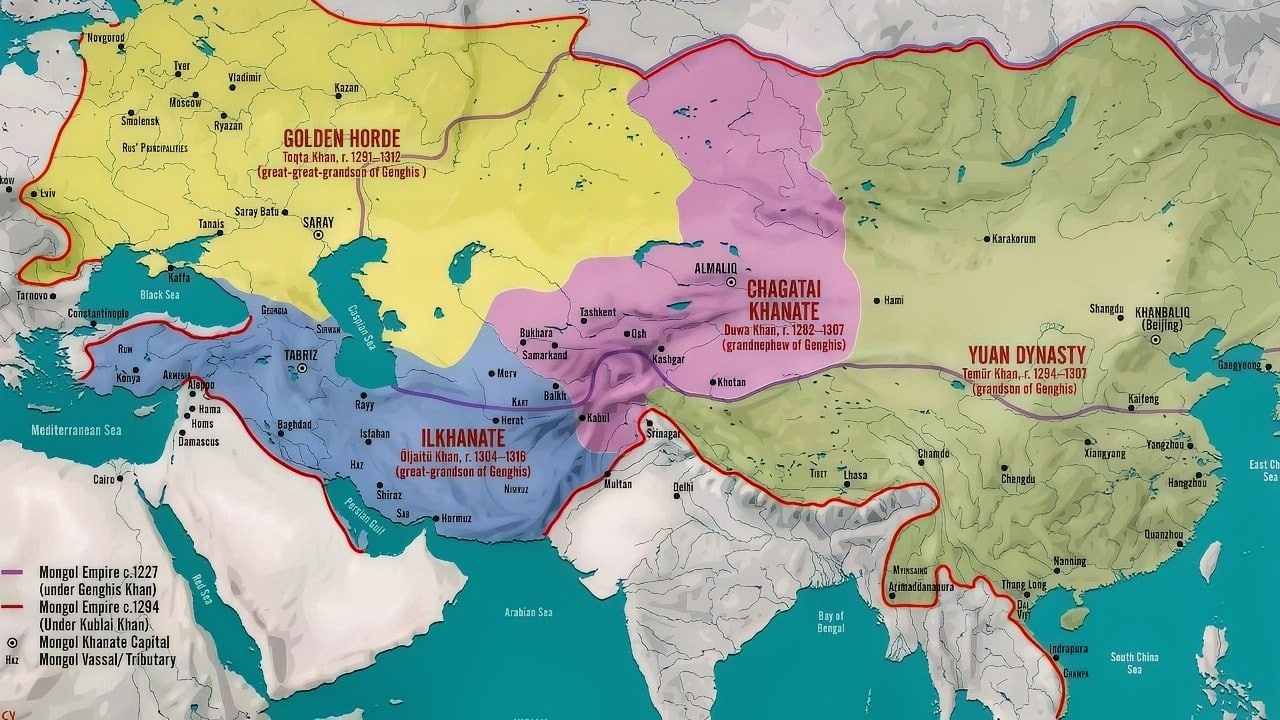
He led merciless conquests of the Western Xia Dynasty in 1209, Kara-Khitan Khanate (Western Liao) in 1218, and the Jin Dynasty in 1234.
But it wasn’t just China that felt his wrath; his Mongol hordes also spread into parts of present-day Central Asian countries and Iran, and thus they conquered the Khwarazmian Empire in 1221.
Genghis Khan certainly showed no mercy to anyone who opposed him; for example, after he captured the city of Urgench (in present-day Uzbekistan), each Mongol warrior, in an army that might have numbered 20,000, was required to execute 24 people.
Yet surprisingly, Genghis Khan also had a benevolent side.
For example, he generally advocated literacy, religious freedom, and trade.
However, many local customs (such as Jewish kosher traditions and Muslim halal traditions) were frowned upon or discarded once Mongol rule was implemented.
In addition, when it came to social policy, he forbade the selling of women, theft of property, and fighting.
He also lived in a modest dwelling, a style of tent called a yurt.
Genghis Khan died on either August 18 or 25, 1227, under mysterious circumstances (although many believe that injured sustained in a fall from his horse) at the approximate age of 65, whilst in the Xingqing Prefecture (AKA the Zhongxing Prefecture.
There is no small irony in the horseback factor, as he once said that “conquering the world on horseback is easy; it is dismounting and governing that is hard.”
His heirs were his four sons, Ogedei, Tolui, Chagatai, and Jochi; Ögedei and Jochi continued to expand their father’s empire, and Tolui begat Kublai Khan, who would conquer all of China and establish the Yuan Dynasty.
Lasting Legacy
The most famous tribute to Genghis Khan in Western pop culture is the 1965 motion picture “Genghis Khan,” directed by Henry Levin (also known for 1959’s “Jules Verne’s Journey to the Center of the Earth”), starring Omar Sharif in the title role, and co-starring James Mason, Telly Savalas, and Eli Wallach.
The film was filmed in Yugoslavia rather than Asia, and film critics nitpicked it for its historical inaccuracies (typical Hollywood embellishment for you, eh) but praised its rousing battle scenes.
About the Author: Christian D. Orr, Defense Expert
Christian D. Orr is a Senior Defense Editor. He is a former Air Force Security Forces officer, Federal law enforcement officer, and private military contractor (with assignments worked in Iraq, the United Arab Emirates, Kosovo, Japan, Germany, and the Pentagon). Chris holds a B.A. in International Relations from the University of Southern California (USC) and an M.A. in Intelligence Studies (concentration in Terrorism Studies) from American Military University (AMU). He is also the author of the newly published book “Five Decades of a Fabulous Firearm: Celebrating the 50th Anniversary of the Beretta 92 Pistol Series.”