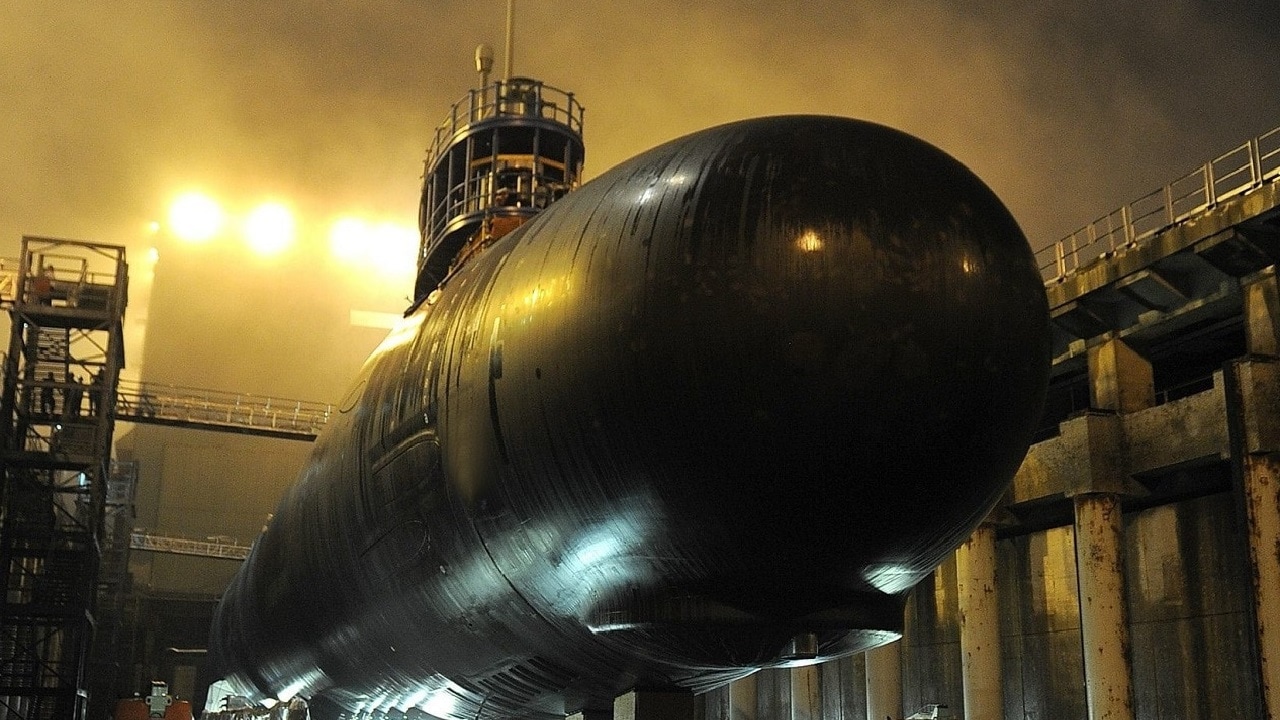
Summary and Key Points: Researchers from the U.S. Navy, Electric Boat, and the University of Connecticut have developed a breakthrough method using “neutron beams” to inspect submarine hulls for microscopic flaws.
-Unlike X-rays, neutron beams can deeply penetrate thick steel without damaging it, allowing engineers to detect internal stress, “ductility dip cracking,” and weld defects before they become catastrophic.
-This technology is critical for ensuring structural integrity at depths beyond 800 feet, where water pressure exceeds 50,000 pounds per square foot, and could also be used to rapidly assess battle damage.
US Navy Breakthrough: Neutron Beams Reveal Hidden ‘Microscopic’ Flaws in Submarine Hulls
Researchers from the United States Navy, academia, and industry are uncovering a breakthrough method to protect submarines from the heavy weight of water pressure, weld cracks, and corrosion.
The technique, discovered through a collaborative effort between the US Navy, Electric Boat, and the University of Connecticut, uses “neutron beams” to detect “microscopic” flaws in a submarine hull. These flaws include potential cracks or structural damage that can be found much earlier than previously possible, enabling problems to be fixed before they become catastrophic.
“Nuclear submarines, which are vital to US national security, regularly dive beyond 800 feet (244 meters) below the ocean’s surface, where external pressures exceed 50,000 pounds per square foot,” an essay in Interesting Engineering states.
The concept is to monitor the weld condition of a submarine hull to detect potential problem areas and make necessary adjustments before irreparable damage occurs. Neutron beams, according to an essay in “Interesting Engineering,” can “penetrate” thick metal submarine hulls without causing damage.
Large steel plates are welded together to connect “modules,” or structural parts of a submarine, and the condition of these welding areas can be precisely monitored, assessed, and anticipated using neutron beams.
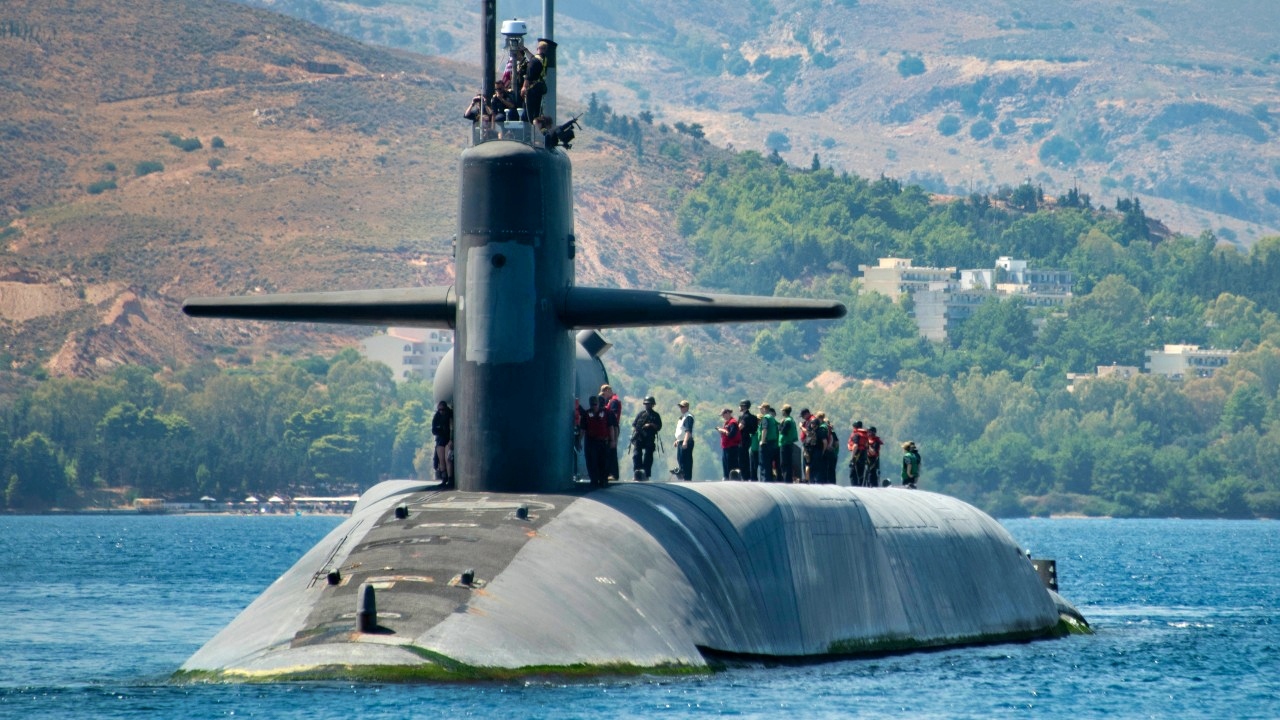
190907-N-UR565-0660NAVAL SUPPORT ACTIVITY SOUDA BAY, Greece (Sept. 7, 2019) The Ohio-class cruise missile submarine USS Florida (SSGN 728) arrives in Souda Bay, Greece, for a scheduled port visit, Sept. 7, 2019. NSA Souda Bay is an operational ashore base that enables U.S., allied, and partner nation forces to be where they are needed and when they are needed to ensure security and stability in Europe, Africa, and Southwest Asia. (Photo by Joel Diller/Released)
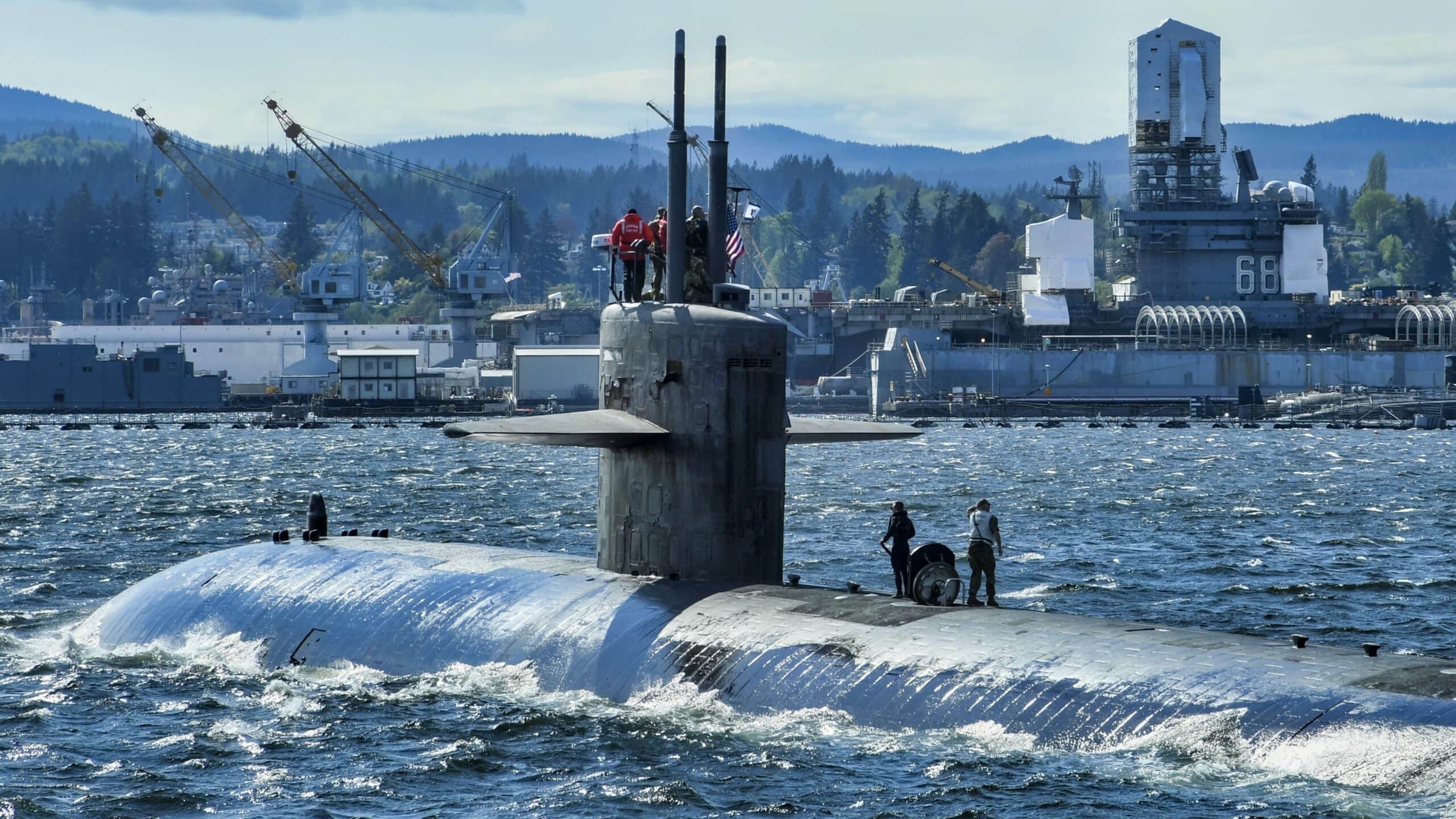
U.S. Navy SSN Submarine. Image Credit: Creative Commons.
Neutron Beams
“Unlike X-rays, neutrons can penetrate deeply into thick metals without damaging them. Using neutron diffraction, the team measured changes in atomic lattice spacing caused by internal stress. At the same time, neutron radiography revealed density variations and hidden internal features within welds,” the essay in Interesting Engineering states.
Upon initial examination, one is unlikely to think of a submarine hull “cracking” or accidentally breaking and opening to let in water, endangering the boat and its crew.
However, even securely welded metal plates experience intense pressure due to many variables, such as water weight placed upon them depending on depth, extreme temperatures, such as arctic conditions, or simple collisions or “hits” of any kind. At depths up to 800 feet, microscopic flaws in a submarine’s steel pressure hull can present “risks” to the structural integrity of the boat, as explained by the Interesting Engineering essay.
One concern for submarine operators is “ductility dip cracking,” in which tiny cracks or fissures can form in welded metals and weaken over time. If weakening is discovered before it reaches a catastrophic level, repairs can be made.
Therefore, the prospect of neutron beams introduces the potential to extend and improve submarine service life without increasing risk.
Damage Assessment
The advantage of neutron beams, should they fully come to fruition as a way to protect submarines, is an issue of timing.
For example, if extremely small or otherwise undetectable cracks in a submarine hull are discovered early in the process, lives can be saved through quick, early repairs.
Once cracks and fissures reach a point of no return, they can, of course, imperil a submarine and its crew.
Yet, a submarine is much more likely to be repaired if minor, seemingly undetectable problems in the welding seams or hull are discovered at the microscopic level.
Thwarting attacks
A technological capability of this kind might quickly help determine the impact or consequence of a kinetic strike or “hit” to a submarine in maritime combat. Perhaps a submarine is hit with rockets or small arms fire from the air when it surfaces, or is partially hit in some areas by torpedoes and other kinds of undersea fire.
The speed at which hull problems can be determined and mitigated or corrected would seem to be a critical factor in deciding whether a submarine survives or fills with water and fully sinks. Naturally, the sooner this kind of damage is known, the more likely a boat is to survive.
Rapid identification of problem areas would enable submarine commanders to repair them before they entirely destroy or disable the undersea boat.
About the Author: Kris Osborn, Submarine Expert
Kris Osborn is the President of Warrior Maven – Center for Military Modernization. Osborn previously served at the Pentagon as a highly qualified expert in the Office of the Assistant Secretary of the Army—Acquisition, Logistics & Technology. Osborn has also worked as an anchor and on-air military specialist at national TV networks. He has appeared as a guest military expert on Fox News, MSNBC, The Military Channel, and The History Channel. He also has a Masters Degree in Comparative Literature from Columbia University.