
Key Points and Summary – This article frames Confucius not as a distant sage but as a young man formed by instability, hardship, and training.
-Born in Lu around 551 BCE, he lost his father early, was raised in relative poverty, and studied the Six Arts—ritual, music, archery, charioteering, calligraphy, and mathematics—an education blending culture and martial competence.
-The piece tracks his early work life, marriage, and rise into government, including a controversial execution order as Minister of Crime.
-It then links Confucius’ anti-war sentiment and emphasis on order to U.S. leaders who hated war yet prepared for it.
Confucius Has a Message About War: Music, Courtesy, and Military Discipline
“When music and courtesy are better understood and appreciated, there will be no war.”—That quote belongs to the great Confucius, AKA “Kongzi” (“Master Kong”), the Father of Chinese ethics.
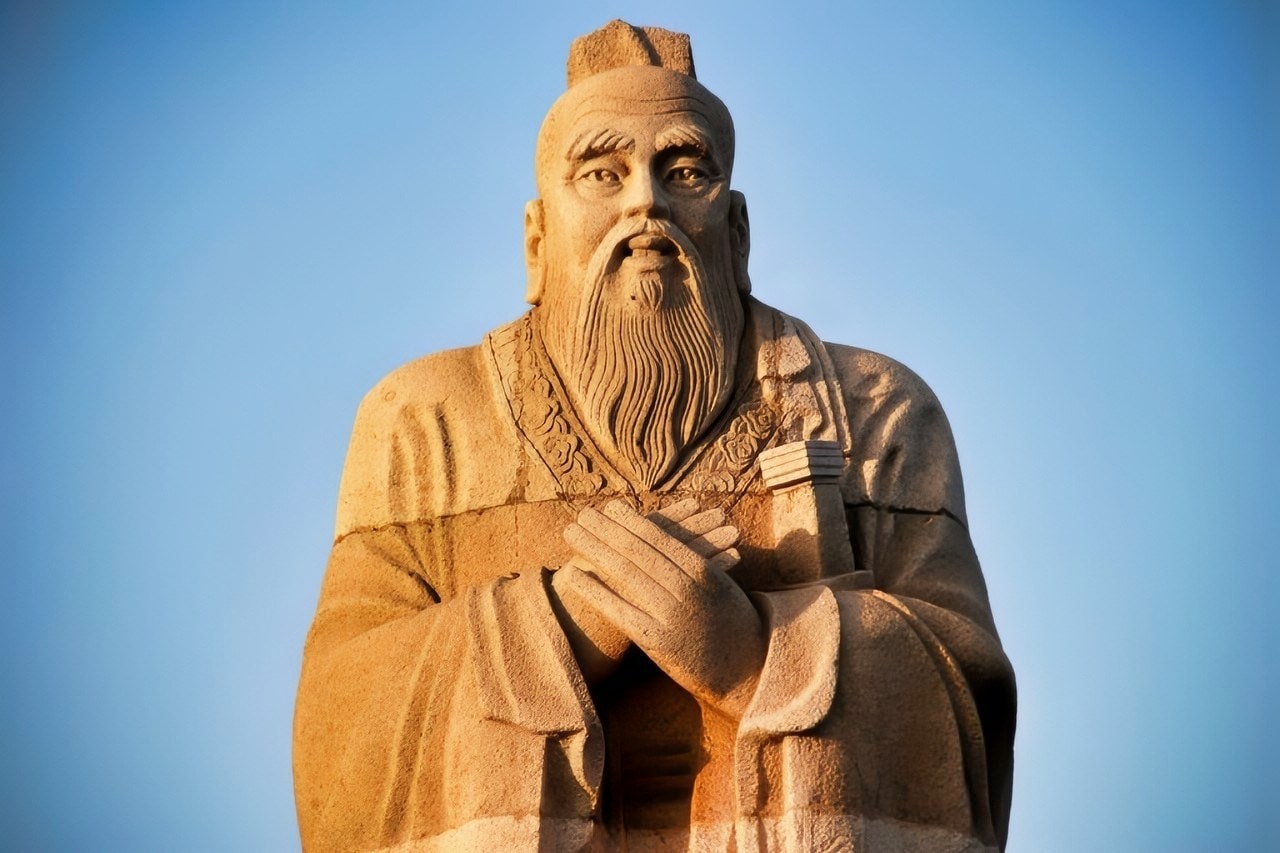
Due to both his real-life work as a philosopher and teacher and the decidedly fictitious quotes ascribed to him by Western comedians, Confucius is typically pictured as this wise old man. But what do we know about Confucius, the younger man, i.e., his early life?
Childhood Years as Kong Qiu
Well, very little. We do know that he was born Kong Qiu in Lu—a vassal state during the Eastern Zhōu Dynasty—circa 551 BCE. Kong Qiu wasn’t a soldier; his father, Kong He (AKA Shuliang He), certainly was, at the time when the so-called “Springs & Autumns” period gave way to the “Warring States” period, which lasted from 475 to 221 BCE (finally ending when China was united under the Qin Dynasty). Presumably, this did much to shape Confucius’s future philosophies on war.
According to his Ducksters mini-bio, “Confucius’ family was part of a growing middle class of people in China called ‘shi.’ They weren’t part of the nobility, but were considered above the common peasants. This gave him a different outlook on life than most people. He thought that people should be promoted and rewarded based on their talents, not on what family they were born into.”
Alas, Kong He died when Kon Qiu was only three years of age, leaving his widowed mother, Yan Zhengzai, to raise him for the remainder of his childhood in a state of relative poverty, which presumably influenced his later beliefs in the importance of merit over bloodlines. However, the lad’s life wasn’t one of total deprivation or destitution, as he and his mother moved into the home of his maternal grandfather, Yan Xiang, a man well-versed in both academic learning and martial arts. Accordingly, the boy was educated in the Six Arts, namely: (Lǐ) – Rituals, (Yuè) – Music and Dance, (Shè) – Archery, (Yù) – Charioteering, (Shū) – Calligraphy, and (Shù) – Mathematics.
Tragically, Yan Zhengzai also died young, i.e., before she even reached her 40th birthday; Kong Qiu was only 17 years old at the time, and in accordance with custom, he entered into three years of mourning.
Young Adulthood
“Confucius didn’t start as a wise teacher; he worked a number of normal jobs first. They included being a shepherd and a clerk.” He used some of the proceeds from these various odd jobs to give his mother a proper burial and thus finally give some closure to the three-year mourning period.
Along the way, he married Lady Qiguan at the age of 19 and had a child, Kong Li; that line proved quite fruitful, and today there are over 2 million known and registered descendants of Confucius.
In 501 BCE, his political career began, starting as the governor of a small town. Sometime thereafter, he attained the position of Minister of Crime, whereupon one of his first official acts was to order the execution—”Punishment of a Gentleman”—of Shaozheng Mao, another Lu state official and scholar, for an alleged “five major crimes,” among them chaos. This is considered the biggest black mark on Confucius’s otherwise unmarred and controversy-free life.
Eventually, he worked his way up to become an advisor at the highest levels of government. This was fitting, as he was a firm believer in a strong and organized central government.
Relevance to American Leaders’ Thoughts on War
The quote from Confucius at the beginning of this article is at least somewhat comparable to quotes from at least three U.S. Presidents who abhorred war but still understood it to be a necessary evil and therefore waged it either as soldiers and/or as civilian commanders-in-chief of America’s armed forces:
–Dwight David Eisenhower (from “The Chance for Peace” address delivered to the American Society of Newspaper Editors on April 16, 1953): “Every gun that is made, every warship launched, every rocket fired signifies, in the final sense, a theft from those who hunger and are not fed, those who are cold and are not clothed. This world in arms is not spending money alone.”
–John Adams (in a 1780 letter to his wife Abigail): “I must study Politicks [sic] and War that my sons may have liberty to study Mathematicks [sic] and Philosophy.”
–Thomas Jefferson (in a letter to Elbridge Gerry dated May 13, 1797): “Much as I abhor war, and view it as the greatest scourge of mankind, and anxiously as I wish to keep out of the broils of Europe, I would yet go with my brethren into these, rather than separate from them.”
About the Author: Christian D. Orr, Defense Expert
Christian D. Orr is a Senior Defense Editor. He is a former Air Force Security Forces officer, Federal law enforcement officer, and private military contractor (with assignments worked in Iraq, the United Arab Emirates, Kosovo, Japan, Germany, and the Pentagon). Chris holds a B.A. in International Relations from the University of Southern California (USC) and an M.A. in Intelligence Studies (concentration in Terrorism Studies) from American Military University (AMU). He is also the author of the newly published book “Five Decades of a Fabulous Firearm: Celebrating the 50th Anniversary of the Beretta 92 Pistol Series.”