
Summary and Key Points: A widely shared quote—“Never argue with stupid people…”—is commonly attributed to Mark Twain, but no credible record ties it to his writings.
-The phrasing appears to be modern, with early variants showing up in 1990s online posts, while its core idea closely parallels Proverbs 26:4 about not answering a fool on their terms.

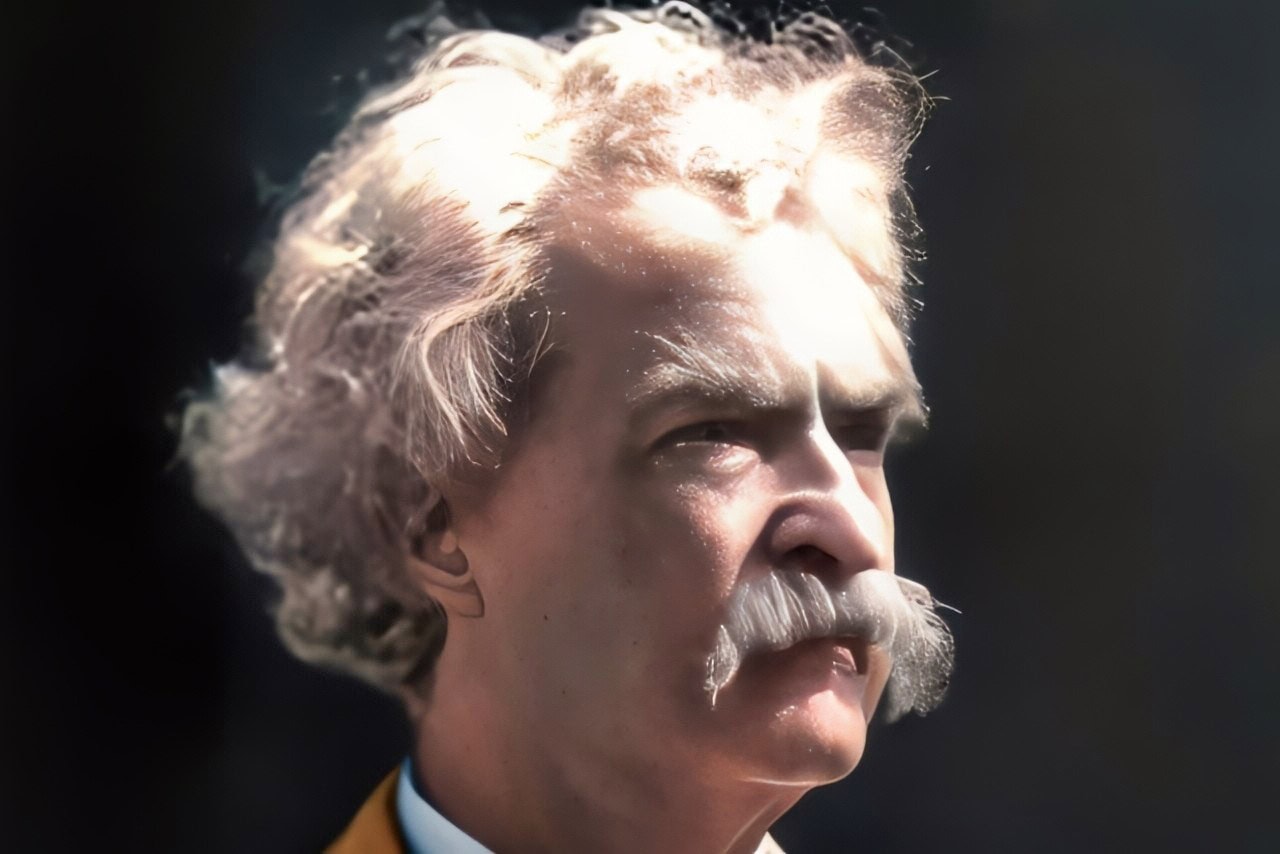
Mark Twain Portrait. Image Credit: Creative Commons.
-The message resonates because bad-faith arguments can waste attention and amplify misinformation.
-That dynamic has grown sharper in the age of AI, where coordinated bot activity and synthetic personas can manufacture consensus and push influence campaigns.
-The line may be fake Twain, but it captures a real strategic trap.
Mark Twain Didn’t Say This – But He Was Still Right
“Never argue with stupid people, they will drag you down to their level and beat you with experience.”
You’ve probably read this quote before. It has long been circulated widely on social media, in motivational quote websites, and in pop culture memes – and it’s almost always credited to Mark Twain. A close look at the history of those words, however, makes it quite clear that Twain almost certainly never said it. Instead, the quote appears to be a modern invention with no clear source.
That being said, the idea it expresses – that engaging in fruitless arguments may only reinforce bad ideas – resonates deeply with people. That’s exactly why it is shared so widely. It is relevant to many aspects of modern life, including national security.

Mark Twain Black and White. Image Credit: Creative Commons.
A Popular Quote – But Not Twain’s
The exact wording of the “never argue with stupid people…” phrase does not appear in any known writings of Mark Twain (Samuel Clemens), who died in 1910.
Comprehensive collections of Twain’s quotes contain no instance of this sentence or anything very close to it ever being said or written by Twain.
There is no evidence whatsoever that links the quote to Twain, beyond memes and viral graphics that claim he did.
So where does it come from?
Well, the best we have today is an excerpt from the Bible that is strangely similar. Proverbs 26:4 in the Bible states: “Do not answer a fool according to his folly, or you yourself will be just like him.” It’s not identical in phrasing, but the idea is similar – and it could indicate that the so-called “Twain” quote is actually a 20th-century evolution of older proverbs.
Early printed examples of the quote date back to the 1990s, including messages in Usenet newsgroups that use variations of the phrase without any attribution.
Over time, the line was gradually conflated with a number of well-known figures from history, including comedians like George Carlin.
Who Was Mark Twain?
Mark Twain was the pen name of Samuel Clemens (1835-1910), one of America’s most influential writers. He authored classics such as The Adventures of Tom Sawyer (1876) and Adventures of Huckleberry Finn (1884), works celebrated for their depictions of 19th-century American life. Twain’s style combined humor, satire, and moral observations – which is likely why modern audiences so often believe that the quote was indeed one of his.
What the Quote Really Means
Regardless of who really wrote it, the meaning behind it – and indeed the meaning of the original Bible verse – is relevant to modern life in many ways.
The core idea – that arguing with someone who is not engaging in good faith will often pull you into unproductive ground – reflects real patterns in human thinking, communication, politics, and geopolitics.
When people argue in good faith, debate can clarify facts and improve understanding. But when an interlocutor is hostile to receiving evidence, doesn’t care for logic, and is primarily seeking to provoke, engagement ultimately becomes unproductive. Not only that, but it consumes attention needlessly, generates unnecessary conflict, and may even inadvertently amplify bad ideas. The phrase – and the Bible verse – captures that dynamic extremely well with some blunt humor.
The best example of this problem today is the rise of online misinformation (and those incorrectly describing facts as misinformation) – but in an age of artificial intelligence, it goes even further than that. Today, fake news and dangerous ideas may quickly spread thanks to a combination of bad-faith activism and the use of artificial intelligence to generate viral social media stories.
Understanding when not to argue, or when to shift strategies, is now a crucial skill for any human being living in the modern world.
Disinformation, Bots, and National Security
The dynamics described by the quote are visible not only in occasional social media conversations and debates, but also in national and international politics, specifically in the actual influence campaigns targeting democratic societies today.
Across multiple 2024 elections, researchers warn that coordinated AI bot swarms – which are large groups of autonomous AI agents designed to mimic human behavior and flood social media with content – have already been used to influence real election campaigns in Taiwan, India, and Indonesia.
“A disruptive threat is emerging: swarms of collaborative, malicious AI agents,” a group of AI and online misinformation researchers warned in a recent report. “These systems are capable of coordinating autonomously, infiltrating communities and fabricating consensus efficiently. By adaptively mimicking human social dynamics, they threaten democracy.”
Meanwhile, AI-enabled bot infrastructure has also been linked to foreign influence operations aimed at pulling strings in American politics. In 2024, the U.S. Department of Justice seized domains and disrupted social media networks tied to Russian government-linked actors that used AI tools to create fake profiles and spread disinformation aimed at U.S. and allied audiences.
Evidence like this illustrates the trap of engagement well – whether with human bad actors or sophisticated AI systems.
The quote attributed to Mark Twain may be shrouded in mystery, but its meaning is surprisingly relevant today.
About the Author:
Jack Buckby is a British researcher and analyst specialising in defence and national security, based in New York. His work focuses on military capability, procurement, and strategic competition, producing and editing analysis for policy and defence audiences. He brings extensive editorial experience, with a career output spanning over 1,000 articles at 19FortyFive and National Security Journal, and has previously authored books and papers on extremism and deradicalisation.