
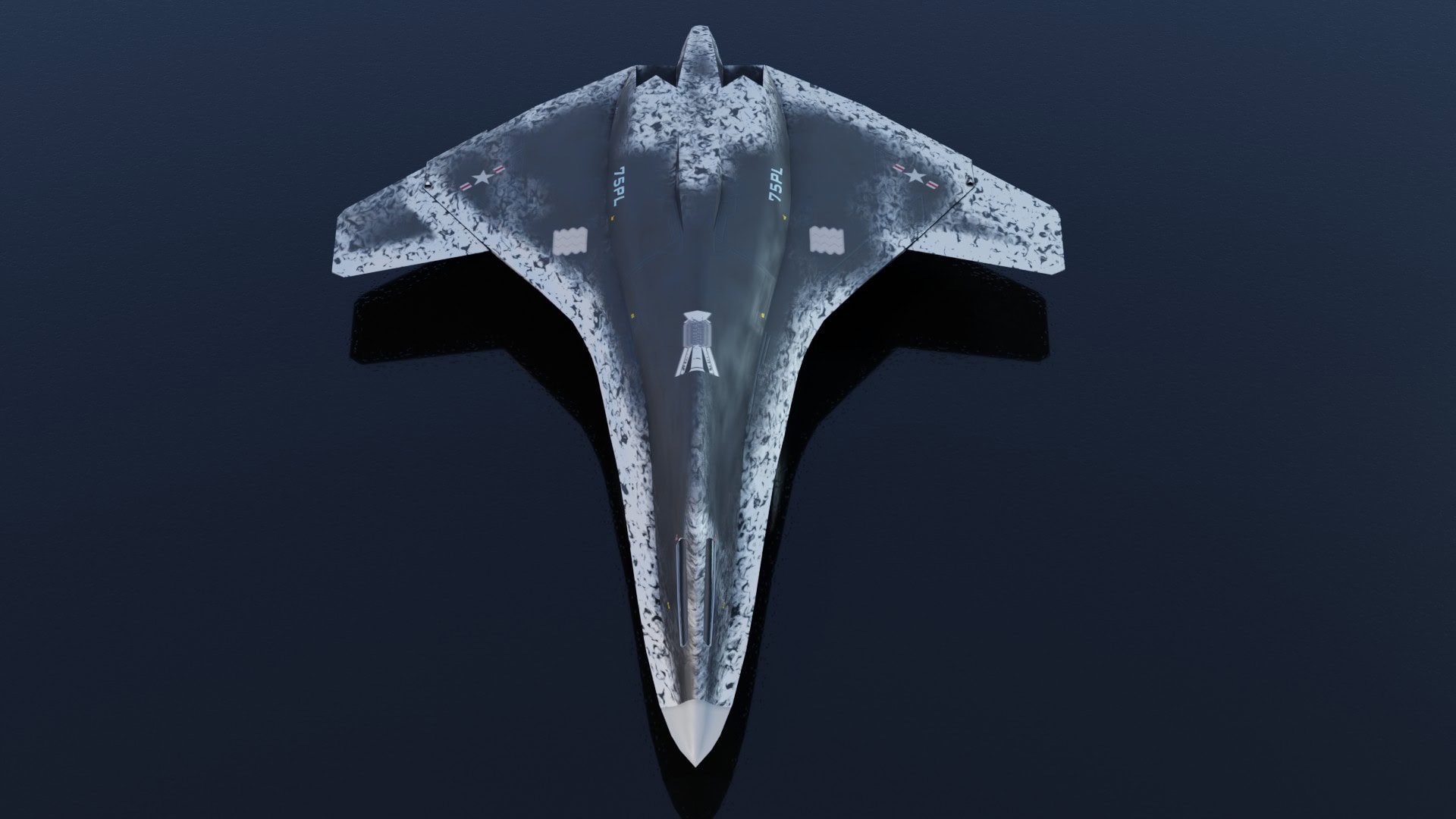
Summary and Key Points on the F-47 Numbers Question
-The U.S. Air Force has selected Boeing to build the F-47, the manned centerpiece of the Next Generation Air Dominance (NGAD) program.
Designed to succeed the F-22 Raptor, this sixth-generation fighter will lead a “family of systems” featuring at least 1,000 autonomous Collaborative Combat Aircraft (CCA) drones.
-These “loyal wingmen” will fly alongside the F-47 to draw fire and extend sensor reach.
-With plans to procure 185 jets, the program aims to counter China’s growing fleet of J-20s and emerging sixth-generation platforms, ensuring American air superiority through the 2030s.
Boeing’s Secret F-47: Inside the 6th-Gen Stealth Fighter Replacing the F-22
As geopolitical tensions rise worldwide, emerging sixth-generation technology could shift the balance of power.
The United States, Russia, and China are all working tirelessly to field new military systems of all kinds.
From stealth bombers and fighter jets to submarines and new destroyers, U.S. officials are banking on upcoming projects to retain air, sea, and land superiority.
The F-47— the sixth-generation fighter jet developed as part of the U.S. Air Force’s Next Generation Air Dominance (NGAD) program—is expected to lead the service’s aerial capabilities once it becomes operational.
NGAD’s origin story
Designed to succeed the legendary F-22 Raptor, the F-47 will incorporate a flight of the latest-generation technologies.
The aircraft will function as the manned component of the NGAD “family of systems.”
More than a decade ago, the Defense Advanced Research Projects Agency (DARPA) first launched its Aerospace Innovation Initiative study to lay out the foundations of a next-generation aircraft. The design would prioritize four areas: propulsion, advanced weapons, digital design, and, of course, stealth.
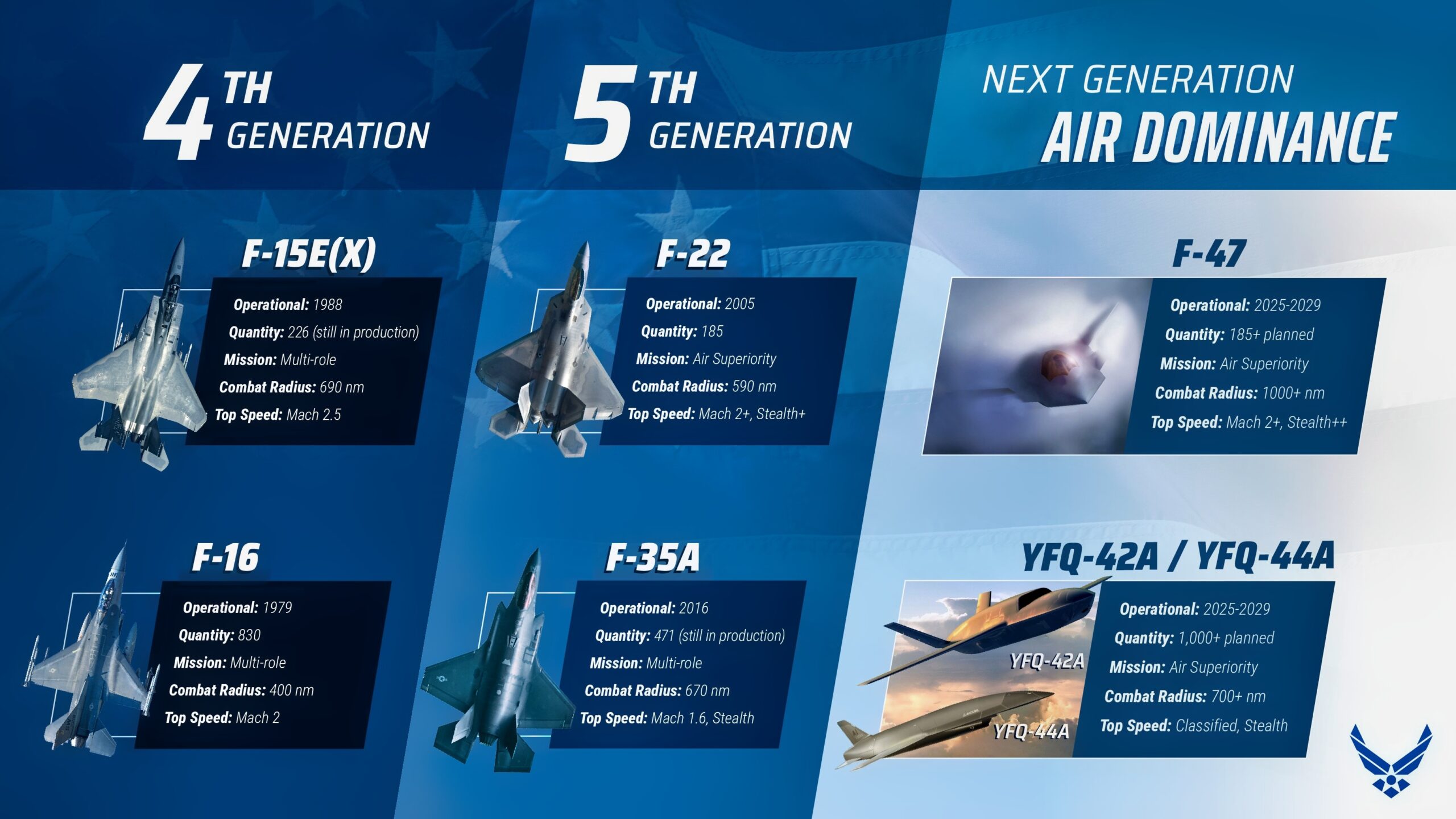
F-47 Infographic. Image Credit: U.S. Air Force
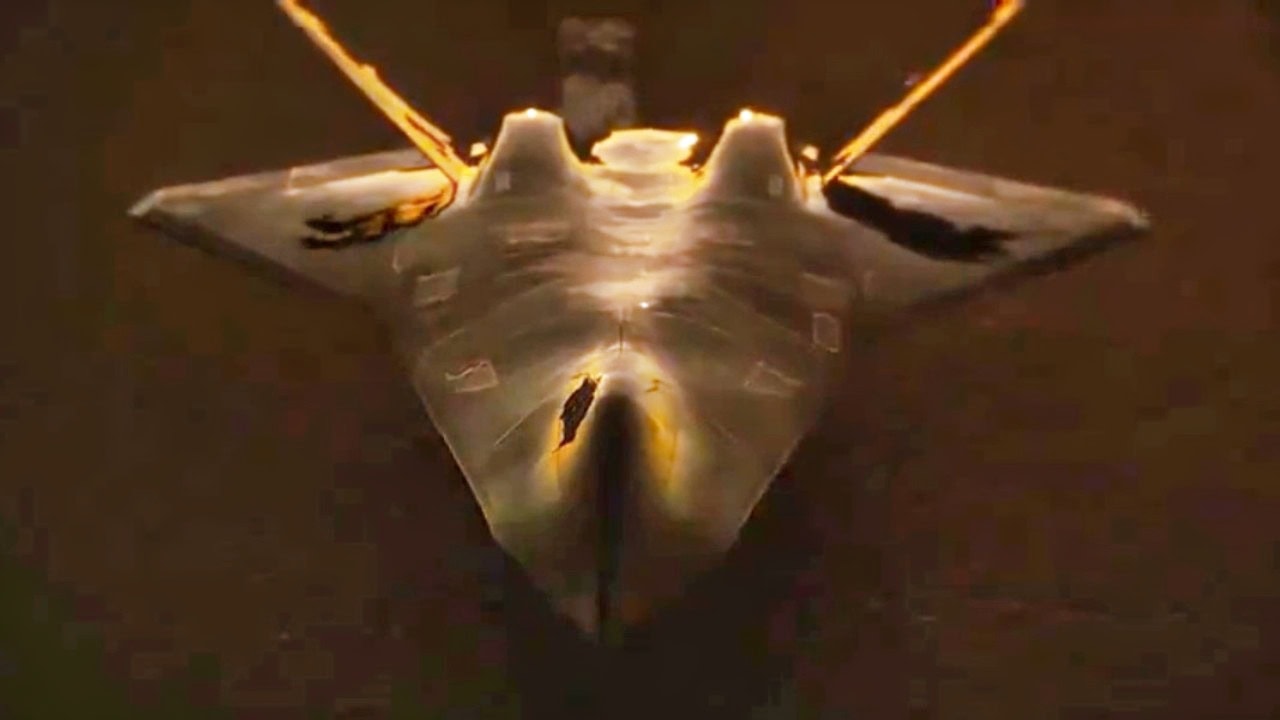
F-47 Fighter from Boeing. Image Credit: U.S. Air Force Screenshot.

Shown is a graphical artist rendering of the Next Generation Air Dominance (NGAD) Platform. The rendering highlights the Air Force’s sixth generation fighter, the F-47. The NGAD Platform will bring lethal, next-generation technologies to ensure air superiority for the Joint Force in any conflict. (U.S. Air Force graphic)
Last year, Boeing won the contract to build the sixth-generation fighter from the ground up. Boeing CEO Steve Parker recently said the sixth-generation fighter is advancing nicely on the production front, noting that the jet’s production is a “testament to the maturity of our design and pedigree coming off the prototype.”
What will make up NGAD’s “family of systems?”
The F-47 is planned to operate with a team of unmanned drones.
The highly autonomous Collaborative Combat Aircraft (CCA) are being constructed to fly alongside their sixth-generation counterparts in a loyal drone wingman-type role.
Since unmanned aerial vehicles are cheaper and easier to operate than manned fighters, acquiring them in mass is a smart move.
The service previously stated its plans to procure at least 1,000 CCAs. As explained by Defense Scoop, “The extra mass provided by CCAs specifically developed for high-end fights will also help the Air Force in establishing air superiority, reducing any capability gap caused by a lack of operational F-22s.”
Former Air Force Secretary Frank Kendall mirrored this rhetoric when describing the role of CCAs, noting that, “The expectation is that these (unmanned) aircraft can be designed to be less survivable and less capable, but still bring an awful lot to the fight in a mixture that the enemy has a very hard time sorting out and dealing with.
“You can even intentionally sacrifice some of them to draw fire, if you will, to make the enemy expose himself.”
How many F-47s will be required?
While CCAs will play an instrumental part in NGAD, ensuring an effective number of F-47 jets are produced remains the top priority for the service.
The Air Force in the past has revealed plans to procure at least 185 of the sixth-generation jets. According to Simple Flying, the annual total output of fighter jets in the U.S. ranges from 318 to 372.
While fielding F-47s will be essential, maintenance of all of the services’ fleets of 4.5- and fifth-generation platforms must be ensured.
What about other sixth-gen projects?
The U.S. is not the only nation with fifth-generation fighter capabilities.
Beijing’s fleet of J-20 jets may be as capable as the F-35 Joint Strike Fighter. Chinese engineers are also working to field their own sixth-generation fighter platform, in addition to other military systems.
Although exact specs and details pertaining to Beijing’s progress are not known, leaked footage and images of platforms under development are enough to raise some alarm.
Only time will tell whether the F-47 is introduced in the numbers required to effectively counter the Chinese threat from the skies.
About the Author: Maya Carlin
Maya Carlin, national security writer with 19FortyFive, is an analyst with the Center for Security Policy and a former Anna Sobol Levy Fellow at IDC Herzliya in Israel. She has over 1,000 articles published over the last several years on various defense issues. Carlin has bylines in many publications, including The National Interest, Jerusalem Post, and Times of Israel. You can follow her on Twitter: @MayaCarlin.