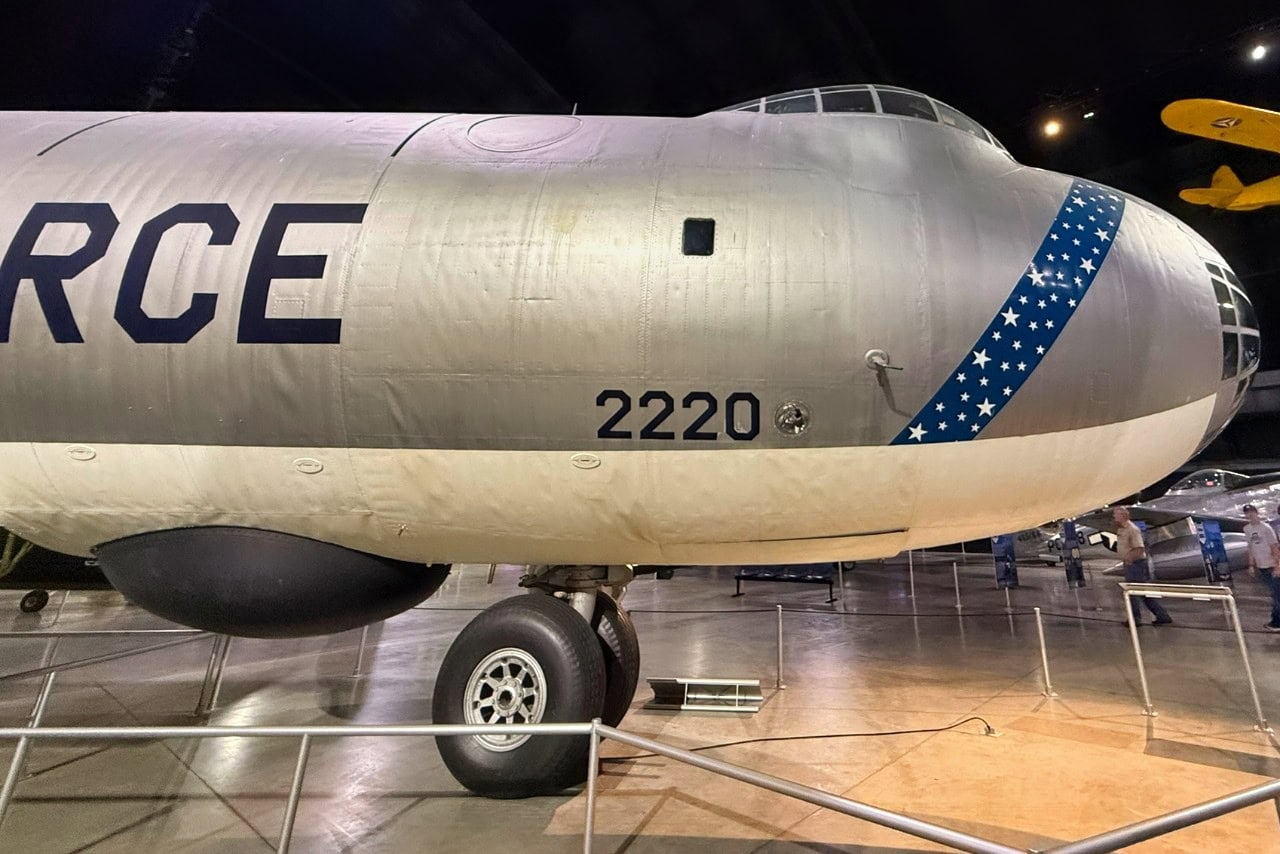
B-36 Peacemaker: The 10,000-Mile Bomber Built for a World Without Britain
In the early days of the Second World War, Nazi Germany had the upper hand. With France out of the war, and British forces evacuated from the continent at Dunkirk, the U.S. feared it could lose its access to British airbases.
The U.S., therefore, prioritized the development of a new type of bomber that could fly from the continental United States all the way to mainland Europe. The result was the Convair B-36 Peacemaker, one of the first long-range strategic bombers ever built.
And, as luck would have it, we visited the B-36 at the National Air Force Museum in Dayton, Ohio. All the photos we present here are from that visit.
Development in a World at War
The Convair B-36’s origins thus lie in the darkest days of World War II. In early 1941, U.S. military planners had to accept it was possible that Nazi Germany could defeat Great Britain, depriving the United States of European bases from which to launch bombing operations.
Faced with this possibility, the U.S. Army Air Corps issued an unprecedented requirement for an intercontinental bomber capable of striking Europe directly from North America and returning without refueling. Combat requirements were quite daunting for the time.
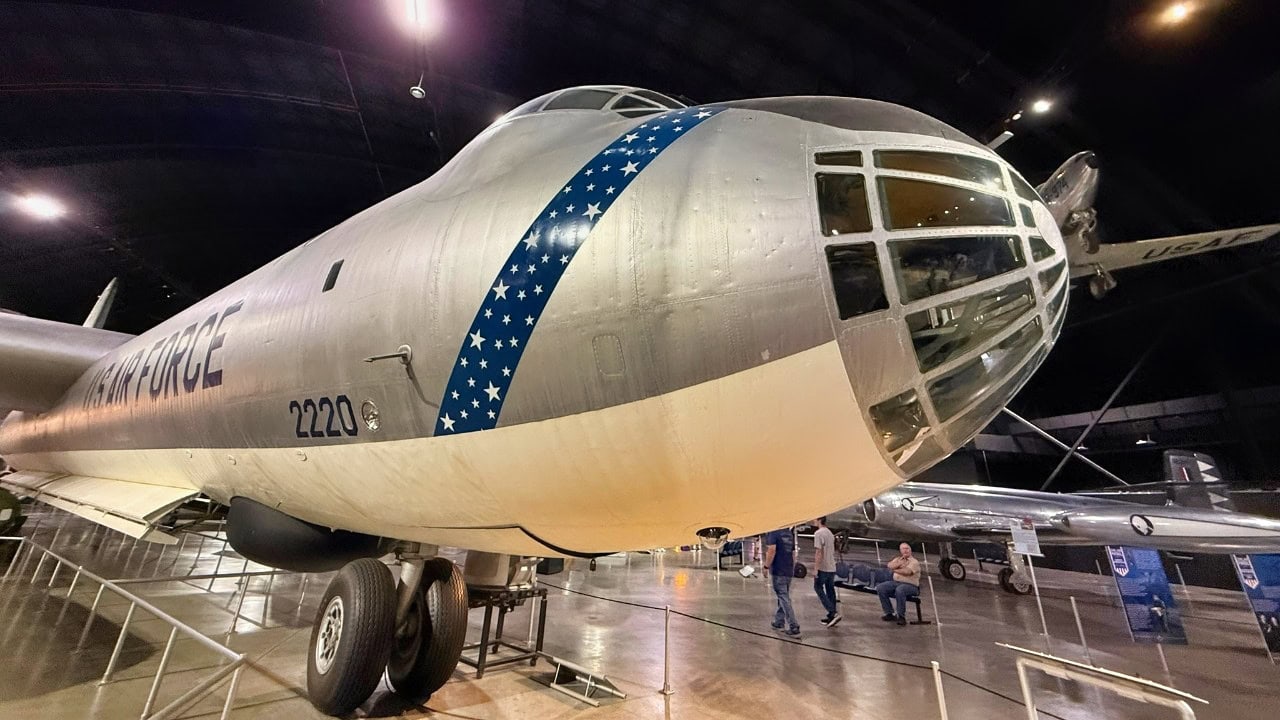
B-36 Bomber 19FortyFive Image.
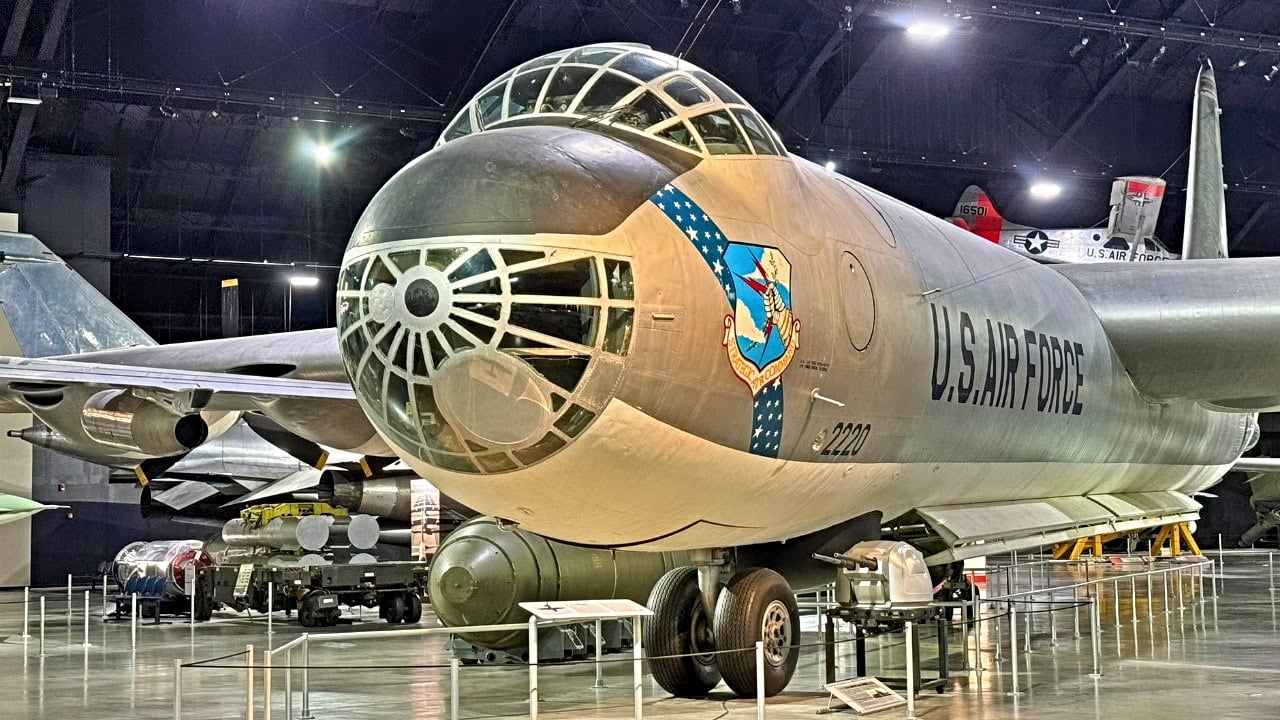
B-36 Bomber 19FortyFive Image. Taken by Harry J. Kazianis in July 2025.
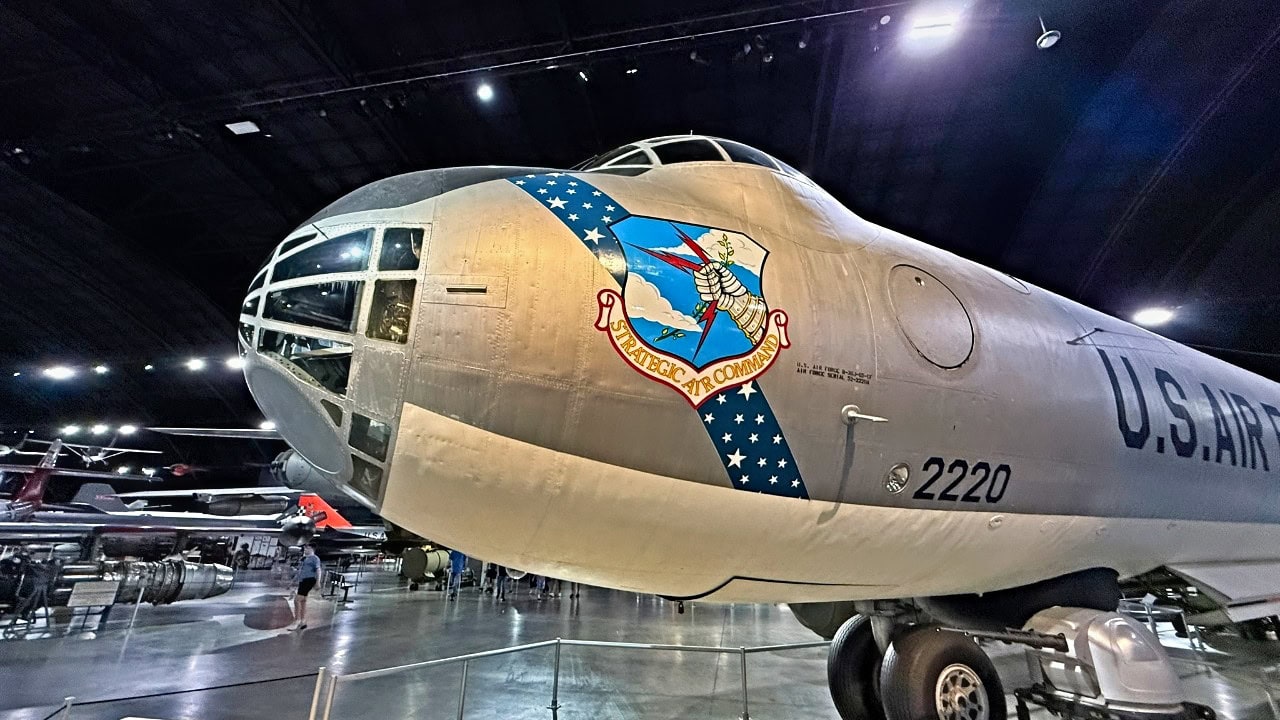
B-36 Bomber 19FortyFive Image. Image taken By Harry J. Kazianis.
The bomber had to have a combat range of roughly 10,000 miles, a service ceiling over 40,000 feet, and the ability to carry a heavy bomb load far beyond anything existing bombers could handle.
In November 1941, Consolidated Aircraft (later Consolidated Vultee, and ultimately Convair) won the contract with its proposed “Model 36,” which would eventually become the B-36. The company proposed an aircraft much larger than even the B-29 Superfortress. It relied on six massive Pratt & Whitney R-4360 Wasp Major piston engines mounted in a pusher configuration. The aircraft still retains its place as the largest piston-engine aircraft ever built and holds the prize of longest wingspan. From the outset, the project pushed the limits of aeronautical engineering.
Development Delays and Engineering Challenges
World War II priorities delayed the B-36 almost immediately. Consolidated’s factories were heavily committed to producing B-24 Liberators and other urgently needed aircraft. The intercontinental bomber project fell into the background, and the B-36 in fact missed the war.
Its long gestation period, however, allowed designers to refine the concept and adapt it to a rapidly changing strategic environment.
As the project continued, the designers ran into several technological hurdles. The massive 230-foot wingspan required thick wing roots that crews could physically crawl through for in-flight maintenance. Early versions incorporated a twin-tail arrangement, but this was later replaced by a single massive vertical stabilizer to save weight and improve stability.
Pressurization systems, radar, and defensive armament all added complexity and led to repeated redesigns.
First Flight and Early Production
The first prototype, the XB-36, finally took to the air on August 8, 1946, nearly five years after the original requirement was issued. Subsequent testing revealed the promise and problems of the design. While the aircraft demonstrated remarkable range and payload capabilities, it also suffered from engine reliability issues, structural challenges, and maintenance difficulties due to its unprecedented size.
Despite these concerns, the strategic context of the immediate postwar period made the B-36 indispensable. The United States emerged from World War II as the only nuclear-armed power, and the B-36 was the only aircraft capable of delivering the very large and heavy first-generation atomic bombs across intercontinental distances.
The first production B-36A aircraft were delivered in 1948, entering service with the newly formed U.S. Air Force’s Strategic Air Command (SAC).
The B-36 in the Early Cold War
In the late 1940s and early 1950s, the B-36 became the backbone of America’s nuclear deterrent. Assigned primarily to SAC, it was emblematic of the long-range strategic bombing doctrine that underpinned U.S. defense policy. The aircraft never flew combat missions, but its constant training flights, overseas deployments, and high-visibility presence were intended to signal U.S. nuclear reach to potential adversaries, particularly the Soviet Union.
Some airframes were repurposed to serve as reconnaissance aircraft. These variants conducted long-range photographic missions along the periphery of the Soviet Union, mapping Arctic regions and collecting intelligence long before satellites or aircraft such as the U-2 became operational. As air defenses advanced, however, the B-36 was phased out of this role.
Technological Evolution: Jets Join Propellers
One of the most distinctive features of the B-36 was its hybrid propulsion system.
Early models relied solely on six piston engines, but as jet technology matured, later variants, including the B-36D and beyond, added four General Electric J47 turbojet engines in underwing pods.
This configuration gave rise to the famous saying, “six turning and four burning,” describing how the aircraft cruised efficiently on piston power but used jets for takeoff and high-speed dashes.
These upgrades improved performance but also increased complexity and fuel consumption. At the same time, advances in Soviet air defenses, particularly the appearance of jet fighters such as the MiG-15 during the Korean War, cast doubt on the survivability of large, relatively slow piston-engine bombers in contested airspace.
Decline and Replacement
By the mid-1950s, rapidly advancing aviation technology began to overtake the B-36. Jet-powered bombers such as the Boeing B-47 Stratojet and eventually the B-52 Stratofortress offered greater speed, flexibility, and survivability. Although B-36 production continued until 1954, its frontline service life was relatively short. The last Peacemakers were retired in 1959, barely a decade after entering service.
Although often criticized for its complexity, maintenance challenges, and vulnerability, the B-36 Peacemaker occupies a unique place in aviation history. It was the largest mass-produced piston-engine aircraft ever built and the first true intercontinental bomber to serve with the United States. Most importantly, it provided a credible nuclear deterrent during a critical transitional period between World War II and the jet-powered Cold War era. Only four complete B-36 aircraft survive today, preserved in museums across the United States.
About the Author: Caleb Larson
Caleb Larson is an American multiformat journalist based in Berlin, Germany. His work covers the intersection of conflict and society, focusing on American foreign policy and European security. He has reported from Germany, Russia, and the United States. Most recently, he covered the war in Ukraine, reporting extensively on the war’s shifting battle lines from Donbas and writing on the war’s civilian and humanitarian toll. Previously, he worked as a Defense Reporter for POLITICO Europe. You can follow his latest work on X.