
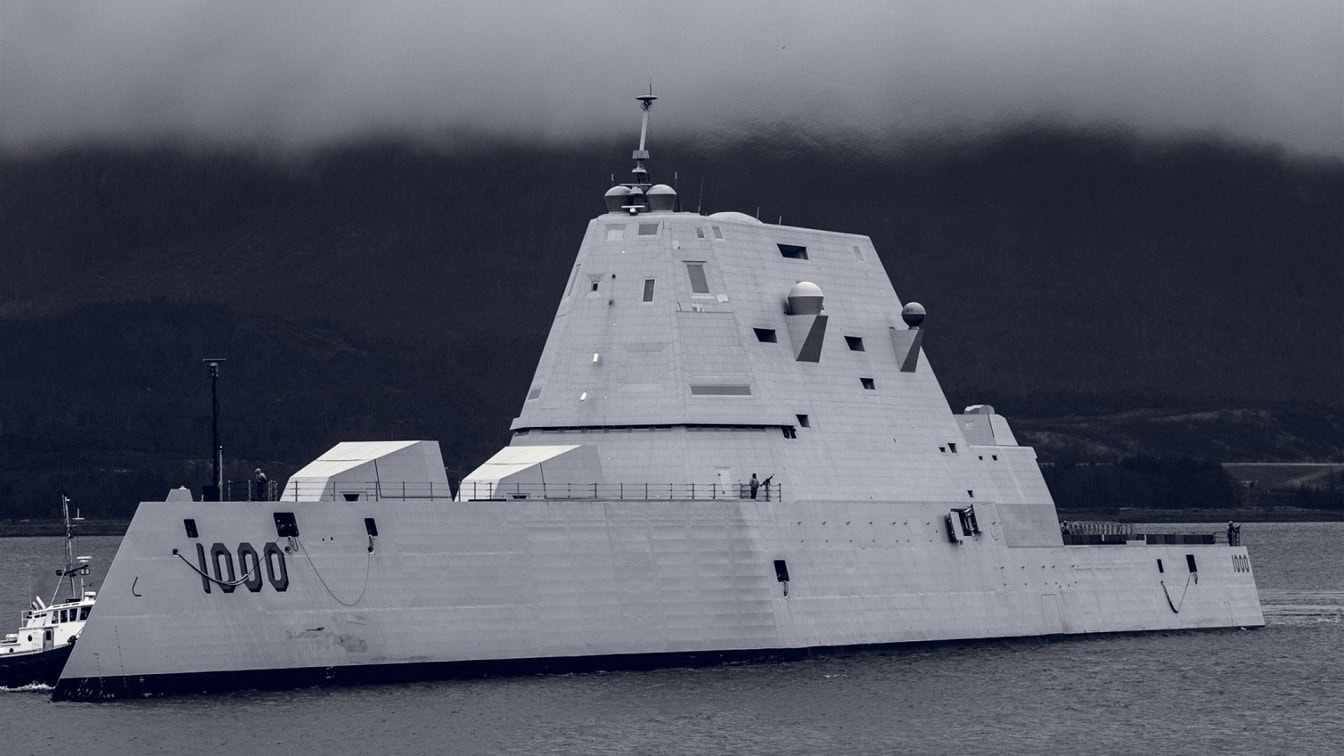
USS Zumwalt Update: Navy’s “Failed” Destroyer Is Back
The USS Zumwalt (DDG-1000) successfully completed builder’s sea trials last month to validate systems installed to incorporate the future Conventional Prompt Strike (CPS) hypersonic weapon. The Zumwalt is now the U.S. Navy’s first hypersonic-capable platform.
This suggests that a boat long written off as a procurement failure has been revived. But are these updates a genuine course correction? Or just a symbolic salvage of an already doomed concept?
History of the Zumwalt
Conceived of during the transition away from the Cold War, the Zumwalt was imagined as a stealthy forward-deployed surface combatant optimized for land attack and littoral operations—often supporting Marines and joint forces ashore.
With a radical tumblehome hull, advanced gun systems (AGS) for long-range naval gunfire, and power systems for future weapons such as railgun and lasers, the Zumwalt was supposed to usher in the Navy’s future. But the ship had problems. Thirty-two ships were planned—that number was first cut to 24, and then to just three. As the buy quantity shrank, the unit cost exploded; the loss of production at scale made each hull prohibitively expensive.
Technical and Conceptual Problems
The Zumwalt’s procurement problems did not show up all at once.
The ship was conceived as an exceptionally complex platform. Success depended on the Navy buying the ship in large numbers to spread costs across the fleet. When the planned purchase collapsed, unit costs soared.
When the AGS’s proprietary ammunition became unaffordable, it effectively rendered the ship’s primary weapon unusable. At the same time, the Navy’s strategic focus shifted toward great-power competition in the Indo-Pacific, where a ship optimized for stationary littoral fire support would have been highly vulnerable to China’s A2/AD networks.
Precision strike, missile defense, and fleet survivability replaced shore bombardment as top priorities, while the Zumwalt’s unique hull and power systems created integration and interoperability challenges.
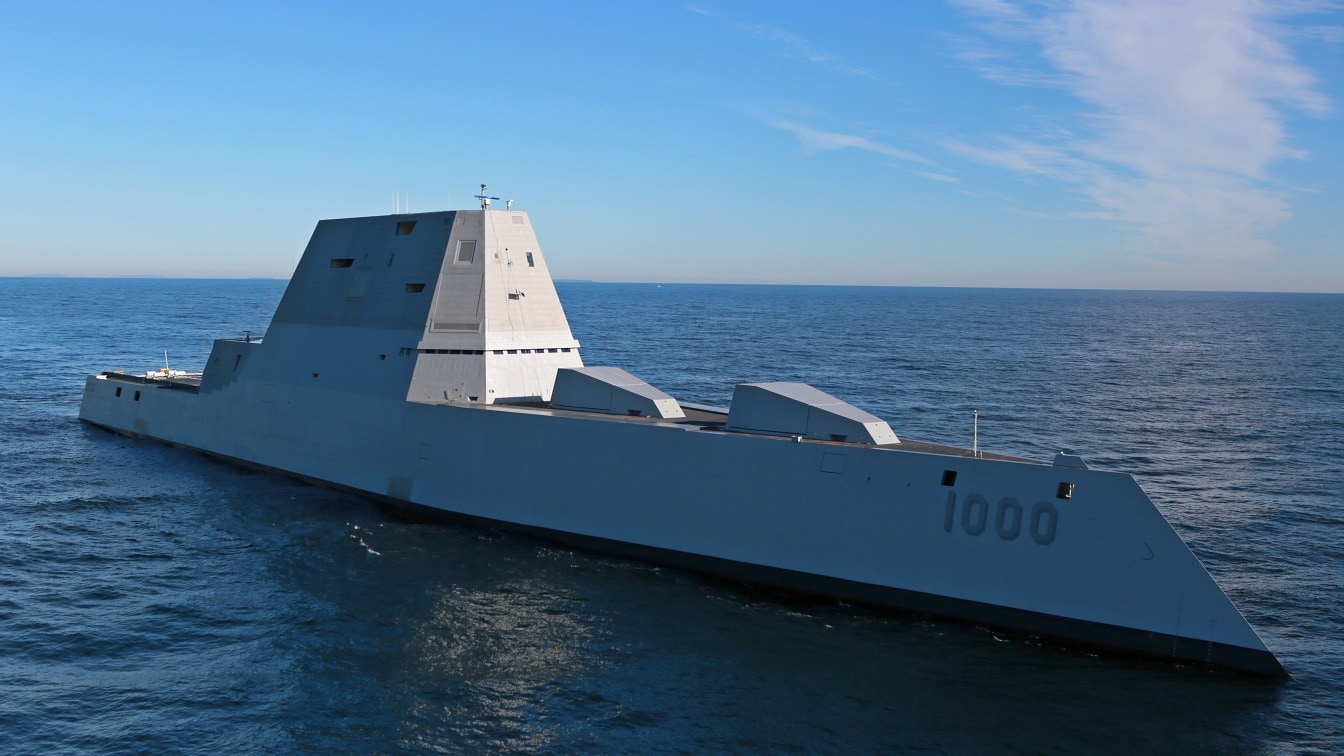
(Dec. 7, 2015) The future USS Zumwalt (DDG 1000) is underway for the first time conducting at-sea tests and trials in the Atlantic Ocean Dec. 7, 2015. The multimission ship will provide independent forward presence and deterrence, support special operations forces, and operate as an integral part of joint and combined expeditionary forces. (U.S. Navy photo courtesy of General Dynamics Bath Iron Works/Released). Zumwalt-Class
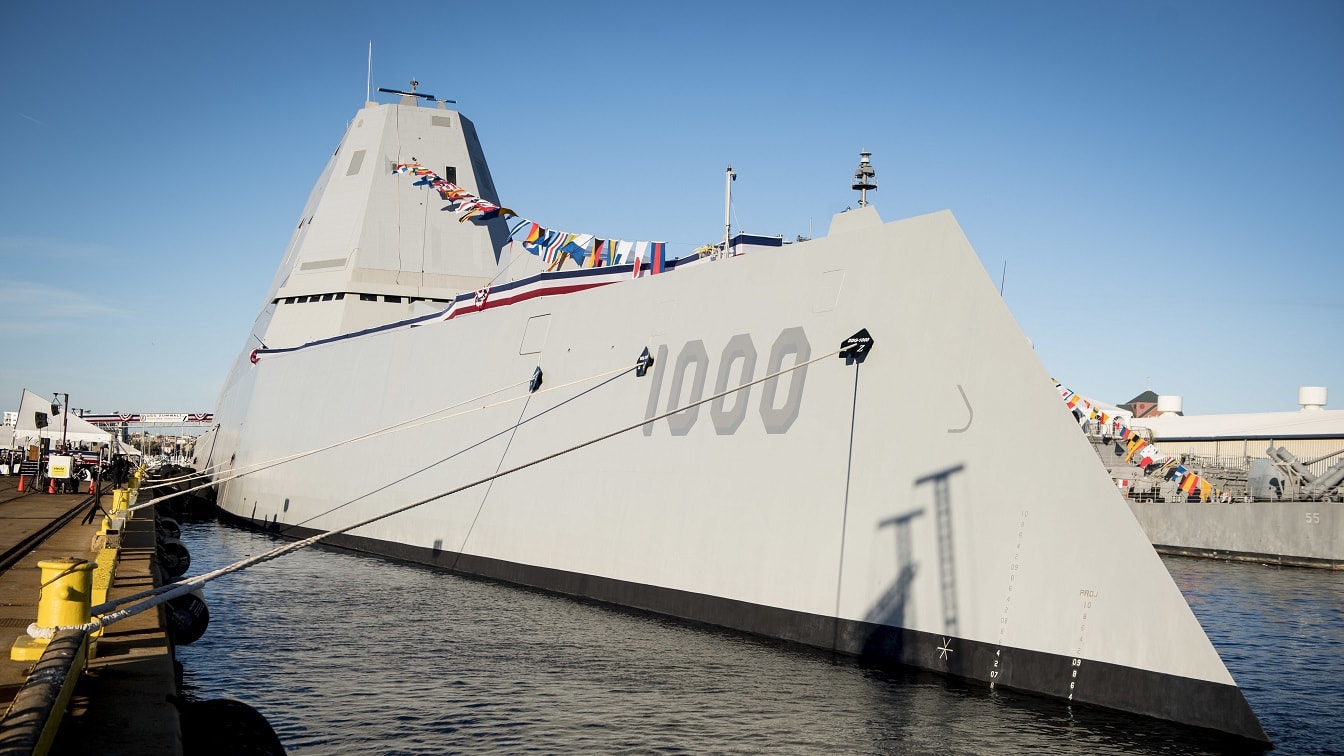
(Oct. 15, 2016) The Navy’s newest and most technologically advanced warship, USS Zumwalt (DDG 1000), is moored to the pier during a commissioning ceremony at North Locust Point in Baltimore. (U.S. Navy photo by Petty Officer 1st Class Nathan Laird/Released)
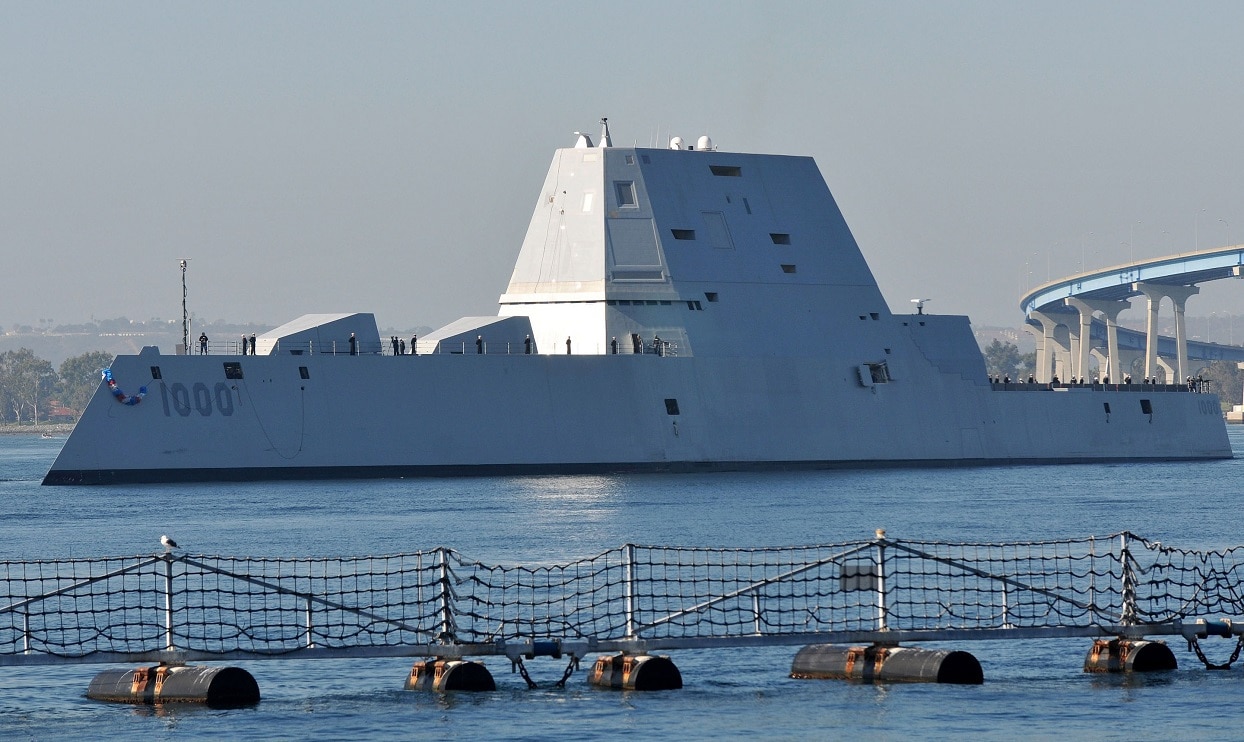
FROM 2016: The U.S. Navy’s newest warship, USS Zumwalt (DDG 1000) passes Coronado bridge on its way to Naval Base San Diego. Zumwalt is the lead ship of a class of next-generation multi-mission destroyers, now homeported in San Diego. (U.S. Navy photo by Petty Officer 3rd Class Anthony N. Hilkowski/Released)

Zumwalt-Class. Image Credit: Navy.
The class was trying to solve too many problems at once—and it was trying to do so with immature technologies that would only work if everything arrived on time and at scale.
The New Upgrades
The Navy removed the failed gun-centric concept, reconfiguring the Zumwalt for missile-centric warfare. This allowed a focus on long-range strike, surface warfare, and distributed maritime operations. The Zumwalt has pivoted from its original purpose as a revolutionary do-it-all platform, to more of a specialized missile carrier. The upgrades suggest that the Navy is accepting sunk costs. The service is treating the Zumwalt as a niche asset and a testbed for advanced strike and power systems.
Saving the Class
Do the upgrades save the class? Operationally, yes, in a limited sense. But program-wide, no. The original vision of stealth destroyers providing naval gunfire support is dead. The class’s survival in any form will depend on its becoming something other than what was originally intended.
Tactically, the updated Zumwalt will likely perform stand-off strike rather than close-in littoral work, participating in high-end conflict roles rather than presence missions. The boat will work best when paired with conventional surface combatants—used selectively, not as a fleet backbone.
Strategically, the Zumwalt reflects a broader lesson in U.S. naval procurement: that revolutionary designs are fragile under budget pressure, and incremental upgrades usually outperform moonshots. China, which currently is carrying out one of the most ambitious shipbuilding sprees in human history, has favored quantity and scalability. The Zumwalt is the opposite: exquisite, complicated, and hard to replicate.
Moving Forward
The value of the Zumwalt moving forward is as a platform for power-generation experiments, advanced sensors, and future weapons integration. In this role, the boat will serve more as a technology bridge than as a warship.
The upgrades make the ships usable and relevant. But they do not justify the original concept or acquisition strategy. The class will be remembered less for what it achieved and more for what it taught. With only three hulls in service, the Navy is incentivized to keep the Zumwalt-class operating for decades, likely into the 2050s, repurposed as niche strike platforms and technology testbeds to redeem the original program—which will likely always be viewed as a failure.
About the Author: Harrison Kass
Harrison Kass is an attorney and journalist covering national security, technology, and politics. Previously, he was a political staffer and candidate, and a US Air Force pilot selectee. He holds a JD from the University of Oregon and a master’s in global journalism and international relations from NYU.