Summary and Key Points: The U.S. Navy’s Columbia-class ballistic missile submarine program, identified as the Pentagon’s top acquisition priority, is reportedly 60% complete and on track for delivery in 2030.
-However, with the entire program coming in at a whopping $348 Billion and delays mounting, questions about this sub keep surfacing, no pun intended.
-Designed to replace the aging Ohio-class fleet, the Columbia features a revolutionary electric drive propulsion system that promises to make it the stealthiest submarine ever built.
-Additional innovations include an X-shaped stern for better maneuverability, “fly-by-wire” navigation adapted from the Virginia-class, and a “life-of-core” nuclear reactor that eliminates the need for mid-life refueling.
-These advancements allow the Navy to maintain strategic deterrence with just 12 Columbia boats replacing the current 14 Ohio vessels.
The Stealthiest Submarine Ever? Inside the Navy’s Columbia-Class
Lurking secretly in dark waters around the world and holding potential adversaries at risk of nuclear destruction from unknown locations, the U.S. Navy’s nuclear-armed ballistic missile submarines offer the backbone of U.S. strategic deterrence.
Undersea strategic deterrence essentially guarantees second-strike retaliatory catastrophic destruction of any adversary who attacks the U.S. with nuclear weapons, thus preventing war by ensuring the complete annihilation of any country that attacks with nuclear weapons.
The promise of total destruction, somewhat paradoxically, one might say, keeps the peace.
This conceptual premise is why, for many years now, the Pentagon has identified the now emerging Columbia-class nuclear-armed ballistic missile submarines as a number one DoD acquisition priority. After years of science and technology, prototyping, and advanced design specs, the U.S. Navy is now building its first Columbia-class submarine, slated to arrive at the end of the decade.
Production Delays
Despite numerous public reports raising questions about the timing of the Columbia class and the possibility of delivery delays, the first Columbia-class submarine is reported by USNI to now be 60% complete and on track for delivery in 2030.
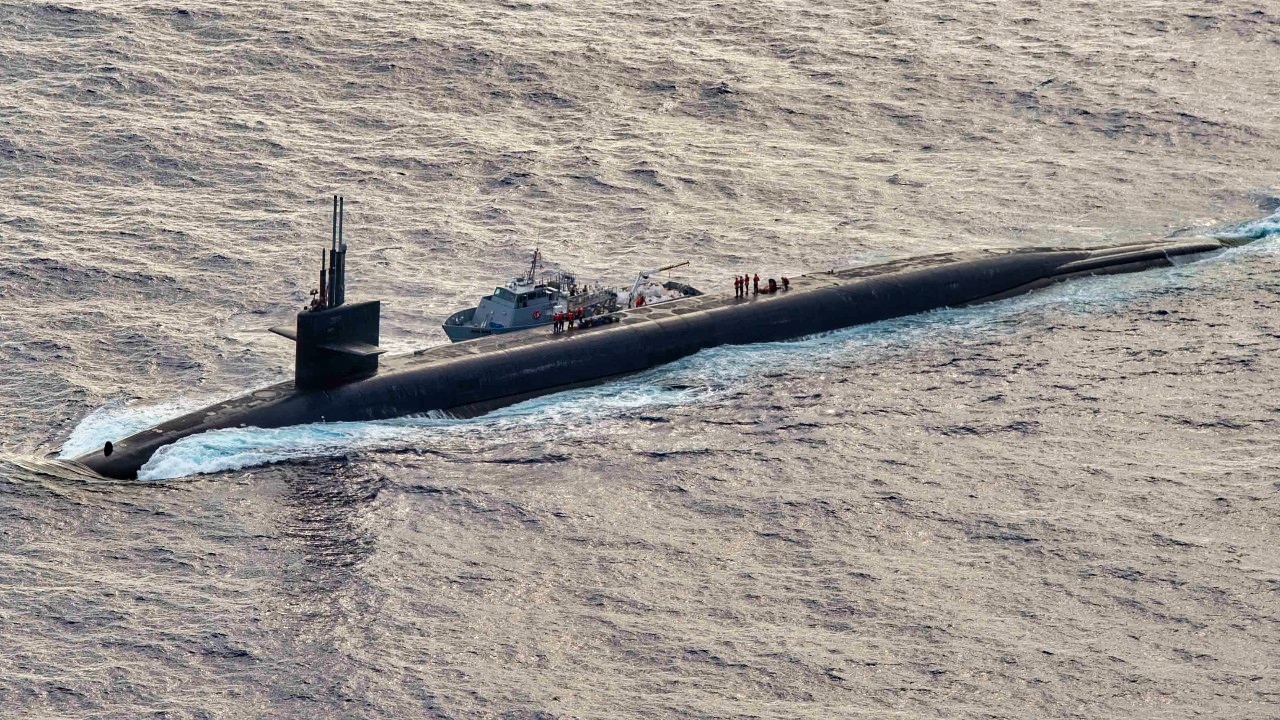
The Ohio-class ballistic missile submarine USS Kentucky (SSBN 737) sails alongside a submarine support vessel during a routine armed air escort (AAE) exercise, April 24, 2025. AAEs are designed to improve interoperability between our services, increasing lethalitythrough multi-domain integration.. Commander, Submarine Group (SUBGRU) 9, exercises administrative control authority for assigned submarine commands and units in the Pacific Northwest providing oversight for shipboard training, personnel, supply and material readiness of submarines and their crews. SUBGRU-9 is also responsible for nuclear submarines undergoing conversion or overhaul at Puget Sound Naval Shipyard in Bremerton, Washington. (U.S. Navy photo by Mass Communication Specialist 1st Class Ryan Riley)
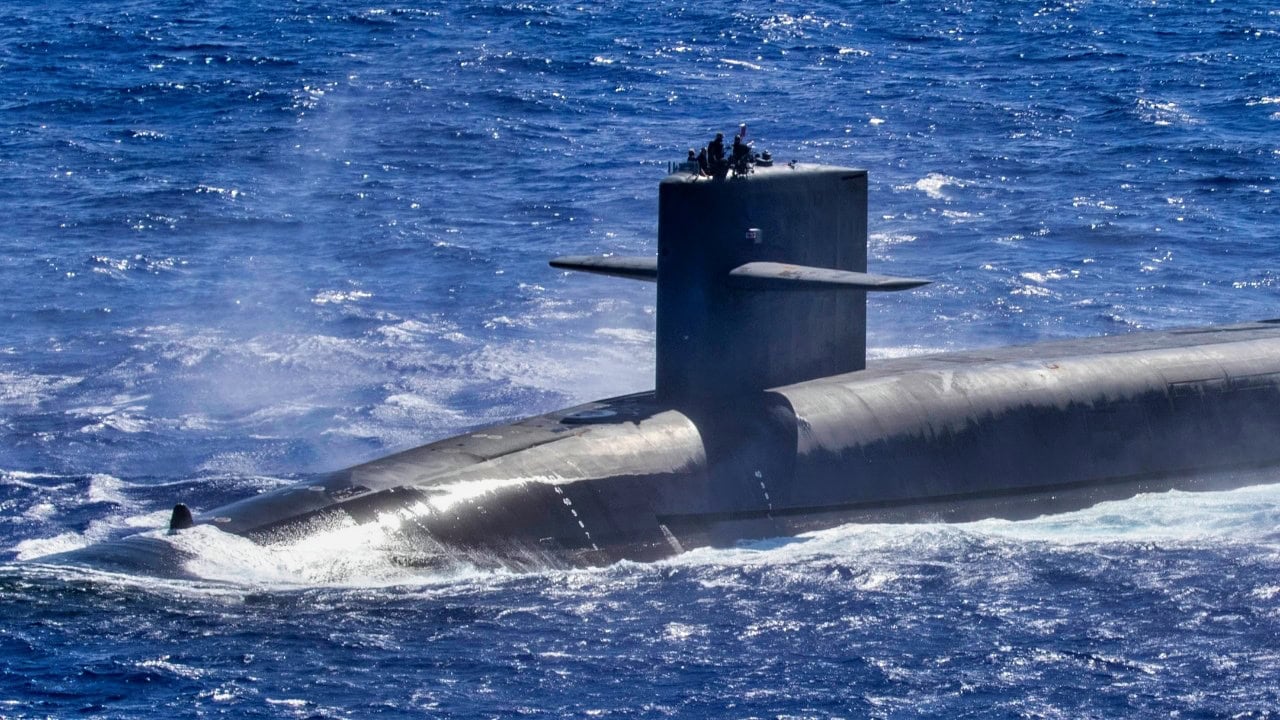
PACIFIC OCEAN (June 28, 2024) – An AS-332 Super Puma assigned to the Lewis and Clark-class dry cargo ship USNS Cesar Chavez (T-AKE 14) delivers supplies to the Ohio-class ballistic missile submarine USS Louisiana (SSBN 743) during a vertical replenishment at sea, June 28, 2024. The presence of the SSBN in the Pacific demonstrates the flexibility, survivability, readiness, and capability of the U.S. Navy submarine forces and complements the many exercises, training, operations, and other military cooperation activities conducted by Strategic Forces to ensure they are available and ready to operate around the globe at any time. Homeported in Bangor, Washington and currently assigned to Submarine Squadron 17, Louisiana is an undetectable launch platform for submarine-launched ballistic missiles, providing the United States with its most survivable leg of the nuclear triad. (U.S. Navy Photo by Mass Communication Specialist Seaman Andrew McPeek)
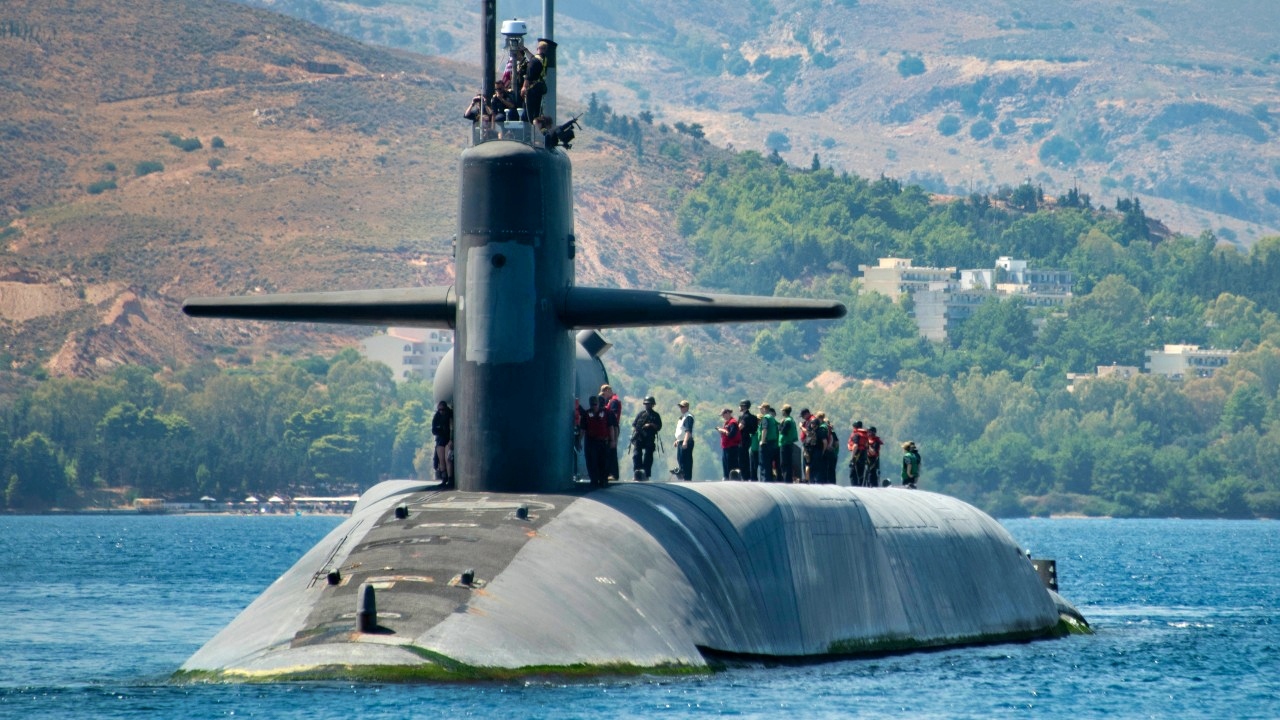
190907-N-UR565-0660NAVAL SUPPORT ACTIVITY SOUDA BAY, Greece (Sept. 7, 2019) The Ohio-class cruise missile submarine USS Florida (SSGN 728) arrives in Souda Bay, Greece, for a scheduled port visit, Sept. 7, 2019. NSA Souda Bay is an operational ashore base that enables U.S., allied, and partner nation forces to be where they are needed and when they are needed to ensure security and stability in Europe, Africa, and Southwest Asia. (Photo by Joel Diller/Released)
Stealthiest Submarine Ever?
Designed to replace the aging fleet of Ohio-class ballistic missile submarines, which have performed admirably for decades, well beyond their expected service life, the Columbias will introduce a wide sphere of new technological leaps forward in the realm of the undersea.
Columbia-class innovations
The innovations woven into the Columbia-class submarines are numerous. Perhaps the most significant of these innovations is the new, ultra-quiet electric drive propulsion system, replacing legacy hydraulic systems.
Among other things, this new drive propulsion system means that Columbia-class submarines will be much harder to detect than existing Ohio-class submarines and therefore better positioned for clandestine strategic deterrence missions.
An electric drive has other advantages as well, enabling more onboard electrical power sufficient to sustain onboard command and control, navigational systems, and the energy required by many of its technologies.
Navy engineers explain that in today’s Ohio-class submarines, a reactor plant generates heat, which creates steam.
The steam then turns turbines, which produce electricity and propel the ship forward through “reduction gears,” which translate the high-speed energy from the turbines into the shaft RPMs needed to move the boat’s propeller.
Longer Missions
Columbias are also being built with a new X-shaped stern intended to improve both maneuverability and quieting for the submarine. Columbias are also built with a “life-of-core” nuclear reactor, which does not require dry-docking for lengthy mid-life refueling procedures.
This massively improves operational tempo, deployability, and mission resilience. It is the reason why the Navy plans to build only 12 Columbia-class boats to replace the current fleet of 14 Ohio-class submarines.
Yet another interesting element of the Columbia-class is that it is being engineered with a handful of innovations now integrated into the U.S. Navy’s Block III Virginia-class attack submarines.
These include the integration of a fiber-optic cable linking periscope sights to command-and-control centers on board, eliminating the need for submariners to stand directly below a periscope. Depending upon how the cable is configured, Commanders can view periscope images from anywhere within the submarine.
An equally, if not more, impactful Virginia-class Block III innovation is the “fly-by-wire” navigational system also built into the Columbias.
Instead of relying on hydraulic or mechanical navigation, fly-by-wire uses computer automation to regulate speed, depth, and other critical navigational variables while ensuring human decision-makers operate in a command-and-control capacity.
This expedites the application of critical, potentially time-sensitive navigational adjustments.
About the Author: Kris Osborn
Kris Osborn is the President of Warrior Maven – Center for Military Modernization. Osborn previously served at the Pentagon as a highly qualified expert in the Office of the Assistant Secretary of the Army—Acquisition, Logistics & Technology. Osborn has also worked as an anchor and on-air military specialist at national TV networks. He has appeared as a guest military expert on Fox News, MSNBC, The Military Channel, and The History Channel. He also has a Masters Degree in Comparative Literature from Columbia University