
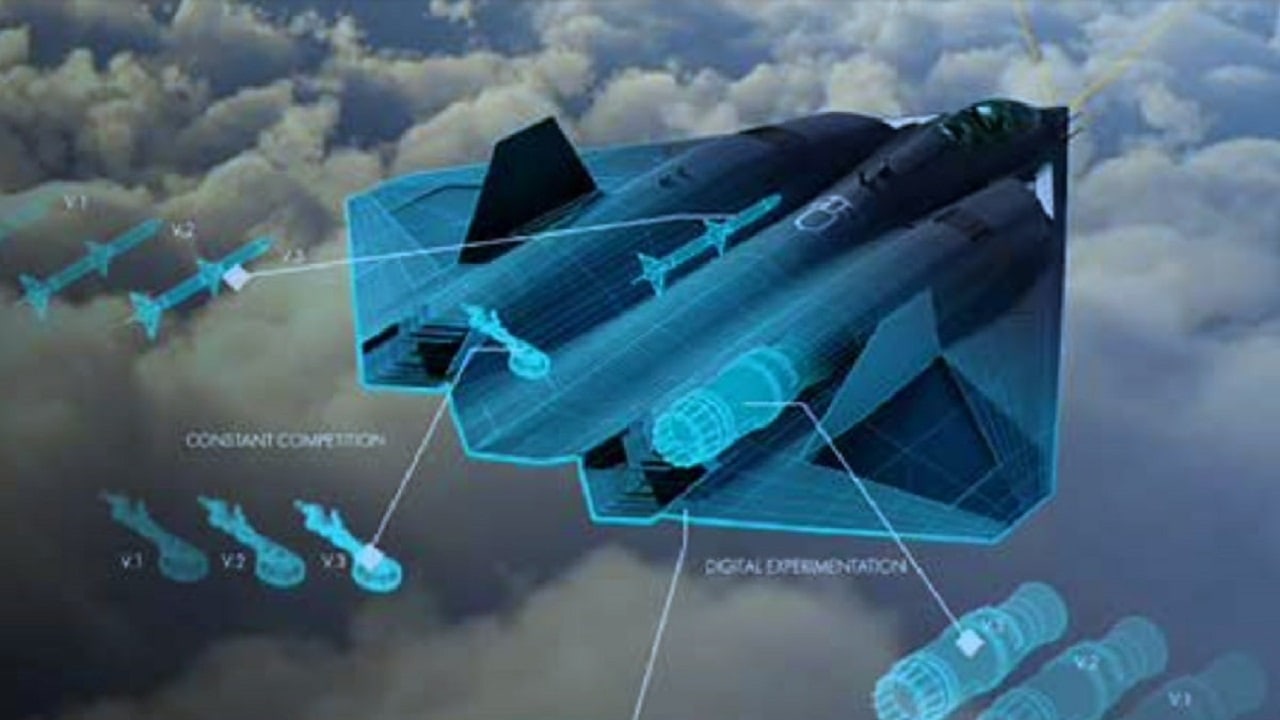
Key Points and Summary – The X-44 MANTA was a radical NASA-Lockheed Martin concept from the 1990s designed to fly without vertical tails, relying instead on multi-axis thrust vectoring and advanced software for stability.
By eliminating the tail, the design aimed to significantly reduce radar cross-section and drag while improving maneuverability.
Although the project was never built due to high technical risks and budget shifts toward the F-22, the X-44’s exploration of “computational dominance” and inherent instability influenced the design of modern stealth aircraft and UAVs.
The X-44 Manta Could Have Changed Fighter History
The X-44 MANTA was one of the most radical US fighter concepts of the 1990s. Designed to fly without vertical tails, the X-44 sought to prove that advanced flight controls could replace traditional stability surfaces.
While ambitious, the X-44 was never built as a full aircraft. Still, the project represented a critical step toward modern stealth shaping and control-law dominance over aerodynamics.
What Was the X-44?
The X-44 MANTA, or Multi-Axis No-Tail Aircraft, was a joint NASA-Lockheed Martin concept intended as a technology demonstrator rather than an operational fighter. The core idea: remove the vertical tails entirely and use thrust vectoring and advanced controls to stabilize and maneuver the aircraft instead.
The goal in removing the tails was to reduce radar cross-section, improve maneuverability, and lower drag. The project wasn’t especially focused on speed or weaponry; instead, it prioritized control, authority, and stability.
Why Did the X-44 MANTA Emerge?
In the late Cold War, and in the immediate post-Cold War period, stealth emerged as the dominant force in fighter design.
Vertical tails are decidedly un-stealthy, being one of the aircraft’s most significant radar reflectors. So designers wanted a cleaner stealth shaping that didn’t require significant compromises to aircraft agility.
The tail was historically considered a required control surface for maintaining stable flight and providing yaw authority.
But by the 1990s, digital fly-by-wire had matured. Thrust vectoring was proving viable. So the X-44 started to seem possible. The program ultimately emerged as a test of whether the software could fully replace hardware in terms of stability. Basically, the question was: how far could designers push instability.
Technical Specifications
The X-44’s defining feature: no vertical stabilizers. Instead, directional control was provided by thrust vectoring, differential control surfaces, and flight controlling computers. The proposed configuration was a modified F-22-derived fuselage and a flat, blended planform.
The aircraft would have relied heavily on multi-axis thrust vectoring (not just the 2D thrust vectoring used on the F-22) and high-speed flight computers, which were proving successful in stabilizing inherently unstable aircraft like the F-16 and F-117. The X-44 would also be inherently unstable, requiring active computer stabilization at all times. But the benefits would be real: reduced radar signature and lower drag. The risks to the design would have been total dependence on software to stay aloft without a passive stability margin. Any failure in the flight control computer would render the aircraft un-flyable.
Why the X-44 was Never Built
The X-44’s technology carried high risks. The flight controls were extremely complex for the era. And the system lacked redundancy; a failure in the computers, or in thrust vectoring, would mean a total loss of control. Meanwhile, program priorities shifted.
The F-22 development became paramount. And in the post-Cold War moment, the budget constricted, making it hard to justify a platform with no clear operational payoff. The US Air Force did not have an urgent need for a tailless fighter. So, the X-44, built to answer the question, “can we do this,” failed to answer the more pressing question, “do we need this.” The program quietly faded away.
Tactical and Strategic Implications
The X-44 was never about dogfighting. It was about survivability in anticipation of the realities of 21st-century airspace. Integrated Air Defense Systems (IADS) were becoming increasingly sophisticated, threatening to deny access to non-stealth platforms entirely.
The US recognized the trend early and began envisioning platforms that could bypass IADS systems. Something with signature control. The X-44, in many respects, demonstrated a shift in prioritiesfrom aerodynamic purity to computational dominance (a shift underscored by the F-16-to-F-35 evolution). The X-44 anticipated that fighters no longer needed to be naturally flyable, or even very good at flying.
Lockheed Martin X-44 MANTA (Multi-Axis No-Tail Aircraft)conceptual aircraft design intended to test feasibility of full yaw, pitch and roll authority without tailplanes. Attitude control relies purely on 3D thrust vectoring. design was derived from the F-22 Raptor pic.twitter.com/o6jcVfX3bA
— Chris Bolton (@CcibChris) February 1, 2023
The program reinforced a core modern principle: the pilot flies the software as much as the aircraft. The strategic implications were clear, that air superiority was increasingly decided by integration, not raw performance.
Legacy of the X-44 MANTA
While the X-44 never flew, its influence is still felt today. Modern stealth aircraft use reduced tails and employ active control for stability.
UAVs, too, incorporated X-44 design philosophies—especially given that accepting instability is easier without a human on board.
The X-44 MANTA, designed to only use TVC for control
byu/spacegenius747 inWeirdWings
In sum, the X-44 MANTA helped to normalize radical instability as an acceptable condition.
About the Author: Harrison Kass
Harrison Kass is an attorney and journalist covering national security, technology, and politics. Previously, he was a political staffer and candidate, and a US Air Force pilot selectee. He holds a JD from the University of Oregon and a master’s in global journalism and international relations from NYU.