
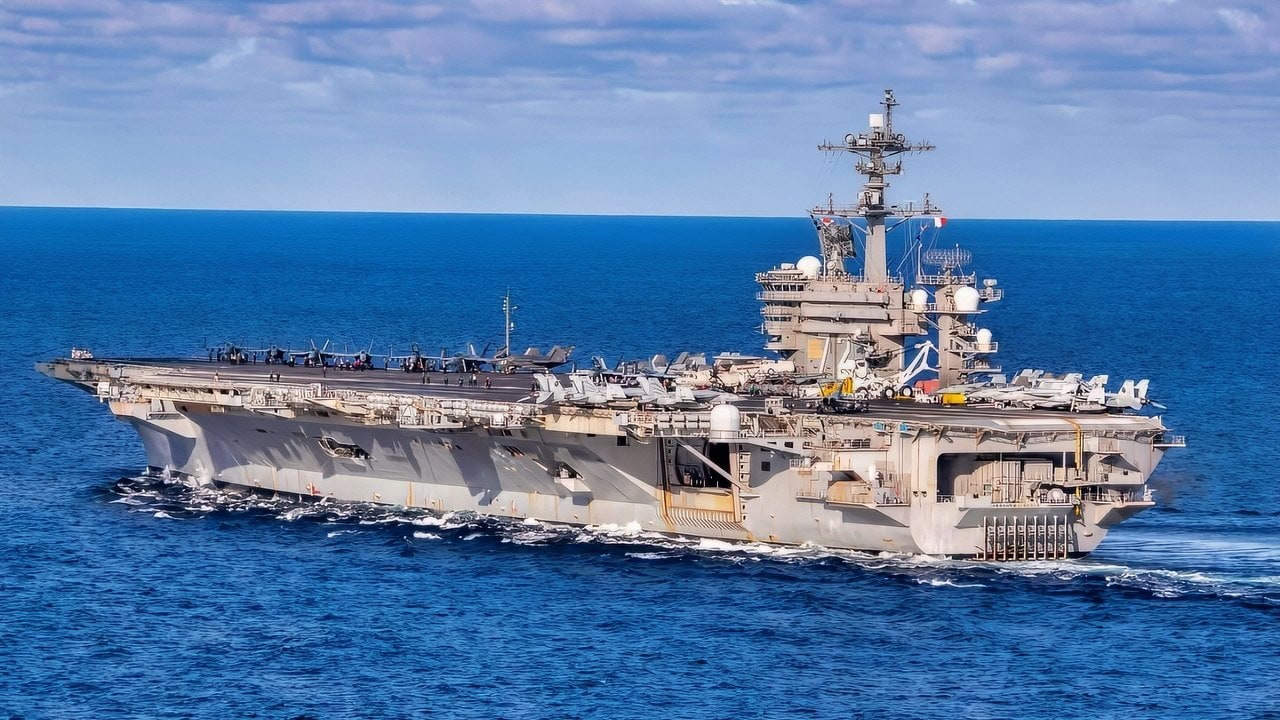
Summary and Key Points: While military analysts focus on the threat of hypersonic missiles, a recent Navy investigation reveals that U.S. supercarriers faced a more immediate danger from within: contaminated drinking water.
-On the USS Nimitz, JP-5 jet fuel infiltrated the potable water supply, sickening 11 sailors and exposing a history of unaddressed tank issues and maintenance backlogs.
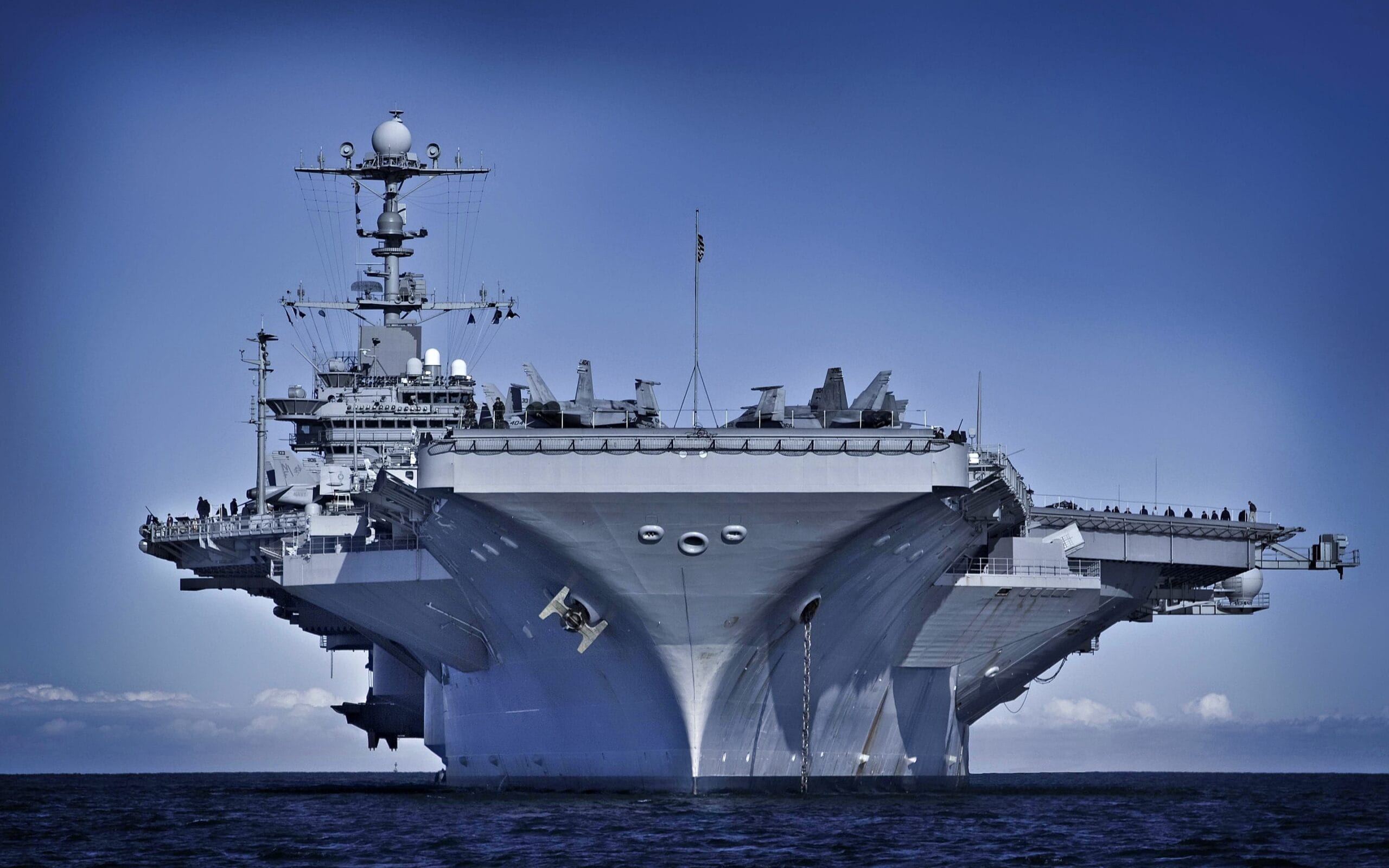
NRL is currently working with Naval Sea Systems Command, Naval Systems Engineering Directorate, Ship Integrity & Performance Engineering (SEA 05P) to transition the new pigment combination into a military specification. The most recent vessel to receive it was USS George Washington (CVN 73).

PHILIPPINE SEA (Feb. 24, 2024) A U.S. Air Force B-52 Stratofortress, attached to the 5th Bomb Wing, and aircraft attached to Carrier Air Wing (CVW) 11, fly in formation over the Nimitz-class aircraft carrier USS Theodore Roosevelt (CVN 71), Feb. 24, 2024. Theodore Roosevelt, flagship of Carrier Strike Group Nine, is underway conducting routine operations in the U.S. 7th Fleet area of operations. U.S. 7th Fleet is the U.S. Navy’s largest forward-deployed numbered fleet, and routinely interacts and operates with allies and partners in preserving a free and open Indo-Pacific region. (U.S. Navy photo by Mass Communication Specialist 1st Class Thomas Gooley)
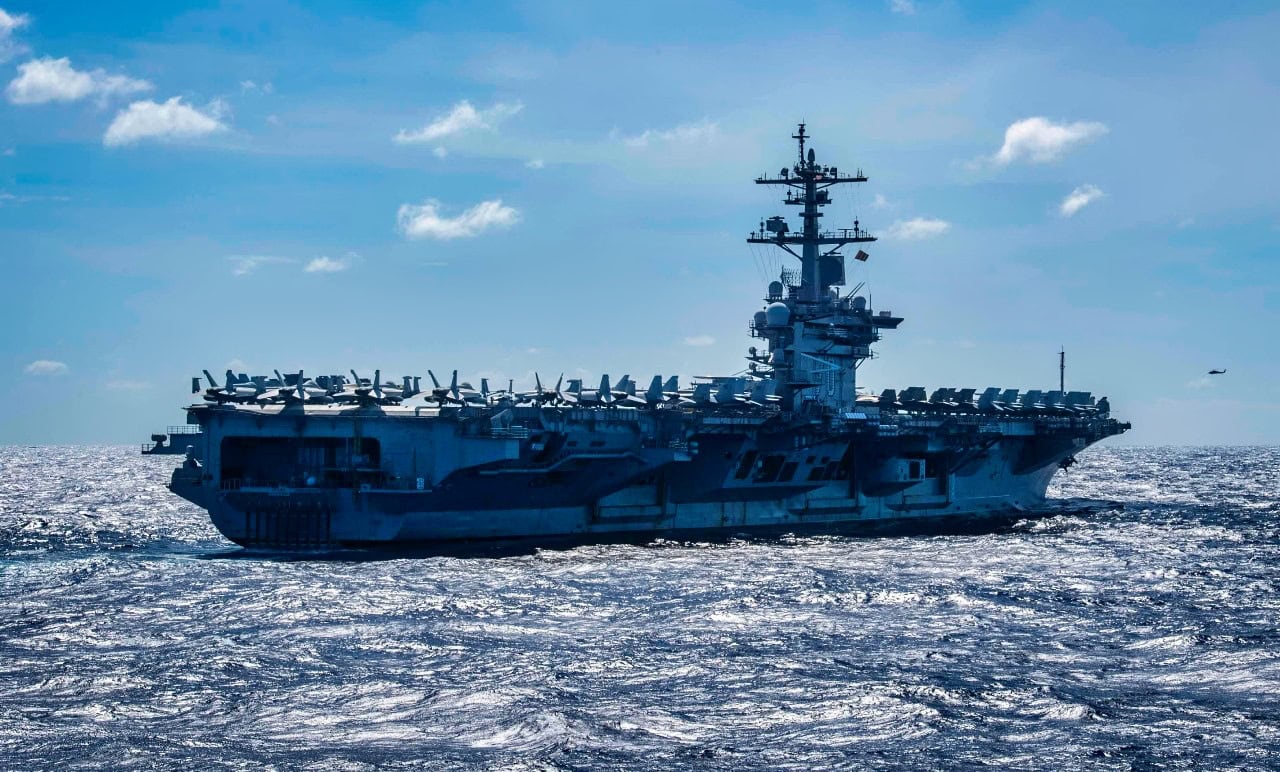
The Nimitz-class aircraft carrier USS Carl Vinson (CVN 70) transits the South China Sea during a Maritime Cooperative Activity with the Philippine Navy, Jan. 17, 2025. The U.S. and Philippines work together as allies, enhancing the interoperability of maritime forces and supporting their shared goal of a free and open Indo-Pacific. Carrier Strike Group ONE, is underway conducting routine operations in the U.S. 7th Fleet area of operations. (U.S. Navy photo by Mass Communication Specialist 3rd Class Brianna Walker)
-Similarly, the USS Abraham Lincoln discovered E. coli bacteria in its water supply due to a corroded vent pipe that allowed bilge water ingress—a situation exacerbated by crew complacency and communication breakdowns regarding “weird tasting” water.
Dirty Water: The Maintenance Failures That Hurt Two Supercarriers
Aircraft carriers in World War II replaced battleships as capital ships—the primary class of warships used for global maritime power projection.
This first became evident during the Pearl Harbor raid and the Battle of the Coral Sea, and it was confirmed beyond a doubt during the epic Battle of Midway. Flattops have held that lofty status ever since, their status bolstered further by the advent of nuclear-powered supercarriers.
However, in this age of renewed great power competition, many military experts declare that the age of carrier dominance is coming to an end. These analysts cite the proliferation of ship-killing missiles—especially hypersonics—and a shortage of effective defenses to counter them.
Yet as scary as those weapons look on paper, the biggest real-world threat that recently befell U.S. Navy Nimitz-class supercarriers was non-kinetic: contaminated drinking water on the USS Nimitz (CVN-68) and USS Abraham Lincoln (CVN-72).
Bottom Line Up Front (BLUF)
The inspiration for this article is a May 17, 2023 article by Geoff Ziezulewicz of Navy Times.
As Ziezulewicz writes, “For years, and through an historically long deployment during the most disruptive phase of the COVID pandemic, the aircraft carrier Nimitz was hauling around polluted water in its potable water tanks, and more than a third of those 26 tanks were out of commission.
“But that issue was never formally documented or addressed until JP-5 jet fuel got into the carrier’s drinking water last fall while the ship was getting ready to deploy, sidelining the carrier and sickening at least 11 sailors, according to a Navy investigation released this week.
“Fellow carrier Abraham Lincoln suffered its own drinking water contamination in September as it ended a deployment, and a separate investigation into that incident released this week shows that the carrier was dealing with water purity issues for longer than the Navy has publicly acknowledged.”
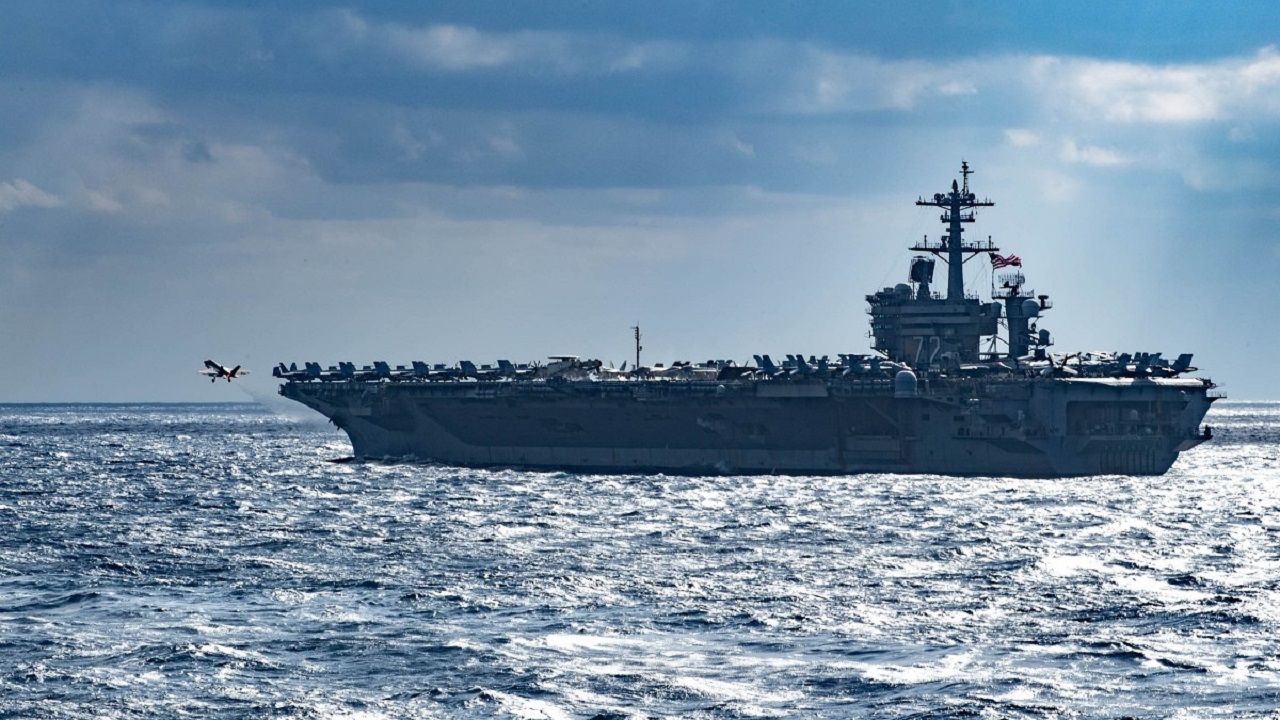
USS Abraham Lincoln. Image Credit: Creative Commons.
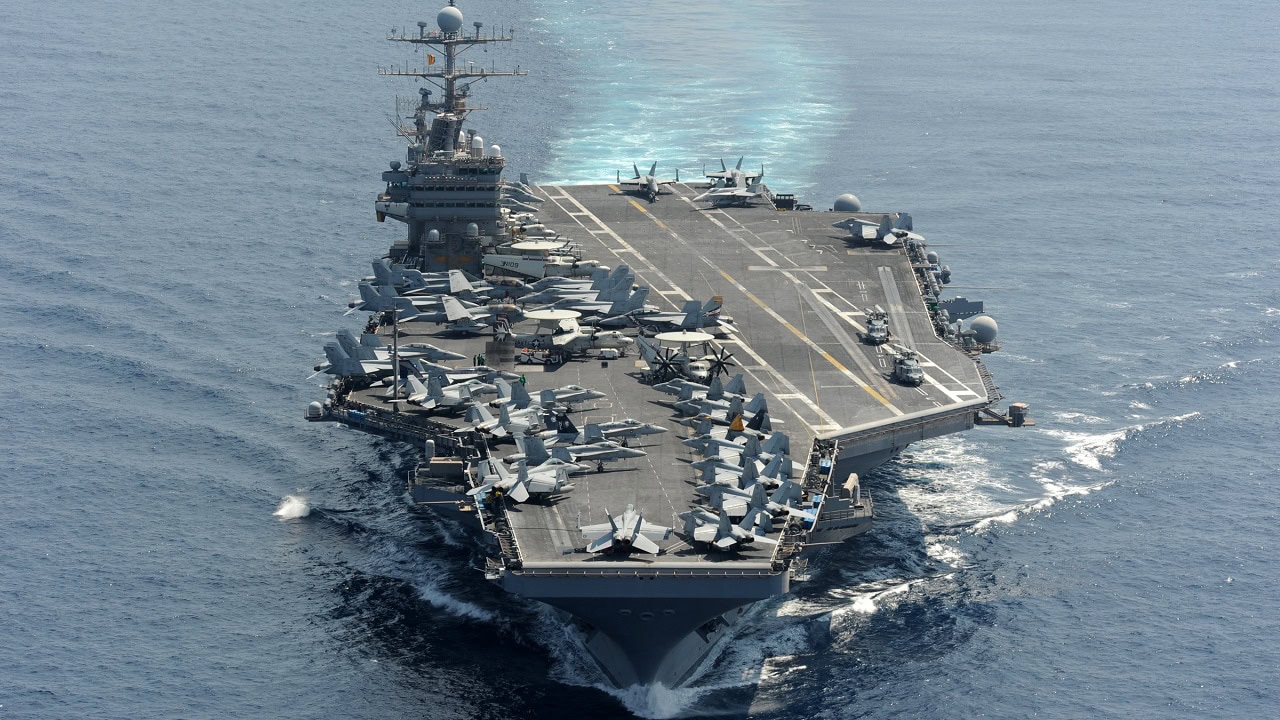
120118-N-QH883-003
INDIAN OCEAN, (Jan 18, 2012) The Nimitz-class aircraft carrier USS Abraham Lincoln (CVN 72) transits the Indian Ocean. Abraham Lincoln is in the U.S. 7th Fleet area of responsibility as part of a deployment to the western Pacific and Indian Oceans to support coalition efforts. (U.S. Navy photo by Chief Mass Communication Specialist Eric S. Powell/ Released)
About JP-5
Yes, you read the passage correctly; JP-5 jet fuel somehow found its way into a carrier’s drinking water supply.
The “JP” in “JP-5” stands for “jet propellant.” This is a high-flash-point kerosine that serves as the primary jet fuel for use onboard aircraft carriers. It is made up of hundreds of hydrocarbon compounds, many of which are also present in gasoline. Though little is known about the specific effects of unintentional human ingestion of JP-5, people who accidentally ingested kerosene reported harmful effects on the respiratory tract, gastrointestinal tract, and nervous system. Meanwhile, laboratory animals exposed to JP-5 via ingestion, inhalation, and dermal contact suffered damage to the liver, decreased immune response, impaired performance on neurological function tests, impaired hearing, and dermatitis.
Lincoln Lamentations
The Lincoln’s drinking water supply was not poisoned by JP-5. Instead, noxious bilge water got into her potable water system in September 2022, and five of her potable water tanks tested positive for E. coli bacterial contamination. E. coli is much less life-threatening than jet fuel but is still plenty miserable, causing severe cramps, diarrhea, and vomiting. Fortunately, none of the Lincoln’s seamen were sickened by the bacteria.
So, How the Heck Did This Happen?
It would be easy to blame complacency or a lack of attention to detail. But that would be an oversimplification.
Among the findings of the official command investigation of the Nimitz occurrence:
-While the vessel was in maintenance at Puget Sound Naval Shipyard in March 2022, the ship’s crew requested assistance to empty and clean the eight potable water tanks “that were full of liquid but out of service for suspected seawater contamination.” But just one of those eight fouled tanks was cleaned, inspected, sanitized, and restored to service, “due to limited time and resources available.”
-“Concerned there would be insufficient time to restore the remaining seven tanks to service, the Reactor Officer directed the Reactor Propulsion Division to develop plans to empty and restore the remaining tanks without the assistance of the shipyard.” While developing plans to empty the carrier’s potable water tanks on their own, the crew was “unaware that any of the tanks contained JP-5,” and assumed they were just dealing with seawater.
The official investigative report on the Abraham Lincoln included the following findins:
-Her contaminated drinking water issues stemmed from a hole in a vent header pipe located six inches above the bilge deck. Corrosion produced that hole “sometime in spring 2022.”
-From September 19-21 of that year, the bilge levels reached the 6-inch height where the corroded venter hole sat, allowing in the dirty fluids. On that third day, after placing the potable water tank into service, sailors told the plant chief machinery operator that the water “tastes weird.” However, that operator did not bother alerting the chain of command “based on perceptions” that moving from shore- to ship-provided water could result in a brief change in taste. The operator did notify the water control watch sailors that “the tank is bad,” but did not elaborate, so the water watch simply took this to mean that chlorine measurements were off.
Once again, “Thou shalt never assume.” Thankfully, complacency didn’t literally kill anyone aboard either warship.
About the Author: Christian D. Orr, Defense Expert
Christian D. Orr is a Senior Editor. He is a former Air Force Security Forces officer, Federal law enforcement officer, and private military contractor (with assignments worked in Iraq, the United Arab Emirates, Kosovo, Japan, Germany, and the Pentagon). Chris holds a B.A. in International Relations from the University of Southern California (USC) and an M.A. in Intelligence Studies (concentration in Terrorism Studies) from American Military University (AMU). He is also the author of the newly published book “Five Decades of a Fabulous Firearm: Celebrating the 50th Anniversary of the Beretta 92 Pistol Series.”