

Summary and Key Points: Donald Rumsfeld’s “you go to war with the Army you have” line became a defining flashpoint of the Iraq War era, delivered during a 2004 town hall with troops in Kuwait raising urgent concerns about equipment and protection.
-The exchange crystallized wider frustrations over readiness, armor shortages, and perceived gaps between the Pentagon’s plans and battlefield reality.
-The backlash was immediate, drawing criticism from political leaders and fueling questions about leadership and strategy as Iraq and Afghanistan turned into grinding campaigns.
-The narrative also revisits Rumsfeld’s “known unknowns” framing and how both phrases came to symbolize his tenure.
Quote of the Day: Rumsfeld’s “You Go to War With the Army You Have” Still Stings
‘You go to war with the Army you have, not the Army you might want or wish to have at a later time.’ – Donald Rumsfeld
Donald Rumsfeld had a long and varied career in American politics.
The Princeton graduate served in Congress in the 1960s, as a White House aide, and as a representative to NATO in the Nixon Administration, and as White House chief of staff under President Gerald Ford, before he was appointed to his first stint as Secretary of Defense.
He was seen as a mentor of Dick Cheney, serving with him in multiple administrations.
But history will likely remember Rumsfeld most for his second stint at the Pentagon during the George W. Bush presidency, when he served as Secretary of Defense for six years. Rumsfeld, in his two stints, was both the youngest and oldest Defense Secretary in history.
Those years consisted of the 9/11 attacks and the launches of wars in Iraq and Afghanistan, as well as the Abu Ghraib scandal. Rumsfeld was also known for his pugnacious press briefings, especially in the early days of the Afghanistan and Iraq wars.
He was even sometimes dubbed the “secretary of war,” decades before Pete Hegseth claimed that title for himself.
Rumsfeld also presided over the realization that both wars were turning into long slogs and that the wider War on Terror was not shaping up the way the Bush Administration had planned.
The Quote
Rumsfeld’s quote about how “you go to war with the Army you have, not the Army you might want or wish to have at a later time” came in December of 2004, when he was addressing American troops in Kuwait who were headed to Iraq.
The question had been raised with Rumsfeld over whether the troops were heading to the front with sufficient equipment.
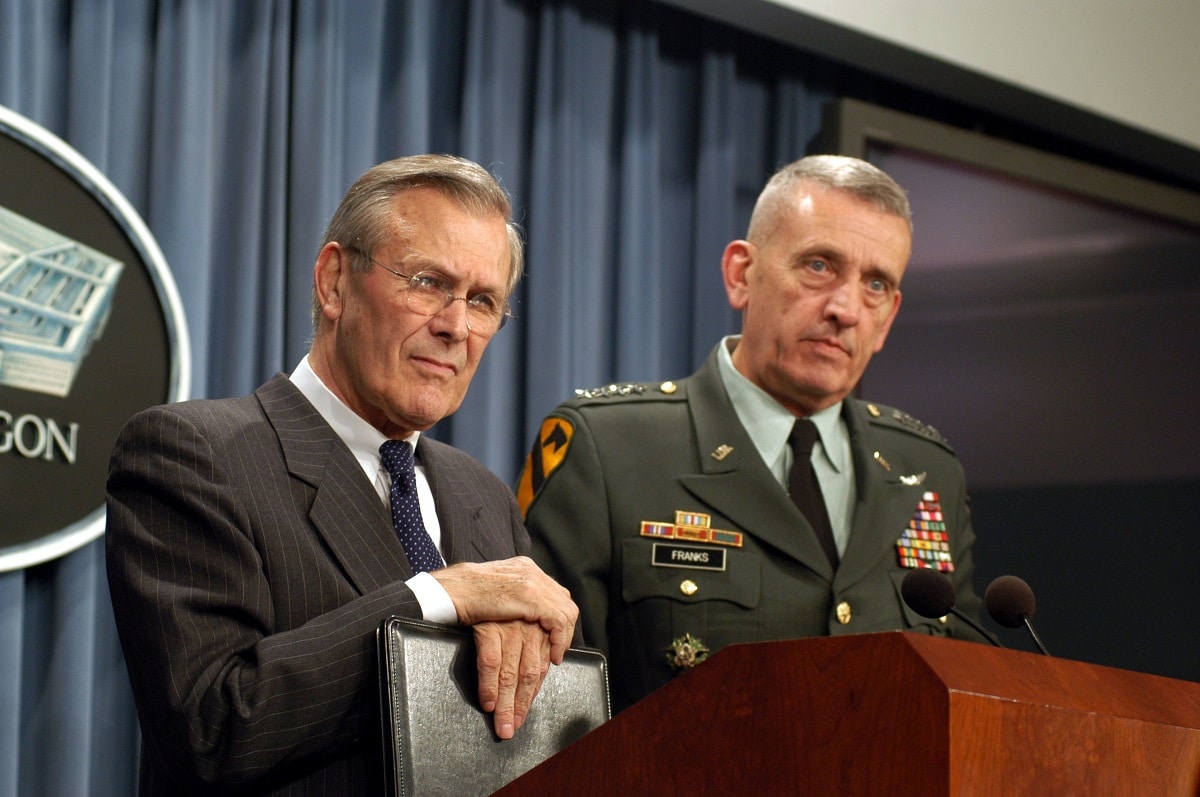
Secretary of Defense Donald H. Rumsfeld (left) and the Commander of U.S. Central Command General Tommy Franks, listen to a question at the close of a Pentagon press conference on March 5, 2003. Rumsfeld and Franks gave reporters an operational update and fielded questions on the possible conflict in Iraq. Image Credit: Creative Commons.
Per a PBS account at the time, Specialist Thomas Wilson of the Tennessee National Guard had asked the Defense Secretary a question.
“We’re digging pieces of rusted scrap metal and compromised ballistic glass that has already been shot up, dropped, busted– picking the best out of this scrap to put on our vehicles go into combat,” Specialist Wilson asked Rumsfeld. “We do not have proper armament vehicles to carry with us North.”
Rumsfeld responded with the famous quote about “you go to war with the Army you have,” adding that “you can have all the armor in the world on a tank, and a tank can be blown up. And you can have an up-armored Humvee, and it can be blown up.”
It was one of several complaints that troops had for Rumsfeld in that town hall, CNN reported at the time, including charges that the Army got better equipment than National Guard units, as well as the “stop-loss” policy of the time.
But it was the “you go to war with the Army you have” comments that did not go over especially well. He was called insensitive and callous, and Sen. John McCain (R-AZ) declared that he had “no confidence” in the then-Pentagon chief.
“I am truly saddened by the thought that anyone could have the impression that I, or others here, are doing anything other than working urgently to see that the lives of the fighting men and women are protected and are cared for in every way humanly possible,” Rumsfeld said in response to the criticism a few weeks later, per the AP.
Known Unknowns
Rumsfeld also became very much associated with a different quote from the Iraq War, from February of 2002, in which he declared, “There are known knowns; there are things we know we know. We also know there are known unknowns; that is to say, we know there are some things we do not know. But there are also unknown unknowns—the ones we don’t know we don’t know.”
His memoir, published in 2011, was titled “Known and Unknown.” Two years later, a documentary in which Rumsfeld was interviewed by filmmaker Errol Morris was titled The Unknown Known.
However, Rumsfeld did not originate that concept, as the phrase had been frequently used in military and NASA circles, at least as far back as the 1960s.
In that memoir, per a review that called it “clearly a sore point,” Rumsfeld addressed the “with the army you have” moment.
“My response also told a simple truth about warfare,” the former Defense Secretary wrote in his book. “I later was told that the soldier’s question had been planted by a Tennessee news reporter who had been embedded with the unit.”
“The source of the question was of little importance – it was a critical issue regarding the safety of our troops, and I did my best to answer it fully,” he added.
The Fall of Rummy
Rumsfeld resigned his position in November of 2006, the day after the Republicans were wiped out in that year’s midterm elections. It would be his last posting in government.
An editorial published in the Army Times, Air Force Times, Navy Times, and Marine Corps Times, a few days earlier, had declared that it was “Time for Rumsfeld to go.”
“Rumsfeld has lost credibility with the uniformed leadership, with the troops, with Congress, and with the public at large,” the editorial said. “His strategy has failed, and his ability to lead is compromised. And although the blame for our failures in Iraq rests with the secretary, it will be the troops who bear its brunt.”
Donald Rumsfeld died in June of 2021, at the age of 88.
“After entering the Pentagon in 2001 with ambitious plans to change how the military does business and develop new weapons systems incorporating emerging commercial technologies, Rumsfeld was instead forced to pivot to managing the grinding insurgencies in Iraq and Afghanistan,” Politico said of Rumsfeld in its obituary.
“That often uncoordinated effort led to a string of disasters — including U.S. forces torturing prisoners at Abu Ghraib, and mounting casualties to underequipped U.S. troops — that resulted in his firing in 2006.”
About the Author: Stephen Silver
Stephen Silver is an award-winning journalist, essayist, and film critic, and contributor to the Philadelphia Inquirer, the Jewish Telegraphic Agency, Broad Street Review, and Splice Today. The co-founder of the Philadelphia Film Critics Circle, Stephen lives in suburban Philadelphia with his wife and two sons. For over a decade, Stephen has authored thousands of articles that focus on politics, national security, technology, and the economy. Follow him on X (formerly Twitter) at @StephenSilver, and subscribe to his Substack newsletter.