
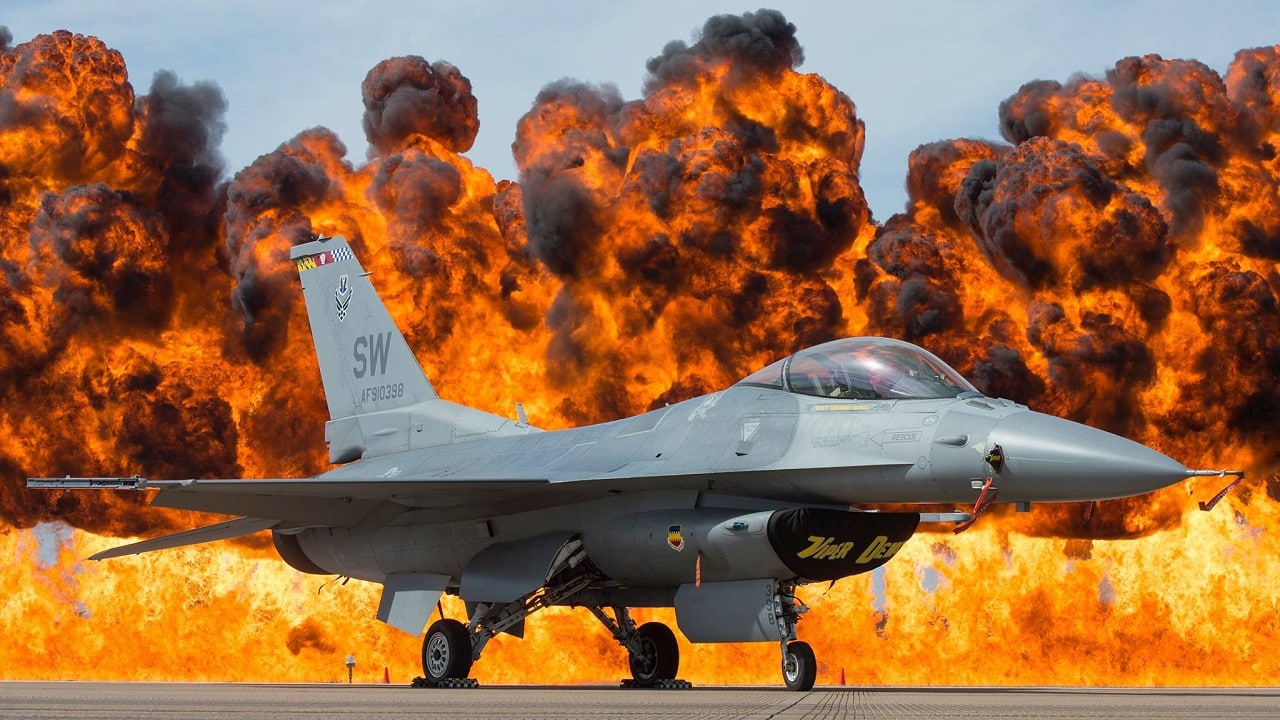
Summary and Key Points: The Air Force is extending the F-16’s relevance into the 2040s by pairing structural life-extension work with modern sensors and avionics.
-Major reinforcements to wing skins, fittings, bulkheads, and key fuselage areas are described as adding roughly 4,000 flight hours, pushing service life from about 8,000 to 12,000 hours.
-At the same time, upgraded F-16s are receiving a new AESA radar, digital cockpit displays, improved mission computers, and more automation to reduce pilot workload.
-Newer Viper variants also add modern electronic warfare features and, in some cases, infrared search-and-track to improve detection in contested environments.
-The result is a 1970s-era airframe performing with many of the sensor and targeting attributes associated with newer fighters.
The F-16 Is Headed for the 2040s—and It’s Getting F-35 Tech to Do It
As far back as 2019, Air Force weapons developers said the fighter had received massive structural upgrades to its upper wing skin and fittings, upper and lower bulkhead, and canopy sill longeron.
These adjustments extended the F-16’s service life by up to 4,000 flight hours, increasing its operational capability from 8,000 to 12,000 flight hours.
The extended service life was made possible by Air Force efforts to give its 1970s-era F-16 fighter jet F-35 technology as part of a massive fleet-wide overhaul intended to improve targeting, attack precision, and computer systems—to extend the fighter’s combat life all the way into the 2040s.
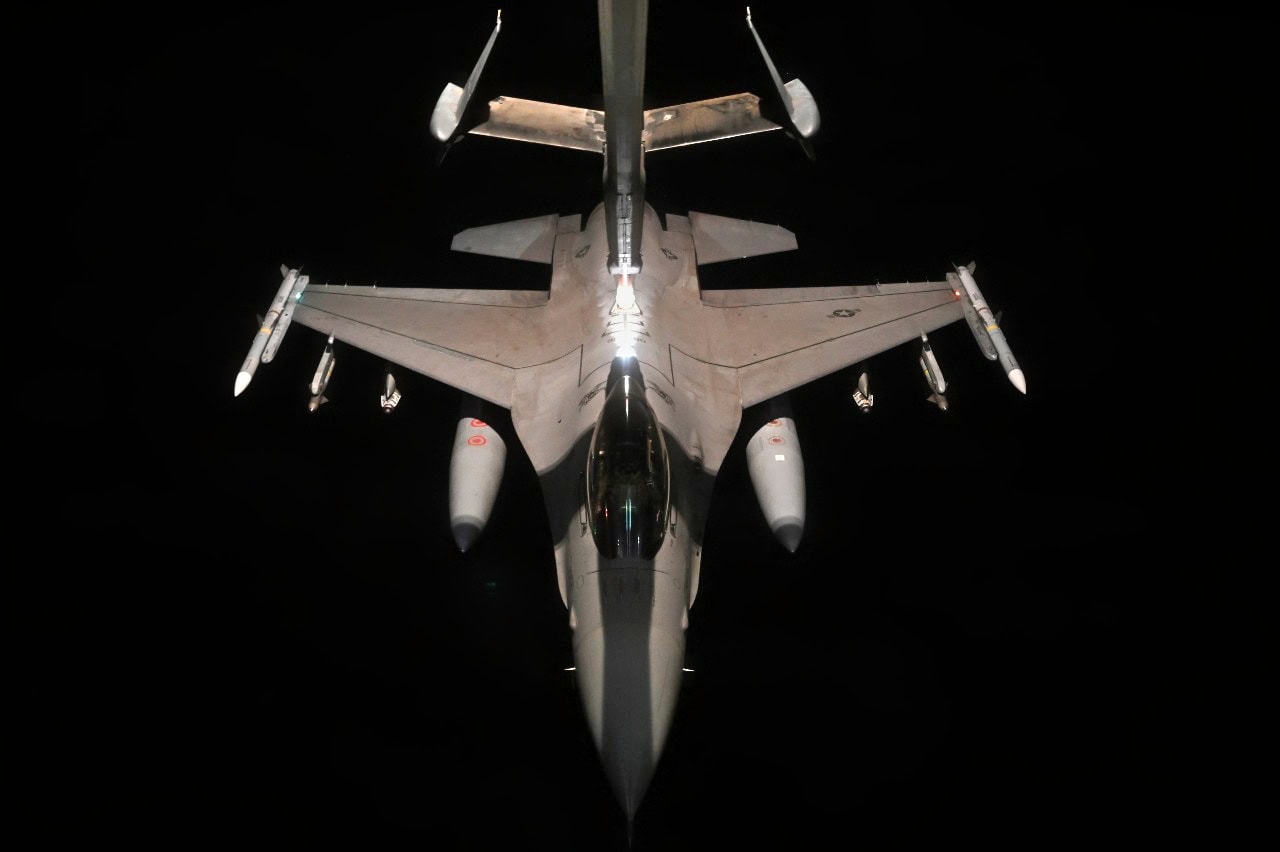
A U.S. Air Force F-16 Fighting Falcon assigned to the 77th Expeditionary Fighter Squadron, receives fuel from a KC-10 Extender assigned to the 908th Expeditionary Air Refueling Squadron, over an undisclosed location within the U.S. Central Command area of responsibility, Dec. 2, 2022. F-16 aircraft routinely conduct presence patrols within the CENTCOM AOR to reassure allies and ensure regional security. (U.S. Air Force photo by Staff Sgt. Gerald R. Willis)
It might be tough to imagine that today’s Air Force F-16 dates back to the 1970s, a fact that might lead some to wonder how the combat aircraft has sustained its combat relevance and performance in the dynamic threat environment of the 2020s.
In fact, the F-16 has not only maintained combat relevance and high performance. Still, it has also been called the “hardest adversary” by a US Navy F/A-18 pilot, according to an interesting write-up in the Aviation Geek Club.
Service Life Extension Plans for F-16 Fighter
The success of fighter upgrades dates back many years to the inception and preservation of a Service Life Extension Program (SLEP), which upgraded the upper wing skin and fittings, adjusted the bulkhead and canopy, and added an F-35 Active Electronically Scanned Array (AESA) radar.
With AESA, the F-16 incorporated an entirely new ability to find, detect, and track enemy threats at much greater ranges. The SLEP aimed to extend the flight time of F-16s from roughly 6,000 to 7,000 flight hours to 8,000 or more.
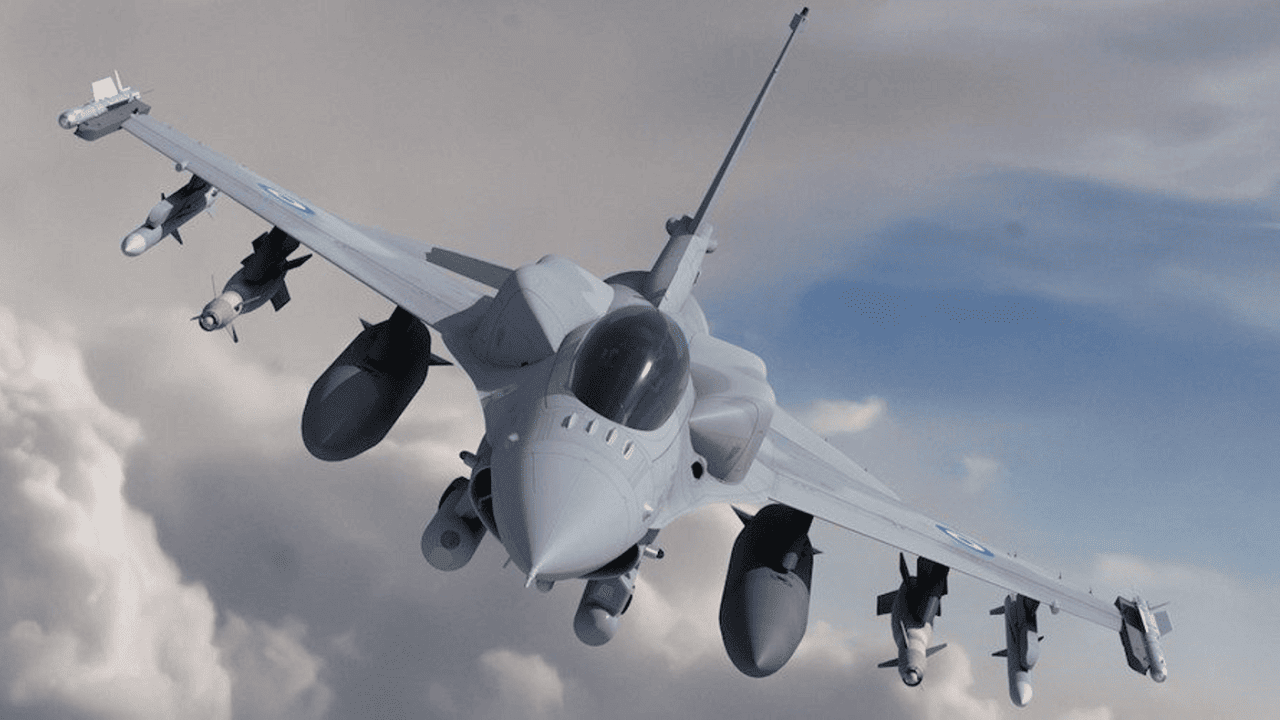
Greece F-16 fighter jet. Image Credit: Creative Commons.
The AESA radar, which Lockheed developers say can track up to 20 targets at once, is a massive upgrade over the F-16’s previous mechanically scanned radar.
By virtue of its ability to track multiple targets, the AESA radar can scan a 360-degree sphere, including horizontal, vertical, and diagonal vectors.
New Digital Cockpit
Not surprisingly, the F-16 has also received new cockpit avionics in recent years, including moving map displays, cockpit video, digital graphics screens, and new target-tracking systems. Upgraded F-16s also use a high degree of increased onboard automation to free up pilot focus and workload.
By automatically performing a range of important procedural functions independently, a pilot is then freed up to focus more intently on other mission-critical tasks.
Alongside the Air Force SLEP, Lockheed Martin has also been developing a new F-16v variant, which continues to inspire allied interest worldwide.
The F-16v also uses new computers and software, along with a high-definition cockpit display.
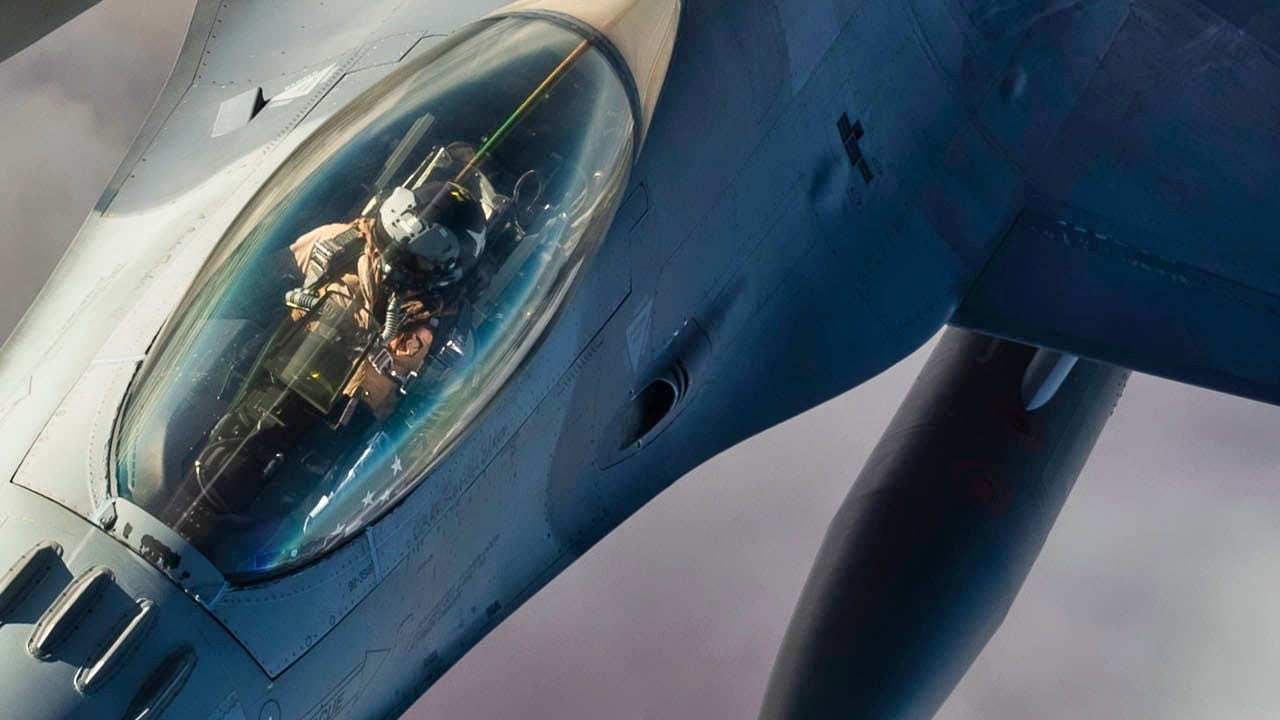
A U.S. Air Force F-16 Fighting Falcon is refueled over the U.S. Central Command area of responsibility Nov. 22, 2024. The F-16 avionics system includes highly accurate enhanced global positioning and inertial navigation systems in which computers provide steering information to the pilot. (U.S. Air Force photo by Staff Sgt. William Rio Rosado)
The “v” model also adds a new data bus, an electronic warfare suite, a missile warning sensor, and a helmet-mounted cueing system.
Infrared Search and Track
This upgraded F-16v technical foundation served as the starting point for Lockheed Martin’s next-generation F-16.
Along with its AESA radar, the F-16 also integrates a high-tech, next-generation targeting system called Infrared Search and Track (IRST). IRST, which is used extensively in the F/A-18 Super Hornet fighter jet, is a passive, long-range sensor that searches for and detects infrared emissions.
Much like the AESA, the IRST can track multiple targets at once and operate in an electromagnetic warfare environment.
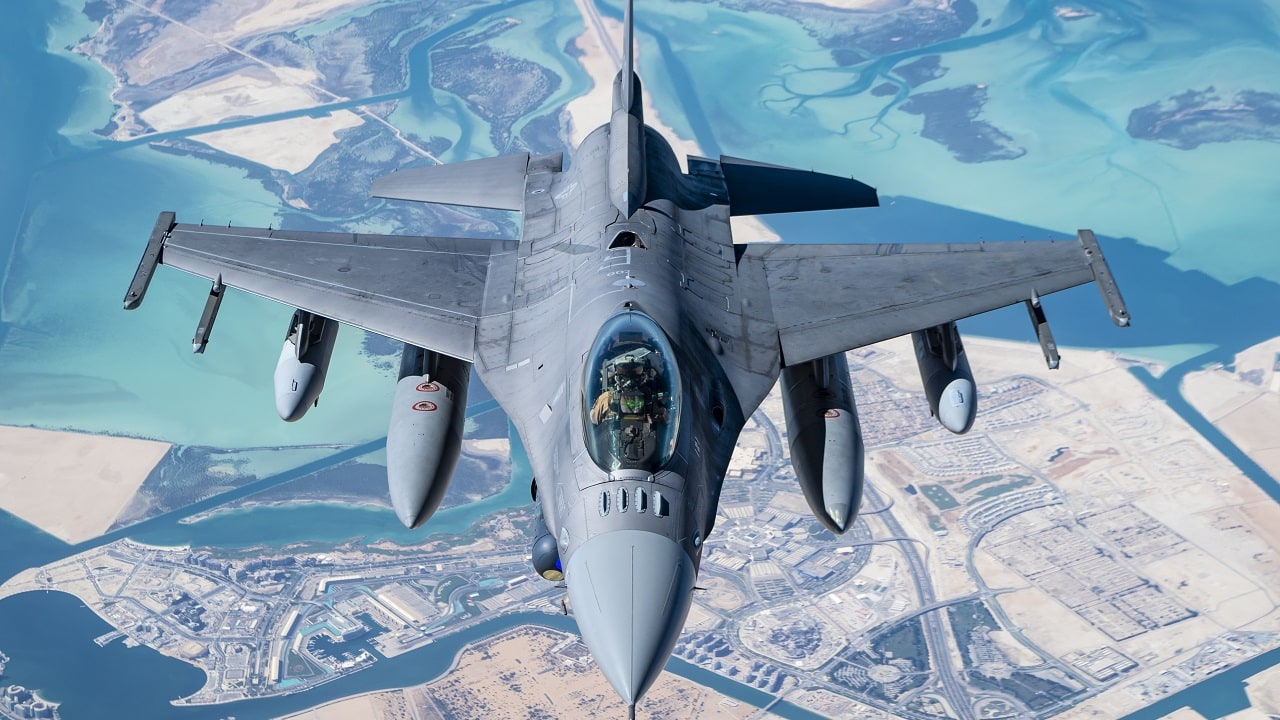
A U.S. Air Force F-16 Fighting Falcon flies over the U.S. Central Command area of responsibility Oct. 14, 2020. The F-16 Fighting Falcon is a compact, multirole fighter aircraft that has proven itself in both air-to-air combat and air-to-surface attack. (U.S. Air Force photo by Senior Airman Duncan C. Bevan)
As a passive, long-range sensor, able to provide air-to-air targeting, IRST introduces new combat variables for the F-16.
In effect, while there are ultimately limits to how much an older aircraft can be upgraded, today’s F-16 is almost an entirely different airplane apart from keeping its basic airframe configuration.
About the Author: Kris Osborn
Kris Osborn is the President of Warrior Maven – Center for Military Modernization. Osborn previously served at the Pentagon as a highly qualified expert in the Office of the Assistant Secretary of the Army—Acquisition, Logistics & Technology. Osborn has also worked as an anchor and on-air military specialist at national TV networks. He has appeared as a guest military expert on Fox News, MSNBC, The Military Channel, and The History Channel. He also has a Masters Degree in Comparative Literature from Columbia University.


Jeremy Gardens
February 9, 2026 at 4:49 am
8000 hours original design service life
Bill wasp
February 9, 2026 at 12:10 pm
So, teaching an old, but lethal dog new tricks works. And a lot cheaper.
DirtyLoad
February 11, 2026 at 4:58 pm
That pic with the fire in the background has an error in it’s caption. The F-16 is not taxiing, it is parked. There is no pilot and it’s rear wheels are chocked.