

Summary and Key Points: Chinese J-15 carrier fighters were observed carrying what appears to be the new YJ-15 anti-ship missile, signaling the weapon may be moving beyond prototype status.
-Reported to be a compact, ramjet-powered supersonic design with a range believed to exceed 1,000 kilometers, YJ-15 would represent a major leap over earlier air-launched options and strengthen China’s stand-off strike toolkit.
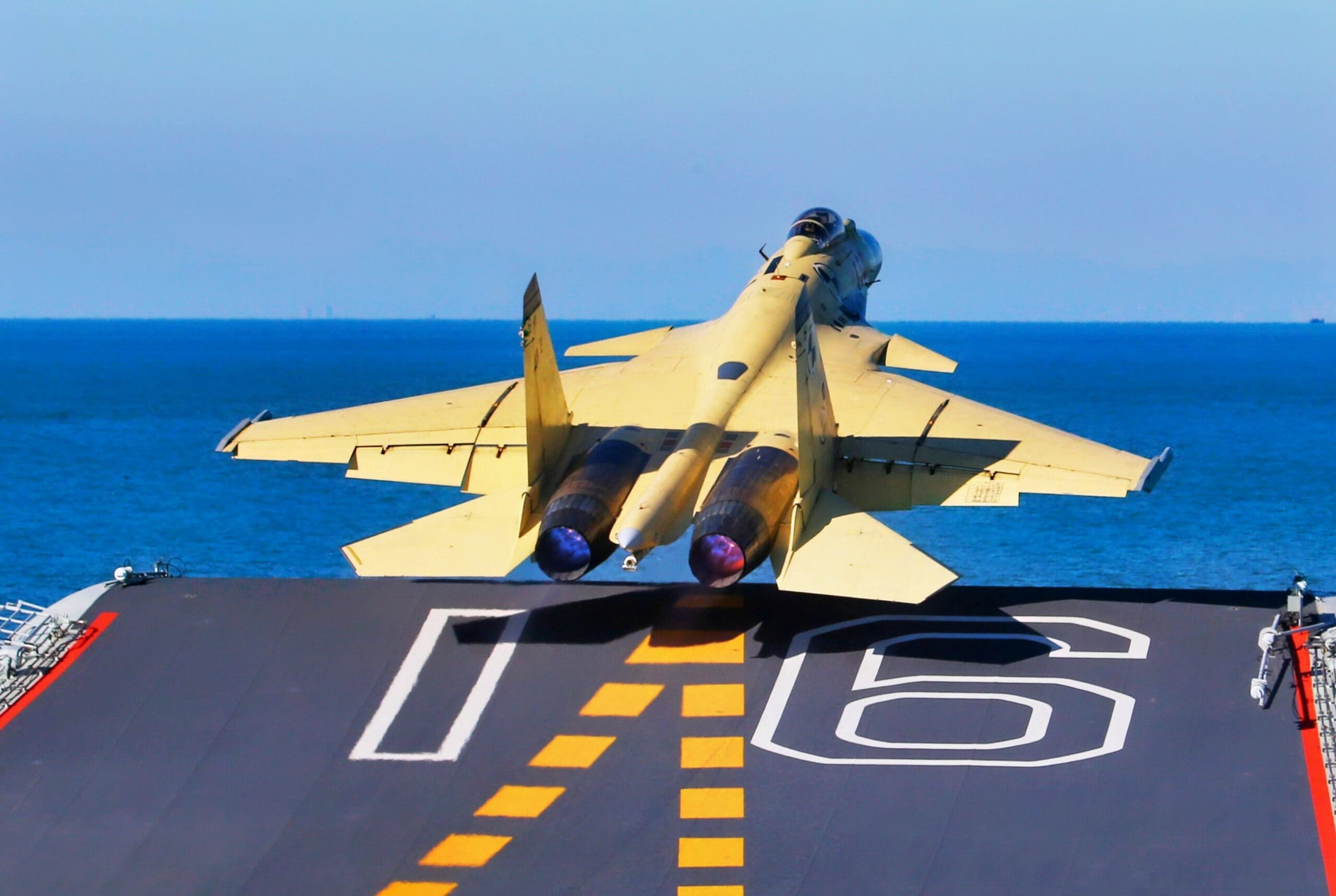
J-15 Fighter from China. Image Credit: Creative Commons.
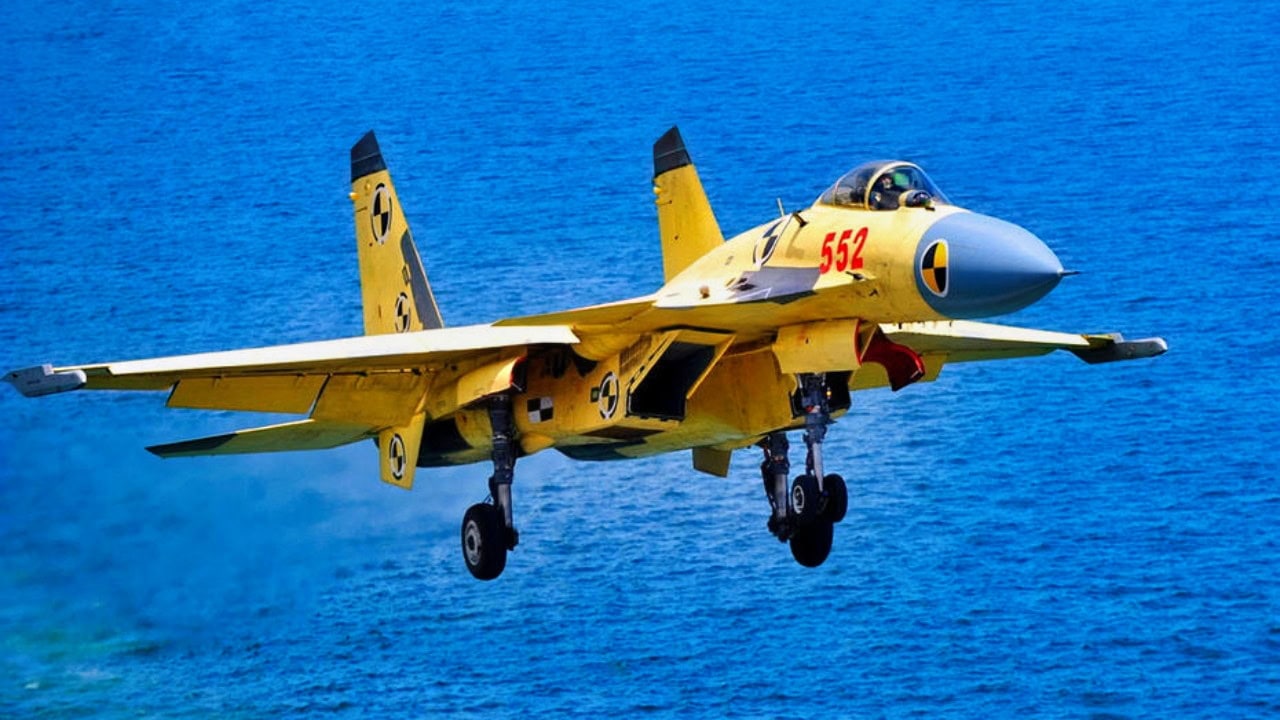
J-15 Flying Shark Fighter from China.
-Analysts assess it could sustain very high speed while minimizing drag, with guidance designed to function in contested electronic warfare environments.
-Paired with CATOBAR operations from the Fujian, the missile could expand the carrier air wing’s payload and engage surface targets.
A 1,000-Kilometer “Carrier Killer”? China’s YJ-15 Spotted on J-15 Fighters
Chinese J-15 carrier-borne fighter aircraft were seen carrying a new anti-ship missile with a range believed to exceed 1,000 kilometers.
The YJ-15 is a new Chinese supersonic ramjet-powered anti-ship missile. It made its first public appearance around the September 2025 Victory Day Parade. The missile is designed to replace the subsonic YJ-83K and supersonic YJ-12 anti-ship cruise missiles, which have been deployed by Chinese fighters and bombers flying around Japan, the Philippines, and Taiwan.
The fact that it was spotted on aircraft suggests the YJ-15 is no longer a prototype and has been operationally active on Chinese naval fighters. The J-15 is a derivative of the Soviet Su-27 Flanker air superiority fighter, heavily enhanced by China to provide be superior to the Russian-built aircraft.
Meet The YJ-15 Missile
While much about the YJ-15 anti-ship missile remains unknown, as with most Chinese weapons, there are certain assumptions that most analysts share.
It is a smaller, versatile weapon, likely capable of Mach 4 or Mach 5 speeds and with a range of more than 1,000 km. It is tailored for use by fighter aircraft, destroyers, and submarines. If the YJ-15’s estimated speed is accurate, that would make it one of the fastest air-launched anti-ship cruise missiles in the world.
The Chinese military has yet to release any data on the actual range of the missile.
However, Janes explains that new air-launched anti-ship missiles can achieve speeds greater than Mach 5 and strike targets at ranges of 1,200 to 1,800 kilometers away—a significant increase from the preceding 500-kilometer range of the YJ-12.
Janes’ full analysis stated, “Believed to be powered by a ramjet engine, the missile features an axisymmetric four-inlet air intake and a streamlined fuselage. This design enables the missile to sustain high-speed flight while minimising drag.
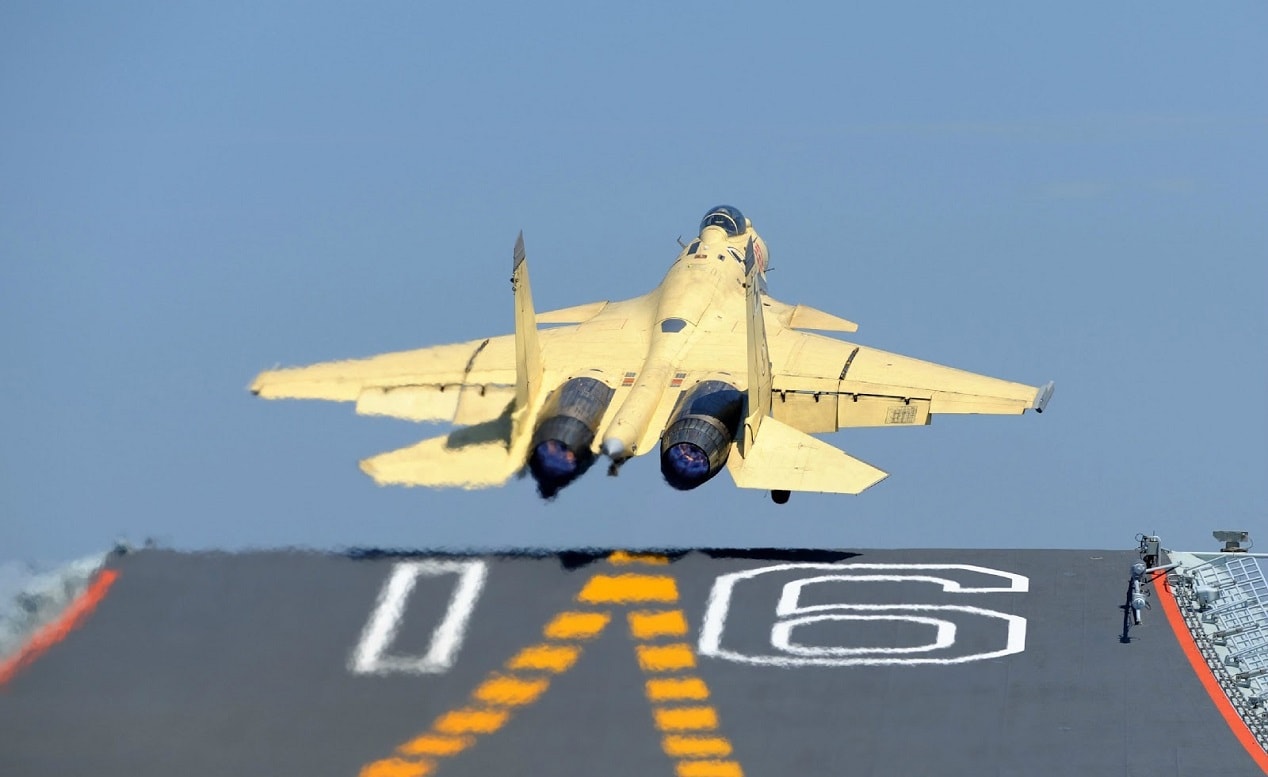
J-15 fighter. Image Credit: Chinese Internet.
“The YJ-15 is estimated to have an overall length of about 6.5 m and a diameter of about 0.5 m. Given these dimensions, it likely weighs about 1,500 kg including a 200 kg warhead.
“These physical characteristics, along with its compact stabilising fins, suggest a configuration optimised for manoeuvrability during mid-course flight without the need for large deployable wings. …
“Furthermore, these characteristics and structural features suggest it is intended for air launch, most likely from the PLA Air Force’s (PLAAF’s) fleet of H-6 strategic bombers.
“This aircraft features the necessary clearance and reinforced pylons to carry such a weapon externally, and its operational profile aligns with China’s doctrine of long-range stand-off strikes.”
These missiles should significantly increase the striking power of Beijing’s naval aviation and complement existing strike capabilities. According to Chinese military media, the J-15 has been equipped with YJ-12s and AKF-98A land attack cruise missiles.
China’s naval fighters will be able to launch with heavier payloads on the People’s Liberation Army Navy’s newest carrier, the Fujian. The 80,000-ton Type 003-class ship is capable of conducting catapult-assisted take-off but arrested recovery operations.
A Smaller, More Compact Design:
The YJ-15 features a four-inlet ramjet design similar to the larger YJ-12, but with a more compact, integrated booster system.
The missile utilizes advanced satellite, radar, and infrared guidance. It reportedly also has anti-jamming features and may even have terminal maneouvre capability. If true, the missile could keep track of targets in heavy electronic warfare environments and be able to evade air defense missiles just before impact.
Targeting and deployment: The YJ-15 is designed for high-speed, low-altitude sea-skimming, it poses a significant threat to naval vessels. It is confirmed to be carried by J-15 carrier-based fighters, enhancing the strike capability of China’s CATOBAR aircraft carriers.
The Chinese military posted a release, stating, “Utilizing onboard radar and electro-optical systems to search for and track airborne and maritime targets, [the KJ-600] provides critical intelligence on enemy situations and directs the carrier-based aircraft in air defense and anti-ship warfare.”
The YJ-15 fills a tactical gap in the People’s Liberation Army Navy (PLAN) arsenal, acting as a “carrier killer” that complements, but is distinct from, the faster, longer-range YJ-21/YJ-19 hypersonic missiles.
While it certainly appears to be an operational missile, nothing for certain is yet known about it. But it would certainly appear that the Chinese PLAN have a significantly upgraded capability to reach out and destroy American warships from increasingly longer ranges.
The YJ-15 signifies China’s accelerated development of advanced anti-access/area-denial (A2/AD) weapons designed to challenge US naval superiority in the Indo-Pacific.
About the Author: Steve Balestrieri
Steve Balestrieri is a National Security Columnist. He served as a US Army Special Forces NCO and Warrant Officer. In addition to writing on defense, he covers the NFL for PatsFans.com and is a member of the Pro Football Writers of America (PFWA). His work was regularly featured in many military publications.