
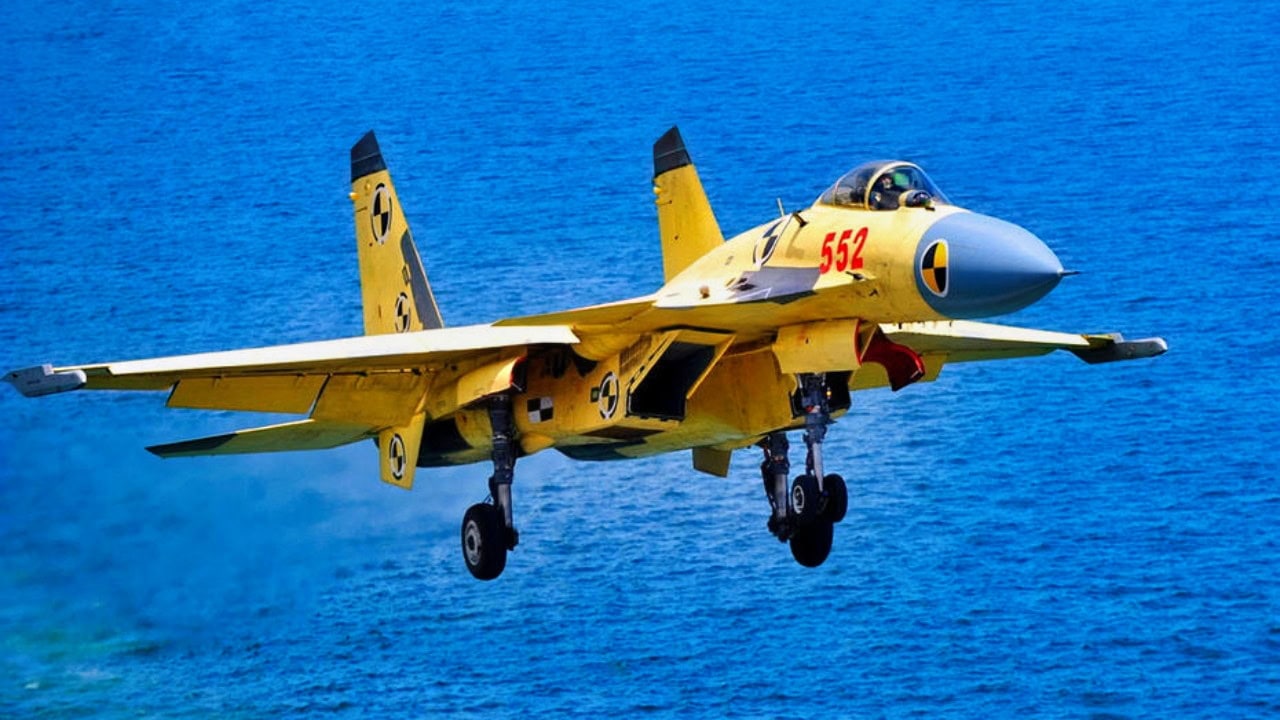
Summary and Key Points: Recent imagery confirms China is transforming its naval power with new J-15 Flying Shark variants optimized for the Fujian carrier’s electromagnetic catapults (CATOBAR).
-Moving beyond the limitations of “ski-jump” launches, the new J-15T features catapult launch bars for heavier fuel and weapon loads.
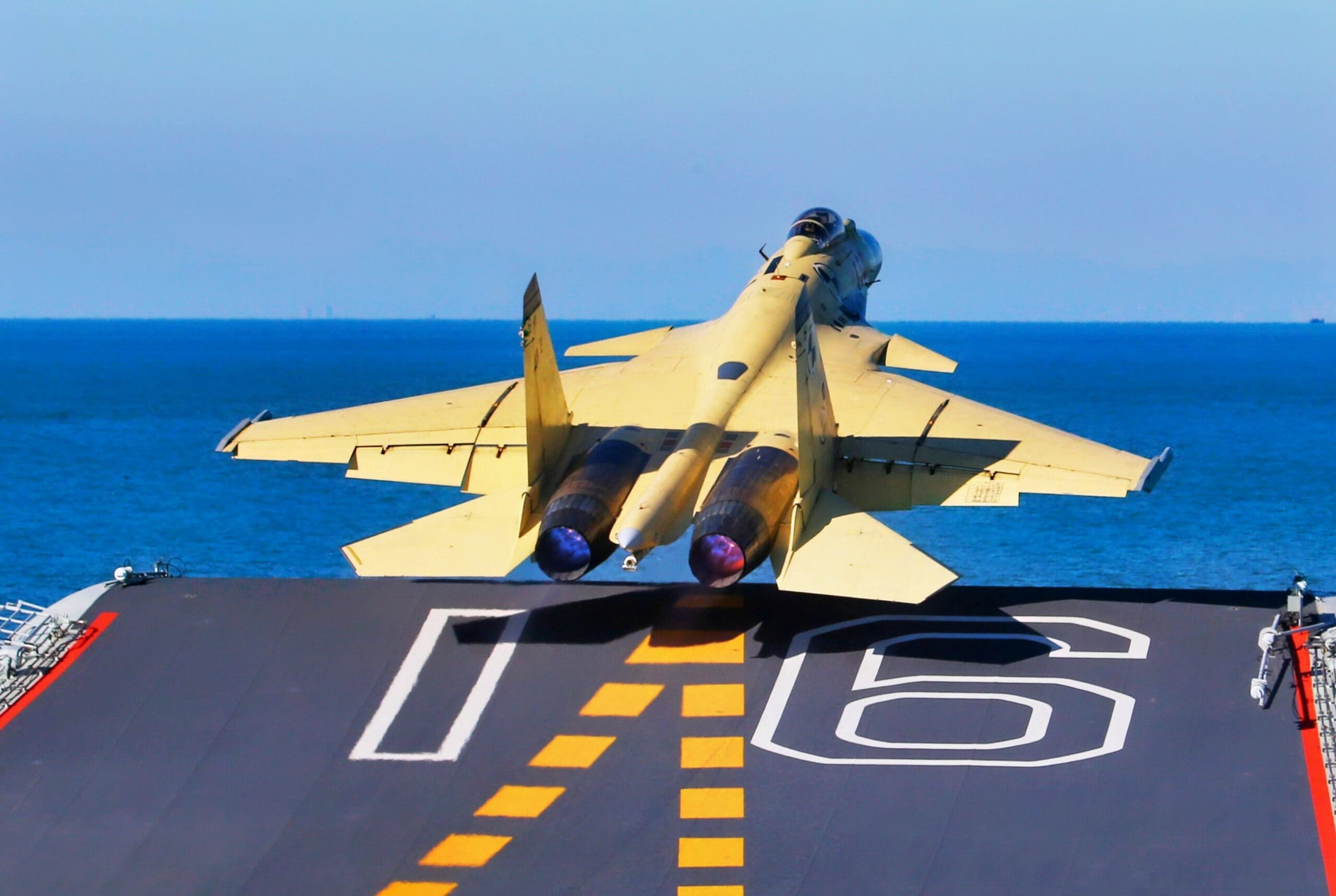
J-15 Fighter from China. Image Credit: Creative Commons.

J-15 Fighter. Image Credit: Creative Commons.
-Even more critical is the two-seat J-15DT, an electronic warfare variant analogous to the U.S. Navy’s EA-18G Growler, designed to suppress enemy air defenses.
-These upgrades signal a strategic shift: the PLAN is no longer just experimenting with carriers but actively building a full-spectrum force capable of high-end conflict with peer adversaries.
China’s ‘Growler’: Inside the New Electronic Warfare J-15DT Built for the Fujian
Recent imagery of new J-15 variants, especially the J-15DT electronic warfare version, suggests more than incremental upgrades. Instead, these aircraft point to a broader transformation: China’s shift from STOBAR to CATOBAR carrier operations.
The story isn’t just about the J-15, but about what the J-15 family reveals about China’s carrier ambitions and how seriously the PLAN takes high-end naval warfare.
Technical rundown of the J-15
The J-15 is a large, twin-engine, carrier-capable multirole fighter derived from the Russian Su-33 airframe and optimized for naval operations. It features reinforced landing gear, a strengthened airframe, folding wings, and an arrestor hook for carrier recovery.
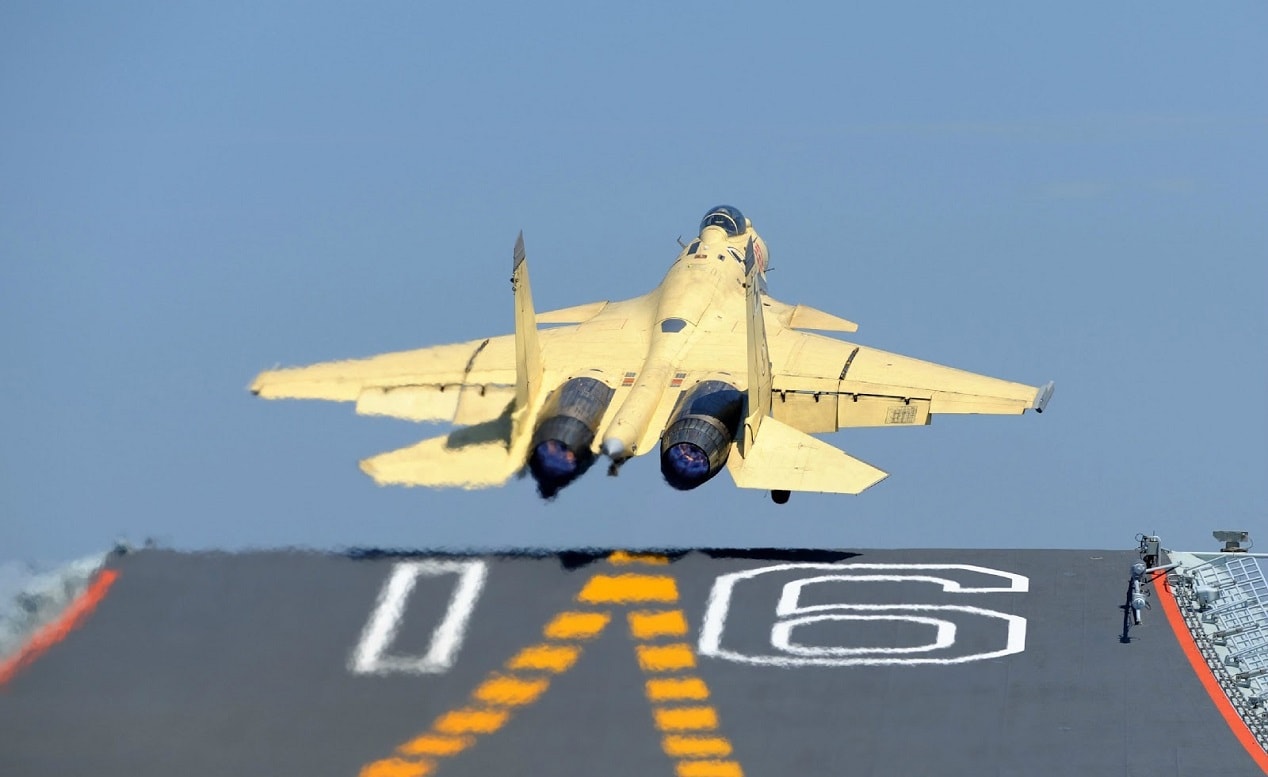
J-15 fighter. Image Credit: Chinese Internet.
Powered by two afterburning turbofan engines, the jet emphasizes range, payload, and endurance over agility. Its size and weight impose launch-performance limits on ski-jump carriers, driving China’s shift towards CATOBAR operations.
The origins and problems of the J-15
The J-15 was derived from the Soviet Su-33 lineage, initially optimized for STOBAR carriers (the Liaoning and Shandong). The aircraft suffered from persistent shortcomings, however: a heavy airframe and limited payload when ski-jump launched, and reduced fuel and endurance. Despite upgrades, the STOBAR compatibility limited the aircraft’s ability to perform strike missions, escort roles, or electronic warfare. These limitations shaped early PLAN carrier doctrine. But CATOBAR changes the equation entirely.
The shift to CATOBAR
The Fujian is China’s first CATOBAR carrier. Equipped with an EMALS-style electromagnetic catapult, the CATOBAR allows for aircraft to operate with heavier fuel loads and larger weapons payloads while enabling support aircraft (EW, AEW&C, drones). CATOBAR is especially critical for electronic warfare and long-range escorts. The CATOBAR allows China to move from mere demonstration carriers to true power-projection platforms. The new J-15 variants are built around that new assumption.
The J-15T: CATOBAR multirole fighter
The J-15T appears to be the CATOBAR-optimized single-seat fighter. Identifiable features include a catapult launch bar, structural reinforcements, AESA radar, and a modernized cockpit. The aircraft’s roles will likely include serving as the PLAN’s primary non-stealth strike fighter, providing fleet defense, and providing escort. The J-15T represents China accepting the original J-15’s limits, but maximizing its utility under CATOBAR conditions. This is likely a bridge platform, not an end goal.
The J-15DT/J-15DH: EW Capable
The J-15DT is arguably the most important new variant. With a role analogous to the US Navy’s EA-18 G Growler, the J-15DT features a tandem two-seat cockpit, wingtip EW pods, multiple external jamming pods, removal of the cannon and IRST, and additional antennas and a revised radome. CATOBAR is essential for the J-15DT because EW pods are heavy, and escort missions demand full fuel stores. Likely missions include escort jamming, stand-off electronic attack, and possible anti-radiation strikes. These new EW variants represent a quantitative leap for PLAN carrier air wings.
Tactical and strategic implications
The J-15D(T) enables penetration support for strike aircraft and suppression of enemy air defenses (SEAD). Combined with the future J-35 and the KJ-600 AEW&C, the J-15 variants help form a coherent carrier air wing, moving PLAN carriers closer to US Navy-style layered operations. The presence of EW capabilities transforms carriers from symbolic operators to contested-environment operators, capable of disrupting air defense systems.
Strategically, the PLAN is no longer experimenting; it is building a full-spectrum carrier force. The signals are clear: through investment in EW, CATOBAR adoption, and specialized aircraft. This indicates planning for high-end conflict with peer adversaries—not just regional intimidation. The J-15 family’s expansion shows that China is willing to accept interim designs while preparing for a future centered on stealth.
Clearly, the J-15 is not China’s endgame but a stepping stone. The J-35 stealth fighter looms as a successor. The KJ-600 adds networking and battle management. Drones and UCAVs are expected to follow. But the J-15 variants provide immediate capability along with training and doctrine development. Functionally, they allow China to practice CATOBAR operations now, while transitioning to stealth platforms later.
A transitional fighter with outsized importance
The J-15 is often dismissed as a derivative of the Flanker. But that may miss the point. The newest J-15 variants reveal China’s seriousness about carrier warfare. And while the J-15 family is hardly revolutionary, it is strategically revealing, a signal that China’s carrier era is entering a more mature phase.
About the Author: Harrison Kass
Harrison Kass is an attorney and journalist covering national security, technology, and politics. Previously, he was a political staffer and candidate, and a US Air Force pilot selectee. He holds a JD from the University of Oregon and a master’s in global journalism and international relations from NYU.