
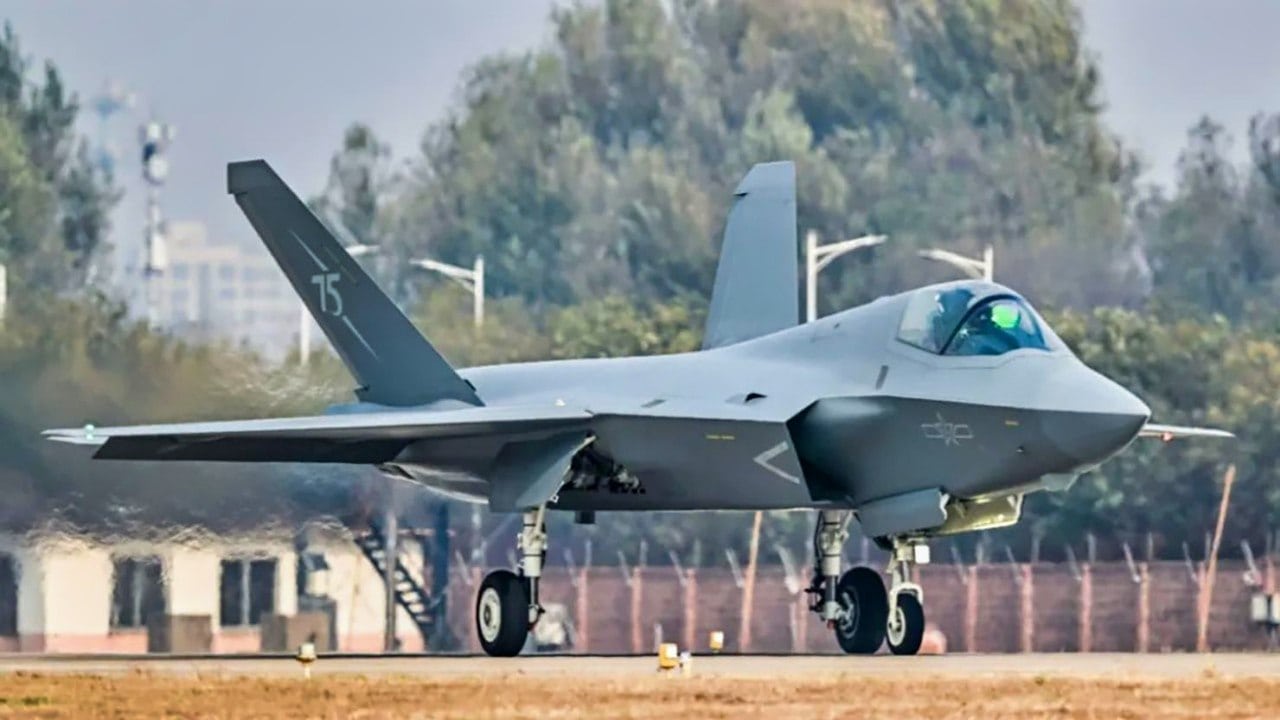
Summary and Key Points: A January 7 video posted on X by Daily CPEC shows two J-35As flying over Shenyang Aircraft Corporation in Liaoning, suggesting mature testing and the start of steady production.
-The J-35A is framed as the land-based counterpart to a carrier-optimized People’s Liberation Army Navy variant, with fewer naval design constraints and more fuel/range potential.
-The program traces back to the FC-31 (2012), evolves into J-35A (2021), expands testing in 2024, targets IOC later this year, and aims for squadron fielding in 2027—alongside a growing People’s Liberation Army Air Force stealth mix that includes the J-20.
China Just Flew 2 J-35A Stealth Fighters—Here’s What That Signals
China has just flown two new J-35As, the latest fifth-generation fighter jet from the People’s Liberation Army Air Force (PLAAF).
This is according to a video on X from the Daily CPEC posted on January 7.
It probably means that the J-35A is being produced regularly, as the flight testing is considered mature. The two airplanes were deployed over the Shenyang Aircraft Corporation factory in Liaoning Province.
The J-35A is the land version of the family, while the J-35 is flying for the People’s Liberation Army Navy (PLAN).
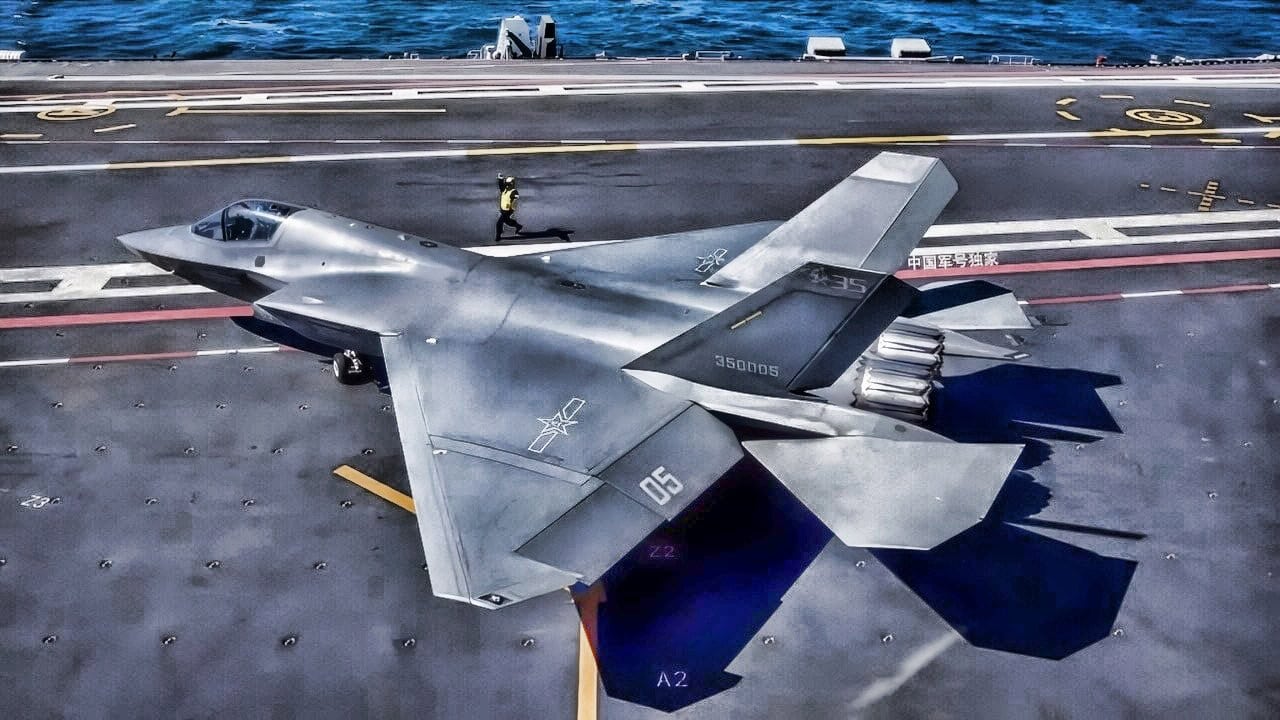
China J-35 Naval Stealth Fighter. Image Credit: PLAN.
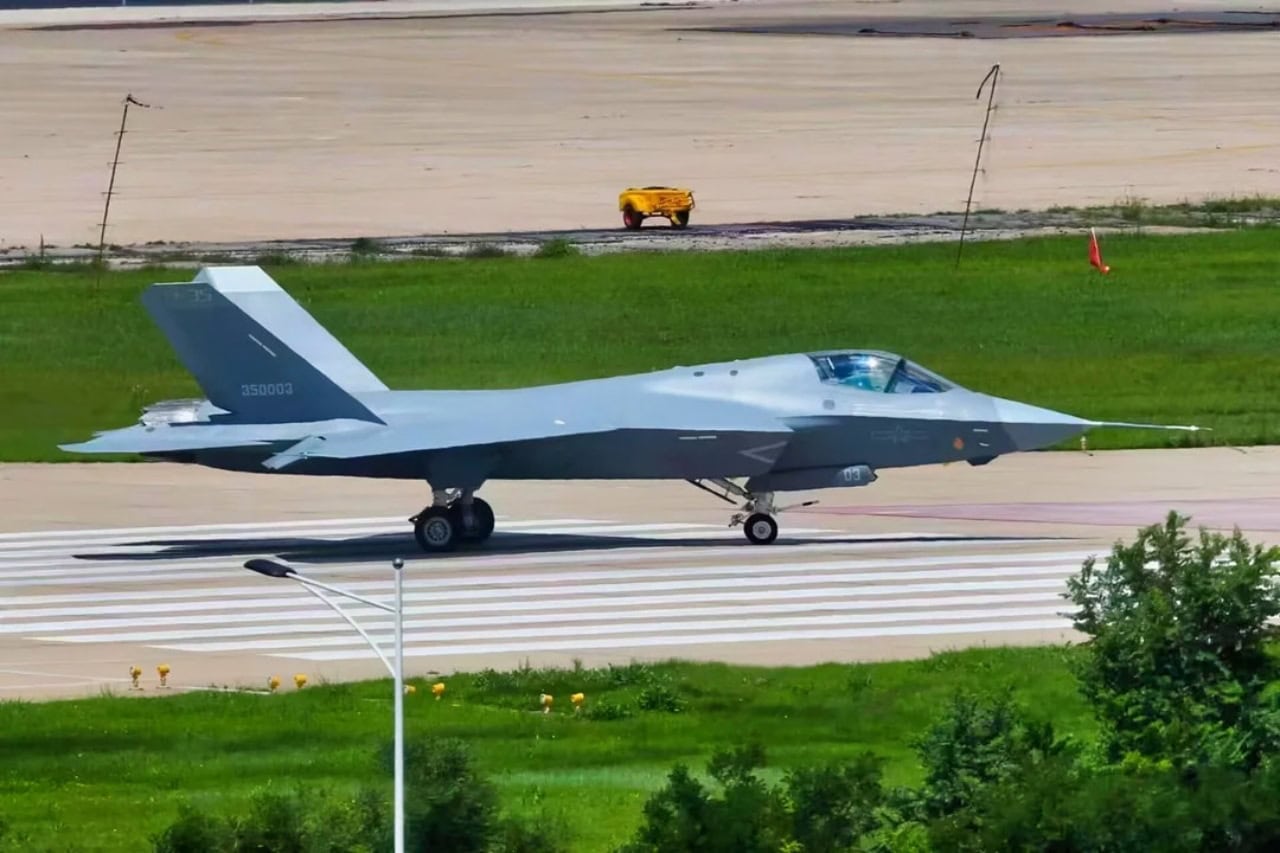
J-35 Fighter. Image Credit: Chinese Internet.
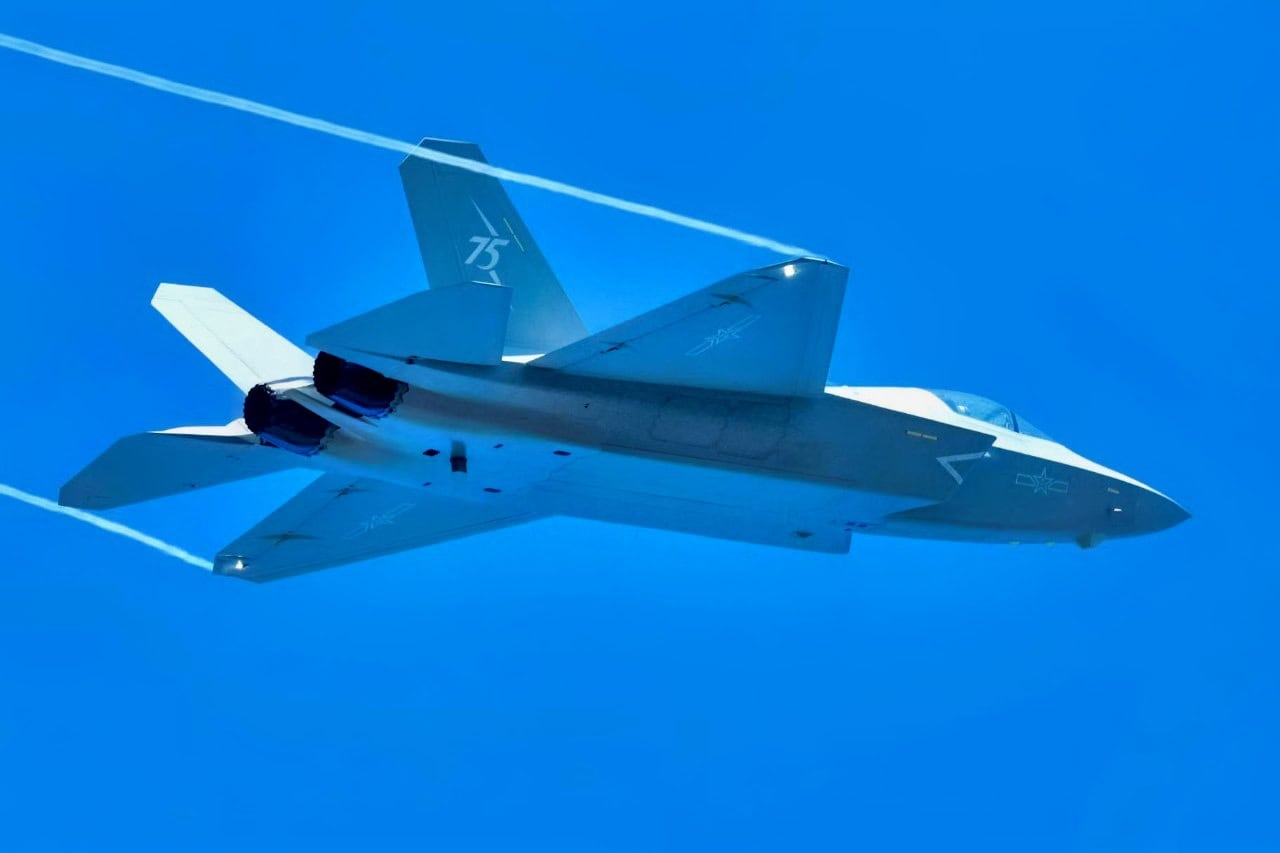
J-35 Fighter. Image Credit: Chinese State Media.
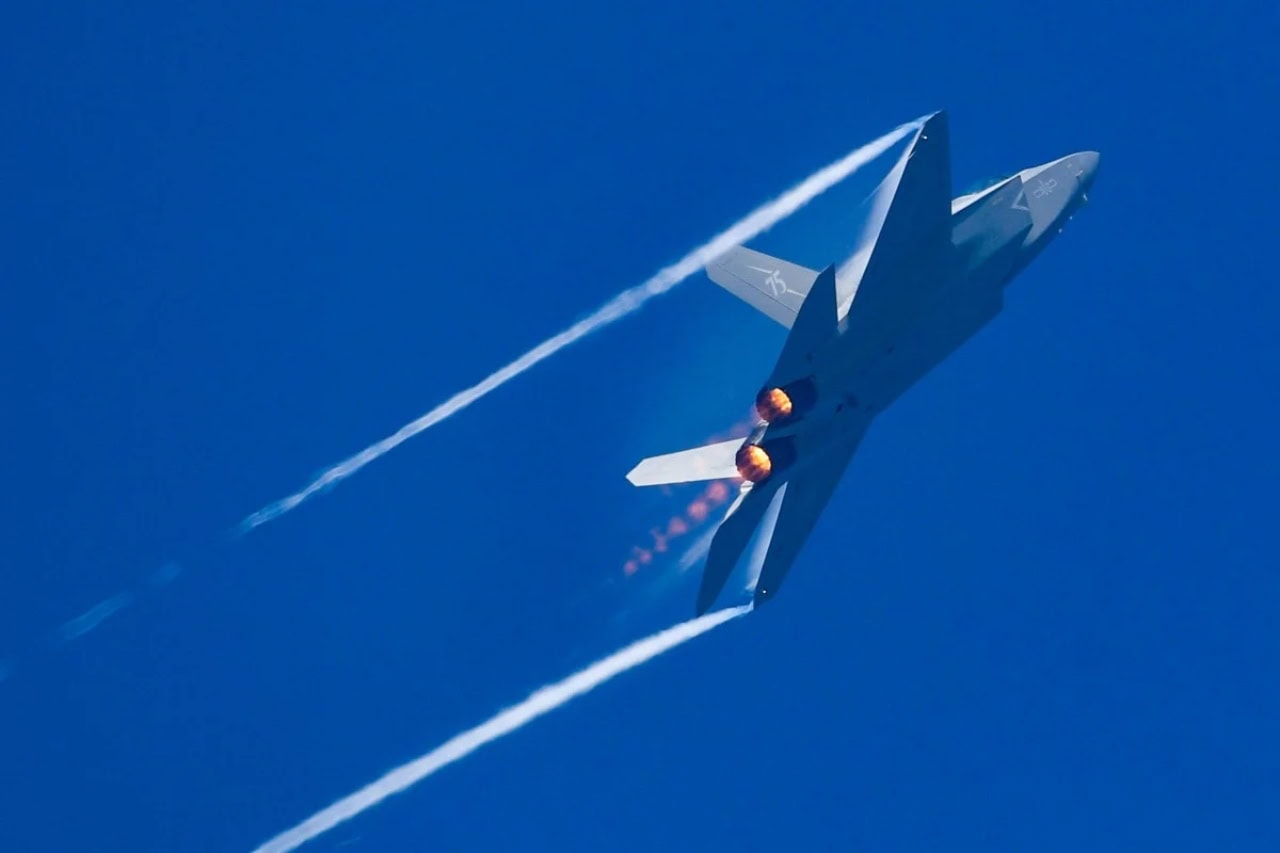
J-35. Image Credit: Chinese State Media.
Therefore, the J-35A is lighter without onboard equipment optimized for aircraft carrier launches and landings.
The J-35A will also be able to carry more fuel than the J-35, which will extend its range and allow it to go faster.
Timeline of the J-35A
The J-35 program emerged from the FC-31 “Gyrfalcon” stealth prototype from 2012.
The FC-31 endured several stop-starts until it became the J-35A project in 2021.
Major testing occurred in 2024. Initial Operating Capability will likely be achieved later this year and the J-35A will go to squadrons in 2027.
“The J-35A is a twin-engine, fifth-generation multirole stealth fighter designed for air superiority, precision strike, and battlefield interdiction missions in high-threat environments. It incorporates internal weapons bays, radar-absorbent materials, diverter-less supersonic inlets, and advanced shaping techniques to reduce radar cross-section,” according to ArmyRecognition.com.
Will the Chinese Replace the J-35A Someday?
But there is a question of how long the PLAAF can keep the fighter flying.
Is China willing to sink funding into the airplane to make it stand the rigors of everyday use for the next several decades? The J-35A should be in business for at least the next 20 years.
The PLAAF is well-equipped. The J-20 will soon have new engines and radar. This gives the Chinese two stealth, fifth-generation fighter jets. The PLAAF may have as many as 250 to 400 J-20s already.
The pair of jets would give the Chinese an effective one-two punch to take on Taiwan, the United States, or Japan. The PLAAF has wanted two stealth jets in the fleet for years.
The Middle Kingdom Know How to Keep a Fighter Flying for 50 Years
China is not shy about updating its fighter fleet. The Chengdu J-7 “grandpa” served from the 1960s to the 2020s.
A 50-year service life shows that China could make the fighter last until the 2060s, even.
To make that happen, technicians and engineers will have to adapt to the times.
There will likely be artificial intelligence in the cockpit in future years, and the pilot may be able to use quantum computing to operate it even better.
Making the J-35A ‘Super’
Stealth coatings will also be improved in the coming years.
There could even be a “super” J-35A someday. Weapons such as hypersonics missiles will get even better. The J-35A will control even more Loyal Wingman drones.
But China is also developing a sixth-generation fighter jet that could replace the J-35A by 2040. The J-36 tail-less sixth-generation airplane could come online in the next few decades.
I don’t see the Chinese totally giving up on the J-35A if the J-36 enters serial production. The People’s Republic wants as many stealth jets as possible, and since it took so many years to develop the J-35A, it is not likely that the PLAAF will retire it with the advent of the J-36.
Engineering Prowess Could Enable China to Have Its Own F-47 NGAD
This would mean the PLAAF could have three stealth fighters in service at once.
That would align with the U.S. effort to produce the F-47 NGAD sixth-generation fighter, with the F-35 and F-22 continuing to be updated over the next few decades.
Stealthiness has already been optimized on the J-35A, if you can believe the Chinese propaganda mill.
The PLAAF believes the fighter has a radar cross-section comparable to that of a small bird. That may be overstated, but it makes sense that the J-35A would be more stealthy than the J-20.
Could the J-35A’s stealthiness be improved even more?
That would mean an airplane virtually blind to enemy air defenses.
The Chinese would thus want the J-35A to serve beyond the 20-year mark. I don’t see it being totally replaced by the sixth-generation jet until the J-36 can be produced in numbers, especially if that airplane is delayed or has cost overruns.
Constant Upgrades on the J-35A Will Not Be Easy
On the other hand, the PLAAF could give up on the J-35A, thinking that the J-36 would eclipse it by a wide margin. This is another scenario that Xi Jinping’s air force must consider.
The evolutionary changes needed on the J-35A may not come about as easily as the Chinese expect, since it took many years to develop.
We will have to wait a few years to see if the J-35A enters full-time active duty with squadrons. It is off to a fine start, and the PLAAF will soon have two active fifth-generation airplanes like the United States. Also, like the F-35, the J-35A could be a hit on the export market, which would give the Chinese funding to continue upgrading it until the 2050s.
At this time, we must consider the jet to be operational until at least 2045, which would give it an enviable production run with a “super” J-35A always a possibility.
The Chinese are set up for success, and having an extra stealth fighter is a promising development for the PLAAF.
About the Author: Brent M. Eastwood
Author of now over 3,000 articles on defense issues, Brent M. Eastwood, PhD is the author of Don’t Turn Your Back On the World: a Conservative Foreign Policy and Humans, Machines, and Data: Future Trends in Warfare plus two other books. Brent was the founder and CEO of a tech firm that predicted world events using artificial intelligence. He served as a legislative fellow for US Senator Tim Scott and advised the senator on defense and foreign policy issues. He has taught at American University, George Washington University, and George Mason University. Brent is a former US Army Infantry officer. He can be followed on X @BMEastwood.