Summary and Key Points: Reuben F. Johnson, a veteran defense technology analyst and Casimir Pulaski Foundation fellow, scrutinizes the Ninth Congress of the Workers’ Party of Korea (WPK).
-Amidst Kim Jong Un’s call for an expanded nuclear inventory, the DPRK has officially terminated dialogue with South Korea (ROK), labeling it the “most hostile entity.”
-This 19FortyFive analysis explores the potential for a renewed Trump-Kim summit before the U.S. President’s April visit to China (PRC), evaluating SIPRI estimates of 50 assembled warheads and the strategic shift toward tactical nuclear deployment in the Indo-Pacific.
50 Warheads and Counting: The Shocking Reality of Pyongyang’s Accelerated Nuclear Program
The supreme ruler of the Democratic People’s Republic of Korea (DPRK), Kim Jong Un, has publicly stated he intends to increase the size of his nation’s nuclear weapons inventory, as well as the range and reliability of the delivery systems that would carry them.
He also called for the United States to respect his nation’s status as a nuclear power, an admonition to the US administration of a kind that is seldom delivered by him personally but usually transmitted via intermediaries.
The US and the DPRK could “get along,” reads translation of Kim’s remarks, but such an agreement to a cooperative type of co-existence would only be possible if Washington were to acknowledge that Pyongyang’s nuclear weapons are not up for discussion or negotiation.
Pyongyang’s Demands of Washington
If Washington “respects our present [nuclear] position as stipulated in the Constitution … and withdraws its hostile policy … there is no reason why we cannot get along well with the United States,” Kim said at what is the Ninth Congress of the Workers’ Party of Korea (WPK), according to the state-controlled media outlet, the Korea Central News Agency (KCNA).
The future state of US-DPRK relations “depends entirely on the US attitude”, Kim stated. “Whether it’s peaceful co-existence or permanent confrontation, we are ready for either, and the choice is not ours to make.”
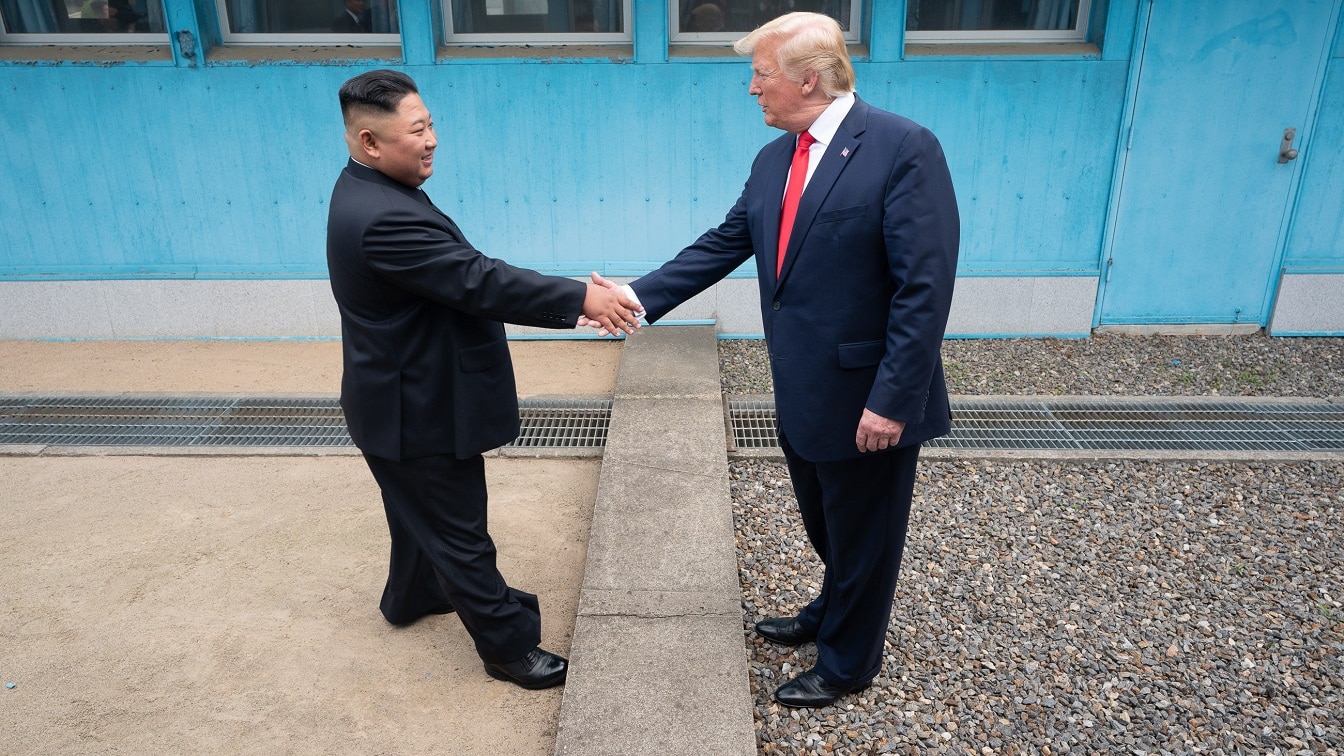
Kim’s statements were part of his address at this once-every-five-years party held at the House of Culture in the capital city of Pyongyang. His position is being interpreted by some experts as an invitation for US President Donald Trump to restart the one-on-one, heads-of-state summits that the two held during Trump’s first term (2016-2020).
The US President is already scheduled to make an official visit to the People’s Republic of China (PRC) in April. The assumption is that Kim is extending what amounts to an oblique invitation to Trump for another summit between the two, sometime before the US President’s visit to Beijing.
Washington Welcome, But Not Seoul
But what seems like an offer for renewing dialogue with the DPRK is only being extended to Washington. Kim ruled out any change to the “freezing out” of South Korea (ROK), declared in November 2023 and officially terminating dialogue with his southern neighbor. Kim further designated the South Korean state today as the DPRK’s “most hostile entity.”
Kim went on to say that the DPRK would “permanently exclude Seoul from the category of compatriots”, adding that “as long as South Korea cannot escape the geopolitical conditions of having a border with us, the only way to live safely is to give up everything related to us and leave us alone.”
The clear message in Kim’s latest remarks is, as one DPRK specialist told the BBC, “an intention to pursue relations with the US independently, without going through South Korea.” This would also seem to bring to an end to the era in which the US, the two Koreas, plus the PRC, Japan, and Russia participated in Six-Party Talks — a set of meetings that had originally been intended to come to a negotiated settlement to prevent the DPRK from acquiring nuclear weapons.
But now that the proverbial nuclear genie is out of the bottle, Kim has stated that he intends to not only hold on to the weapons he has but also press on full-speed ahead with Pyongyang’s nuclear programme.
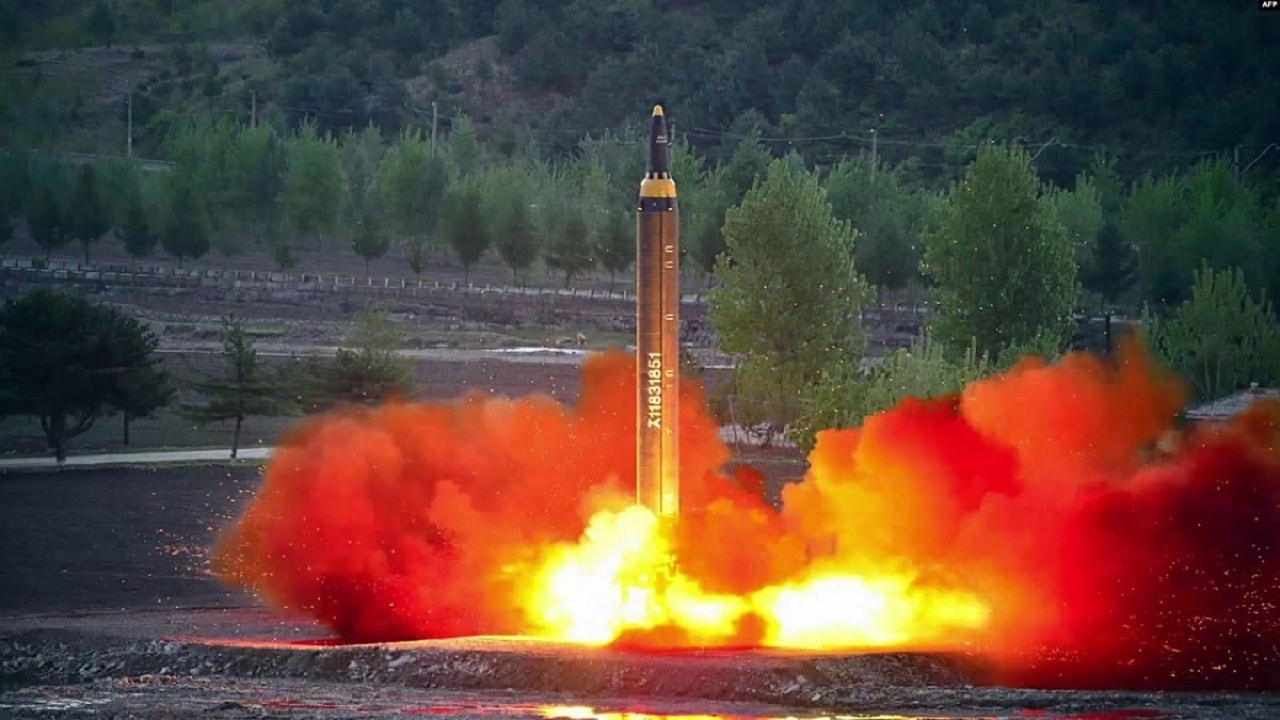
Hwasong-12 IRBM. Image Credit: North Korea State Media.
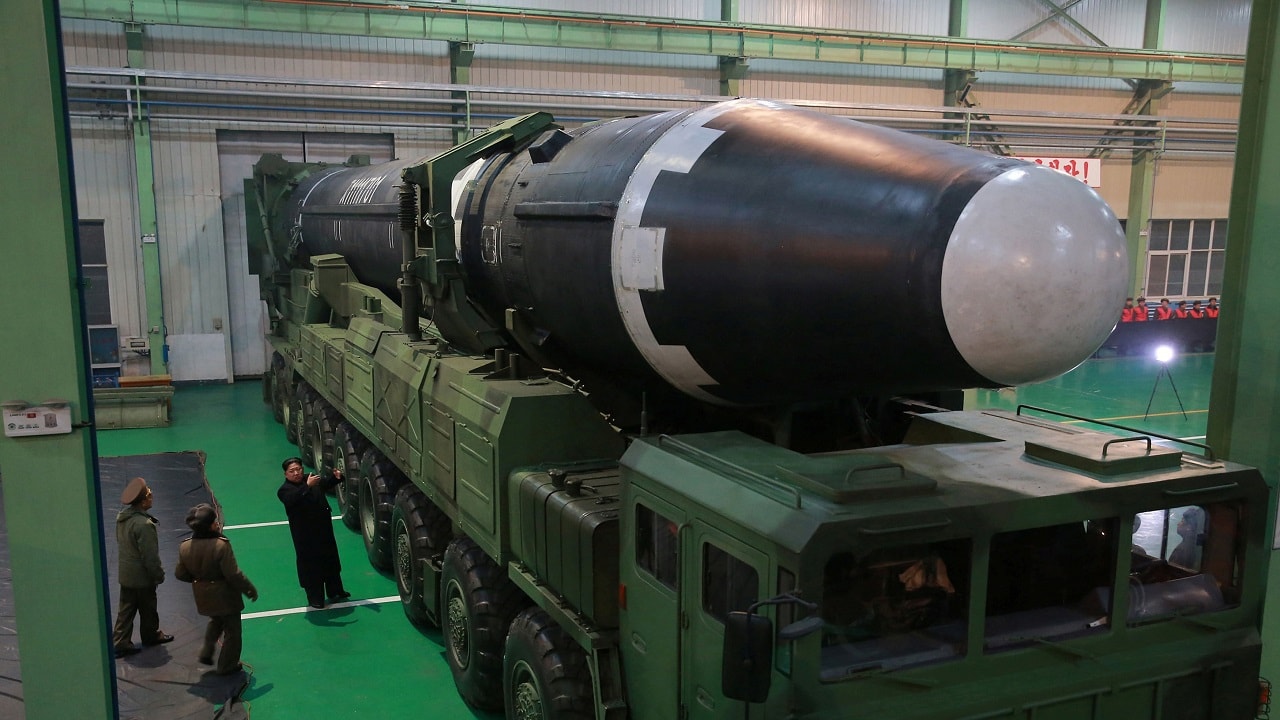
North Korean leader Kim Jong Un near Hwasong ICBM. Image Credit: North Korean State Media.
“We will focus on projects to increase the number of nuclear weapons and expand nuclear operational means, he said.”
The KCNA said this week that due to Kim’s leadership, the DPRK has “radically improved” its “war deterrence” and “with the nuclear forces as its pivot.”
However, experts on nuclear weapons development are split on just how much further the isolated state has advanced the status of its program, or how much progress has been made in “weaponizing” its nuclear warheads by placing them atop a missile that could deliver them to a target without the missile itself failing.
The Impossibility of Determining the True Status of the DPRK’s Program
In reality, the true state of the nuclear program is an unknowable proposition, given that this is one of the DPRK’s most closely-held secrets. And secrets being guarded inside of a nation where a pathological security regime regulates everything down to daily life are likely never to be revealed.
What is really taking place inside the nation’s nuclear weapons program is almost impossible to ascertain, given the degree to which it has been shrouded from all public view.
The Stockholm International Peace Research Institute (SIPRI), an independent think tank that releases yearly reports on defense production and arms trading, estimated more than a year ago that Pyongyang had up to 50 assembled nuclear warheads and enough fissile material to produce up to 40 more.
“Like several other nuclear-armed states, North Korea is putting new emphasis on developing its arsenal of tactical nuclear weapons,” Matt Korda, an Associate Researcher with SIPRI’s Weapons of Mass Destruction Programme and Senior Research Fellow for the Nuclear Information Project at the Federation of American Scientists, was quoted as saying in the organization’s report. “Accordingly, there is a growing concern that North Korea might intend to use these weapons very early in a conflict.”
About the Author: Reuben F. Johnson
Reuben F. Johnson has thirty-six years of experience analyzing and reporting on foreign weapons systems, defense technologies, and international arms export policy. Johnson is the Director of Research at the Casimir Pulaski Foundation. He is also a survivor of the Russian invasion of Ukraine in February 2022. He worked for years in the American defense industry as a foreign technology analyst and later as a consultant for the U.S. Department of Defense, the Departments of the Navy and Air Force, and the governments of the United Kingdom and Australia. In 2022-2023, he won two awards in a row for his defense reporting. He holds a bachelor’s degree from DePauw University and a master’s degree from Miami University in Ohio, specializing in Soviet and Russian studies. He lives in Warsaw.