
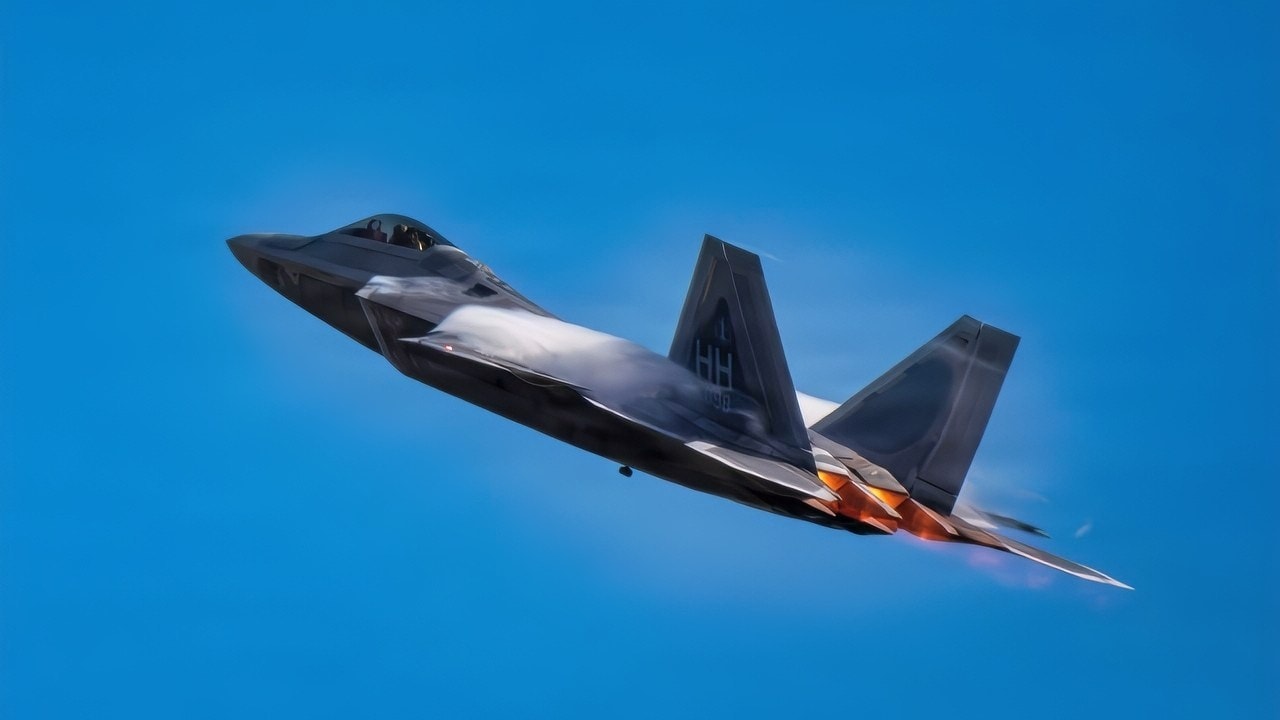
Summary and Key Points: Dr. Brent M. Eastwood, a defense analyst and former US Army Infantry officer, evaluates the 2012 Red Flag-Alaska maneuvers where German Luftwaffe pilots in Eurofighter Typhoons scored multiple notional kills against USAF F-22 Raptors.
-Utilizing high-G maneuvers and a superior thrust-to-weight ratio, the Typhoons exploited the WVR “merge” to neutralize the Raptor’s low-observable advantage.
-This 19FortyFive report analyzes how the F-22’s use of external fuel tanks and specific Basic Fighter Maneuvers (BFM) constraints led to a tactical anomaly, proving that situational awareness and pilot prowess remain decisive factors even in the era of thrust-vectoring and sensor fusion.
Raptor Salad for Lunch: The Day German Eurofighters “Killed” the F-22 at Red Flag
You are likely used to reading about the efficacy of the F-22 Raptor. This is one of the most stealthy airplanes in the world. It has ample ability to win aerial combat matchups. The weapons on board are effective for both dogfighting and ground-strike missions. The Air Force has been flying it for years and working out all the kinks. It has also been updated mightily to lengthen its service record.
Sometimes the F-22 flies against allies to rehearse maneuvers to see if its radar evasion capability still leads the world. These combat exercises can provide insights into how effective the Raptor is in multinational drills.
F-22 Gets Eaten for Lunch
That’s why observers turned their heads when the F-22 went up against German Eurofighter Typhoons. The Luftwaffe prevailed over the Americans. The Germans claimed that the notional kills proved that they had “Raptor salad for lunch.” The pilots from Deutschland even affixed Raptor decals to the fuselage of their Typhoons to commemorate the aerial victories.
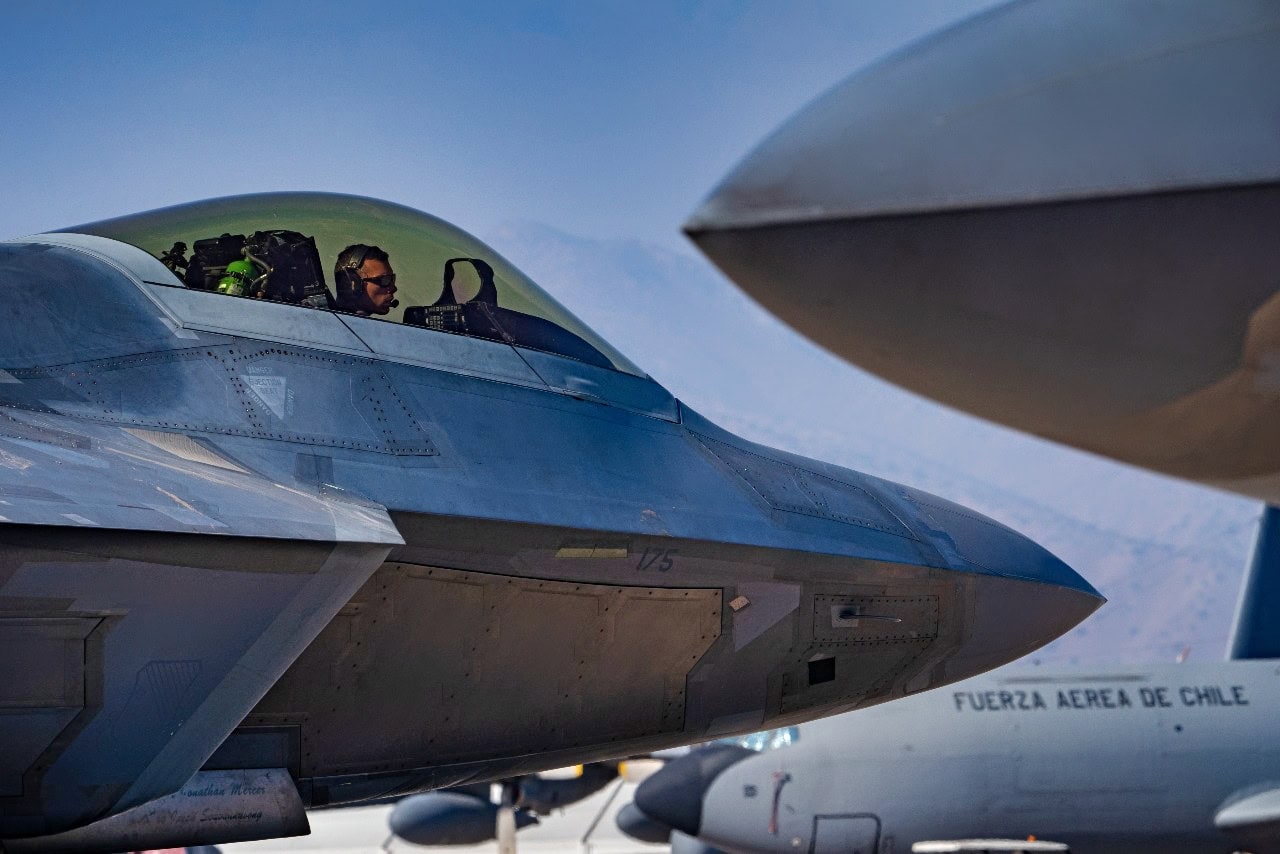
U.S. Air Force Technical Sgt. Fernando Llama, F-22 Demo Team avionics specialist, preforms an engine run to check all aircraft systems are good-to-go for the 2022 FIDAE Air & Trade Show, April 3, 2022 in Santiago, Chile. Avionics specialists like Llama are responsible for the maintenance of the onboard flight computers, integrated avionics, and many electrical systems and components. (U.S. Air Force photo by Staff Sgt. Don Hudson)
Maybe It Is Time to Replace the Raptor
What is next for the Raptor? Does this difficulty against an ally prove that the F-22 has ample weak-points that signify it should be replaced by the new F-47 NGAD sixth-generation fighter? That may be an overly critical assessment based on a single aerial exercise.
The German pilots may have just been more effective than their American brethren during two weeks of maneuvers. Dogfighting often comes down to which aviator wants it more and who can prove aerial prowess at the controls. We may be sounding the alarm too loudly against the Raptor.
German-American Matchup in 2012
To investigate this further, we must turn back to 2012. The Germans and their Eurofighters were invited to participate in the Red Flag aerial exercises over Alaska. The Luftwaffe sent eight Typhoons and 150 personnel for the drills. They would conduct maneuvers for two weeks across a variety of missions.
These operations had the innocuous name of Basic Fighter Maneuvers, but the pilots knew better. This meant dogfighting and extensive dogfighting. In some exercises, German aviators flying within visual range in Eurofighters were able to spot and “kill” Raptors flying with external fuel tanks, which may have reduced their stealth.
The Great Aspects of the F-22
While the F-22 is a fifth-generation airplane, the Raptor has one similarity with the Eurofighter Typhoon as Alex Hollings mentions in Sandboxx News. They both entered service in the early to mid-2000s. But the Raptor was superior in stealth. This platform could also be updated over many years, so the F-22 would have long-term viability and result in a warbird that could evolve with the times.
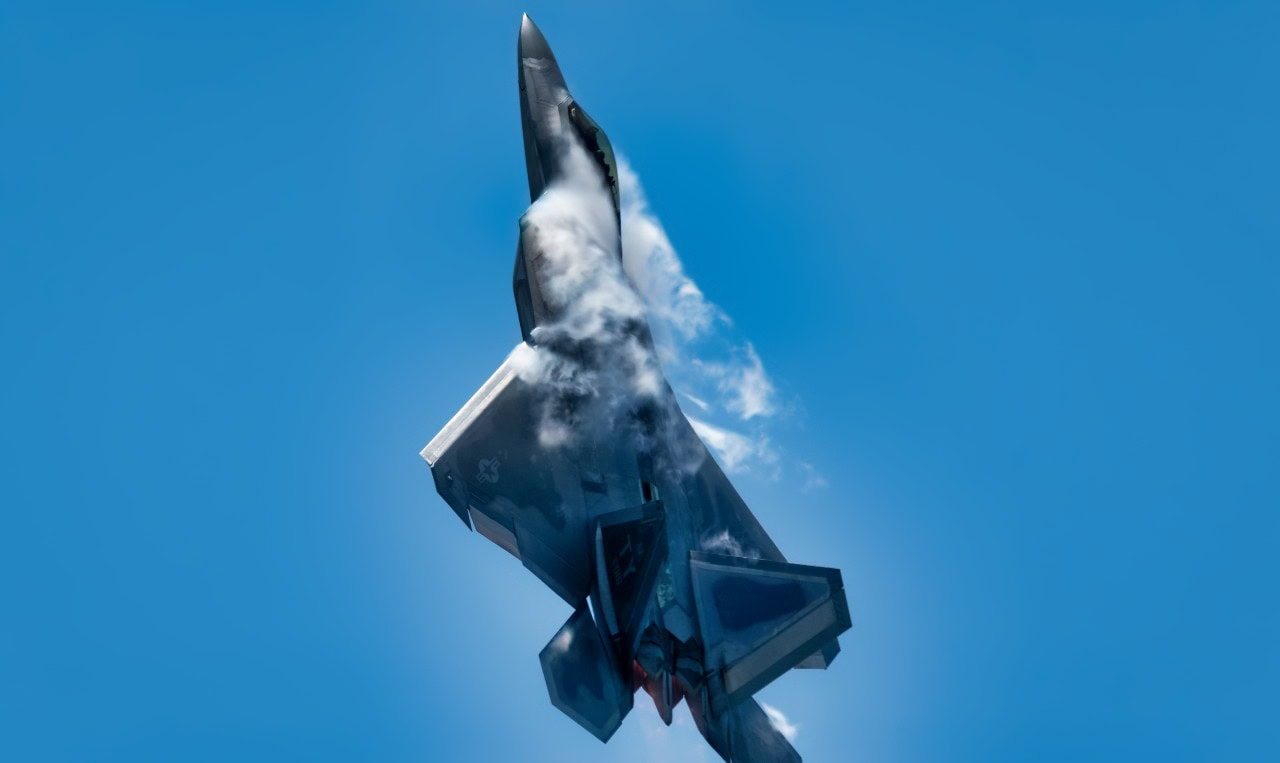
U.S. Air Force Maj. Josh Gunderson, F-22 Demo Team commander, performs maximum power takeoff during a demonstration for the 67th National Security Forum at Maxwell-Gunter Air Force Base, Montgomery, Alabama, May 13, 2021. The F-22 Raptor’s two Pratt and Whitney F119 Turbofan engines bring a combined 70,000 pounds of thrust, allowing the aircraft to takeoff straight into the vertical. (U.S. Air Force photo by Staff Sgt. Don Hudson)
The sensor fusion and avionics are excellent, and the pilots have a high level of situational awareness. “When you’re flying the Raptor, you’re not thinking about flying the Raptor,” explained F-22 pilot Randy Gordon in a lecture he gave at MIT, “You’re thinking about employing the Raptor. Flying is secondary,” Hollings noted.
The F-22 is highly maneuverable due to its thrust vector control. That’s what makes it a great dogfighter. This vector thrust should have given the Raptor the means to win the notional fight against the German Typhoons.
“As a result, the F-22 bridges two combat philosophies offering such a high degree of stealth and situational awareness that it can win most fights before the opponent even knows that it’s there, alongside a highly respectable slew of traditional dogfighting traits that allow it to stand and swing with the most dynamic hotrod dogfighters of the previous generation,” Hollings wrote.
Don’t Dismiss the Eurofighter Typhoon
However, the Eurofighter Typhoon has some tricks up its sleeve. The warbird has some stealth attributes for a fourth-generation fighter. It absorbs radar waves more effectively than its competitors. The range is topnotch as is the maneuverability. The airframe’s strength enables it to handle diverse mission sets and makes it a capable dogfighter, supported by excellent electronic warfare capabilities and high-G maneuvers.
The Typhoon is a bit slower than the F-22’s MACH 2.25. The Eurofighter speeds along at MACH 2 on its best days. However, the European aircraft has a higher thrust-to-weight ratio, which favors it in combat.
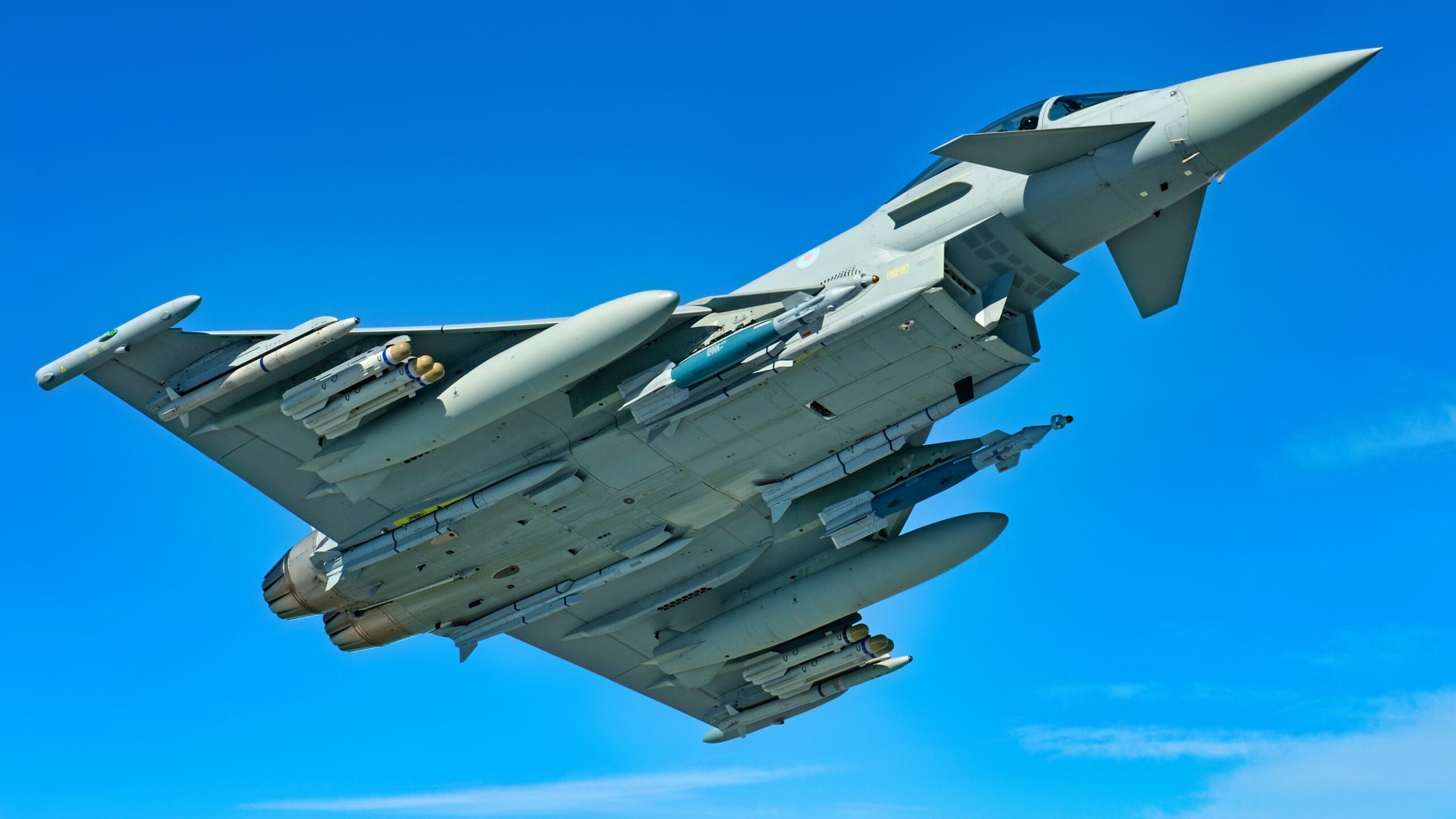
Eurofighter Typhoon. Image Credit: Creative Commons.
Let’s Not Overreact
Let’s not read too much into the head-to-head matchup during Red Flag 2012.
The Raptor pilots, flying within visual range, probably spotted the Eurofighter first, but for some reason did not engage its Sidewinders. The American pilots made a fateful mistake, but that doesn’t mean the F-22 has any type of problem. This was primarily due to poor tactics by Air Force pilots.
So give the Germans some credit. They were, however, flying without external weapons or fuel tanks. This enhanced their radar evasion and gave them an advantage in combat. Chalk this up to a little bit of flukiness. The F-22 is still a superior aircraft in my view.
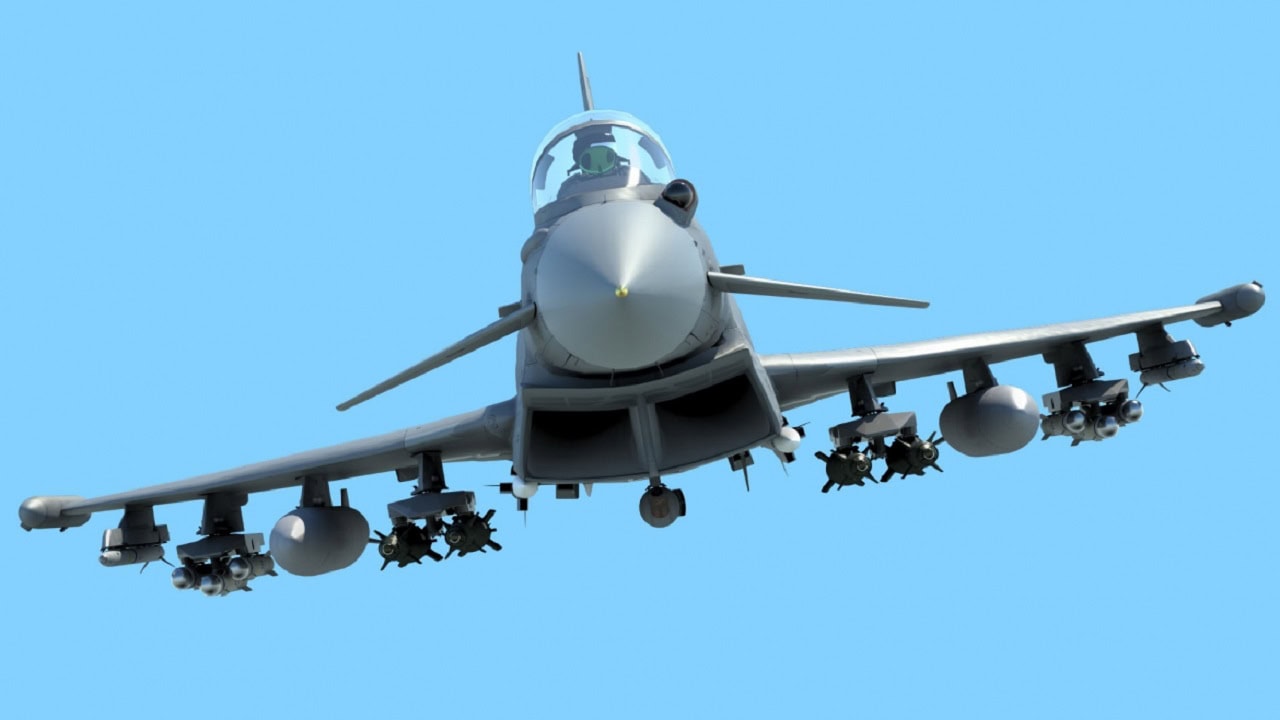
Typhoon fitted with the common launcher (computer generated image: for illustrative purposes only)
The Germans were having a good day, and the Americans were not at their best. However, this was a lesson learned, and it will be studied closely by the Air Force to ensure a fourth-generation aircraft does not get so lucky again.
About the Author: Dr. Brent M. Eastwood
Author of now over 3,000 articles on defense issues, Brent M. Eastwood, PhD is the author of Don’t Turn Your Back On the World: a Conservative Foreign Policy and Humans, Machines, and Data: Future Trends in Warfare plus two other books. Brent was the founder and CEO of a tech firm that predicted world events using artificial intelligence. He served as a legislative fellow for US Senator Tim Scott and advised the senator on defense and foreign policy issues. He has taught at American University, George Washington University, and George Mason University. Brent is a former US Army Infantry officer. He can be followed on X @BMEastwood.