
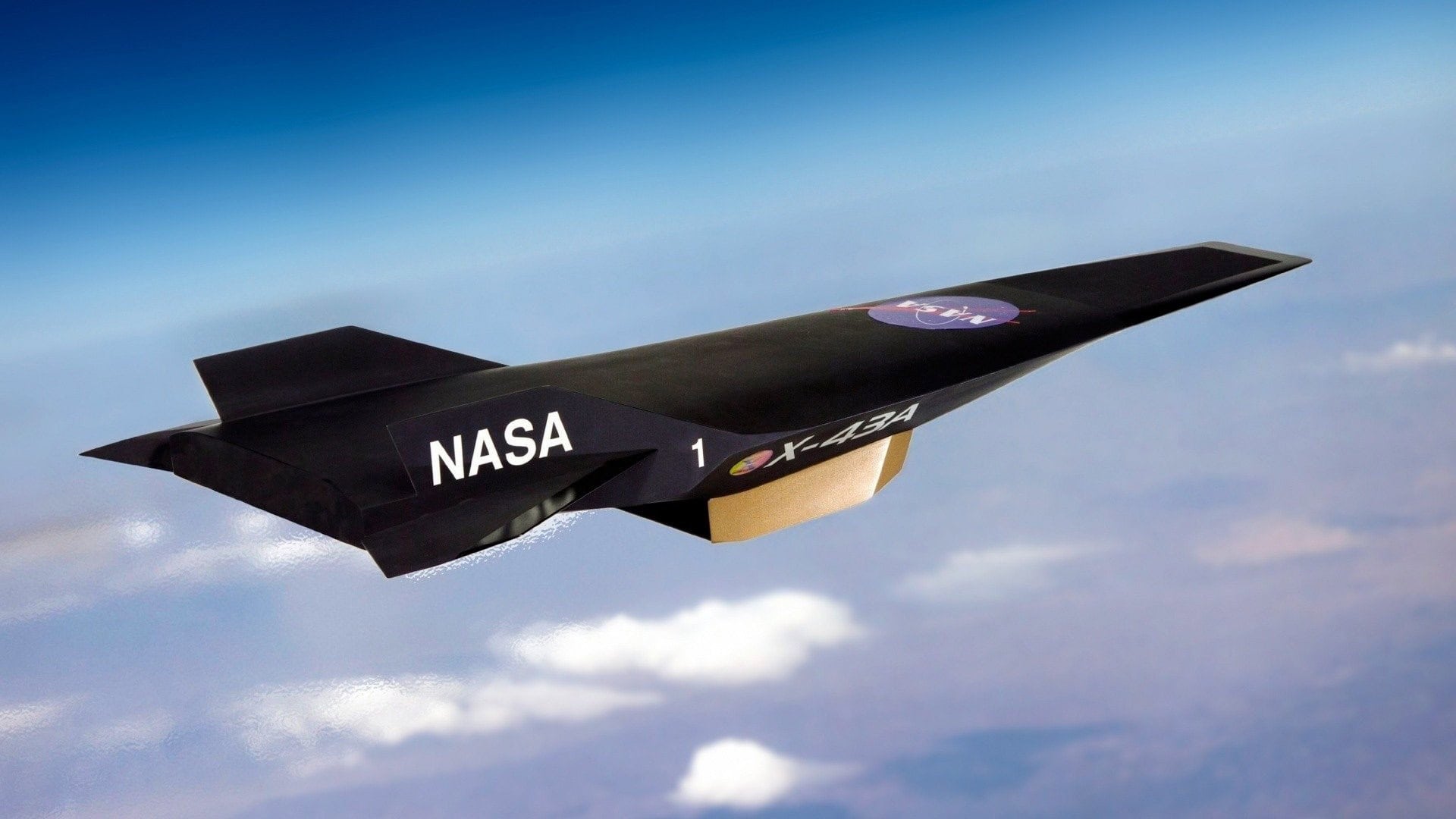
Synopsis: The X-43D was a program that could have seen Mach 15, but it never occurred. NASA’s Hyper-X program proved air-breathing hypersonic flight was possible, culminating in the X-43A’s record Mach 9.64 run at roughly 110,000 feet in 2004.
-Built as a short, disposable lifting body and boosted by a Pegasus rocket off a B-52, the X-43A generated rare data on scramjet combustion and high-speed aerodynamics that ground tests can’t fully replicate.
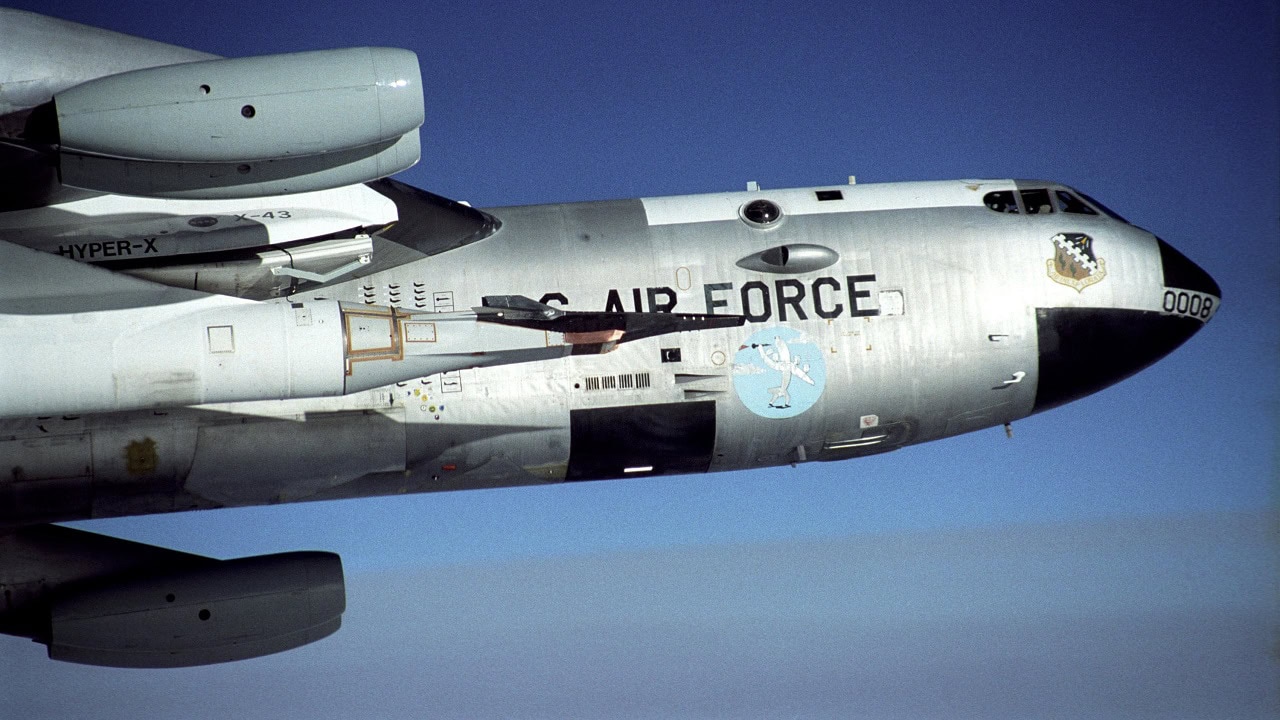
The X-43A was a small experimental research aircraft designed to flight-demonstrate the technology of airframe-integrated supersonic ramjet or “scramjet” propulsion at hypersonic speeds above Mach 5, or five times the speed of sound. Its scramjet engine is an air-breathing engine in which the airflow through the engine remains supersonic.
-Follow-on concepts like the Mach 5–7 X-43C and the proposed Mach 15 X-43D were studied but never built as priorities and funding shifted.
-The program ended after meeting its narrow objectives—leaving a lingering “what if” in hypersonics.
The X-43 Program Was A Potential Game-Changer
The X-43D was a proposed, unbuilt iteration of NASA’s Hyper-X program designed to achieve sustained hypersonic flight at approximately Mach 15 (11,500 mph).
It was intended to study scramjet engine operability and the durability of high-temperature materials, following the successful Mach 9.6 flight of the X-43A in 2004. Still, it did not move beyond feasibility studies due to funding and strategic shifts.
The first captive-carry flight of NASA’s X-43A hypersonic research vehicle occurred on April 28, 2001, aboard a B-52 over the Pacific Test Range. A Pegasus booster rocket was attached to the X-43A and carried on the B-52’s wing pylon.
The follow-on vehicle, known as X-43D, was a hydrogen-fueled scramjet demonstrator designed to reach approximately Mach 15 and to gather flight-environment and engine data that ground tests could not provide.
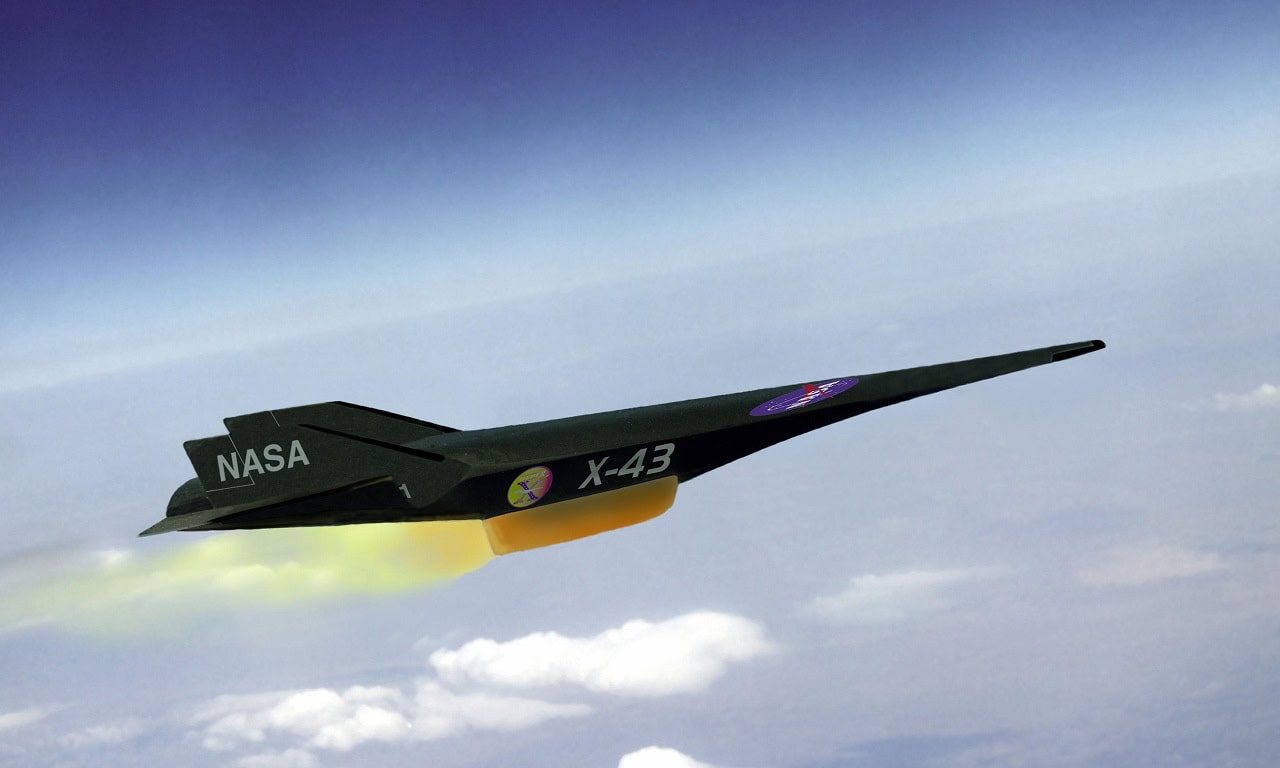
X-43. Image: NASA.
Unfortunately, the priorities and focus changed, and the project was shelved.
Is the US that far behind Russia and China In Hypersonics?
However, despite widespread claims that the United States is lagging behind China and Russia in hypersonics, the US has flown hypersonic vehicles longer than anyone and holds the record for an air-breathing aircraft, achieving Mach 9.64 (6,363 mph) at an altitude of 110,000 feet.
In contrast, the SR-71 Blackbird cruised at Mach 3; the NASA X-43 aircraft was moving at a remarkable speed.
But with all of the promising returns from the aircraft, why was the X-43 project terminated?
The X-43A Project Was a High-Risk, But High-Reward Project
NASA wrote that the eight-year, approximately $230 million NASA Hyper-X program was a high-risk, high-payoff research initiative that tackled challenges never before attempted.
No vehicle powered by an air-breathing engine had ever flown at hypersonic speeds before the successful March 2004 flight.
Additionally, the rocket boost and subsequent separation to achieve scramjet test conditions required complex components that had to function properly for mission success.
Careful analyses and design were applied to reduce risks to acceptable levels; however, some residual risk remained inherent to the program.
Meet The X-43A
The X‑43A was a 12-foot-long, 5-foot-wide lifting-body jet aircraft intended for a single flight and not recoverable. It was one of NASA’s “better, faster, cheaper” programs developed by the space agency in the late 1990s. The aircraft weighed about 3,300 pounds, and the program cost $230 million.
The X-43A was powered by a scramjet, a supersonic combustion ramjet integrated into its lower fuselage, designed to achieve speeds of up to Mach 10. This was the first hypersonic (Mach 5+) research program since the X-15 in the 1960s. NASA built three X-43A aircraft: the first two were designed to fly at Mach 7, and the third at Mach 10.
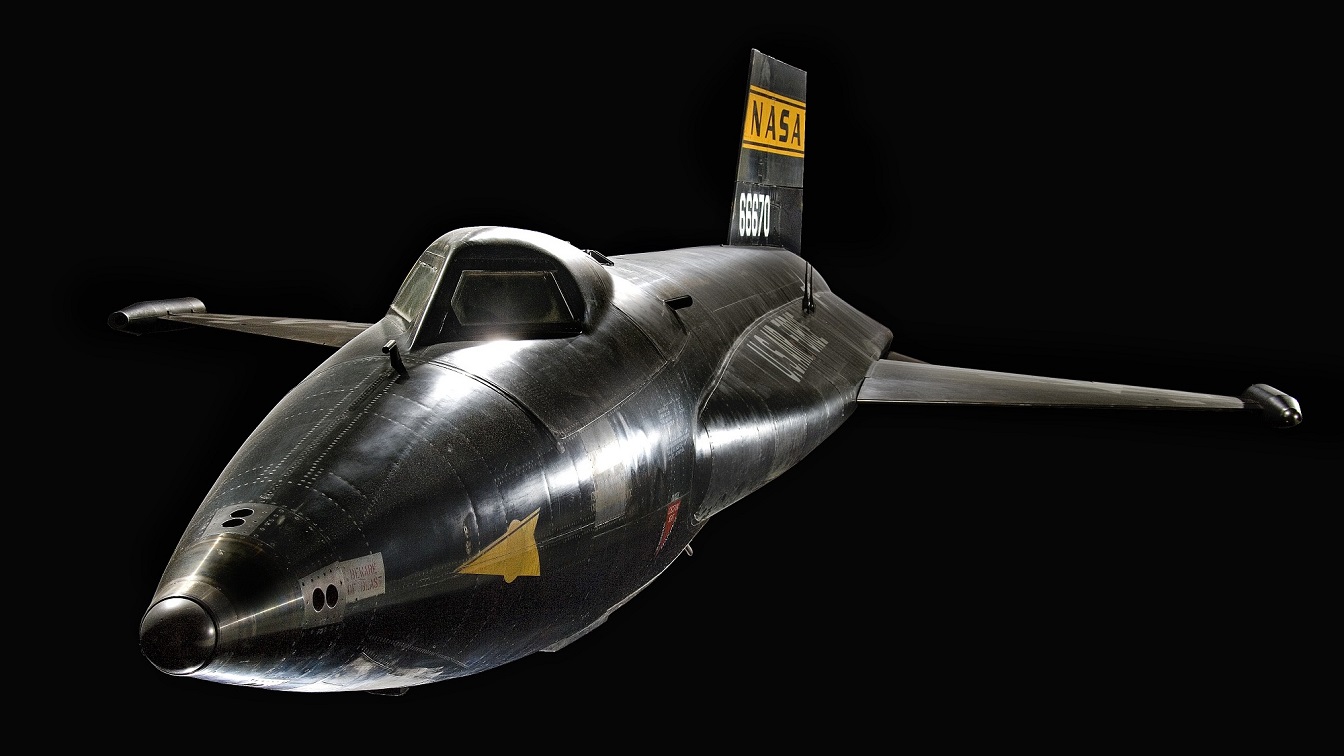
Three-quarter left front view of the North American X-15 (s/n 56-6670) at the Smithsonian National Air and Space Museum, July 10, 2007
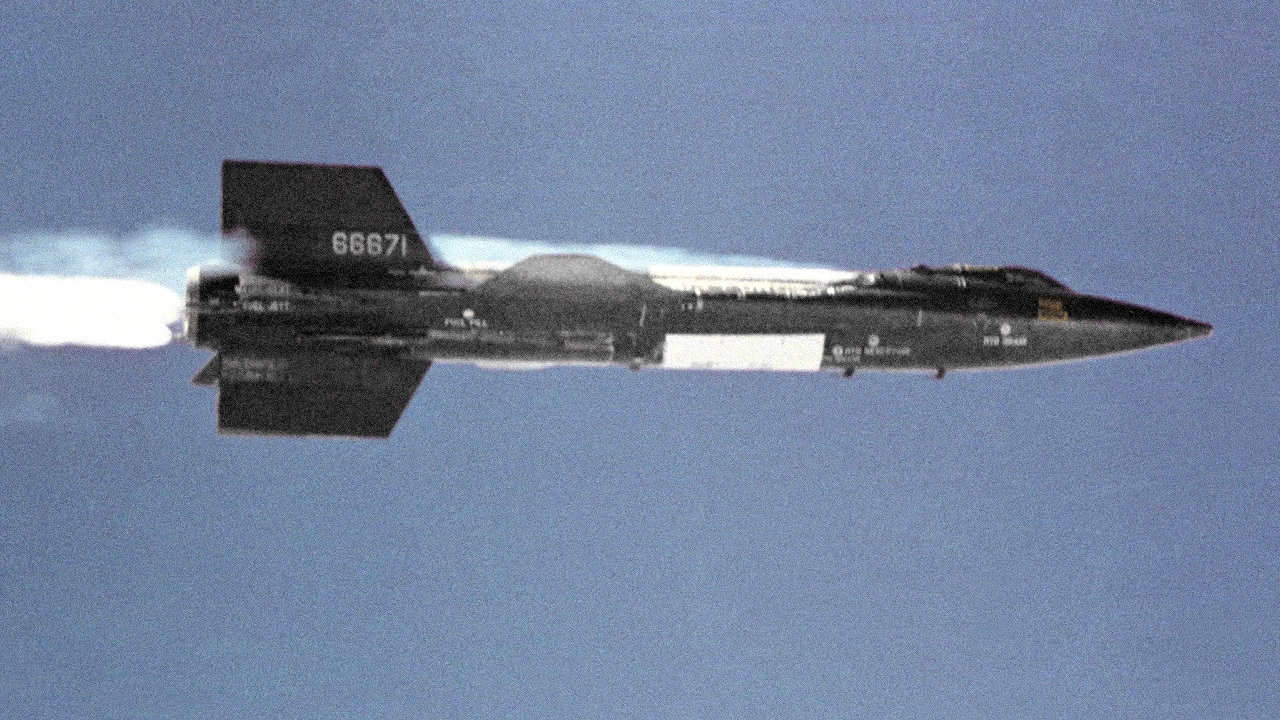
X-15. Image Credit: NASA.
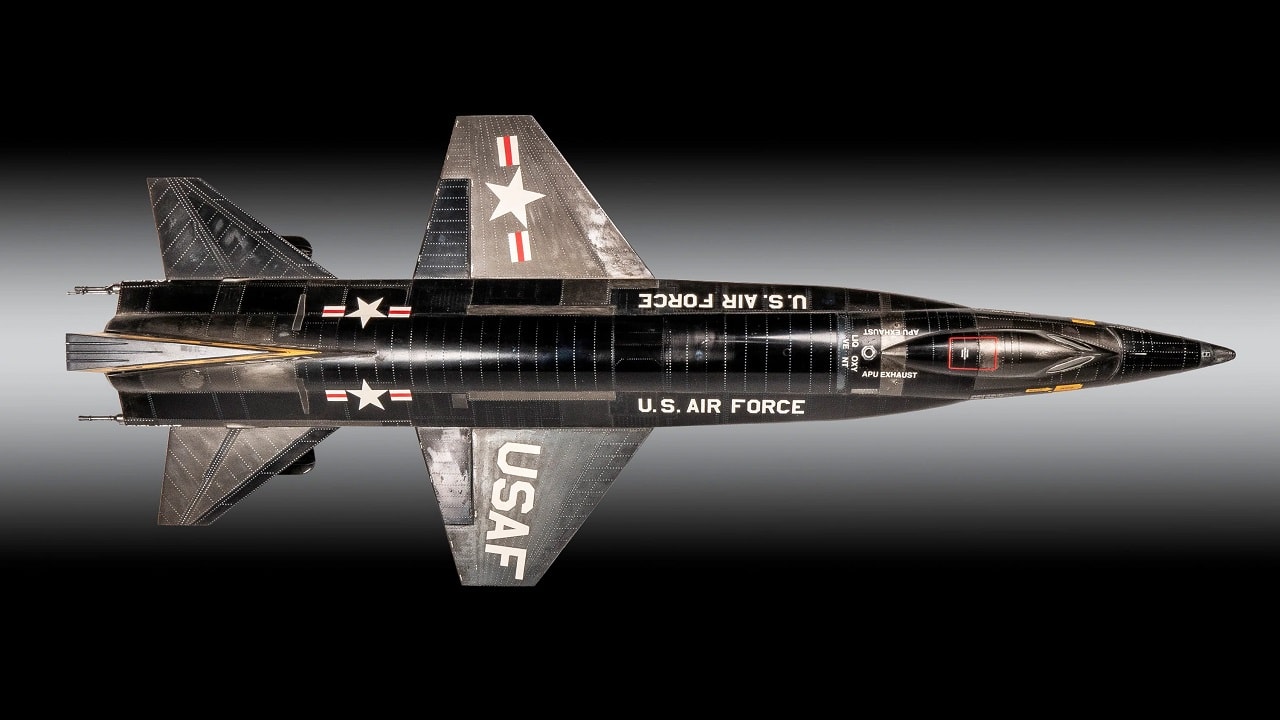
X-15. Image Credit: Creative Commons.
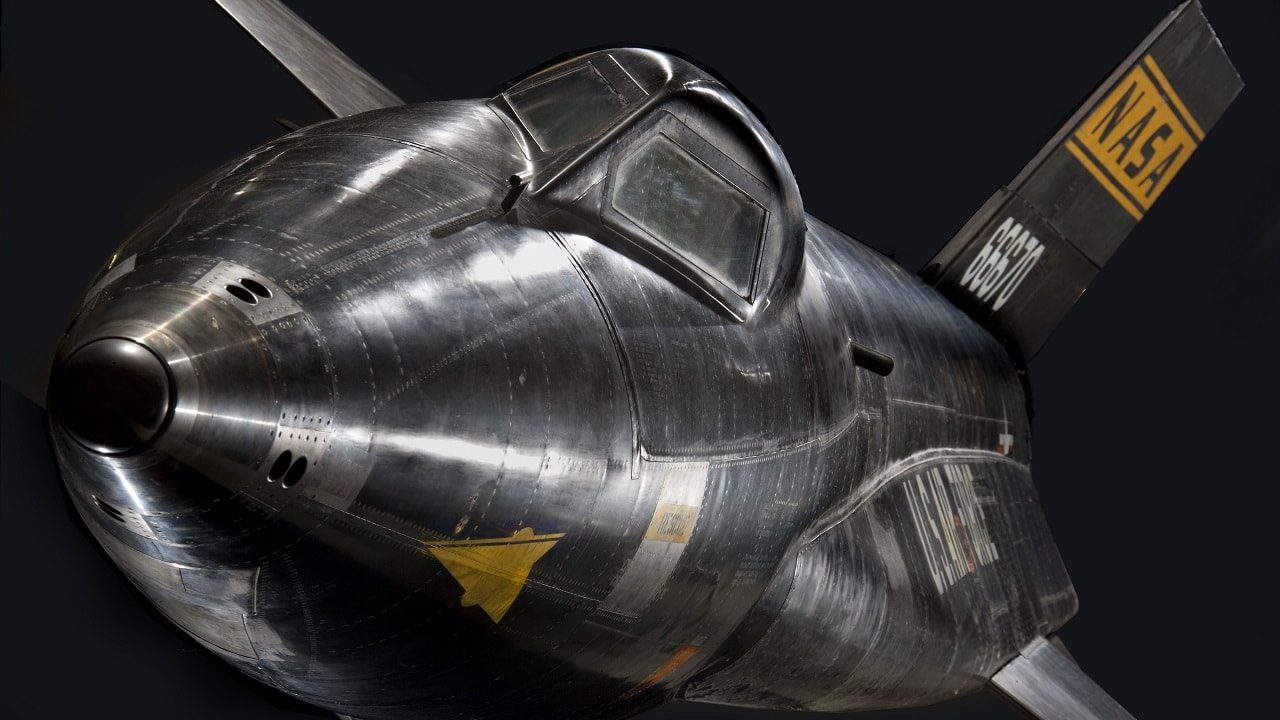
Three-quarter left front view, close up, of North American X-15 (s/n 56-6670) at the Smithsonian National Air and Space Museum, July 10, 2007
The first aircraft was destroyed when the first stage of the winged Pegasus booster rocket failed. In 2004, tests were conducted, and the X-43A reached Mach 6.83.
The final X43A flew on November 16, 2004, and set a speed record of Mach 9.64 (6,363 mph) at an altitude of approximately 33,500 meters (110,000 feet).
The high-speed maneuvering glide flew for nearly ten minutes, during which hypersonic aerodynamic data was collected while en route to a mission completion point, hundreds of miles due west (450 miles at Mach 7, 850 miles at Mach 10) in the Naval Air Warfare Center Weapons Division Sea Range off the southern coast of California.
Each vehicle was submerged in the ocean as planned and was not recovered.
How Do Scramjets Work?
According to NASA, “A scramjet (supersonic-combustion ramjet) is a ramjet engine in which the airflow through the engine remains supersonic.
Scramjet-powered vehicles are envisioned to operate at speeds up to Mach 15. Ground tests of scramjet combustors have shown this potential, but no flight tests have surpassed the Mach 9.6 X-43A flight.”
Because scramjets use external air for combustion, they are a more efficient propulsion system for atmospheric flight than rockets, which must carry their own oxygen. Scramjets are ideally suited for hypersonic flight within the atmosphere.
NASA planned to build an X-43B, an ambitious project in which the aircraft would fly at supersonic speeds at lower altitudes and then use scramjet propulsion at higher speeds and higher altitudes.
The planned “Hyper X” aircraft, the X-43C, was scheduled for the late 2000s and was to demonstrate a solid-hydrocarbon scramjet engine at speeds between Mach 5 and 7 sometime around 2008. However, the project was canceled.
Why Did NASA “Conclude” the X-43 Project?
The NASA X-43 program was not formally “canceled” but instead concluded after successfully meeting its narrow objectives, according to NASA. The program was a three-flight effort to demonstrate scramjet technology, and after the final successful flights in 2004, NASA had the data it needed.
Following these successes, national priorities shifted, with the “Vision for Space Exploration” announced in 2004 and funding redirected to human spaceflight, leading NASA to shift its focus away from near-term hypersonic research.
Was the program canceled too soon? It is the question that begs answering. The proposed X-43D was supposed to be the Mach15 risk-reduction step between NASA’s experiments and cutting-edge operational hypersonic systems. That step, regrettably, never happened.
The X-43A Program Met Its Limited Objectives
The Hyper-X program was designed to have three flights. The first flight in 2001 failed, but the second and third flights in 2004 were successful, demonstrating hypersonic flight at Mach 6.8 and Mach 9.6.
After these successes, the program had achieved its goal of proving that air-breathing hypersonic flight was possible.
The 2004 “Vision for Space Exploration” redirected NASA’s focus toward human spaceflight, particularly the Moon-to-Mars initiative. This led to budget cuts to aeronautics research, including hypersonics, and to a reduction in program support.
This initiative most prominently refers to the 2004 initiative by President George W. Bush, which focused on a human return to the Moon by 2020 to prepare for eventual missions to Mars and beyond.
This vision entailed completing the International Space Station (ISS), retiring the Space Shuttle, developing new vehicles such as the Crew Exploration Vehicle (later renamed Orion), and establishing a sustained human presence on the Moon.
More recently, President Trump’s vision has emphasized returning to the Moon, developing new rockets such as the Space Launch System (SLS), and establishing the US Space Force.
The Air Force Continues Hypersonic Testing
The Air Force has continued to test hypersonic aircraft through the X-51 “Waverider” program. The X-51 Waverider can fly 600 nautical miles in 10 minutes after being released from a B-52 mothership, like the X-43A. It made its first flight in 2010.
The Air Force built four X-51 Waveriders, which were technology demonstrators and were not intended as prototypes for a weapon.
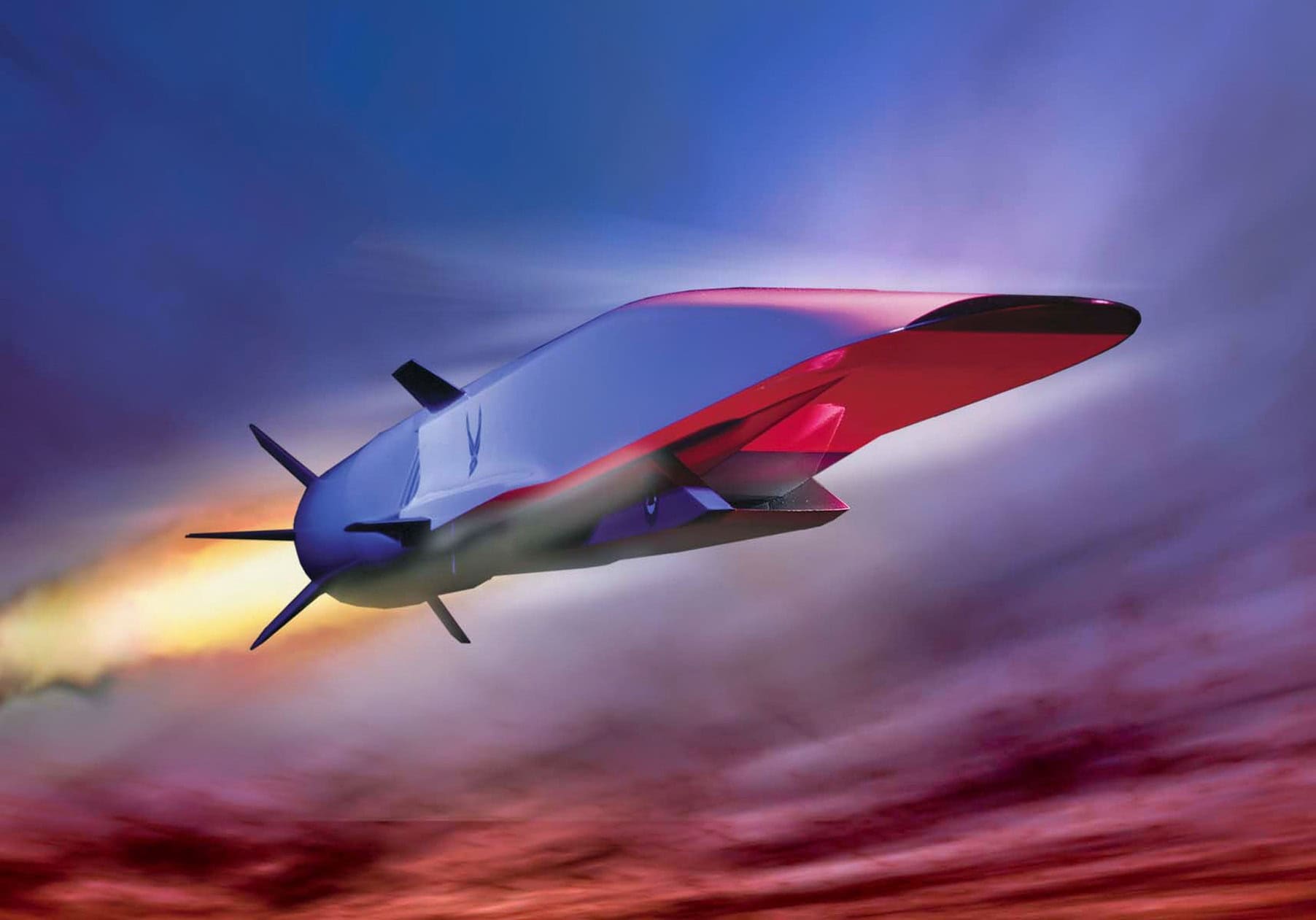
The X-51A Waverider is set to demonstrate hypersonic flight. Powered by a Pratt Whitney Rocketdyne SJY61 scramjet engine, it is designed to ride on its own shockwavem and accelerate to about Mach 6. (U.S. Air Force graphic)
The final flight of the X-51A occurred on May 1, 2013, and was the most successful in meeting all experimental objectives. The cruiser traveled more than 230 nautical miles in just over six minutes, reaching a peak speed of Mach 5.1, approximately 3,913 mph.
About the Author: Defense Expert Steve Balestrieri
Steve Balestrieri is a National Security Columnist. He served as a US Army Special Forces NCO and Warrant Officer. In addition to writing on defense, he covers the NFL for PatsFans.com and is a member of the Pro Football Writers of America (PFWA). His work was regularly featured in many military publications.