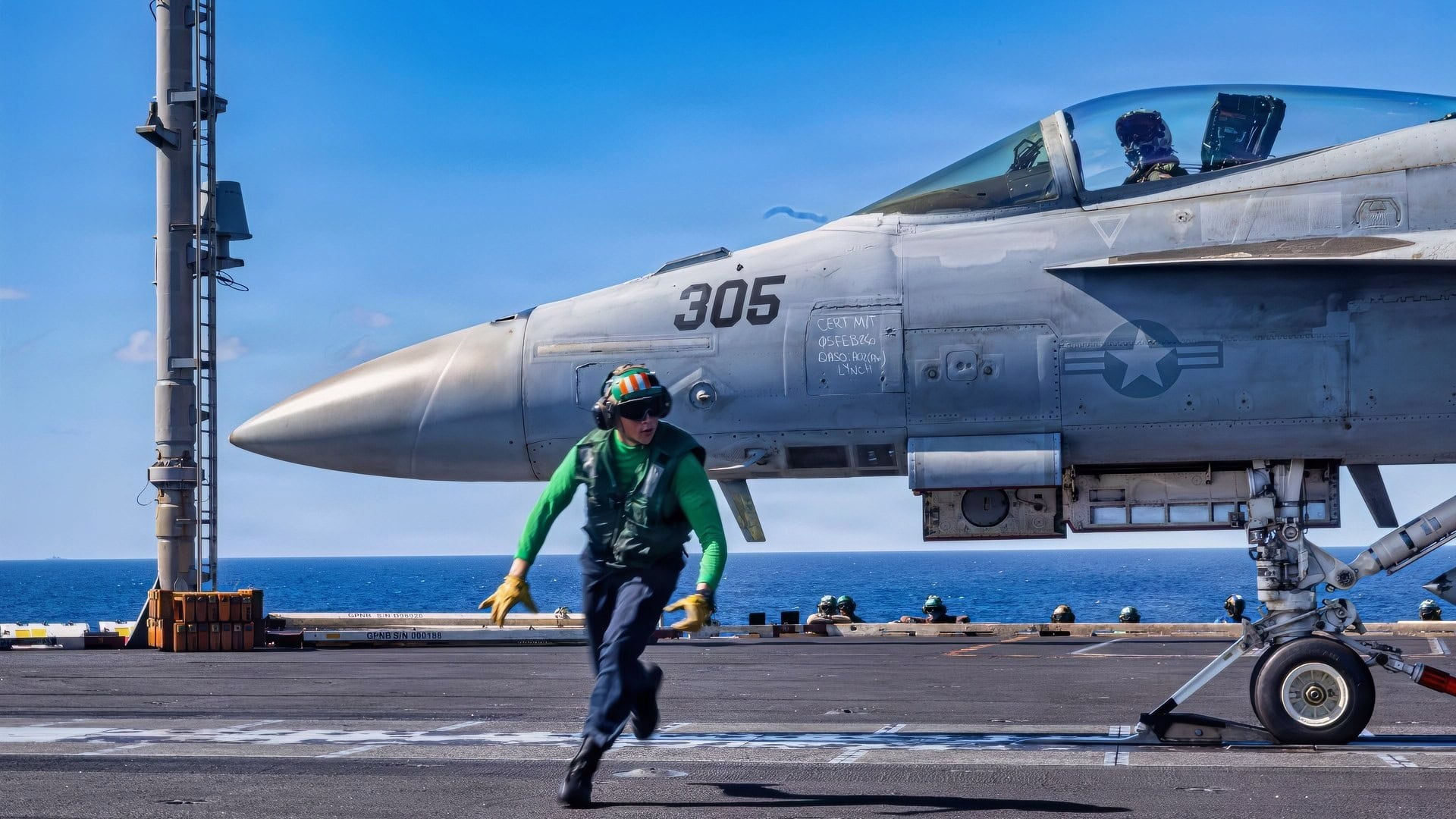
Summary and Key Points: Supercarrier USS Abraham Lincoln is already in the Middle East, and reports say USS Gerald R. Ford will soon deploy to the Arabian Sea, creating a two-carrier strike posture meant to increase pressure on Iran.
-Dual-carrier operations would multiply launch points for coordinated sorties, pairing F-35Cs, F/A-18s, and E-2D Hawkeyes with cruisers and destroyers carrying Tomahawk missiles.
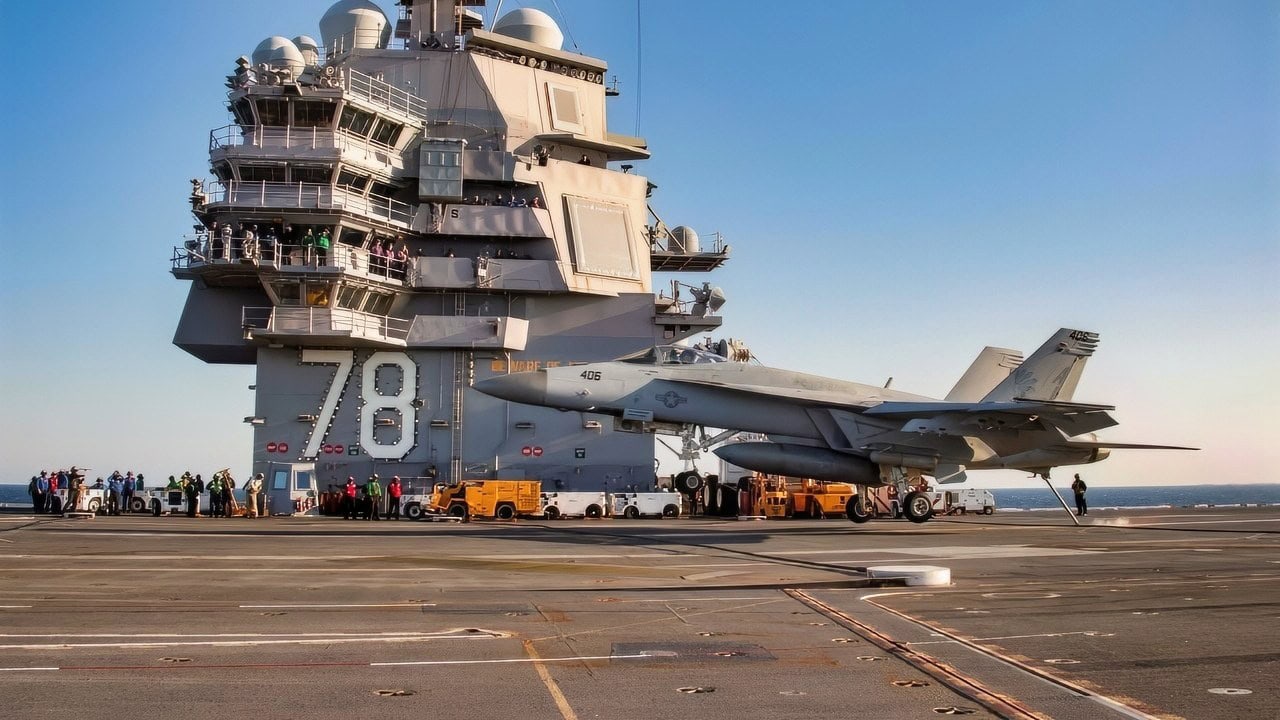
USS Gerald R. Ford Supercarrier Flight Deck. Image Credit: Creative Commons.
-With roughly 900-mile strike reach, sea-launched salvos could hit command sites, air defenses, and depots, setting conditions for quick, precise strikes—potentially even a decapitation-style raid—while stealth jets help find mobile launchers and shifting targets across the region, without committing to a prolonged air campaign.
2 U.S. Aircraft Carriers Will Soon Be Near Iran: Ford Joins Lincoln for Dual-Strike Pressure
The USS Abraham Lincoln (CVN-72) is already in the Middle East after surging from as far away as the South China Sea. Soon, it will be joined by a second carrier strike group (CSG): The USS Gerald R. Ford (CBN-79), the most advanced aircraft carrier in the world, will deploy to the Arabian Sea, according to reports on February 13.
The Ford set out for its most recent deployment in June 2025 and was sent to the Caribbean last October as part of Operation Southern Spear.
A second CSG in the region would intensify the pressure U.S. President Donald Trump could place on Iran. With the increased number of quality assets, U.S. forces could threaten a much larger-scale, coordinated campaign against Iranian targets.
The U.S. Navy sometimes trains dual-carrier operations, during which two carrier air wings simultaneously launch and coordinate large-scale, sustained, sea-launched air attacks.
A second CSG could operate from a different strike location to multiply options and angles of attack.
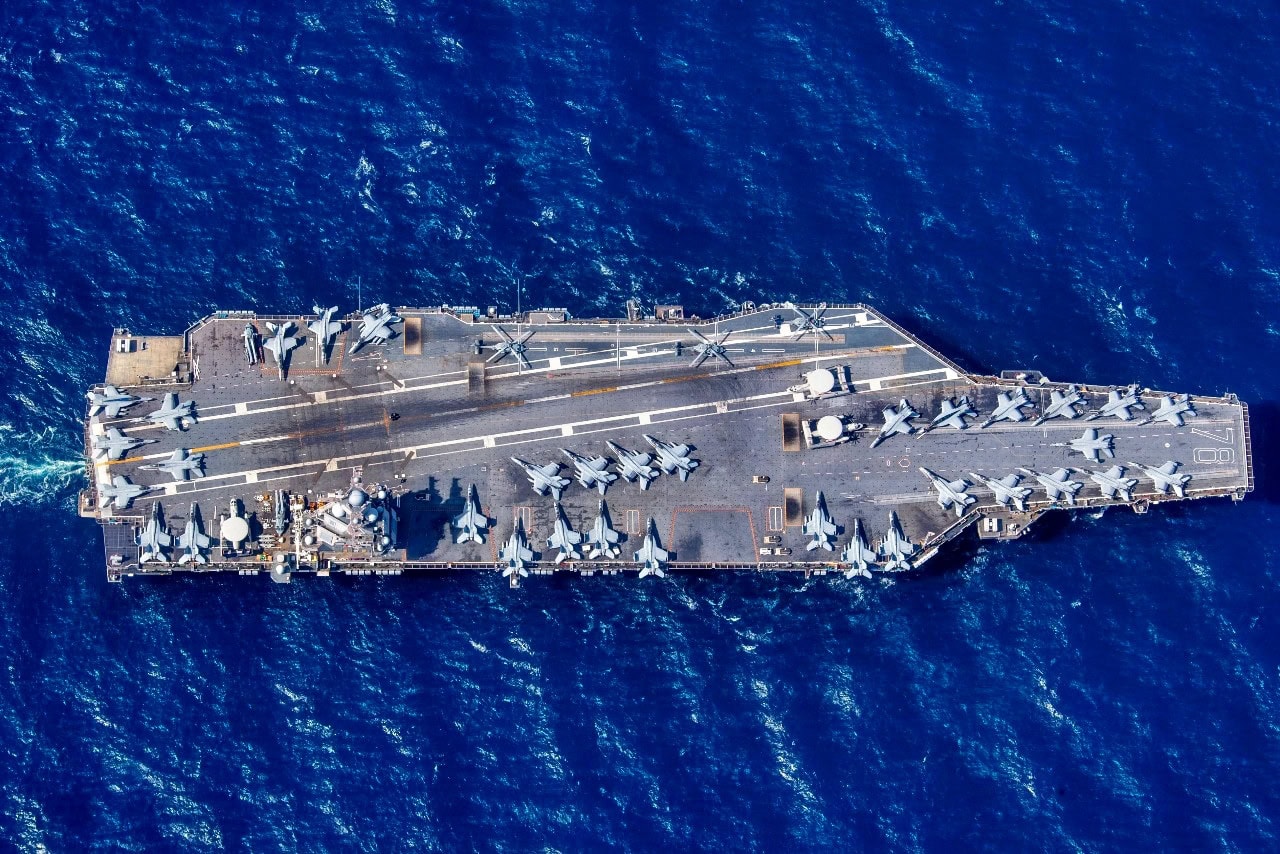
The first-in-class aircraft carrier USS Gerald R. Ford (CVN 78) transits the Atlantic Ocean, March 19, 2023. Ford is underway in the Atlantic Ocean executing its Composite Training Unit Exercise (COMPTUEX), an intense, multi-week exercise designed to fully integrate a carrier strike group as a cohesive, multi-mission fighting force and to test their ability to carry out sustained combat operations from the sea. As the first-in-class ship of Ford-class aircraft carriers, CVN 78 represents a generational leap in the U.S. Navy’s capacity to project power on a global scale. (U.S. Navy photo by Mass Communication Specialist 2nd Class Jackson Adkins)
Both carrier air wings would include F-35Cs, F-18s, and fixed-wing surveillance assets such as the E-2D Hawkeye. Each CSG is also ringed by heavily armed cruisers and destroyers.
The warships not only protect the large carriers from incoming attack, but also offer heavy attack options such as Tomahawk cruise missiles.
Aircraft Carrier Strike Group Fire Power
Arleigh Burke-class destroyers are built with vertical launch systems capable of firing precision-guided Tomahawk missiles to a range of 900 miles.
Targets in CSG-launched operations tend to involve leadership headquarters, command and control facilities, troop and weapon locations, and ammunition depots.
While an operation against Iran would likely be quite different from that carried out in Venezuela, there could be some tactical similarities.
A strike on Iran would likely be quick, precise and extremely targeted. There would not likely be a land deployment or a prolonged air campaign— any potential operation would seek to be short and decisive.
It might involve a decapitation strike, meaning a targeted lethal attack on leaders and command-and-control facilities designed to cripple or destroy the regime without causing widespread destruction.
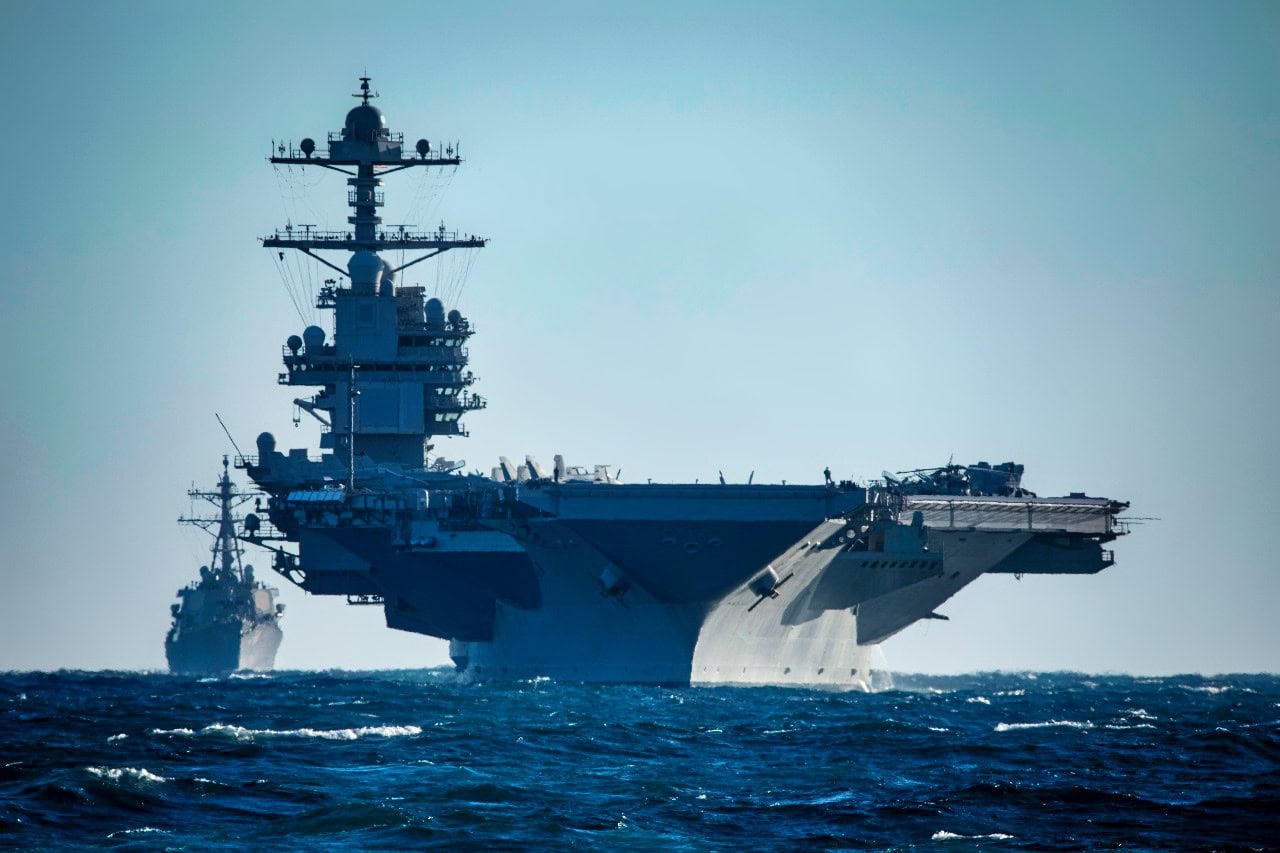
A view from the Ticonderoga-class guided missile cruiser USS Normandy (CG 60) of the first-in-class aircraft carrier USS Gerald R. Ford (CVN 78) and the Arleigh Burke-class guided missile destroyers USS Thomas Hudner (DDG 116), USS Ramage (DDG 61) and USS McFaul (DDG 74) as the ships steam in formation during a drill while underway as part of the Gerald R. Ford Carrier Strike Group March 5, 2023. Ford Carrier Strike Group is underway in the Atlantic Ocean executing its Composite Training Unit Exercise (COMPTUEX), an intense, multi-week exercise designed to fully integrate a carrier strike group as a cohesive, multi-mission fighting force and to test their ability to carry out sustained combat operations from the sea. As the first-in-class ship of Ford-class aircraft carriers, CVN 78 represents a generational leap in the U.S. Navy’s capacity to project power on a global scale. (U.S. Navy photo by Mass Communication Specialist 2nd Class Malachi Lakey)
Decapitation Strike from the U.S. Navy on Iran?
Without any top-level command and control, forces and supporters loyal to the Iranian regime would be unable to communicate, receive orders, undertake cohesive action, or ensure stability.
The intent would be to disable any authority that operates on behalf of the regime and enable protesters to essentially take over the country—or create a power vacuum that new leaders could fill.
Advanced Tomahawk missiles present U.S. naval commanders with a number of strike options.
The Block IV Tomahawks operate with a two-way datalink enabling a missile to change course in flight as needed, loiter if necessary, and even collect intelligence on high-value target areas.
Beyond Block IV, the Navy also operates Tactical Tomahawks—cruise missiles able to adjust course very quickly to track and destroy moving targets. These Tomahawks can use new generations of radio-signal throughput and guidance technology to hit moving ships or, in the case of Iran, track and target leaders on the move.
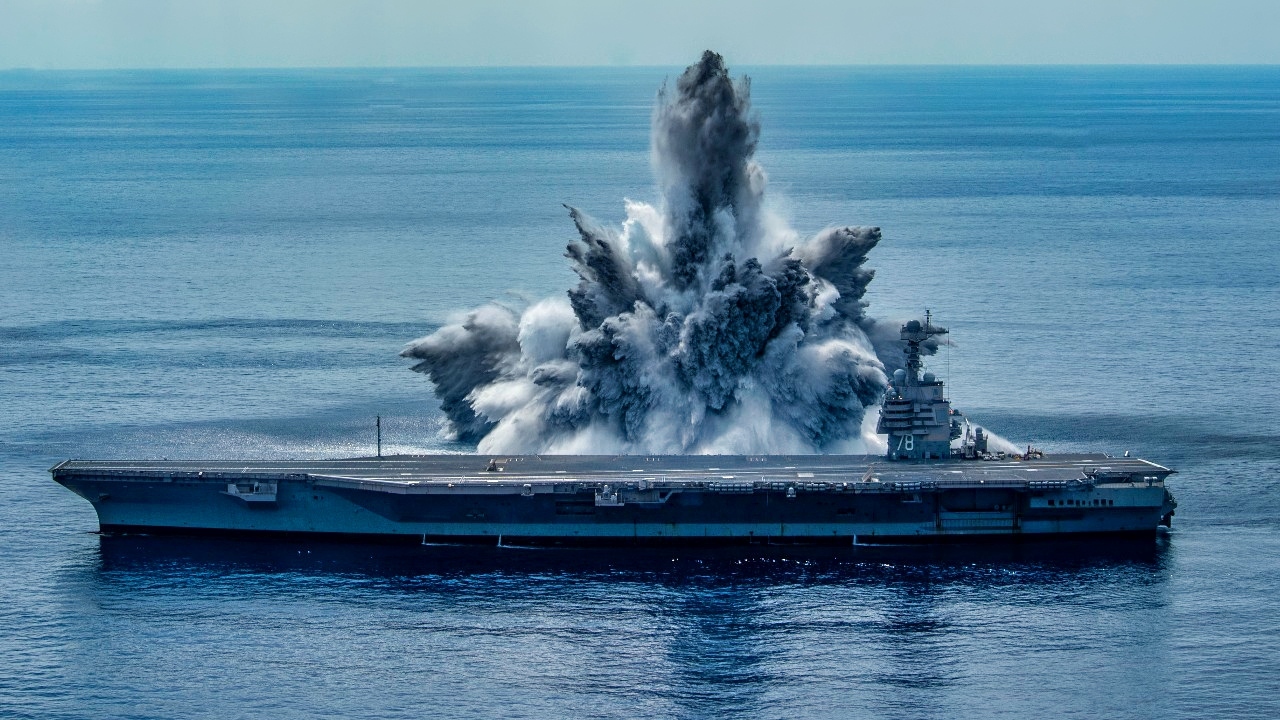
The aircraft carrier USS Gerald R. Ford (CVN 78) successfully completes the third and final scheduled explosive event of Full Ship Shock Trials while underway in the Atlantic Ocean, Aug. 8, 2021. The U.S. Navy conducts shock trials of new ship designs using live explosives to confirm that our warships can continue to meet demanding mission requirements under harsh conditions they might encounter in battle. (U.S. Navy photo by Mass Communication Specialist 3rd Class Novalee Manzella)
F-35Cs & Air Attack from Navy Supercarriers
Ships and submarines fire cruise missiles from long ranges with high accuracy and set conditions for an air attack by destroying air defenses, troop locations, or other fixed high-value targets.
However, fifth-generation stealth aircraft also might be needed, especially if Iran operates mobile air defenses or ballistic missile launchers to target U.S. assets in the region.
While Iranian air defenses, drones, and aircraft were likely degraded significantly by Israeli F-35I Adir strikes during operations in the summer of 2025, air supremacy may need to be established to support a quick-strike option or to strike moving targets from the air.
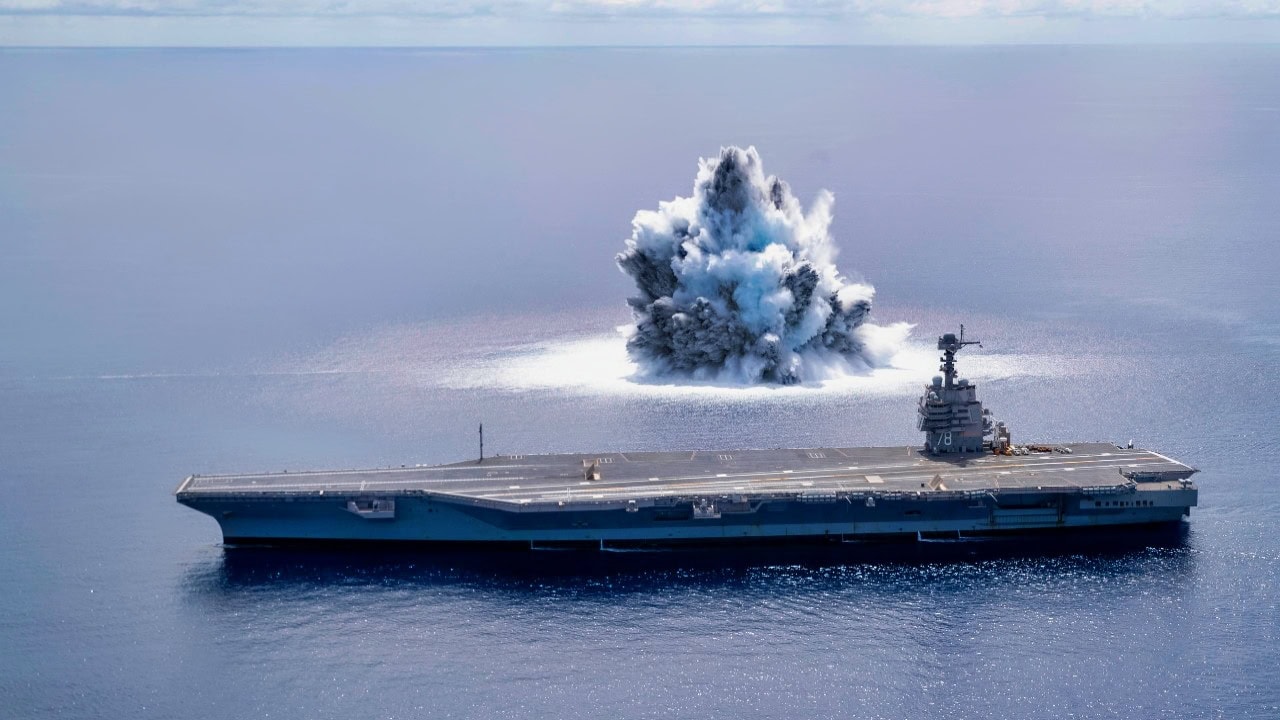
The aircraft carrier USS Gerald R. Ford (CVN 78) completes the first scheduled explosive event of Full Ship Shock Trials while underway in the Atlantic Ocean, June 18, 2021. The U.S. Navy conducts shock trials of new ship designs using live explosives to confirm that our warships can continue to meet demanding mission requirements under harsh conditions they might encounter in battle. (U.S. Navy photo by Mass Communication Specialist 3rd Class Riley B. McDowell)
An aircraft such as the F-35C has surveillance and targeting capabilities that are as important as its attack options, so these aircraft would be in position to find targets from the air.
About the Author: Kris Osborn
Kris Osborn is the President of Warrior Maven – Center for Military Modernization. Osborn previously served at the Pentagon as a highly qualified expert in the Office of the Assistant Secretary of the Army—Acquisition, Logistics & Technology. Osborn has also worked as an anchor and on-air military specialist at national TV networks. He has appeared as a guest military expert on Fox News, MSNBC, The Military Channel, and The HistoryChannel. He also has a Master’s Degree in Comparative Literature from Columbia