
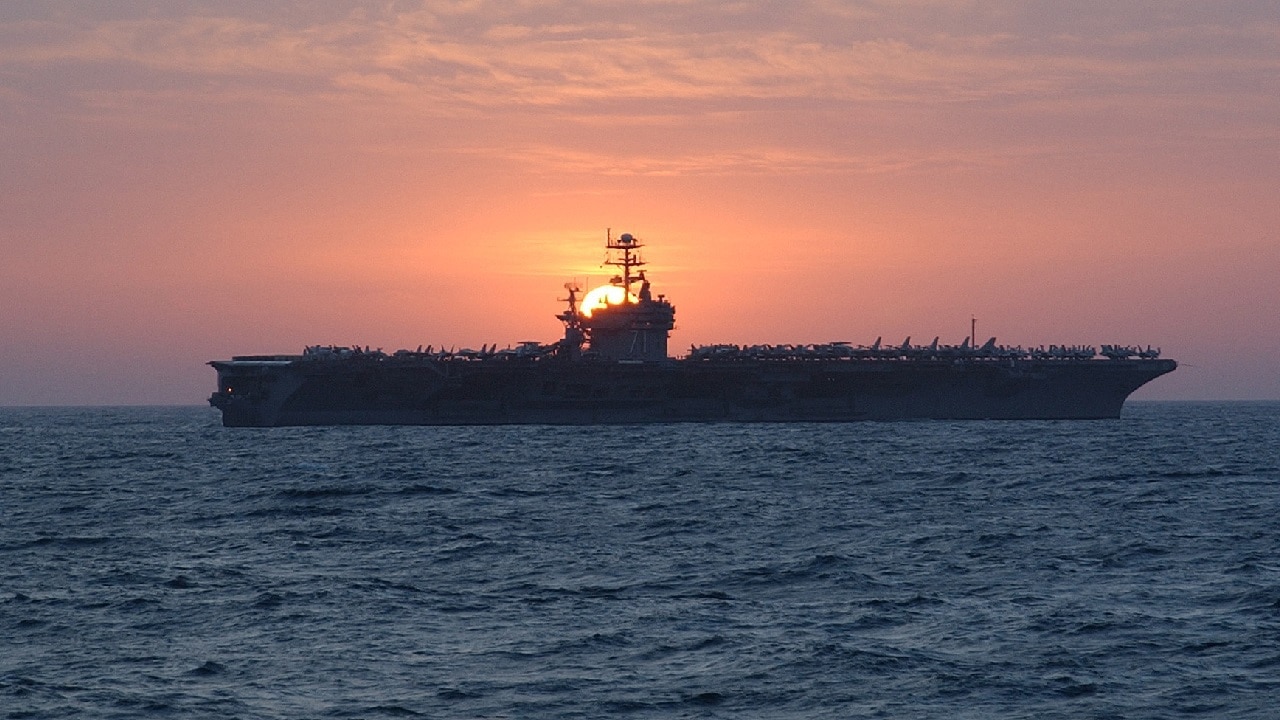
Synopsis: USS Theodore Roosevelt (CVN-71), the fourth Nimitz-class supercarrier, carries the radio call sign “Rough Rider” and the crew nickname “The Big Stick,” linking the ship to Theodore Roosevelt’s cavalry legacy and his naval-minded worldview.
-Its path to commissioning ran through cancellations, reversals, and shifting carrier concepts—before modular construction sped its build.

PHILIPPINE SEA (Feb. 24, 2024) A U.S. Air Force B-52 Stratofortress, attached to the 5th Bomb Wing, and aircraft attached to Carrier Air Wing (CVW) 11, fly in formation over the Nimitz-class aircraft carrier USS Theodore Roosevelt (CVN 71), Feb. 24, 2024. Theodore Roosevelt, flagship of Carrier Strike Group Nine, is underway conducting routine operations in the U.S. 7th Fleet area of operations. U.S. 7th Fleet is the U.S. Navy’s largest forward-deployed numbered fleet, and routinely interacts and operates with allies and partners in preserving a free and open Indo-Pacific region. (U.S. Navy photo by Mass Communication Specialist 1st Class Thomas Gooley)
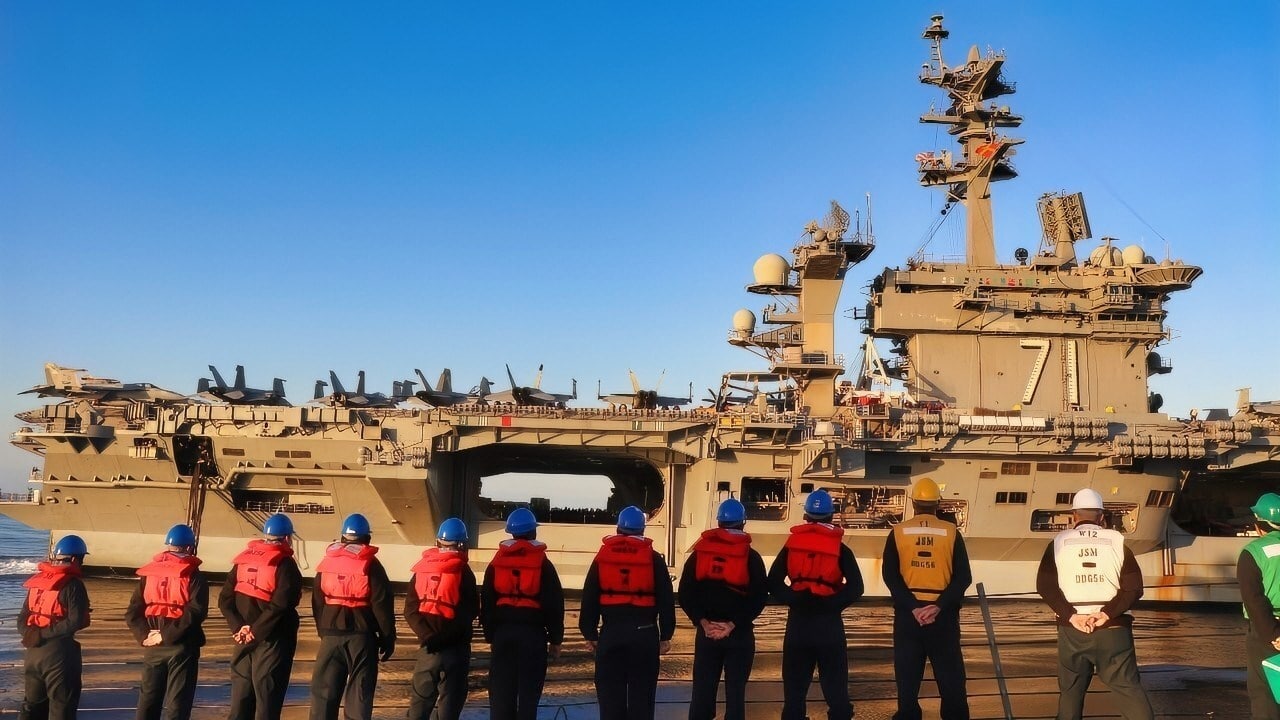
PACIFIC OCEAN (Nov. 28, 2023) Line handling crew assigned to the Arleigh Burke-class guided-missile destroyer USS John S. McCain (DDG 56) prepares to come alongside USS Theodore Roosevelt (CVN 71) for a replenishment at sea. John S. McCain is currently conducting routine training and certifications in the U.S. 3rd Fleet area of operations. (U.S. Navy photo by Ensign Garrett Fox).
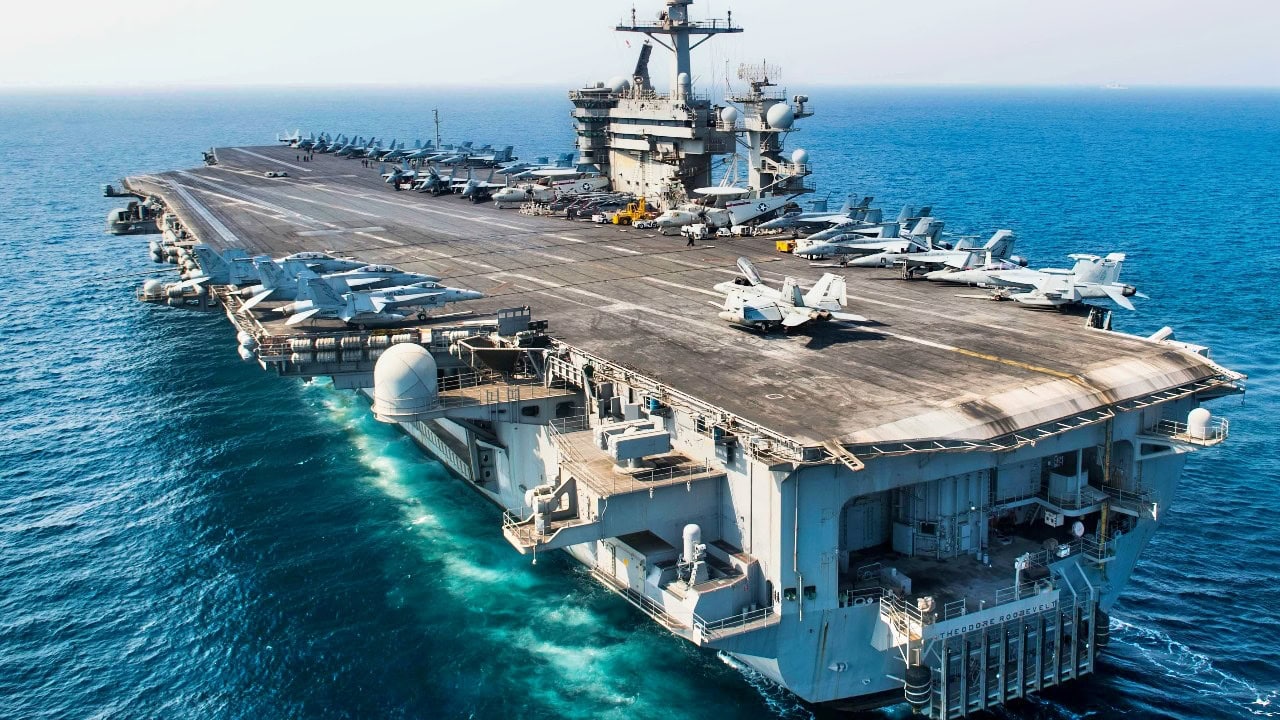
(Oct. 10, 2015) The aircraft carrier USS Theodore Roosevelt (CVN 71) transits the Arabian Gulf. Theodore Roosevelt is deployed in the U.S. 5th Fleet area of operations supporting Operation Inherent Resolve, strike operations in Iraq and Syria as directed, maritime security operations and theater security cooperation efforts in the region.
-The carrier’s operational record spans Desert Storm sortie generation, follow-on strikes, Bosnia deployments, and post-9/11 operations in Afghanistan and Iraq.
-In 2020, a major COVID outbreak forced a Guam offload and skeleton-crew operations.
-After a punishing 278-day deployment, it entered maintenance—then sailed again on January 21.
The USS Theodore Roosevelt, Call Sign Rough Rider
The USS Theodore Roosevelt (CVN-71) is the fourth Nimitz-class, nuclear-powered aircraft carrier in the United States Navy.
She is named in honor of Theodore Roosevelt, the 26th president of the United States, a former under-secretary of the Navy, and a proponent of naval power.
The carrier is the fourth ship named in honor of Teddy Roosevelt, with three bearing his full name and a fourth with just his last name.
Another three US Navy ships bear the name “Roosevelt” in honor of members of the Roosevelt family.
The carrier’s radio call sign is “Rough Rider,” the nickname of President Roosevelt’s 2nd Squadron, 1st US Volunteer Cavalry, unit during the Spanish–American War. Her crew also knows her as “The Big Stick.”
The carrier was launched in 1984, and its first action was during the Gulf War in 1991.
Brief History of the USS Theodore Roosevelt
The planned carrier (CVN-71) was canceled by President Gerald Ford in 1976 because he wanted to replace it with two CVV-type, medium-sized, conventional-powered carriers expected to operate V/STOL aircraft.
The carrier’s building was pushed back again when President Carter vetoed the 1979 Fiscal Year Department of Defense authorization bill because of the inclusion of the CVN-71 Nimitz-class nuclear replacement, which was to be followed by two CVV-type, medium-sized, conventionally powered carriers, or supercarriers, in the Navy shipbuilding program.
However, with the Iran hostage crisis, Carter reversed his stance, and the carrier was included in the 1980 DOD authorization bill. The keel was laid in 1981, and the Navy announced on November 3 of that year that she would be named after Teddy Roosevelt.
She was the first ship to be built using modular construction, cutting her construction time by 16 months. It has been used in carrier construction ever since.
The carrier was commissioned at Newport News, VA, on October 25, 1986. On December 28, 1990, the USS Theodore Roosevelt departed for Operation Desert Shield. Once combat operations commenced on January 15, 1991, for Operation Desert Storm, the carrier launched 4,300 sorties against Iraqi troops until the February 28 cease-fire, earning her first “Battle E” (Battle Effectiveness Award).
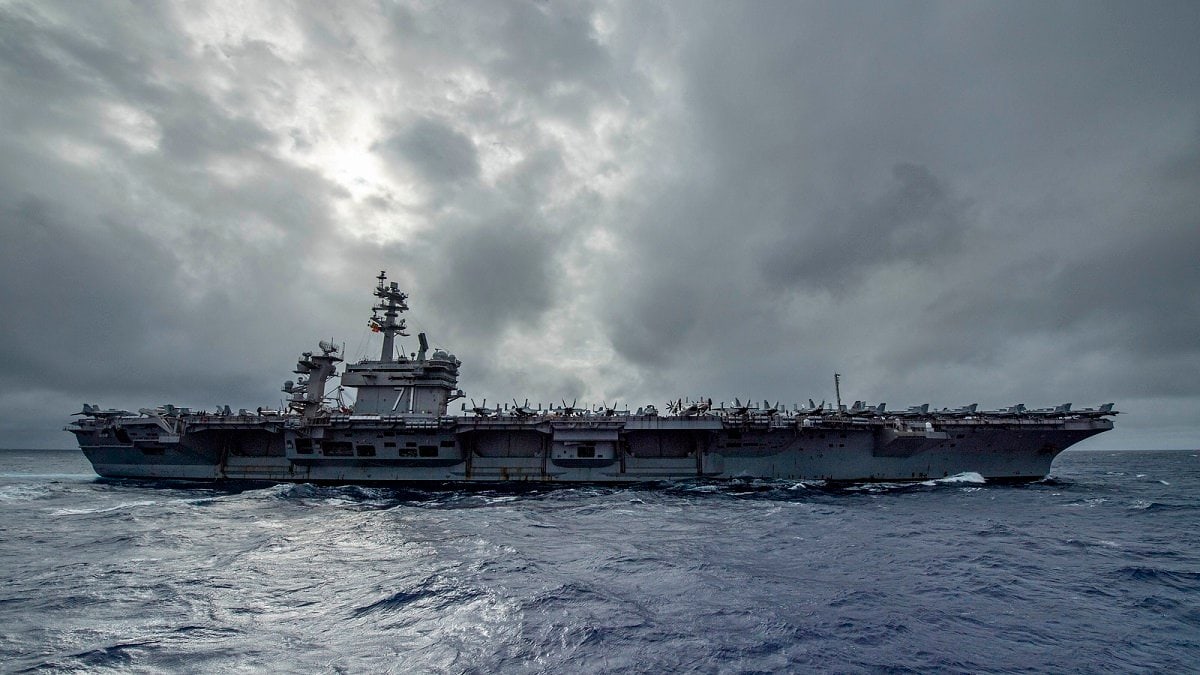
PACIFIC OCEAN (Jan. 12, 2021) The aircraft carrier USS Theodore Roosevelt (CVN 71) transits the Pacific Ocean, Jan. 12, 2021. The Theodore Roosevelt Carrier Strike Group is on a scheduled deployment to the U.S. 7th Fleet area of operations. As the U.S. Navy’s largest forward deployed fleet, with its approximate 50-70 ships and submarines, 140 aircraft, and 20,000 Sailors in the area of operations at any given time, U.S. 7th Fleet conducts forward-deployed naval operations in support of U.S. national interests throughout a free and open Indo-Pacific area of operations to foster maritime security, promote stability, and prevent conflict alongside 35 other maritime nations and partners. (U.S. Navy photo by Mass Communication Specialist 3rd Class Jason Waite) 210112-N-SS350-1028.
The USS Theodore Roosevelt lost three aircraft during Desert Storm. But the carrier was soon diverted to bombing Iraqi targets after they turned on the Kurds in northern Iraq.
The carrier served two tours off the coast of Bosnia and another enforcing the no-fly zones over Iraq in 1994-1995, 1996, and 1999.
After the attacks on America on 9/11, the Roosevelt deployed in support of Operation Enduring Freedom. In 2003, the carrier was once again sent to the Middle East to support the attacks on Saddam Hussein’s forces during “Operation Iraqi Freedom.” More deployments followed in support of US troops in Afghanistan.
The USS Theodore Roosevelt had a massive outbreak of COVID-19 in 2020, where 1331 sailors tested positive for COVID-19. For a time, the ship evacuated 4,069 sailors in Guam, leaving only a 400-man skeleton crew to maintain the carrier’s reactor, fire-fighting equipment, and the ship’s galley. The carrier returned to duty on May 21, 2020, after a two-month quarantine.
After completing a demanding 9-month deployment that ended in October 2024, in which it operated across the US 3rd Fleet (Pacific), US 5th Fleet (Middle East), and US 7th Fleet (Indo-Pacific) areas of responsibility, Theodore Roosevelt returned to its San Diego homeport for an extended maintenance and training cycle.
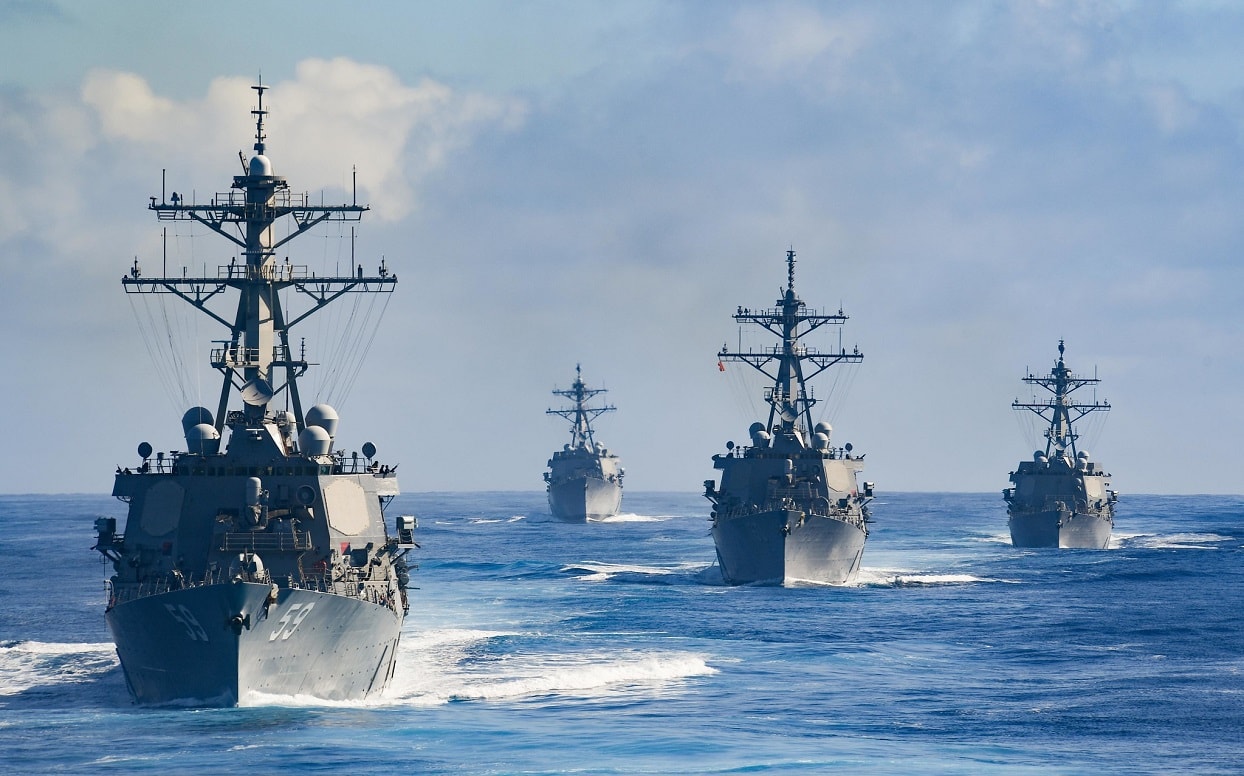
PACIFIC OCEAN (Jan. 22, 2020) Ships assigned to Destroyer Squadron (DESRON) 23 transit the Pacific Ocean, Jan. 22, 2020. DESRON 23, part of the Theodore Roosevelt Carrier Strike Group, is on a scheduled deployment to the Indo-Pacific. (U.S. Navy photo by Mass Communication Specialist 3rd Class Erick A. Parsons/Released)
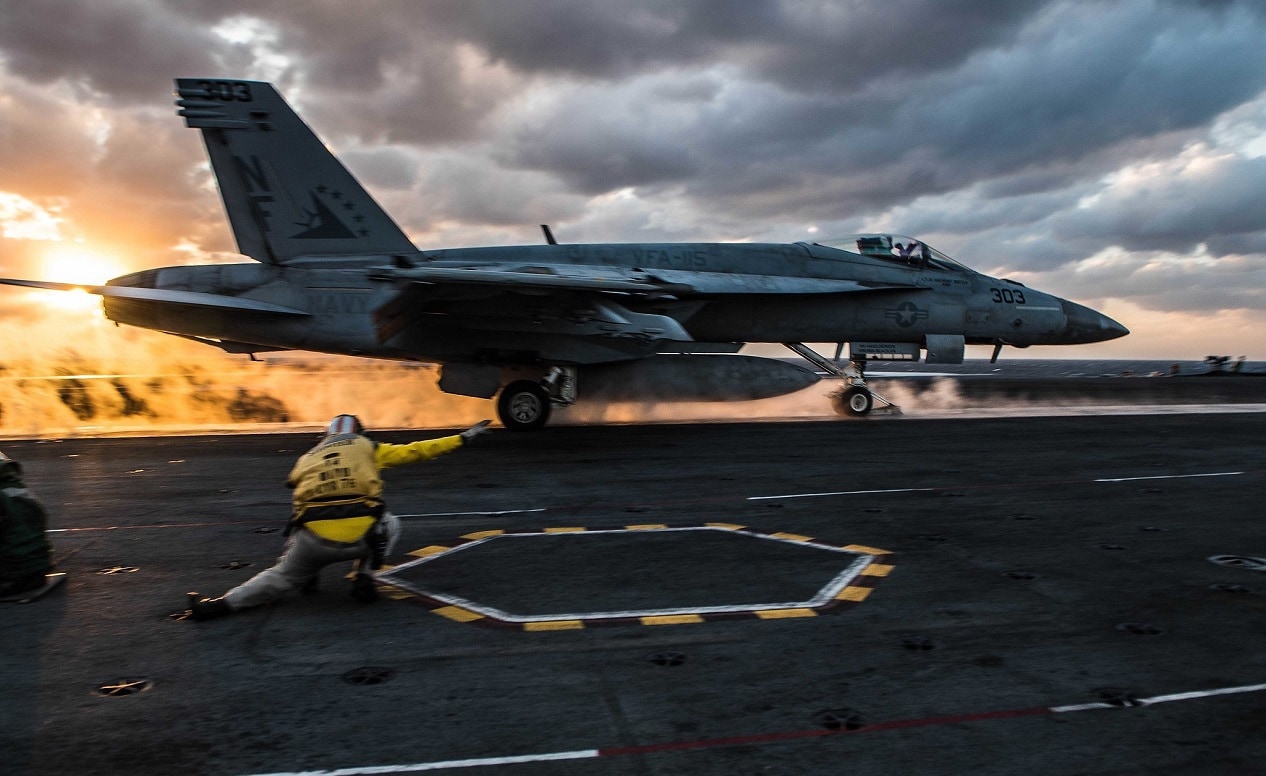
A U.S. Navy F/A-18E Super Hornet of Strike Fighter Squadron (VFA) 115 launches from the flight deck of the aircraft carrier USS Ronald Reagan (CVN 76) in the western Pacific Ocean Nov. 11, 2017. The Ronald Reagan, Theodore Roosevelt and Nimitz strike groups are underway conducting flight operations in international waters as part of a three-carrier strike force exercise. The U.S. Pacific Fleet has patrolled the Indo-Pacific region routinely for more than 70 years promoting regional security, stability and prosperity.
The 278-consecutive-day deployment was tough on the ship and the crew. It delayed much-needed maintenance, requiring additional work to return the ship to service.
The USS Theodore Roosevelt, CVN-71, continues to serve in the Pacific Fleet. She recently sailed out of San Diego on her latest drilling and exercises on January 21 and is already back in port.
According to reports, she sailed in the US Third Fleet area of operations.
About the Author: Steve Balestrieri
Steve Balestrieri is a National Security Columnist. He served as a US Army Special Forces NCO and Warrant Officer. In addition to writing on defense, he covers the NFL for PatsFans.com and is a member of the Pro Football Writers of America (PFWA). His work was regularly featured in many military publications.