
America Is Winning the Air War Over Iran. The War Keeps Going Anyway
The early reports out of Central Command have a familiar feel to them—air defenses in Iran degraded, fixed sites hit hard, strike packages moving through Iranian airspace with a level of control that, not that long ago, would have taken weeks to establish. None of that is in dispute, and it matters more than people sometimes let on.
What is harder to ignore is something else: The war is still going.
Iran is still launching attacks, still adapting, still absorbing damage and continuing to function as a state under pressure. The tempo has shifted since the opening days, but it has not collapsed into anything that looks like resolution. The conflict has settled into an uneven rhythm—sometimes quiet, then sharp again—that doesn’t line up with how decisive this was supposed to feel. That gap is not just the fog of war. It is the signal.
The Part That Works
On its own terms, the U.S.-Israeli air campaign has been effective. High-end systems such as fixed facilities, known production nodes, and pieces of the integrated air defense system have taken the brunt of the damage. These are the things the U.S. military is designed to find and break, and it has done so with speed and consistency.
The ability to dismantle large parts of a state’s military infrastructure from the air in days is not trivial. If war were decided by the destruction of identifiable targets, this one would already look decided—but it doesn’t, and that mismatch is where the problem starts to come into view.
What Doesn’t Break Cleanly
The problem is not that airpower is failing. It is that the things it does best are not the things that end wars, and that becomes more obvious the longer a campaign runs.
The systems that are easiest to find are usually the ones that matter most at the beginning. They are also the ones that disappear first. What remains behaves differently. Mobile launchers move, disperse, and disappear into terrain or urban cover. Command structures bend rather than snap. Communication becomes less efficient and more fragmented, but it does not vanish. Lower-end capabilities—simpler systems and improvised solutions—start to fill gaps in ways that are hard to track and harder to eliminate outright.
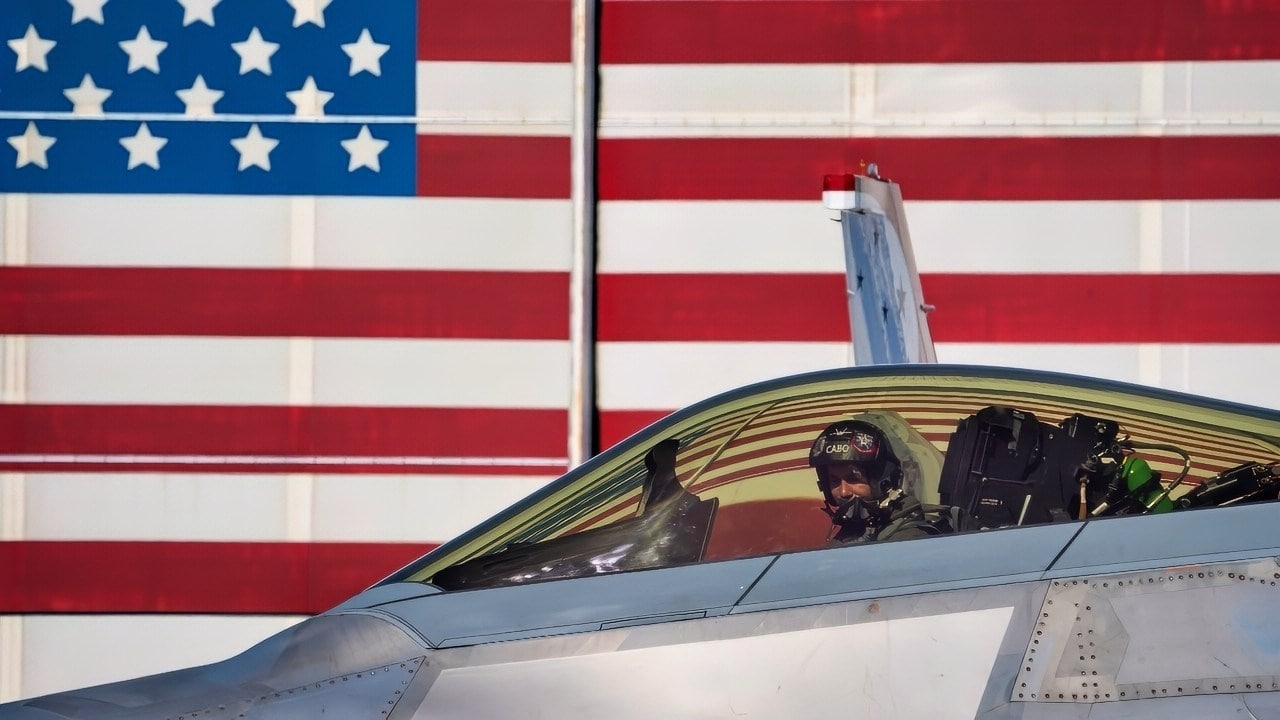
U.S. Air Force Maj. Josh Gunderson, F-22 Demo Team commander, taxis by the Wallops Island Flight Facility NASA hanger June 17, 2021, at Wallops Island, Va. The primary function of the F-22A Raptor is an air dominance and multi-role stealth fighter, and can carry a combination of air-to-air missiles and air-to-ground bombs. (U.S. Air Force photo by Staff Sgt. Don Hudson)
What emerges is not collapse but something more stubborn: a military that is being degraded but not destroyed. A system under stress that adapts as it absorbs that stress. It is less capable than it was—in places badly so—but it is not gone. That is enough to keep a war going.
A Pattern Taking Shape
Watch what the United States is doing next on Iran, because this is where the campaign becomes more revealing.
The strikes continue, pressure is sustained, and new targets are added as they emerge, but the character of the operation does not shift into something larger. There is no move toward seizing territory, no serious preparation for occupation, no indication that Washington intends to own what comes after. That restraint is not incidental, and it is not obviously temporary.
At some point it is worth saying plainly that this does not look like a campaign waiting for its next phase. It looks like the model: coercion without occupation, if you want a label for it—punish, degrade, contain, keep the pressure on while staying out of the cities and off the ground.
There is a tendency in Washington to treat this as transitional, as if a larger decision is still pending. Maybe there is. But nothing in the way this campaign is unfolding suggests that a fundamentally different phase is coming.
Iran War: Why It Looks Like This
Some of this is strategic preference, but a good deal of it reflects constraints.
Two decades of war have settled certain arguments. Large-scale occupations are politically toxic, financially draining, and operationally messy in ways that no amount of planning seems to fix. The U.S. military can remove a regime; it has little interest in rebuilding one. At the same time, the force has evolved in a particular direction. It is extraordinarily good at finding, fixing, and striking targets at distance. It is not built to govern territory or manage populations over time.
Add in competing theaters, limited bandwidth, and a political system with little tolerance for open-ended commitments, and the boundaries start to look less like choices and more like conditions. Airpower fits inside those conditions. Occupation does not.
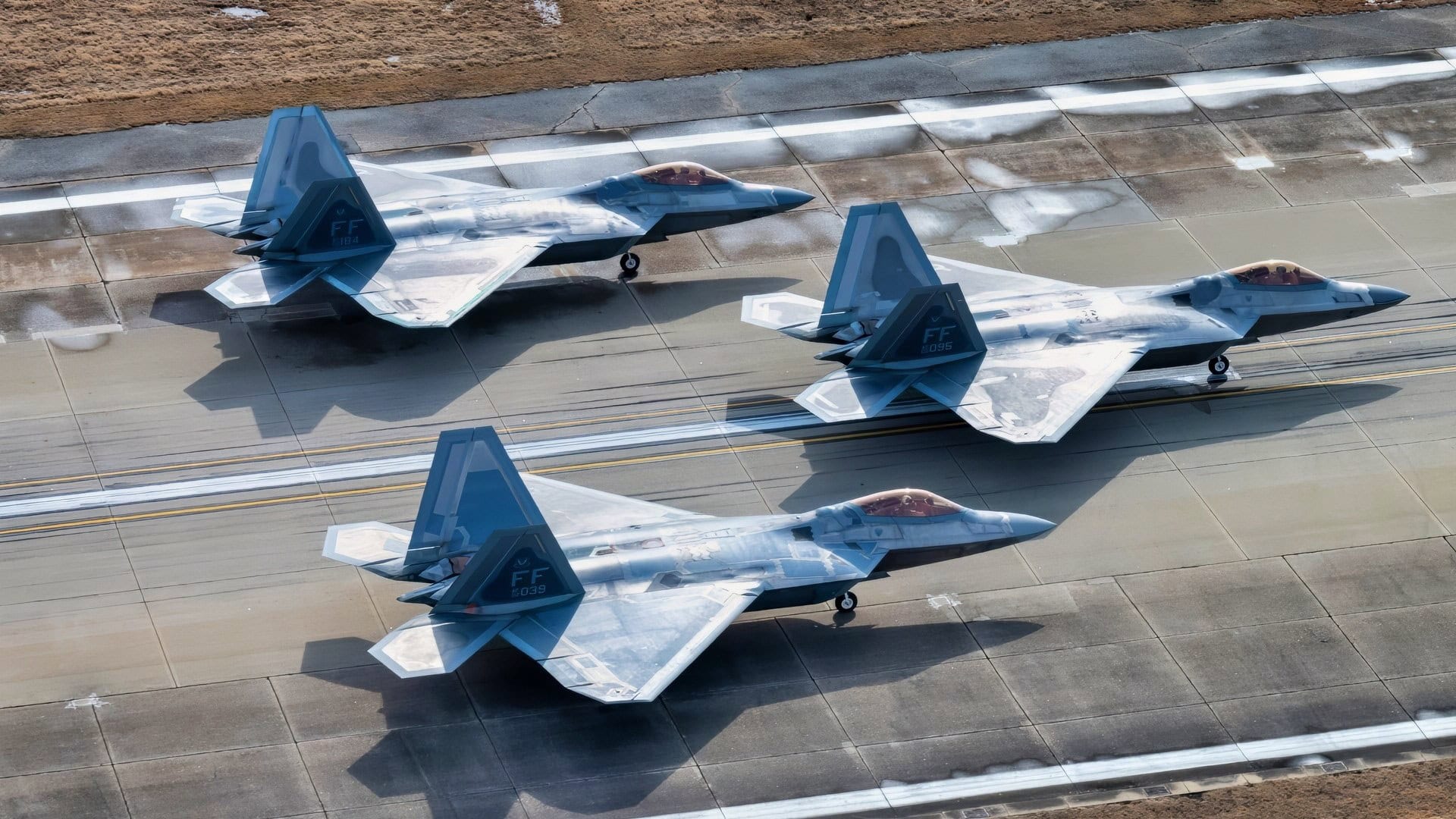
LANGLEY AIR FORCE BASE, Va. – F-22 Raptors from the 1st Fighter Wing sit in position on the runway fduring the Elephant Walk at Langley Air Force Base, Virginia, Jan. 31, 2025. The surge was designed to showcase the wing’s operational readiness and its ability to rapidly mobilize airpower. The 1st FW operates F-22 Raptors and T-38 Talons, maintaining combat capabilities that enable the U.S. Air Force to execute missions across the globe. With a focus on air superiority, the 1st FW plays a critical role in defending the nation’s interests. (U.S. Air Force photo by Tech Sgt. Matthew Coleman-Foster)
The Trade-Off, Now Visible
This is where the war as it unfolds becomes harder to misread.
The United States is able to impose real damage, reducing key capabilities and forcing adaptation while limiting its own exposure. That part is working as intended. What it does not produce—at least not on its own—is a clear end to the conflict.
The regime remains in place. Its capabilities are diminished, in some areas significantly, but they are not eliminated. The capacity to regenerate persists, and the risk of escalation does not disappear so much as shift and reappear in different forms. That may be manageable. It may even be acceptable under certain conditions.
It is still a trade-off—and a consequential one: a way of war that manages threats over time rather than resolving them, applying pressure without ever quite forcing a decisive outcome.
What We Are Seeing, Before It Ends
It is too early to call this outcome. The war is still moving, still open to shocks, still capable of turning in ways that are hard to predict.
But some things are already visible if you look at how the campaign is actually behaving. Airpower dominance does not, on its own, produce strategic closure. Degradation is not the same as elimination. Pressure can be sustained without forcing collapse.
The United States appears to be operating within a model that accepts those limits and works inside them. That may prove sustainable. It may even prove effective in a narrow sense. It is not the same thing as winning in the way Americans once understood it.
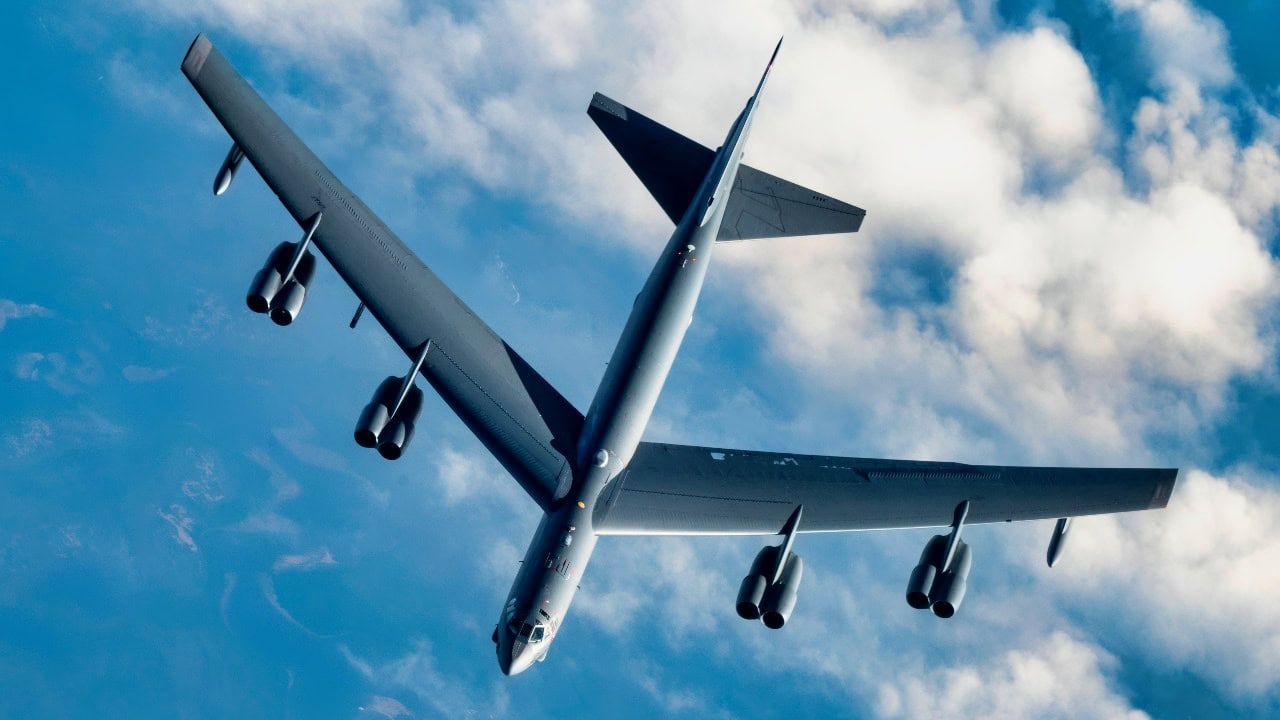
A U.S. Air Force B-52 Stratofortress departs after being refueled by KC-135 Stratotanker over the Pacific Northwest July 18, 2024. The 92nd Air Refueling Wing and 141st ARW’s ability to rapidly generate airpower at a moment’s notice was put to the test when Air Mobility Command’s Inspector General team conducted a no-notice Nuclear Operational Readiness Inspection, July 16–18, 2024. During the NORI, Airmen demonstrated how various capabilities at Fairchild AFB enable units to generate and provide, when directed, specially trained and equipped KC-135 Stratotanker aircrews to conduct critical air refueling of U.S. Strategic Command-assigned strategic bomber and command and control aircraft. (U.S. Air Force photo by Staff Sgt. Lawrence Sena)
No Clean Ending
There is a tendency, especially in Washington, to look for the moment when a war can be declared over—a line you can point to, a statement you can make. Nothing about this war suggests that kind of ending is coming soon.
The United States has demonstrated, again, that it can break a state’s military infrastructure from the air, faster and more precisely now than at any point in its history. What this war is making harder to ignore is what comes next—or rather, what doesn’t.
America can keep breaking things from the air. Ending the fight on terms it can live with is something else entirely.
About the Author: Dr. Andrew Latham
Andrew Latham is a professor of international relations and political theory at Macalester College in Saint Paul, MN. You can follow him on X: @aakatham. He writes a daily column for 19FortyFive.com.