
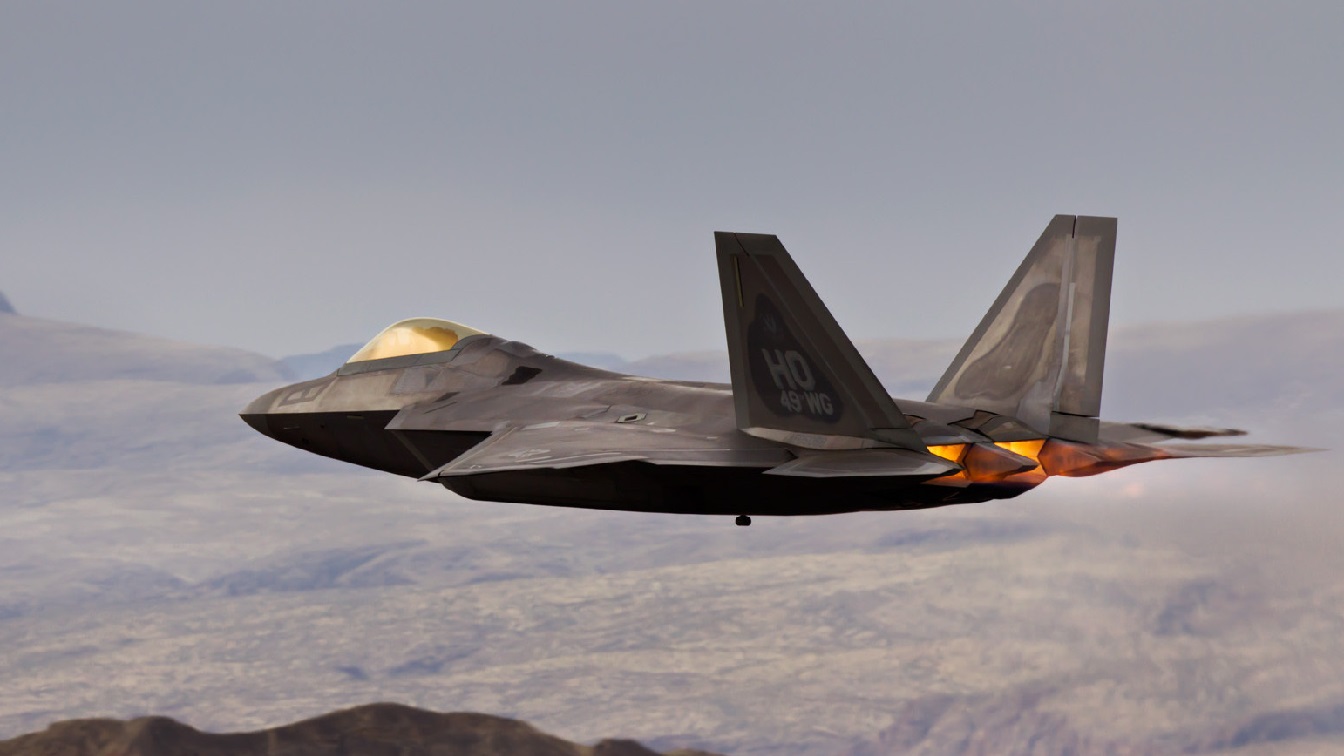
Summary and Key Points: Jack Buckby, a defense analyst specializing in strategic competition, evaluates the combat performance of F-22 and F-35 fighters during Operation Epic Fury.
-Contrasting the 2018 Ørland Air Base exercises with the 2026 Iran conflict, Buckby analyzes how early NATO integration drills paved the way for successful decapitation strikes against Iranian leadership, including Ayatollah Khamenei.
-This 19FortyFive report explores the synergy between the F-22’s air superiority and the F-35’s sensor fusion, concluding that the once-simulated dogfights have transitioned into a high-stakes regional campaign that validates the airframe maturity and networked capabilities of the fifth-generation fleet.
How F-22 and F-35 Doctrine Evolved from Norway 2018 to the 2026 Iran Air War
As the United States and Israel wage a coordinated air campaign against Iran that offers the chance of dramatically reshaping the politics of the Middle East – including strikes deep into Tehran and exchanges of missiles and drones throughout the region – advanced combat aircraft are proving their worth in real-world conflict.
Joint operations by Israel and U.S. forces have so far killed senior Iranian leaders, including Supreme Leader Ayatollah Ali Khamenei, and prompted Iranian missile response against Israel and U.S. bases in the Gulf.
This real-world use of advanced aircraft stands in stark contrast with a now-seven-year-old NATO training exercise that brought together two U.S. Air Force F-22 Raptors (a platform that has since been deployed to the Middle East as part of Operation Epic Fury) and two Norwegian Air Force F-35s over Norway. The exercise was considered a simulated dogfight at the time: a rehearsal of allied integration and deterrence missions. Back then, reports revealed that the simulation didn’t result in a winner or a loser – or, at least, no winner or loser was announced. But in 2026, the stakes are real – and so far, the U.S. is proving that both of these advanced fighter jets are just as capable as the simulations suggested they are.
What Happened In Norway in 2018
In August 2018, two U.S. F-22 stealth fighters and two of Norway’s newly delivered F-35A Lightning IIs conducted a series of simulated dogfights over Ørland Air Base, Norway, as part of a short-term U.S. deployment intended to bolster NATO’s deterrent posture.
The goal of the exercise was to strengthen the NATO alliance and increase its deterrence power. The Raptors were part of a larger rotation of 13 U.S. Air Force F-22s operating in Europe at the time, taking part in training missions in Greece, Poland, and other locations.
Photographs that accompanied reports about the exercise showed the F-22s receiving fuel from a KC-135 tanker over Norwegian airspace en route to Ørland, demonstrating the logistical complexity if deploying these advanced fighters over long distances.
The decision to host the exercise in Norway was made because Ørland is home to six of the Scandinavian country’s planned fleet of 52 F-35As at a time when Norway was rapidly building its fifth-generation airpower at NATO’s northern flank.
Norwegian F-35 pilot Maj. Morten Hanche told Reuters he would not name a winner, instead saying only that the F-22 was “a very formidable opponent.”
What It Meant Then
The Norway event was fairly significant. Col. Lesie Hauck, the chief of the U.S. Air Force’s fifth-generation integration division in Europe, told Reuters that the one-day exercise was intended to lay the groundwork for allied integration of the platform’s stealth capabilities.
“Every training opportunity that we have betters our readiness for any potential adversary of the future,” Hauck told the outlet.
1At the time, the United States had announced plans to base F-35s in Europe, with the first U.S. F-35s expected to arrive on the continent in 2021 under a deliberately phased deployment aimed to reassure allies after Russia’s 2014 annexation of Crimea. Norway, Denmark, Italy, Turkey, Israel, Britain, and the Netherlands were listed as countries set to compare notes on the F-35 in upcoming meetings at a time when the F-35 was becoming the chosen platform for allied integration. At the same time, though, the F-35 program was still off to a shaky start, amid cost growth and a series of technical challenges – problems that have not entirely gone away.
Where Things Stand Today
Fast forward to 2026, and many more countries operate or have ordered F-35s. Norway completed delivery of its planned fleet of 52 F-35As in 2025, becoming the first partner nation to fulfill its program of record. Germany has decided to buy dozens of F-35s in a major post-Ukraine reset, extending stealth integration much deeper into Europe. Finland also selected the F-35 as its replacement for legacy fighters.

An F-35A Lightning II flown by a 65th Aggressor Squadron (AGRS) pilot takes off for its first flight with a new paint scheme at Nellis Air Force Base, Nevada, May 26, 2022. The mission of the 65 AGRS is to know, teach and replicate fifth-generation air adversaries tactics. (U.S. Air Force photo by Airman 1st Class Josey Blades)
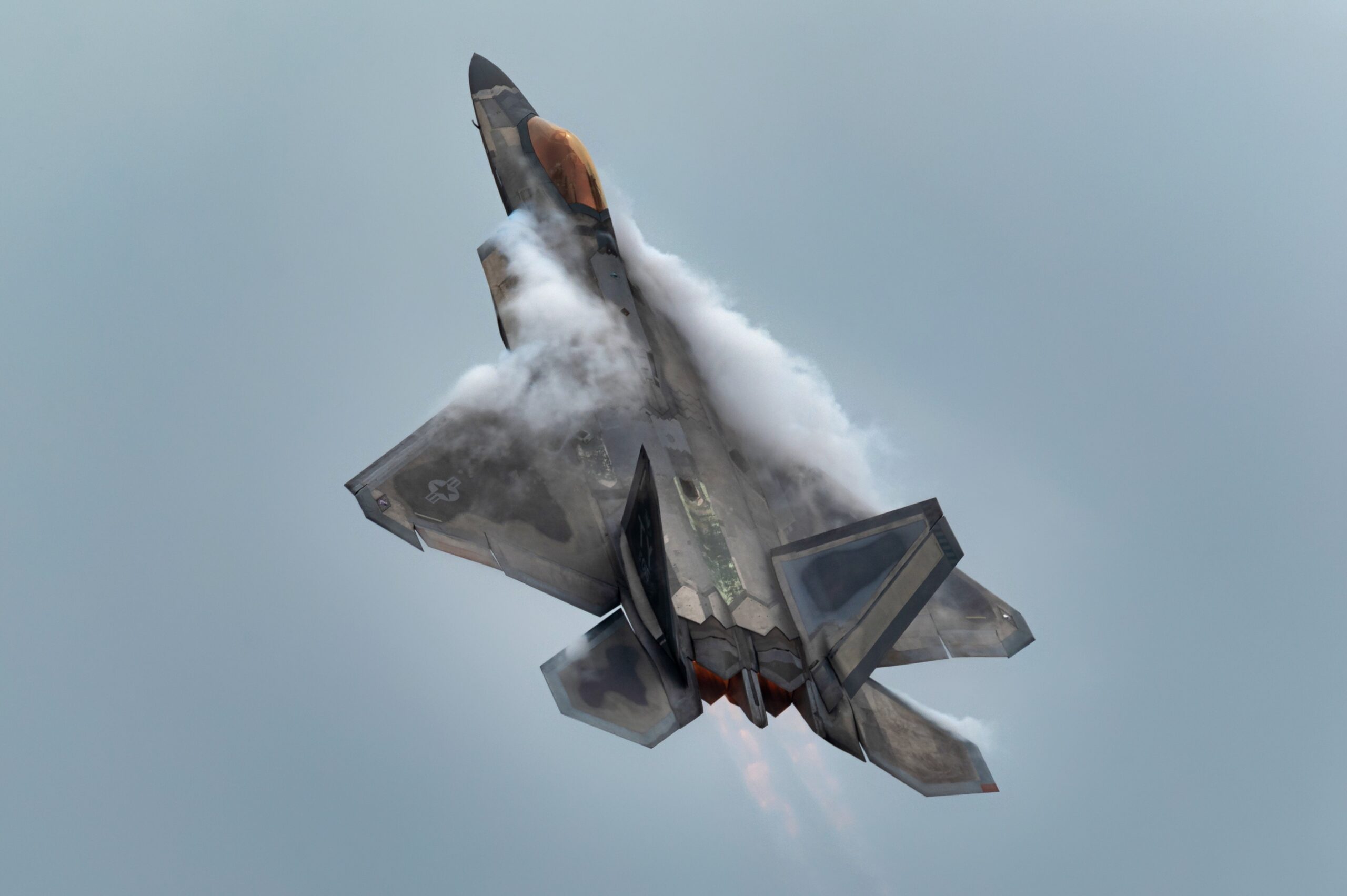
U.S. Air Force Maj. Josh Gunderson, F-22 Demo Team commander, performs maximum power takeoff during a demonstration for the 67th National Security Forum at Maxwell-Gunter Air Force Base, Montgomery, Alabama, May 11, 2021. The F-22 Raptor’s two Pratt and Whitney F119 Turbofan engines bring a combined 70,000 pounds of thrust, allowing the aircraft to takeoff straight into the vertical. (U.S. Air Force photo by Staff Sgt. Don Hudson)
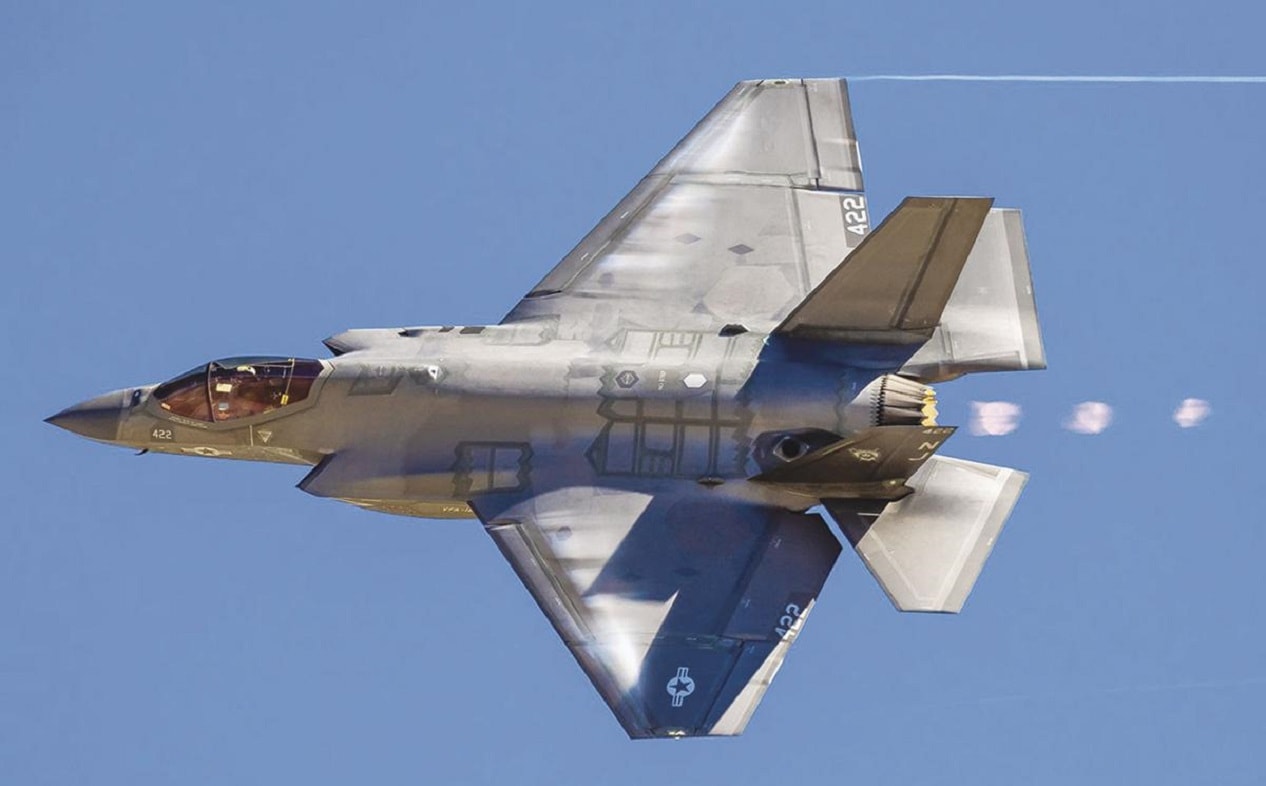
F-35. Image: Creative Commons.
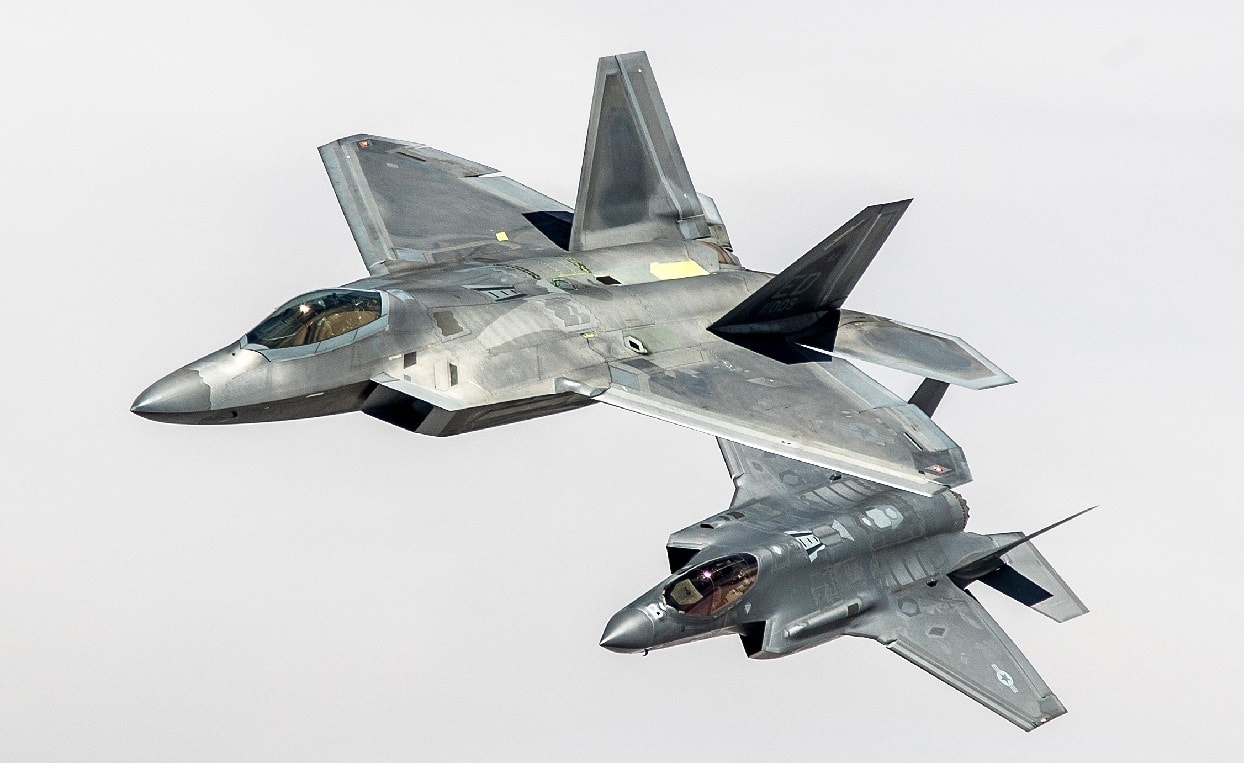
IFG Family Photo, F-22, A/C 4009, LtCol Lee “Split” Bryant, F-35A, AF-3, Major Jonathan “Spades” Gilbert, F-16D, A/C 835, Major Charles Brantigan & Major Scott “Gins” Rinella, in formation over ISB, Tanker View, 15 May 2019
Today, those aircraft are far more than training assets. In the Iran conflict initiated on February 28, 2026, fifth-generation aircraft have been used to strike high-value targets deep within Iran, including leadership and strategic command infrastructure, and to suppress air defenses ahead of further operations.
Iran’s response has included missile and drone attacks across Israeli territory, U.S. bases in the Gulf, and civilian infrastructure across various Gulf states.
Why the 2018 Exercise Still Matters
The 2018 Norway exercise matters now because it was an early, intentional test of how Western allies planned to integrate stealth fighters into a coherent deterrent and operational framework capable of fighting wars – a framework that is now being stress-tested in real combat conditions.
The F-22 remains the U.S. Air Force’s premier air superiority platform, designed for stealth, supercruise, and combat agility, and continues to shape doctrine for contested airspace engagements. Meanwhile, the F-35 – a multirole fighter designed for sensor fusion and networked operations – has become the backbone of NATO’s stealth fleet.
In less than ten years, the same aircraft that once conducted training sorties over Norway have been positioned for combat operations against Iran, including forward deployment of F-22s to Israel and F-35s striking Iranian targets.
About the Author: Jack Buckby
Jack Buckby is a British researcher and analyst specialising in defence and national security, based in New York. His work focuses on military capability, procurement, and strategic competition, producing and editing analysis for policy and defence audiences. He brings extensive editorial experience, with a career output spanning over 1,000 articles at 19FortyFive and National Security Journal, and has previously authored books and papers on extremism and deradicalisation.