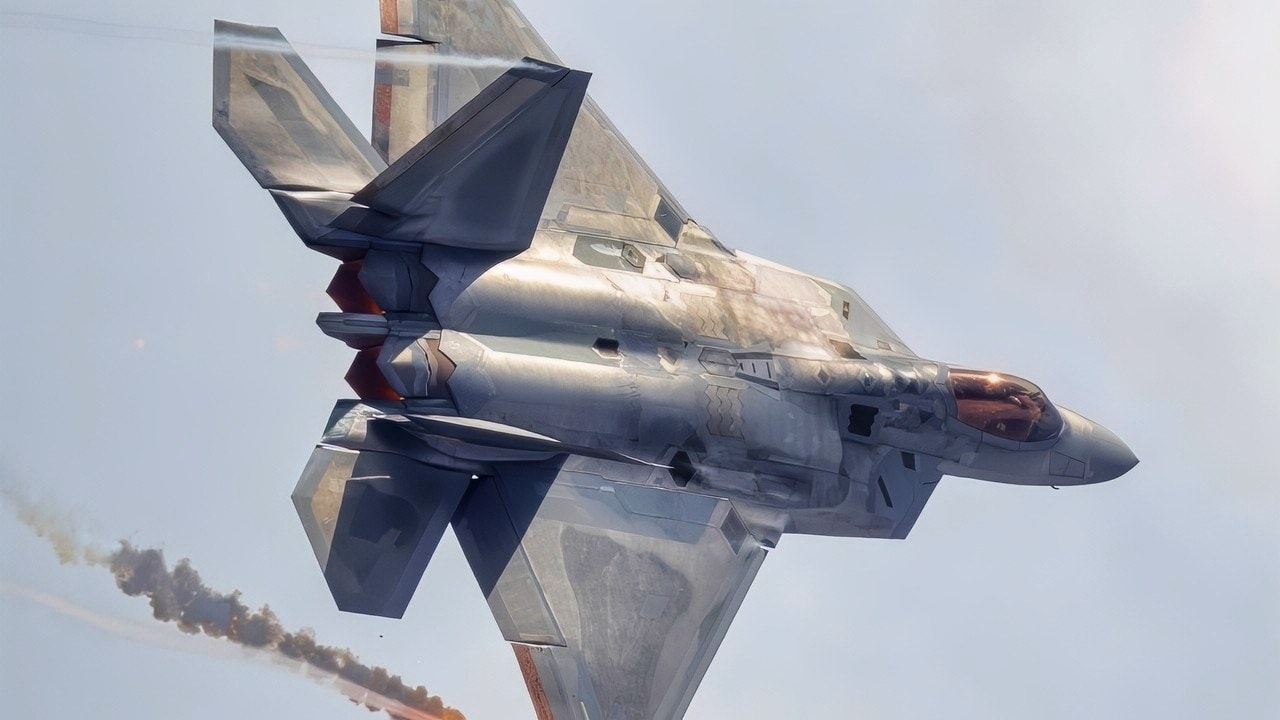
Summary and Key Points: Journalist Georgia Gilholy evaluates the U.S. Air Force’s latest F-22 Raptor modernization, dubbed “Raptor 2.0,” unveiled at the 2026 AFA Warfare Symposium.
-To counter the Indo-Pacific “tyranny of distance,” Lockheed Martin is integrating faceted low-drag external fuel tanks (LDTP) and underwing Infrared Search and Track (IRST) pods.
-These upgrades extend the fighter’s combat radius to over 800 miles without sacrificing its VLO stealth signature.
-By providing passive detection for threats like China’s J-20, as analyzed by Aaron Spray, the Raptor 2.0 serves as a critical technology bridge until the Boeing F-47 (NGAD) enters service.
Closing the Pacific Gap: How the F-22 Raptor 2.0 Solves the Tyranny of Distance
The F-22 Raptor was built for air dominance, but for years, there were questions about how its range would hold up if war erupted in the Indo-Pacific.
Now, if a new Lockheed Martin scale model unveiled at the Air & Space Forces Association’s Warfare Symposium is any guide, the U.S. Air Force is trying to fix that without giving up too much of the jet’s signature stealth advantage.
According to The War Zone, the updated “Raptor 2.0” configuration features faceted low-drag external fuel tanks and underwing infrared search-and-track pods, offering the clearest look yet at how the F-22 will be reshaped for the final stretch of its service life.
The new tanks matter because the F-22’s short-legged reputation has long sat uneasily beside the enormous distances of the Indo-Pacific.
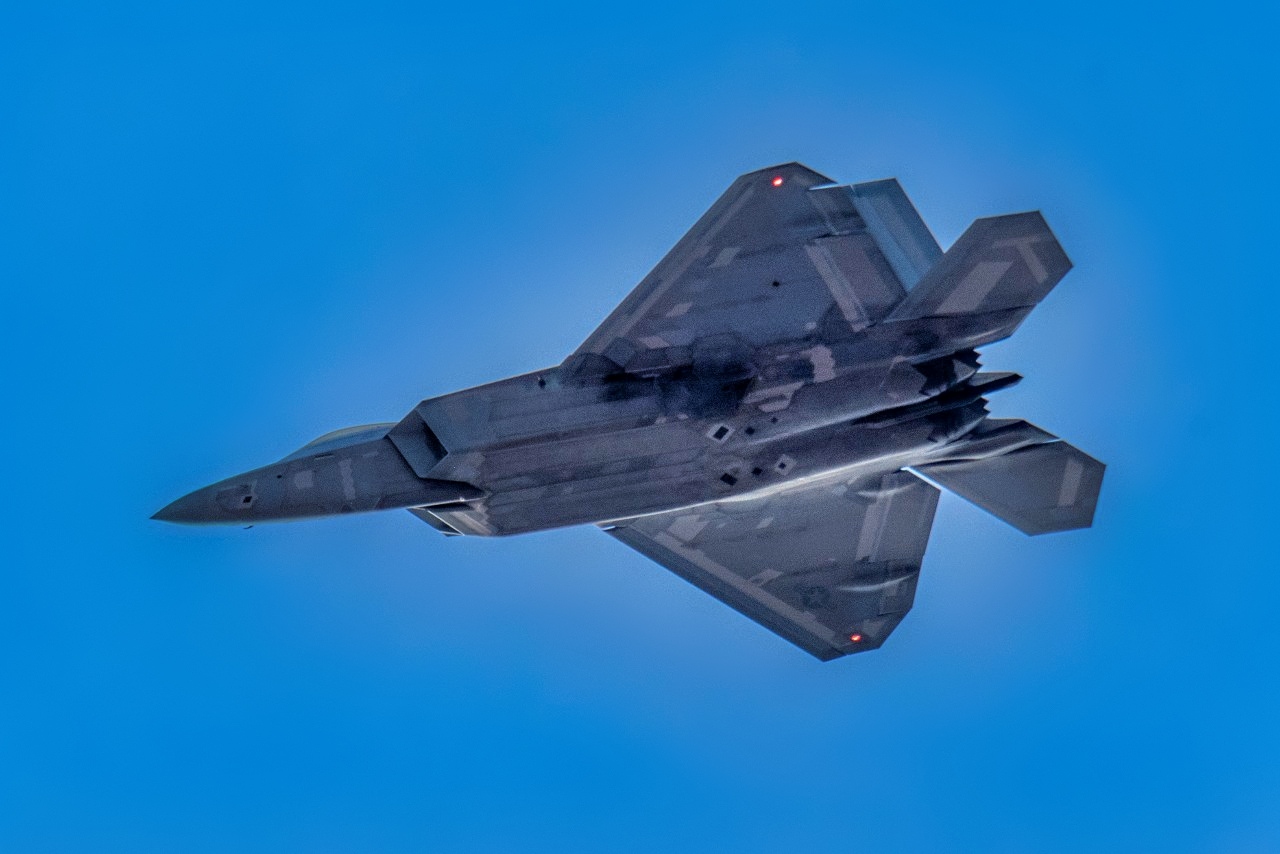
A U.S. Air Force F-22 Raptor assigned to the 3rd Wing conducts aerial practices at Joint Base Elmendorf-Richardson, Alaska, March 28. The F-22 is an American twin-engine, all-weather, supersonic stealth fighter aircraft and provides power projection across the Indo-Pacific region. (U.S. Air Force photo by Airman 1st Class Tala Hunt)
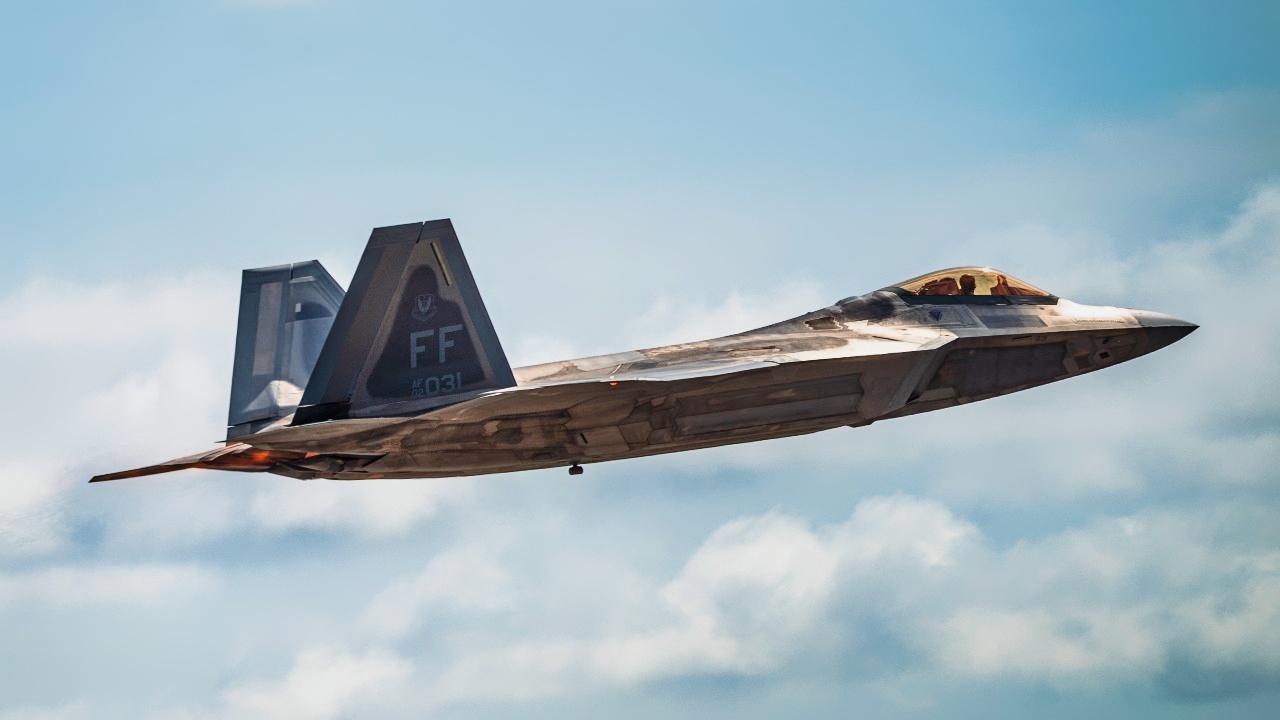
A U.S. Air Force F-22 Raptor assigned to the 71st Fighter Squadron, Joint Base Langley-Eustis, Virginia, takes off during Checkered Flag 25-2 at Tyndall Air Force Base, Florida, May 8, 2025. Air Combat Command’s Checkered Flag exercise simulates the full mobilization and deployment cycle, ensuring unit readiness for contingency operations. (U.S. Air Force photo by Airman 1st Class Zeeshan Naeem)

The F-22 Raptor Demonstration Team uniform is worn during a practice demonstration at Langley Air Force Base, Virginia, Nov. 13, 2025. The all-black flight suit is a signature look for Air Combat Command demonstration teams. (U.S. Air Force photo by Staff Sgt. Lauren Cobin)
The Air Force’s own fact sheet says the aircraft has a ferry range of more than 1,850 miles with two external tanks, but legacy tanks come with a significant trade-off.
These jets were far from ideal in high-threat airspace, down to the distinct radar signature penalty they imposed.
The stealthier new tanks are intended to ease exactly that problem. Lockheed even expects Raptors to roll into full-on combat in some scenarios with the new tanks still attached.
The model’s infrared search-and-track pods are just as cutting-edge, allowing the F-22 to find and track aircraft without relying solely on radar emissions.
In its FY2025 budget, the Pentagon explicitly noted that advanced IRST sensors will boost detection and targeting of threat aircraft in electronic attack scenarios.
In layman’s terms, the Raptor is being adapted for a battlespace where Chinese aircraft such as the J-20 are part of the central planning problem.
That makes the timing especially interesting.
In a recent comparison of the F-22 and China’s J-20, Simple Flying journalist Aaron Spray argued that the Chinese jet’s long reach is one of its defining strengths, particularly in threatening the tankers and airborne early-warning aircraft on which U.S. airpower depends.
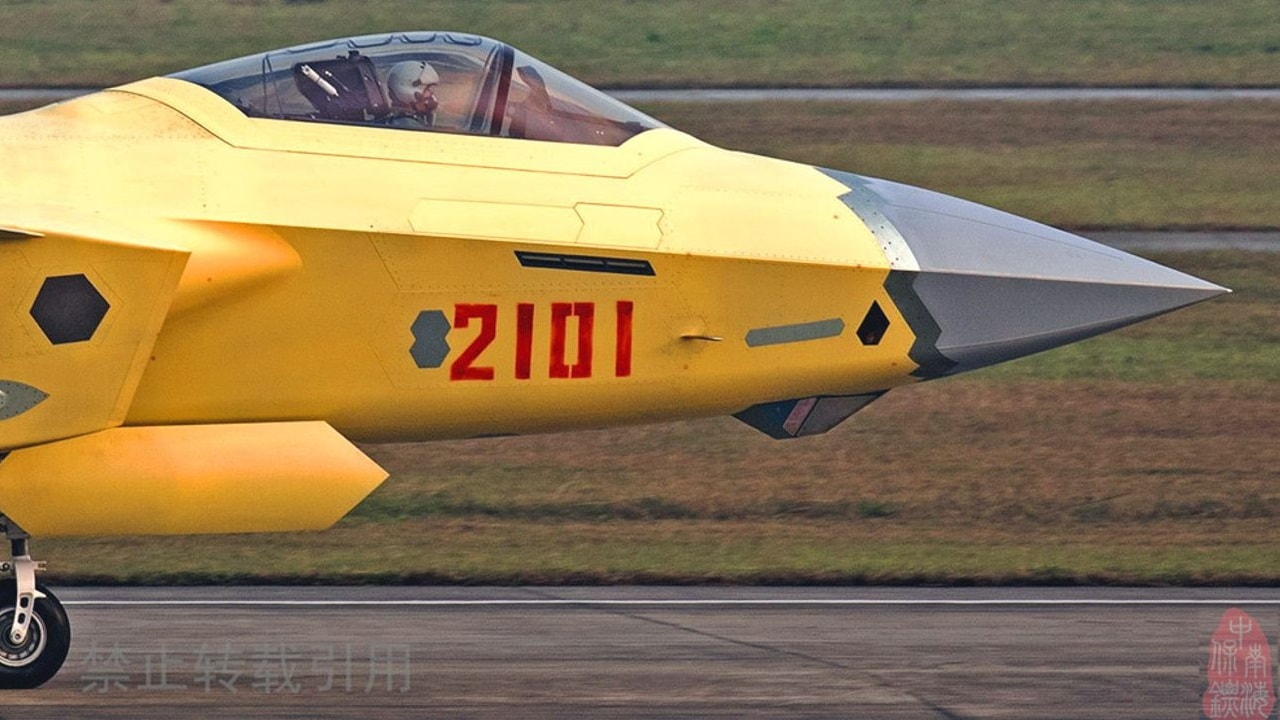
J-20 Stealth Fighter. Image Credit: Chinese Military.
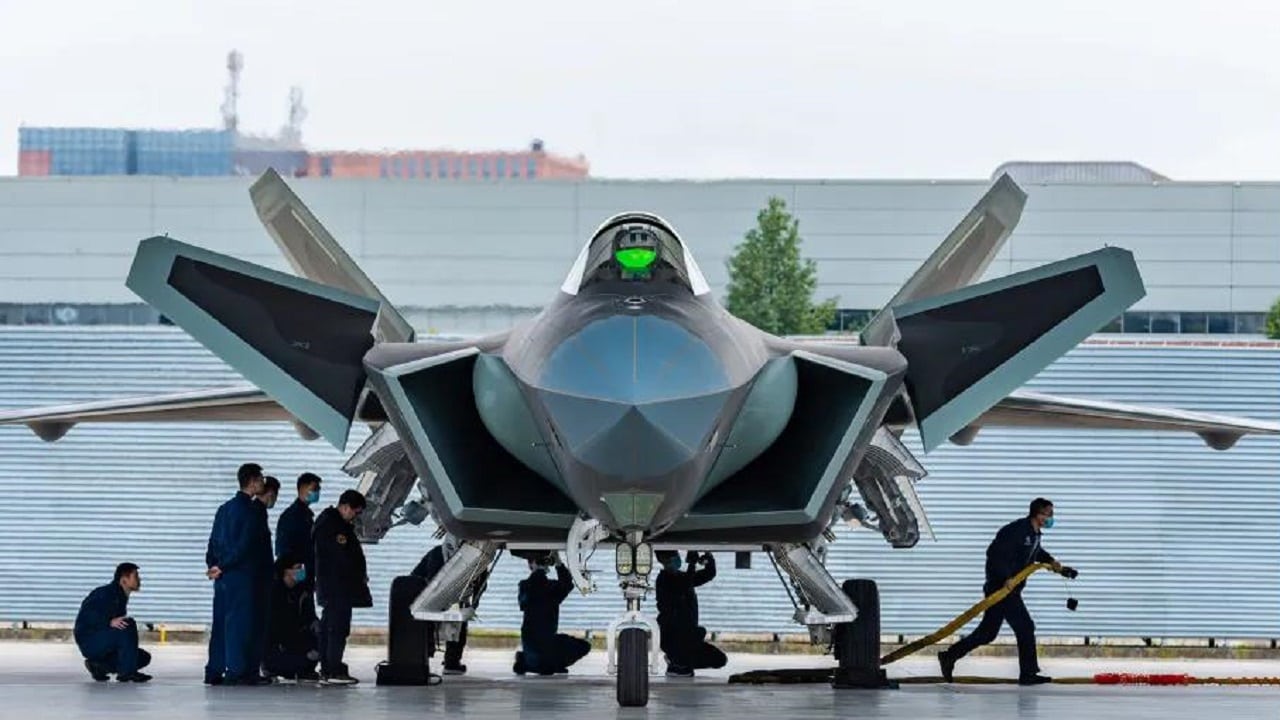
J-20. Image Credit: Chinese Internet.
Whether or not one accepts every part of that comparison, the broader point stands: the Air Force is clearly trying to make its small F-22 fleet more survivable and more relevant in a theatre where distance is tyranny.
The F-22 remains, according to the Air Force’s own description, unmatched in its blend of stealth, maneuverability, and avionic integration.
Still, the jet must serve as both a frontline asset and a technology bridge to the future F-47.
It seems all the more like the U.S. is keen to squeeze more life out of a tiny fleet because it has little choice.
About the Author: Georgia Gilholy
Georgia Gilholy is a journalist based in the United Kingdom who has been published in Newsweek, The Times of Israel, and The Spectator. Gilholy writes about international politics, culture, and education. You can follow her on X: @llggeorgia.