
The Russian Navy Is Going All In on the New Yasen-Class Submarine: The U.S. Navy Is Watching
Russia is moving to replace its entire fleet of third-generation nuclear-powered attack submarines with a smaller number of advanced fourth-generation boats, in a sweeping overhaul that will be complete within the next ten years.
The plan was confirmed on March 19, 2026, by Aleksandr Moiseyev, Commander-in-Chief of the Russian Navy, who said the transition would see legacy Soviet-era submarines phased out in favor of Project 885 Yasen and Project 885M Yasen-M units over the next decade.
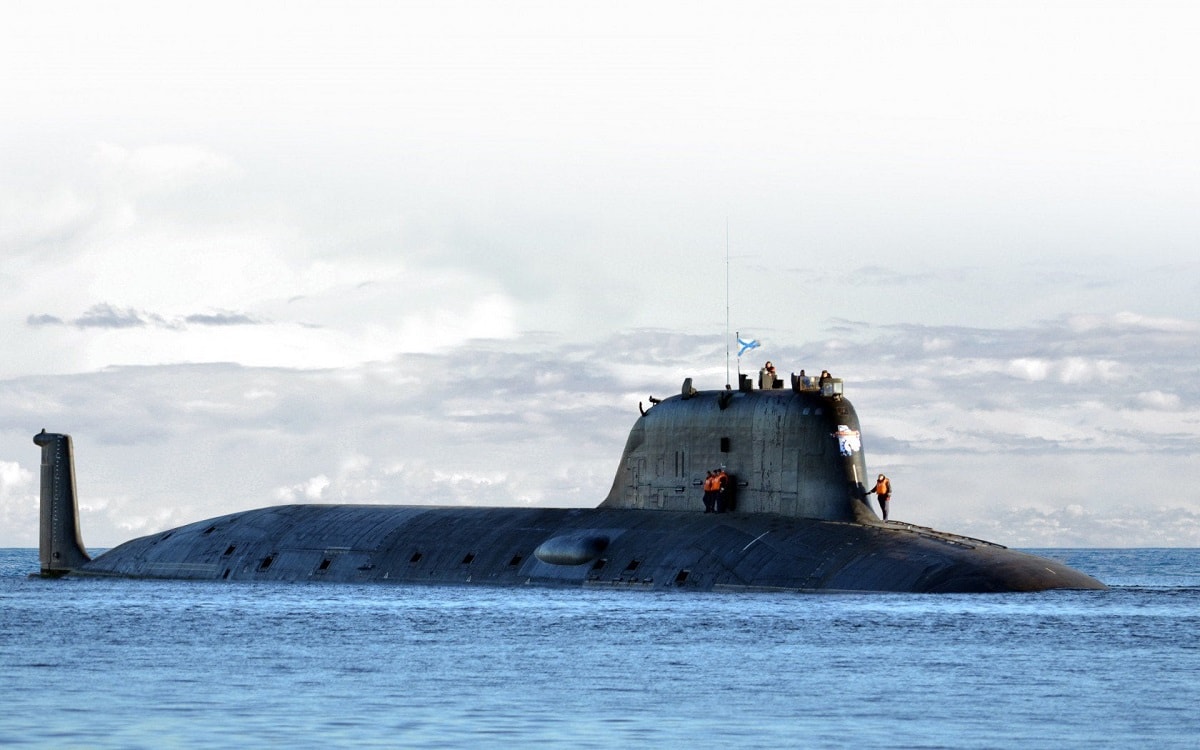
Yasen-Class Submarine. Image Credit: Russian Federation.
“As for multipurpose submarines, the main and promising project – Yasen / YasenM, designed by the SPMBM Malachite USC, will replace in the next decade all the third-generation nuclear submarines available in the Navy: 971st, 945th, 949th projects,” Moiseyev told the Krasnaya Zvezda newspaper.
The decision will see the retirement of several long-serving submarine classes, including the Akula, Sierra, and Oscar-II, many of which entered service between the mid-1980s and late 1990s.
In their place, Russia aims to field a standardized fleet of roughly 10 to 12 Yasen-type submarines, reducing overall hull numbers while significantly increasing each unit’s capability.
The decision is part of an ongoing focus on expanding Russia’s stealthy, long-range strike platforms operating below the surface – a decision that seems to be overshadowing efforts to expand the visible surface fleet.
The implications are significant, too. Russia would not simply be modernizing aging equipment, as it has a tendency to do – especially amid the war in Ukraine – but instead restructuring its naval force around a smaller number of multi-role submarines capable of launching cruise and hypersonic missiles.
The subs will also conduct anti-submarine warfare, operating across key theaters such as the Arctic, the North Atlantic, and the Pacific. The news comes as undersea warfare becomes increasingly central to great power competition, with the United States and China investing heavily in next-generation submarine fleets.
The Soviet-Era Submarines Russia Is Phasing Out
The submarines being retired under the new plan were designed for a very different strategic environment than the one we face today. During the Cold War, the Soviet Union built a large and diverse submarine fleet tailored to specific mission sets, rather than a single flexible platform.
The Project 971 Akula-class submarines were developed primarily for anti-submarine warfare, intended to track and counter U.S. Navy ballistic missile submarines and carrier strike groups. Introduced in the 1980s, the Akula represented a significant improvement in quietness over earlier Soviet designs, narrowing the acoustic gap with U.S. submarines for the first time.
The Project 949A Oscar-II class, meanwhile, was built as a dedicated anti-carrier platform. The large submarines were equipped with P-700 Granit cruise missiles designed to overwhelm U.S. carrier defenses, and their role reflected Soviet doctrine at the time, which aimed to counter U.S. naval power through concentrated, high-volume strikes.
The Project 945 and 945A Sierra-class submarines featured titanium hulls, allowing for deeper diving and improved survivability – though those features came at a high cost. Not only were they more expensive, but they were also more complex to build and maintain.
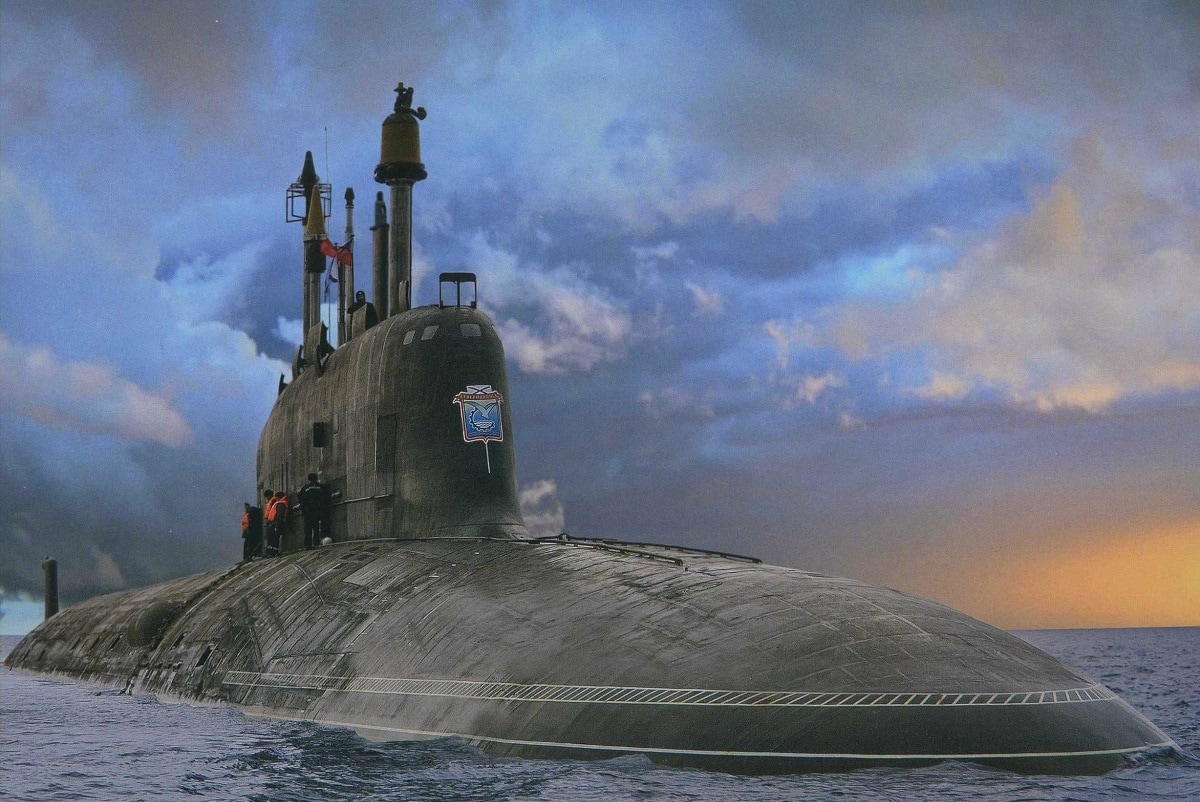
Yasen-Class. Image: Creative Commons.
The submarines were effective for their time, but their limitation have become increasingly apparent. Many now rely on aging nuclear reactors and legacy electronic systems, and the platform-specific logistics chains for each submarine mean maintenance and sustainment are complex.
They are also less flexible in modern operations, as the submarines were designed for very specific roles that are no longer entirely relevant.
Russia, then, is currently maintaining a fleet that was built for Cold War conditions. These vessels are large and specialized, but they are becoming increasingly difficult to sustain – and that’s all happening at a time when naval warfare is shifting toward multi-role platforms and long-range precision strike capabilities.
The Yasen-Class That Will Replace Them
The Project 885 Yasen and improved Project 885M Yasen-M submarines that will form the backbone of Russia’s new fleet are the product of an entirely different design philosophy. Rather than specializing in a single mission, these submarines are intended to combine the roles of different naval assets, ranging from cruise missile carriers and attack submarines to anti-ship platforms.
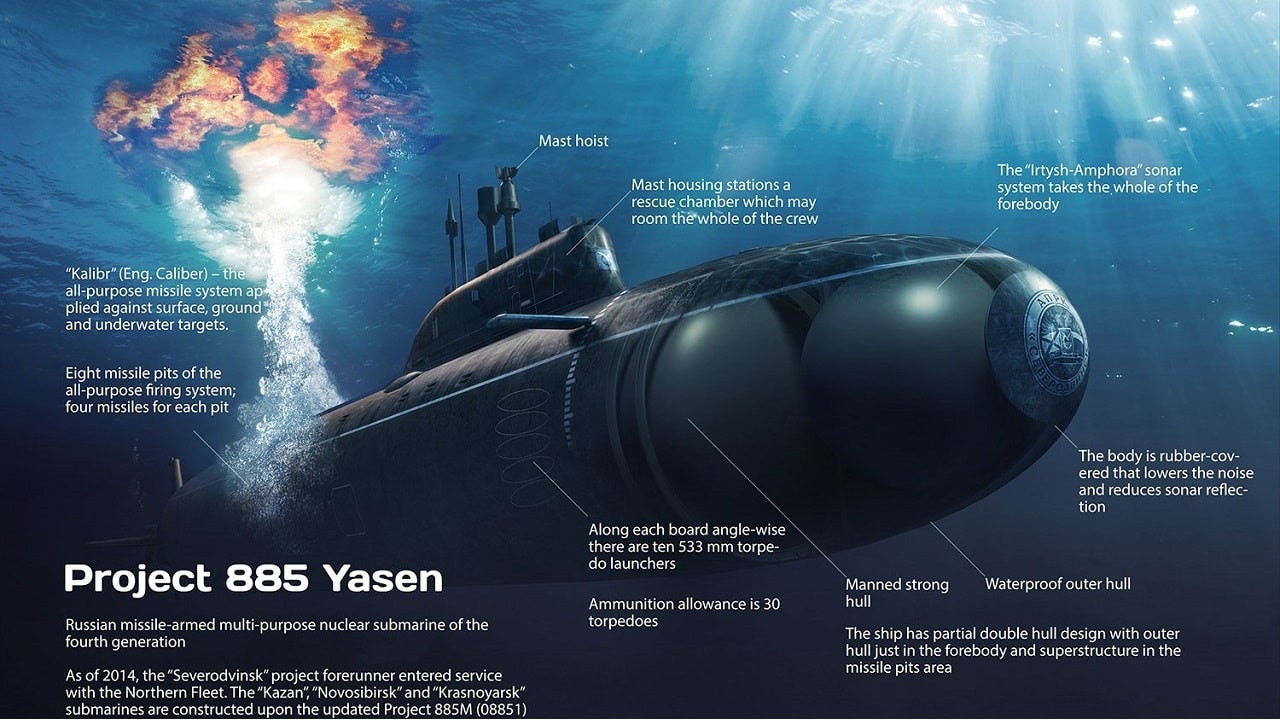
All of these capabilities are intended to be packaged neatly into a single undersea vessel. Each Yasen-class submarine is equipped with a vertical launch system capable of carrying up to 32 cruise missiles, including Kalibr land-attack missiles with ranges exceeding 1,500 kilometers, Oniks anti-ship missiles, and the newer Zircon hypersonic missile, which Russia has been integrating into naval platforms since the mid-2020s.
Those features allow a single submarine to conduct long-range strikes against land targets and engage surface vessels while operating in contested maritime environments. It means the Russian Navy will no longer need to rely on dedicated platforms for every mission. In addition to its missile systems, the Yasen-class carries ten 533 mm torpedo tubes capable of deploying torpedoes and anti-submarine weapons.
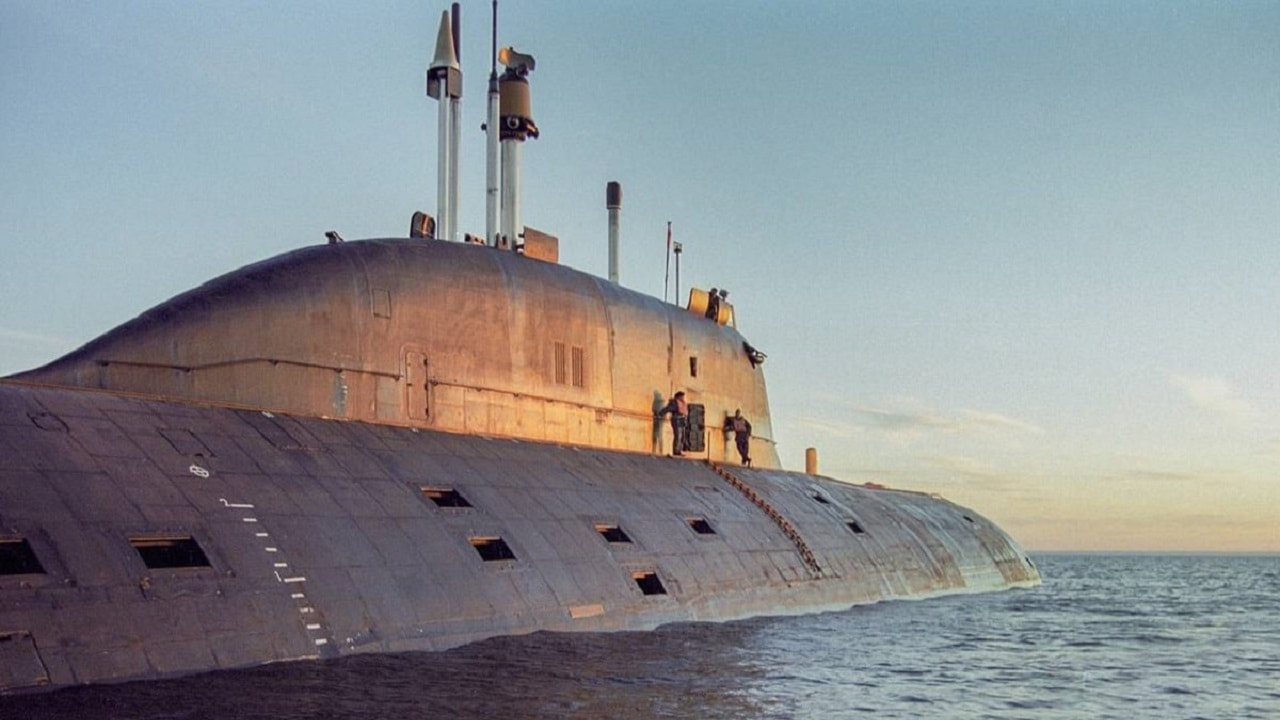
Yasen-Class. Image Credit: Creative Commons.
Central to the design of the new ships is stealth and its detection capabilities. The submarines use anechoic coatings to reduce sonar reflections, have low-magnetic steel hulls, and use advanced reactor cooling systems that can operate on natural circulation to minimize noise. Their sonar suite also includes a large spherical bow array, flank arrays along the hull, and a towed array for long-range detection, all of which significantly improve situational awareness over older designs.
Automation also means crew requirements are now less demanding. While earlier submarines often required crews of 80 men or more, the Yasen-M variant operates with around 60 to 65 personnel.
The result is a platform that brings together multiple mission sets into a single, versatile submarine, allowing Russia to reduce the number of hulls it operates while increasing its overall capabilities.
Can Russia Build the Fleet It Wants?
While the design of the Yasen-class represents an obvious leap forward, the question is whether Russia can produce enough of these submarines to meet its stated goals within the proposed timeline.
The Sevmash shipyard in Severodvinsk is responsible for the construction of the Yasen and Yasen-M submarines.
This is Russia’s primary facility for nuclear submarine production, and as of 2026, one Yasen submarine and several Yasen-M submarines are currently in service. Additional boats are under construction, but production timelines have been historically long.
The lead Yasen-class submarine, Severodvinsk, took well over a decade to complete, while subsequent units have been built more quickly, with timelines closer to 8 years.
Output remains limited, with Russia typically producing one nuclear submarine per year or fewer.
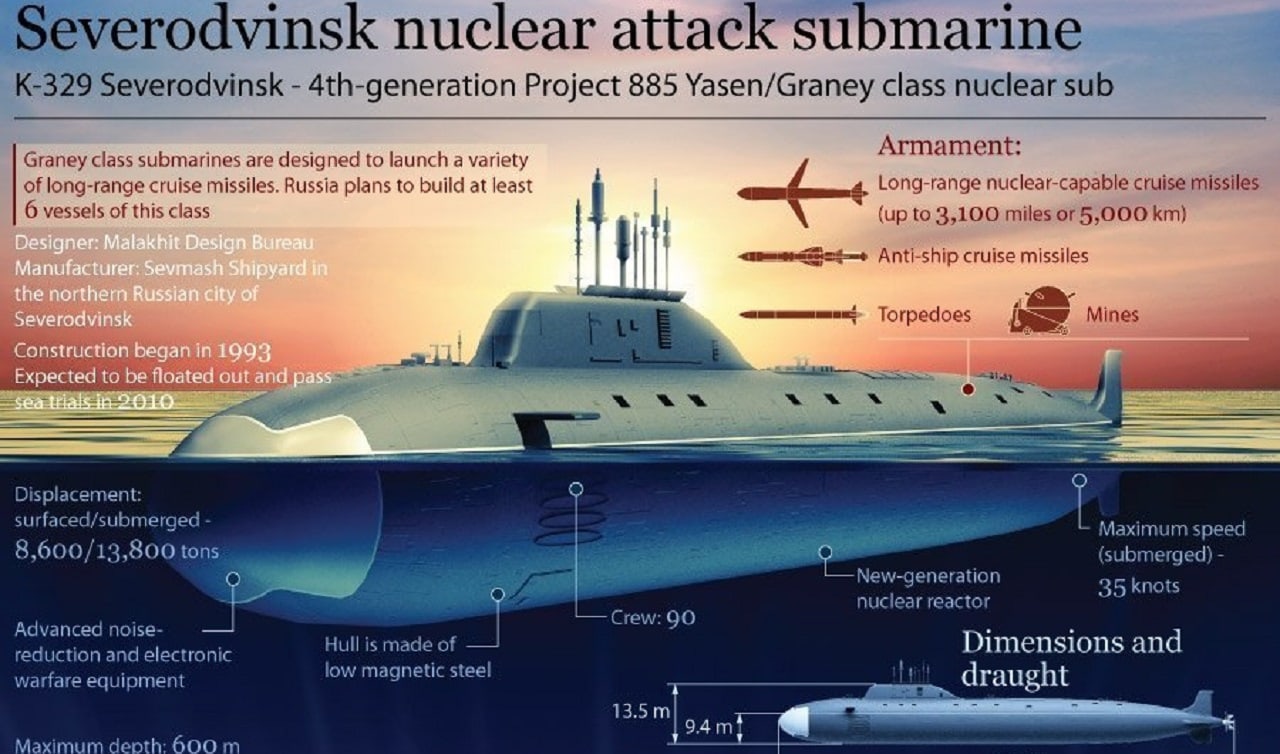
Yasen submarine diagram from Russian state media.
Nuclear submarines are among the most complex systems any country builds, and replacing an aging fleet requires a sustained production rate high enough to offset retirements – and even the United States has struggled to meet its own target of building two attack submarines annually.
For Russia, the challenge is even bigger: construction is concentrated at a single primary yard and has historically been slowed by supply chain bottlenecks, sanctions, workforce limitations, and the technical demands of both nuclear propulsion and advanced stealth systems.
Sanctions imposed after 2014, which were expanded following the invasion of Ukraine in 2022, have complicated access to many components and technologies – and with all that in mind, it remains to be seen how easily Russia can scale production to replace dozens of legacy boats quickly enough.
MORE – The 5 Letter Word That Makes the Ford-Class Aircraft Carrier Worth Every Penny
About the Author: Jack Buckby
Jack Buckby is a British researcher and analyst specialising in defence and national security, based in New York. His work focuses on military capability, procurement, and strategic competition, producing and editing analysis for policy and defence audiences. He brings extensive editorial experience, with a career output spanning over 1,000 articles at 19FortyFive and National Security Journal, and has previously authored books and papers on extremism and deradicalisation.

