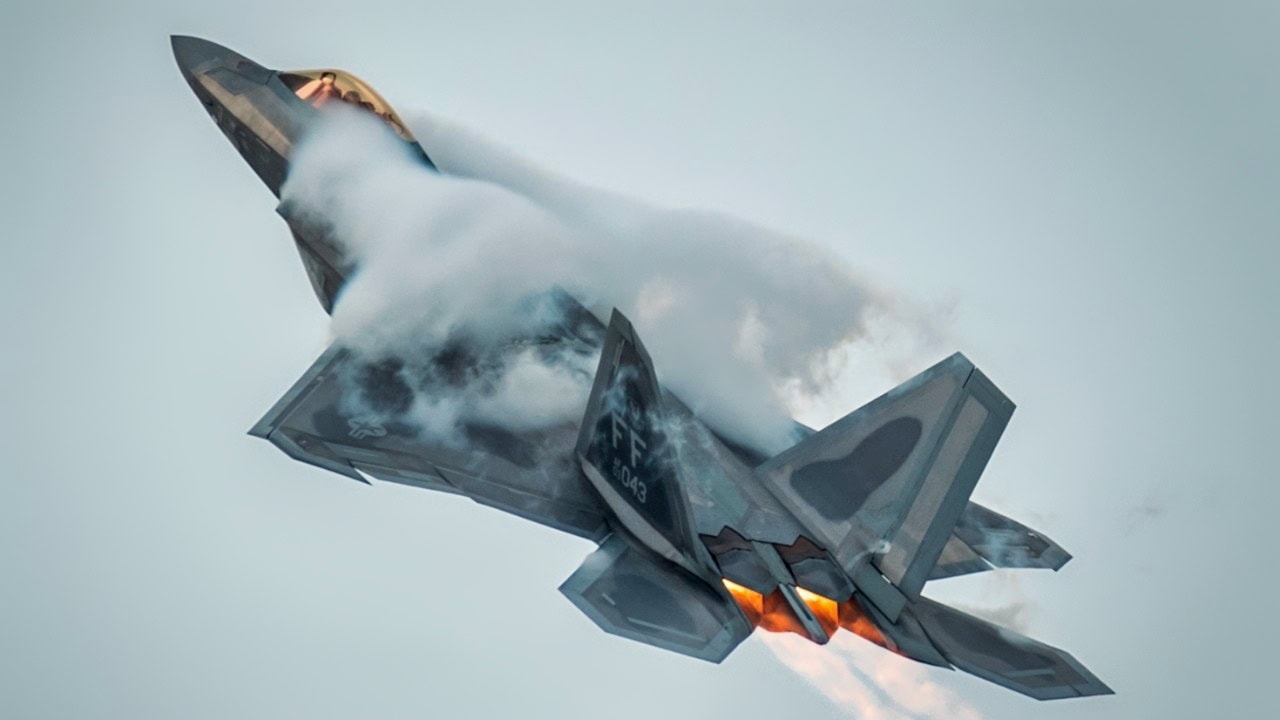
Summary and Key Points: Reuben F. Johnson, Director of Research at the Casimir Pulaski Foundation, evaluates the catastrophic losses suffered by the Islamic Republic during the opening days of Operation Epic Fury.
-The reported deaths of Supreme Leader Ayatollah Ali Khamenei, IRGC commander General Mohammad Pakpour, and former president Mahmoud Ahmadinejad mark the total decapitation of Tehran’s leadership.
-This 19FortyFive report analyzes the tactical shift from the 2025 Operation Midnight Hammer to a nationwide air campaign targeting 24 provinces, evaluating the effectiveness of 200 IDF and USAF jets in dismantling Iran’s missile industry and air defense infrastructure.
Operation Epic Fury: The Total Decapitation of Iran’s Clerical and Military Leadership
This past weekend’s combined US and Israeli strikes on Iran’s critical government nodes and military facilities have already racked up a significant list of losses for the Islamic Republic of Iran’s leadership.
Among those killed in what was described as an “all hands on deck” meeting of the nation’s most senior officials were Iran’s clerical Supreme Leader Ayatollah Ali Khamenei, Iran’s Defence Council secretary Ali Shamkhani, Defence Minister Brigadier General Aziz Nasirzadeh, and Islamic Revolutionary Guard Corps (IRGC) commander General Mohammad Pakpour.
In all, some 40 senior figures died in this strike on the Iranian government’s leadership compound.
Among others reported killed were the controversial hardliner and former president of Iran (2005-2013) Mahmoud Ahmadinejad.
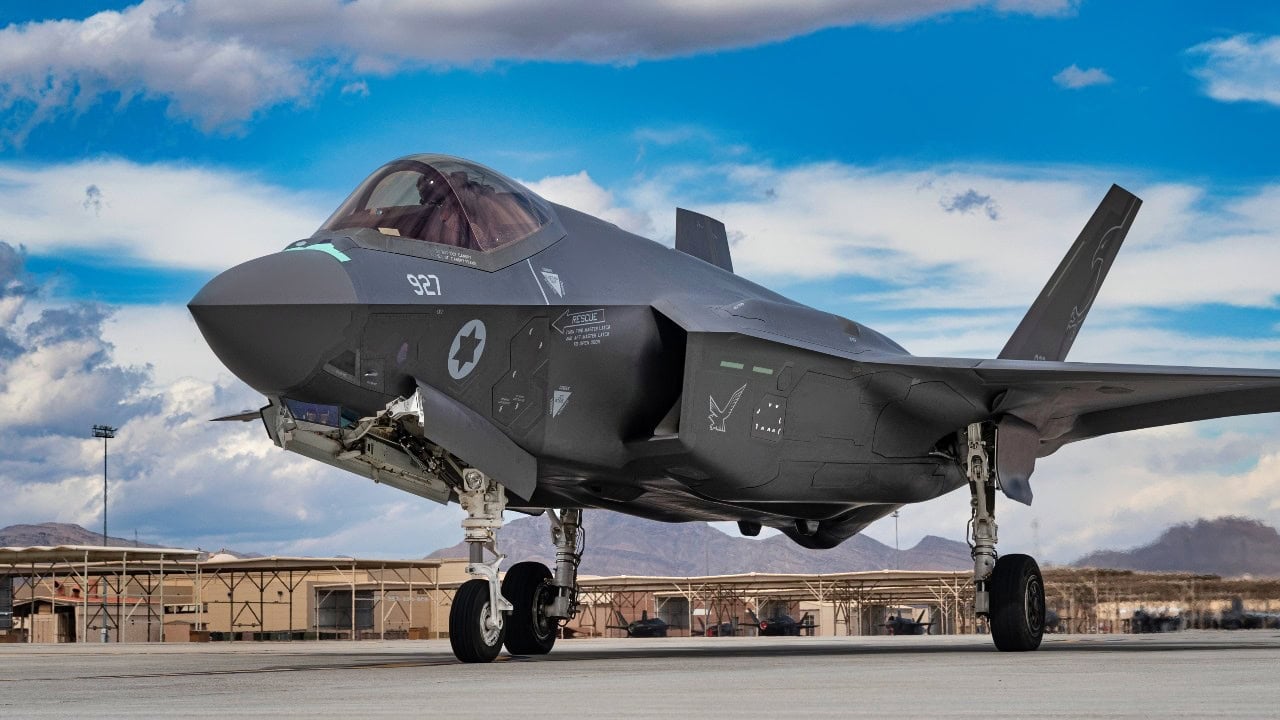
F-35I Adir Fighter from Israel
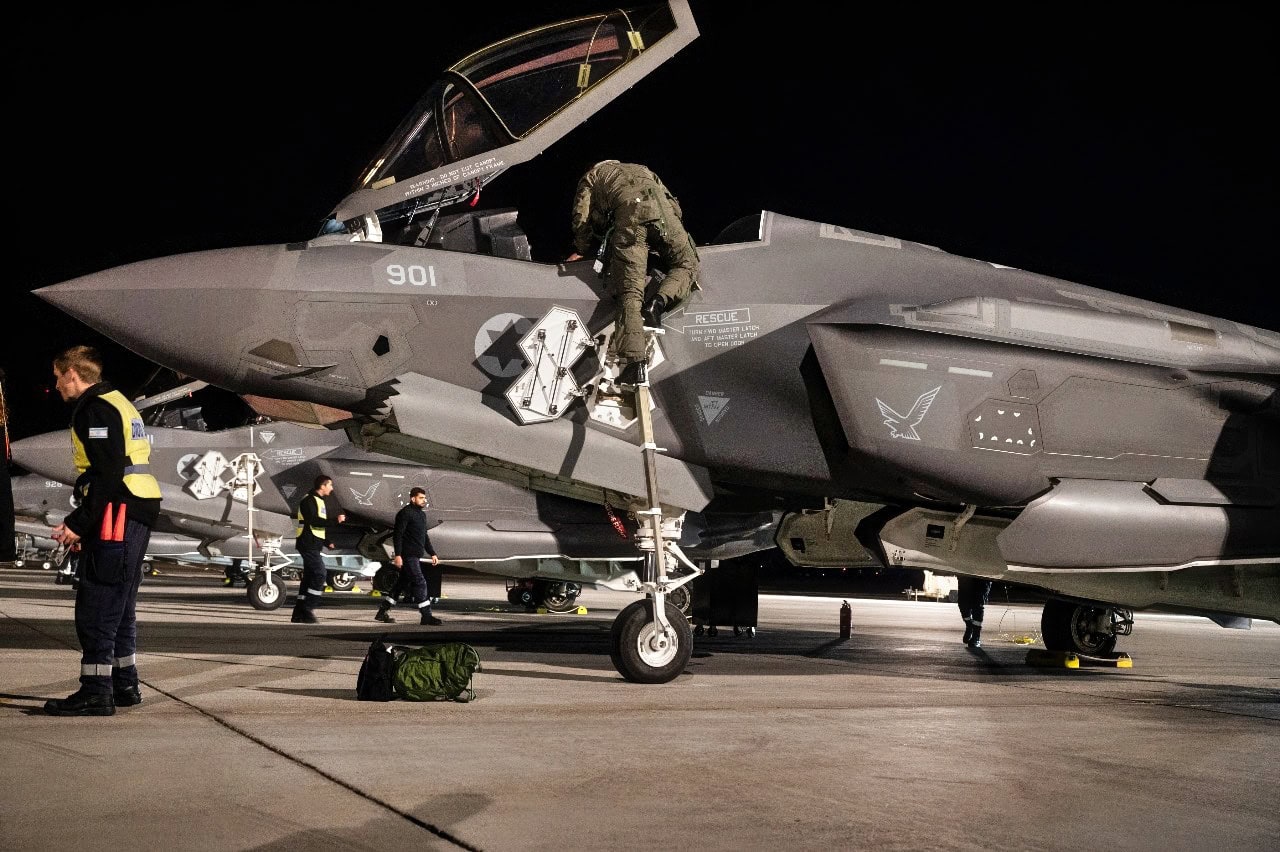
An Israeli Air Force pilot climbs into an F-35I Adir prior to a Red Flag-Nellis 23-2 mission at Nellis Air Force Base, Nevada, March 16, 2023. Red Flag is an opportunity to build on the success of JUNIPER OAK 23-2, JUNIPER FALCON, and additional combined exercises to enhance interoperability with Israel, strengthen bilateral cooperation, and improve capabilities in ways that enhance and promote regional stability and reinforce the United States’ enduring commitment to Israel’s security. (U.S. Air Force photo by Airman 1st Class Trevor Bell)
The IRGC has since named a new commander in chief, Ahmad Vahidi, but it remains unclear how much of the organization’s infrastructure remains intact. IRGC installations and its headquarters buildings have been among the first-order targets in the initial two days of what may turn out to be an extended air campaign.
Also being struck in some of the first two days of hostilities are Iran’s air defense capabilities, missile and drone launching sites, and military aerodromes.
According to the Israel Defense Forces (IDF), around 200 fighter jets have been engaged in an “extensive attack against the missile array and the defence systems” in western and central regions of Iran.
The IDF reports that those jets dropped “hundreds of munitions on” about 500 different targets. On Sunday, Israel said it had launched another round of attacks on “the heart of Tehran”, while at the same time, Iran began launching its own attacks against Israel and other neighboring nations. So far, in addition to the Jewish state, Bahrain, Kuwait, Qatar, the United Arab Emirates, and Jordan have been targeted.
The military operation has been named “Operation Epic Fury” by the US military. It was kicked off after weeks of warnings by Trump that he would resort to extensive military action if the Iranians refused to sign up to a new agreement requiring the dismantling of Tehran’s nuclear program.
Elimination of Nukes and the Regime
US President Donald J. Trump has stated that one of the primary goals of this operation is to “ensure that Iran does not obtain a nuclear weapon”.
A good portion of the targets being hit by both the US Armed Forces and the IDF are designed to do just that and continue the eradication of Iran’s nuclear effort that was begun by last summer’s Operation Midnight Hammer.
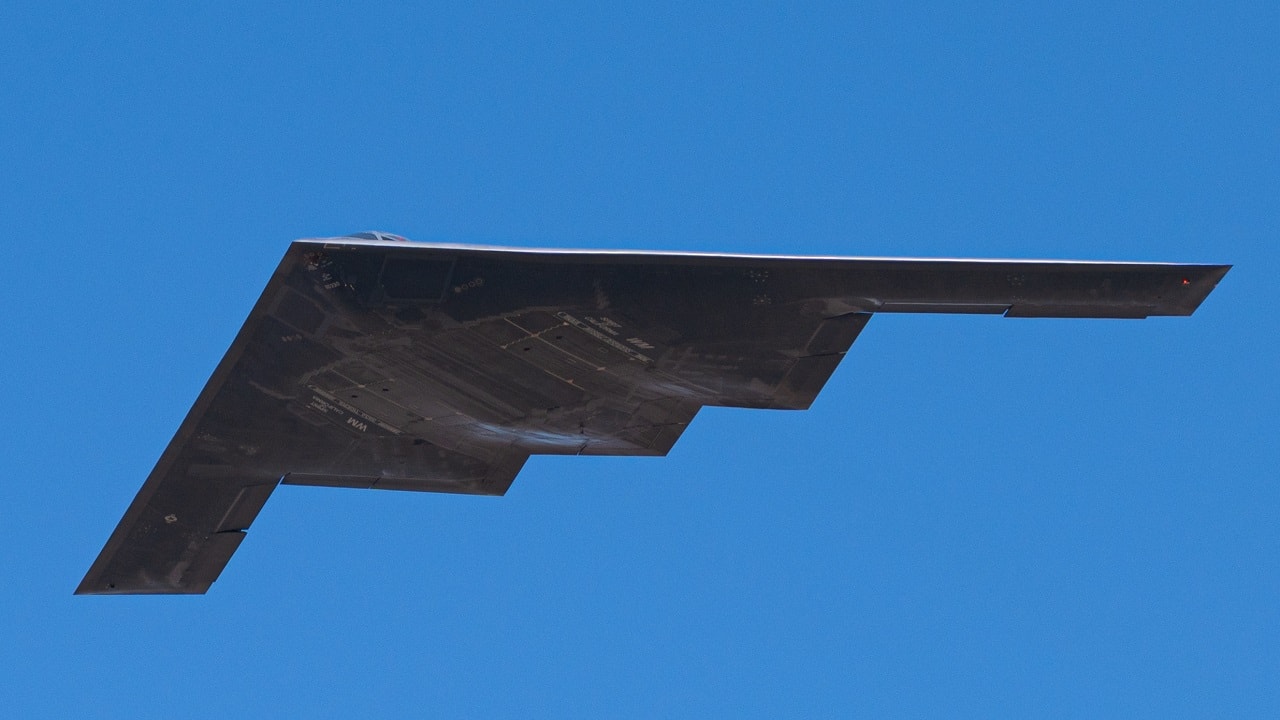
A B-2 Spirit stealth bomber from Whiteman Air Force Base completes a fly-over during the Sound of Speed Airshow at Rosecrans Air National Guard Base, in St. Joseph, Missouri, May 1, 2021. The air show was hosted by the city of St. Joseph and 139th Airlift Wing, Missouri Air National Guard to thank the community for their support. (U.S. Air National Guard photo by Airman Janae Masoner)
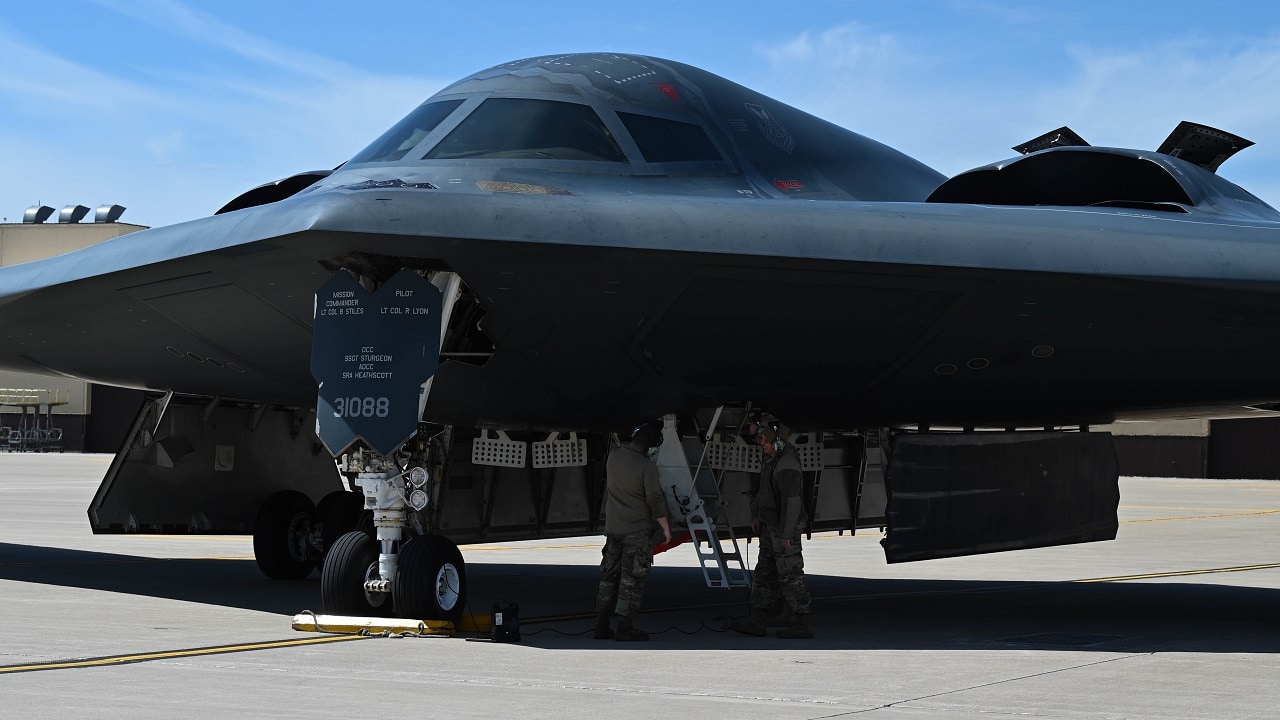
Crew chiefs assigned to the 509th Aircraft Maintenance Squadron prep a B-2 Spirit stealth bomber for a hot-pit refuel, at Whiteman Air Force Base, Missouri, April 4, 2022. Exercise Agile Tiger promotes resilience, innovation, competitiveness and process improvement, all talents required to address today’s complex challenges. (U.S Air Force Photo by Senior Airman Christina Carter)
The US military’s Central Command (CENTCOM) said its objective is to “dismantle the Iranian regime’s security apparatus, prioritizing locations that posed an imminent threat”.
Prior to those statements, Israeli Prime Minister Benjamin Netanyahu said that his nation and the US had launched the “operation to remove the existential threat posed by the terrorist regime in Iran”.
“We’re going to destroy their missiles and raze their missile industry to the ground. It will be totally again obliterated,” Trump said in an eight-minute video posted on his Truth Social platform on Saturday morning.
Trump also warned that Iran’s armed forces should lay down their arms in return for what he described as “complete immunity”.
If they refuse to do so, then they would likely “face certain death”, said the US President.
Aside from his urging Iranian forces to lay down their arms, he was equally emphatic that Iran’s people rise up against their government.
Trump called on the Iranian people to make preparations to overthrow the clerical regime that has ruled the country since the 1979 Islamic Revolution under a repressive Sharia-law establishment.
“When we are finished, take over your government,” he stated. “It will be yours to take. This will be probably your only chance for generations.”
Attacks Reported Across the Nation
Reports from Iran are at times fragmentary, as major parts of the country have been experiencing internet blackouts.
Nonetheless, explosions have been reported in many parts of the country since Saturday morning.
In the process of the many air attacks, 24 of Iran’s 31 provinces have been hit, according to a spokesman for the Iranian Red Crescent who was able to speak to some of the local media in his region.
The main source of much of the news out of Iran for weeks now has been videos taken and uploaded to social media platforms like Instagram.
Besides many explosions in the capital, Tehran, there have been reports of similar incidents in Karaj, Isfahan, Qom, and Kermanshah, located in the centre of Iran and in the west.
Among the many commentaries and analyses that have been produced in the past 24 hours is a piece by a cohort of authors in The Atlantic.
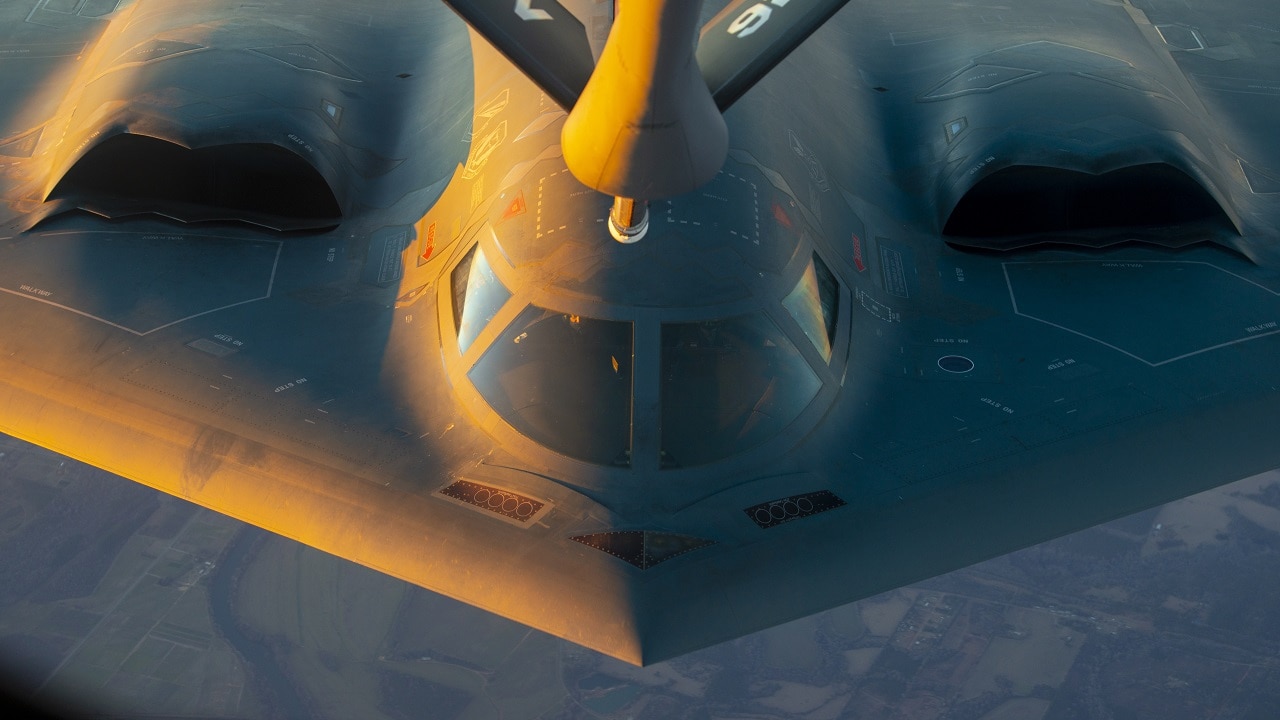
A B-2 Spirit assigned to Whiteman Air Force Base, Mo., prepares to receive fuel from a KC-135 Stratotanker, Feb 7, 2021. A B-2 Spirit performed alongside a B-1B Lancer and a B-52 Stratofortress for the Super Bowl LV flyover on Feb. 7, 2021. (U.S. Air Force photo by Airman 1st Class David D. McLoney)
According to sources who spoke with one or more of the authors the US President’s recent past “success with a limited strike on Iran’s nuclear facilities over the summer, as well as last month’s operation that removed Nicolás Maduro from power in Venezuela, may have convinced Trump that the US military is ‘an almost biblical force that can accomplish anything’,” said one Trump adviser.
The issues at present are, first, how long the US is prepared to sustain this program of air strikes. Complete destruction of Iran’s nuclear weapons program is an achievable goal and can be measured with some certainty by facilities and sites wiped out.
But the parallel objective of seeing the Iranian people rise up in numbers and to do so with the means to take down the regime is far less certain and depends on many variables.
If this fails to materialize, it would mean that the air campaign has at least partially failed to achieve its lofty ambitions.
About the Author: Reuben F. Johnson
Reuben F. Johnson has thirty-six years of experience analyzing and reporting on foreign weapons systems, defense technologies, and international arms export policy. Johnson is the Director of Research at the Casimir Pulaski Foundation. He is also a survivor of the Russian invasion of Ukraine in February 2022. He worked for years in the American defense industry as a foreign technology analyst and later as a consultant for the U.S. Department of Defense, the Departments of the Navy and Air Force, and the governments of the United Kingdom and Australia. In 2022-2023, he won two awards in a row for his defense reporting. He holds a bachelor’s degree from DePauw University and a master’s degree from Miami University in Ohio, specializing in Soviet and Russian studies. He lives in Warsaw.